
What's on this page
- What a food truck actually costs, up front
- The startup range by truck choice
- The truck itself: the biggest single line
- The new versus used truck decision
- Kitchen equipment and the build-out
- Ventilation, the hood, and power
- Permits, licenses, and the regulatory maze
- The commissary kitchen requirement
- Initial inventory and opening supplies
- POS, payments, and the tech stack
- Wrap, branding, and signage
- Insurance: vehicle and liability
- Generator, propane, and fuel
- Working capital: the runway people underfund
- Where the startup budget actually goes
- Lease versus buy for the truck and equipment
- Financing the launch
- Where startup cost goes wrong
- Break-even and payback
- A worked example: one used truck and one new truck
- The bottom line
Ask ten food truck owners what it cost them to start, and you will get ten numbers spread across an order of magnitude, from the low tens of thousands for a bare used rig to well past a hundred and fifty thousand for a new custom build. All of them can be true, which is exactly why the question resists a clean answer. The truck everybody pictures is real, and it is usually the single biggest line, but the kitchen bolted inside it, the permits, the commissary rent, and the cash cushion to survive the first slow months decide as much about whether you can afford to start as the rig on the sticker does.
This case study prices the whole thing, choice by choice and line by line: the spectrum from a used truck to a new custom build and why the range is so wide, the truck itself as the largest single cost, the kitchen equipment and build-out inside it, the new-versus-used decision, the permits and the regulatory maze, the commissary kitchen most operators are required to rent, initial inventory, the point-of-sale and tech stack, the wrap and signage, insurance, the generator and propane, and the working capital runway first-timers underfund more than any other line. It extends our startup-cost coverage into the mobile-food vertical, sitting alongside our case study on the cost to open a coffee shop, and you can run your own launch budget as you read with the equipment ROI calculator.
Key takeaways
- The truck and its built-in kitchen are almost always the largest single cost, and the gap between a used rig and a new custom build is where most of the total range lives, illustratively.
- The lines first-timers miss sit outside the truck: permits and the commissary kitchen rent that the law often requires, plus the working capital to survive the ramp.
- A used truck with a sound engine and a working kitchen is the far cheaper way in, and the mechanical inspection matters more than the sticker price.
- The ventilation hood, fire suppression, and power to run the kitchen are code-required lines that first-timers routinely underbudget.
- Where a food truck plan goes wrong is almost always underbudgeting permits and the commissary, then running out of runway before the truck breaks even.
What a food truck actually costs, up front
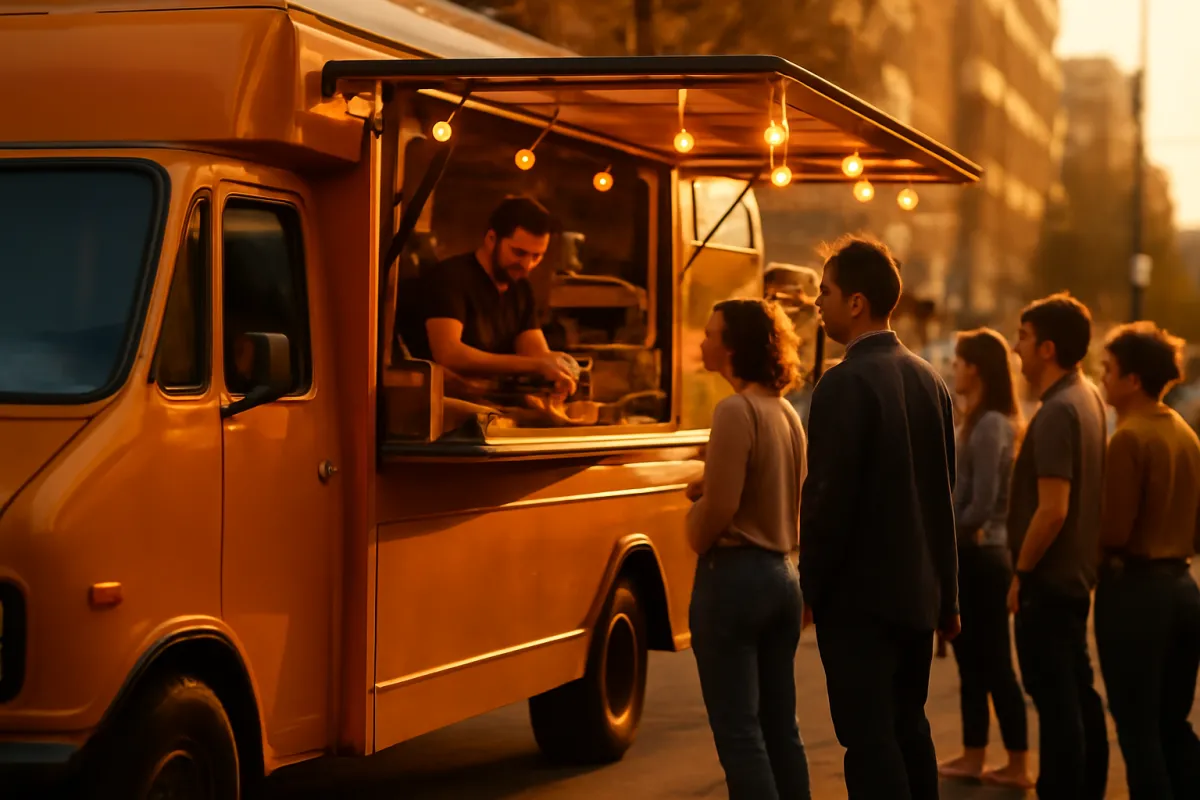
The phrase “food truck” hides a spectrum of builds with very different cost structures, and the first job of an honest budget is to say which one you are starting. At the low end sits a bare-bones used truck, an older rig with a basic kitchen that runs and passes inspection but shows its miles, bought cheap and pressed into service with minimal changes. A step up is a used truck that is already built out for the kind of food you want to serve, so the expensive kitchen is inherited rather than installed. Then comes a retrofit or a wrapped truck, where you buy a sound shell or a bare box and build the kitchen to your menu, and finally a new custom build, a purpose-designed rig with a new kitchen and no operating history behind it.
Each rung up the ladder multiplies the cost, and the multiplier is not gentle. Moving from a basic used truck to a new custom build is not a bigger version of the same purchase, it is a different balance sheet, with a longer build time and a much larger loan. The single most useful thing you can do before pricing a single line item is decide which build you are actually starting, because it sets the scale of every number that follows.
The startup range by truck choice
Put the four common builds on one axis and the point makes itself: the total to start spans a range so wide that quoting an average is close to useless. The chart below sketches illustrative all-in figures, meaning everything it takes to get serving including a working capital cushion, across the four builds. These are planning shapes, not quotes, and a specific launch can land well outside them depending on the truck’s condition and how much kitchen it needs.
Illustrative food truck startup cost by truck choice
All-in cost to launch, including a working capital cushion. Shape, not a quote.
The new custom build costs roughly three times the basic used rig, and the gap is almost entirely the truck and the kitchen inside it, not the permits or the wrap. Pick the build first, then price its lines.
The takeaway is not the exact figures, it is the shape. The permits, the commissary, and the wrap cost roughly the same whichever truck you start with, yet the total to launch varies several-fold, which tells you the truck and its kitchen are where the money concentrates. Run your own truck choice, equipment budget, and runway through the companion beside this case study, and the range collapses into a single number for the build you are actually starting.
The truck itself: the biggest single line
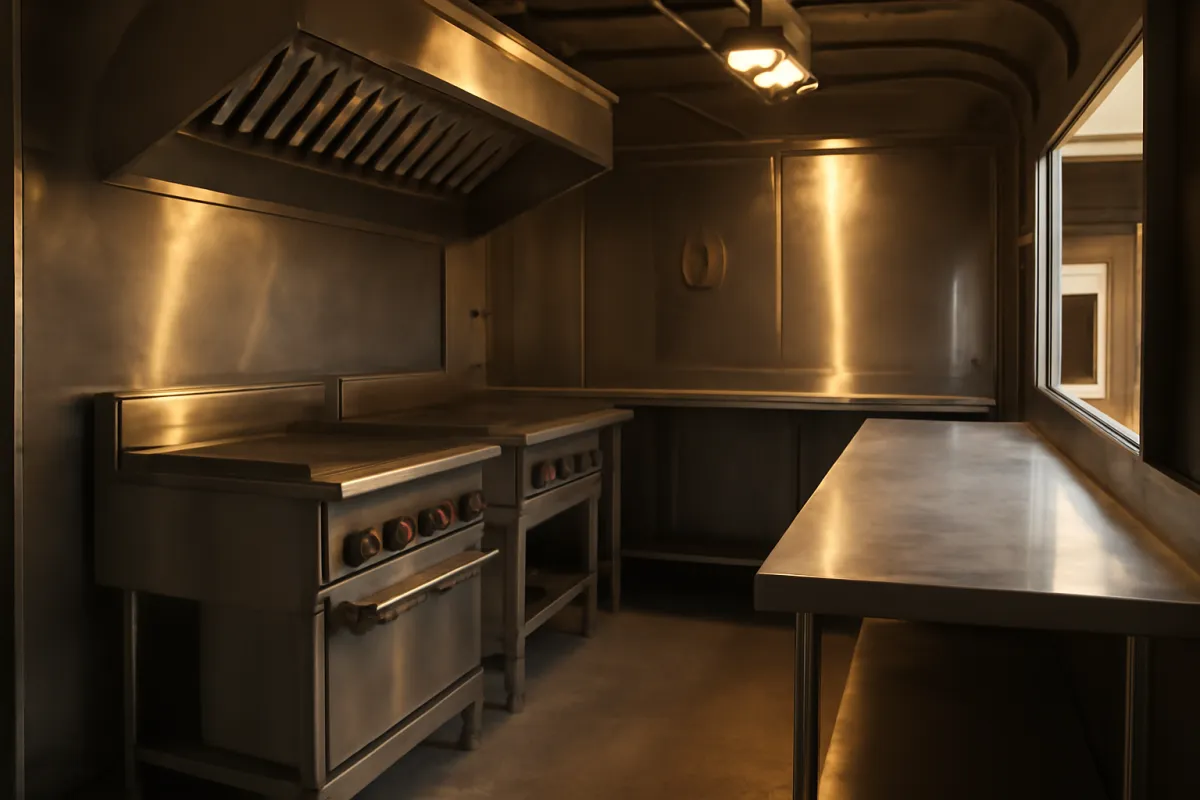
For nearly every build, the truck, including the kitchen equipment fixed inside it, is the largest single cost, and it is the line that varies most between two operators serving the same menu. A used truck with a sound drivetrain and a working kitchen can be had for a fraction of a new custom build, while a retrofit falls in between once you add the cooking line, refrigeration, a hood, and power. A new custom build carries the full cost of a new vehicle plus a new kitchen designed to your menu, which is why it anchors the top of the range.
The truck is really two purchases stacked into one: a commercial vehicle that has to run reliably, and a commercial kitchen that has to pass a health inspection. On a used rig you inherit both, for better and for worse, so the condition of the engine and the state of the equipment matter as much as the asking price. On a new build you specify both, which costs more but lets you design a kitchen that fits your food. The practical discipline is to price the truck and the kitchen as one number, because a cheap truck with a kitchen you have to rip out and rebuild is not the bargain the sticker suggests.
The new versus used truck decision
Once you know roughly what you want to serve, the sharpest cost lever is whether you buy new or used, and for most first-time operators the used truck is the far cheaper and lower-risk way in. A new custom build carries a steep premium for a rig with no operating history to justify it, and a first launch is exactly the moment to preserve cash and prove the concept before committing six figures. The same cost-per-working-year logic our case study on used versus new equipment applies to machines applies to the truck itself: a rig a few years old delivers most of the working life at a fraction of the new price.
The catch with used is mechanical, and it is a real one. A truck is a vehicle before it is a kitchen, and an engine or transmission failure does not just cost money to fix, it takes you off the road entirely and kills revenue while it is down. That is why the inspection matters more than the sticker: a pre-purchase check of the drivetrain, the generator, the propane system, and the kitchen equipment by someone who knows trucks is cheap insurance against a rig that looks fine and is not. Buy the used truck that has been maintained, not the cheapest one on the listing, and treat a clean inspection as the price of entry rather than a nice-to-have.
Kitchen equipment and the build-out
Inside the truck sits a dense stack of commercial kitchen equipment, and on a bare or retrofit build the cost of installing it is a major line in its own right. The cooking line, meaning a griddle, range, fryer, or the specific equipment your menu demands, is the obvious part, but refrigeration, a freezer, prep counters, sinks, and shelving all have to fit into a space measured in a few dozen square feet, which makes the build a tight and expensive puzzle. Illustratively, the equipment and build-out is a mid four-figure to high five-figure line depending on the menu and whether you buy new or used.
This is where two of our equipment case studies apply directly, because a truck kitchen is a stack of decisions that repeat on every appliance. Our used-versus-new equipment case study is the frame for whether each piece should be bought new or used, and our buy-versus-lease case study is the frame for how to pay for it, since financing the kitchen can preserve the cash a young truck lives on. A tight menu is the strongest lever on this line, because fewer dishes mean fewer appliances, less power to run them, and a simpler build. Price the kitchen to the food, not the food to a kitchen you overbought.
Ventilation, the hood, and power
The lines first-timers most often miss inside the kitchen are the ones the fire code cares about: the ventilation hood, the fire-suppression system, and the electrical or gas power to run everything. Any truck with a cooking line that produces grease-laden vapor generally needs a commercial hood and an automatic fire-suppression system, and both are code-required, inspected, and rarely cheap. They are not the fun part of the build and they are easy to leave out of an early budget, which is exactly why they blindside people when the fire inspection makes them non-negotiable.
Power is the other quiet line. A food truck runs its kitchen off a generator, a battery system, propane, or some combination, and sizing that power to the equipment is both a cost and an engineering problem: a griddle, a fryer, refrigeration, and lighting draw more than a small generator can carry, so the power system scales with the kitchen. Propane feeds the cooking line on most trucks and carries its own tanks, regulators, and safety requirements. Budget the hood, the suppression system, and the power together with the cooking equipment, not as afterthoughts, because they are the lines that most often turn a build-out estimate into a bigger final bill.
Permits, licenses, and the regulatory maze
Before a truck can legally serve a single plate, it needs a stack of permits and licenses, and the process costs time as much as money. The common list includes a business license, a food handler or food manager certification, a mobile food vendor permit, a health department permit tied to an inspection, a fire safety permit for the cooking and suppression system, and parking or vending permits for the spots where you operate, plus a commissary agreement in many places. Fees vary widely by city and state, and illustratively they add up to a real four-figure line, though the bigger cost is often the delay, because a truck cannot earn while a permit or inspection is pending.
The regulatory maze is a leading reason food truck launches slip, and it is one of the two places a plan most often goes wrong. Requirements differ not just by state but by city and even by the specific event or location you want to serve, so a truck permitted in one jurisdiction may need a fresh permit to cross into the next. The practical move is to map the full stack for the places you actually intend to operate before you buy the truck, and to involve the local health and fire authorities early so the build is designed to pass the first inspection rather than rebuilt to pass the second. Compliance is not a line to trim, because a failed inspection or a missing permit is far more expensive than doing it right once.
The commissary kitchen requirement
Here is the line first-timers most reliably forget, and the second place a plan most often goes wrong: the commissary kitchen. In most jurisdictions, health code requires a licensed commercial kitchen where you prep food, store inventory, fill and empty water tanks, and often clean the truck, because a truck alone is not considered a complete food operation. The commissary is not a one-time cost, it is a recurring monthly rent, which means it belongs in your operating burn from day one, not just the startup budget.
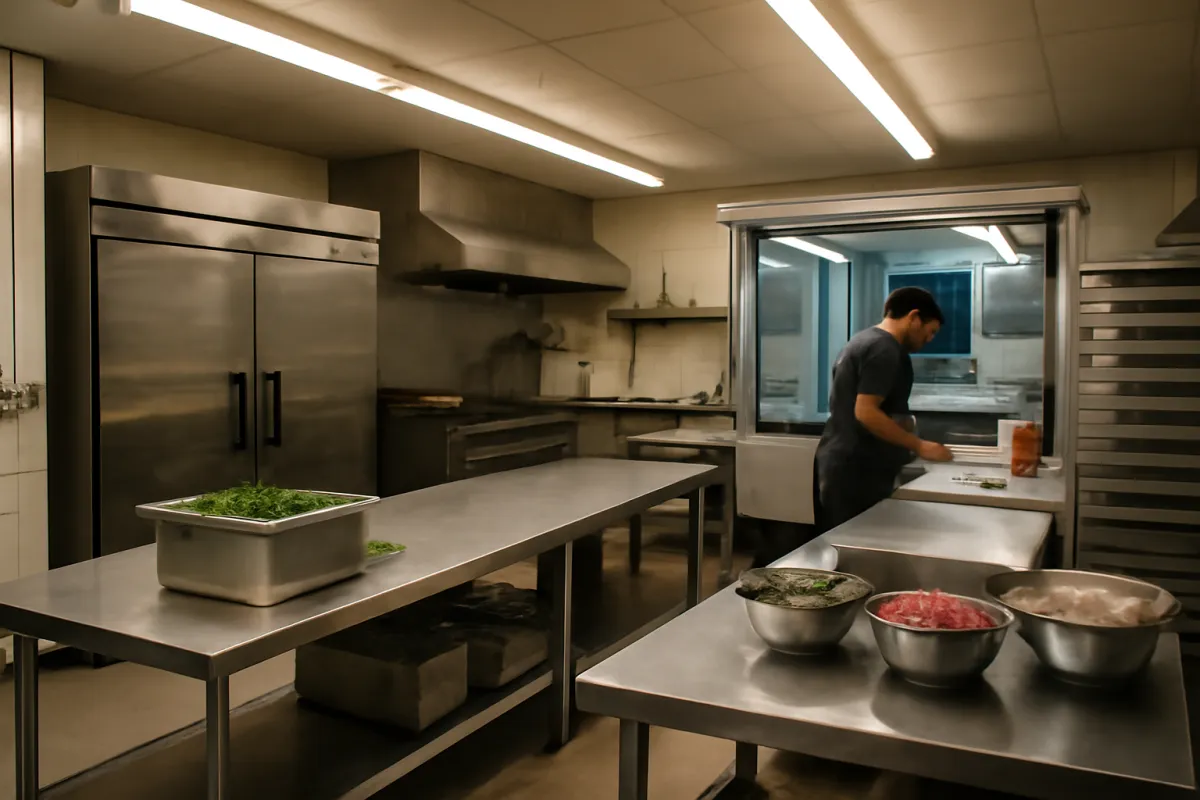
Illustratively, commissary rent runs from a few hundred to well over a thousand dollars a month depending on your city and how much space and access you need, and it can be shared with other operators to split the cost or rented as off-hours time from an existing restaurant kitchen. The exact requirement is local, so confirm what your health department expects before you build a plan that assumes the truck is a self-contained business. A plan that leaves out the commissary is not just missing a line, it is missing a legal requirement and a fixed monthly bill that quietly stretches the runway the truck needs to survive.
Initial inventory and opening supplies
A truck cannot open with empty shelves, so the first order of food, packaging, disposables, and cleaning supplies is a startup line, not just an operating one. Illustratively, the opening inventory for a food truck is a modest four-figure line, and it recurs as an operating cost the moment you start serving, so it also feeds the working capital you need to keep restocking before sales catch up. Perishable ingredients in particular have to be bought ahead of demand you cannot yet predict, which makes early inventory a place where cash goes out before it comes back.
The lever here is the menu, as it is nearly everywhere in a food truck budget. A tight, focused menu means fewer ingredients to stock, less spoilage on items that do not sell, and a smaller opening order, while a sprawling menu multiplies the inventory and the waste. Packaging and disposables, meaning the containers, wraps, napkins, and utensils every order goes out in, are easy to underestimate because they are cheap per unit and consumed constantly, so budget them as a steady recurring cost from the first day. Many trucks open deliberately narrow and expand the menu once they learn what their crowd actually buys, which protects both the inventory line and the kitchen build-out behind it.
POS, payments, and the tech stack
The point-of-sale system is the cash register of a modern food truck, and it has shifted from a big hardware purchase toward a smaller upfront cost with an ongoing subscription and a card-processing rate. A typical setup is a tablet or terminal, a card reader that works on the move, a receipt printer, and sometimes a customer-facing display, plus the monthly software fee and the processing rate that follows every sale. Illustratively, the hardware is a modest startup line, while the real cost lives in the transaction fees, which are an operating cost that quietly taxes every plate you sell.
Around the core POS sits the rest of a food truck’s tech: a mobile hotspot or data plan so the card reader works wherever you park, a location or event tool so customers can find you, accounting software, and possibly online ordering. None of these is large on its own, but together they form a recurring monthly cost that belongs in the burn the working capital has to cover, not just the one-time startup budget. Because a truck moves, reliable connectivity matters more than it does for a fixed cafe: a card reader that drops offline at a busy event is lost sales. Buy the POS that keeps working on the move, keep the stack lean, and watch the processing rate, because a fraction of a percent on every sale adds up across a season.
Wrap, branding, and signage
A food truck sells partly on how it looks, because the truck is the sign, the storefront, and the marketing all at once. The wrap, meaning the printed vinyl graphics that cover the exterior, turns a plain rig into a recognizable brand, and it is a line unique to mobile food that a fixed cafe does not carry in the same way. Illustratively, a full professional wrap is a four-figure line depending on the size of the truck and the complexity of the design, and it covers both the design work and the printing and application.
Beyond the wrap sits the rest of the branding: the logo, the menu boards mounted at the service window, and the small touches that make the truck feel finished and trustworthy at a glance. The honest framing is that branding matters more for a truck than for many businesses, because a customer decides in seconds whether the rig at the curb looks like food they want, and a clean, coherent wrap does real work in that moment. It is still a place to be efficient rather than lavish, since a strong simple identity beats an expensive muddled one. Budget the wrap properly because it is doing double duty as marketing, and keep the rest of the branding lean until sales support more.
Insurance: vehicle and liability
Insurance is a line a food truck cannot skip and a first-timer can easily underbudget, because a truck needs more than one kind of coverage. It is a vehicle, so it needs commercial auto insurance, and it is a food business serving the public, so it needs general liability coverage, and many operators also carry product liability, property coverage on the equipment, and workers’ compensation once they hire. Illustratively, insurance is a recurring monthly or annual cost that belongs squarely in the operating burn, and the premium scales with the coverage, the vehicle, and where and how often you operate.
The reason insurance deserves its own attention is that events, festivals, and commissaries frequently require proof of specific coverage before they will let a truck operate, so it is not only a prudent expense, it is often a gate to the locations that make money. A truck without the right certificate of insurance can be turned away from the very events it counted on, which turns a skipped line into lost revenue. Price the coverage your target locations actually require, treat it as a fixed cost of being allowed to serve, and fold it into the monthly burn the working capital has to cover rather than treating it as an optional extra.
Generator, propane, and fuel
A food truck carries its own utilities, and the cost of powering and moving it is a recurring line that a fixed restaurant never sees in the same form. The generator that runs the kitchen burns fuel every serving day, the propane that feeds the cooking line has to be refilled, and the truck itself burns fuel driving between the commissary, the serving spots, and the events. Illustratively, these energy costs are a steady monthly line that scales with how much you cook and how far you drive, and they are easy to underestimate from a budget built around the one-time purchase of the truck.
There is a startup piece and an operating piece here. The generator and the propane system are part of the truck build, a capital line included in the rig or added during the retrofit, and their capacity has to match the kitchen as covered above. The fuel and propane to run them, by contrast, are pure operating cost that shows up every day the truck works, and a busy event day burns noticeably more than a slow one. Budget the energy as a variable cost tied to your serving schedule, not a flat monthly figure, and remember that a bigger kitchen and a longer drive both raise it, which is one more reason a tight menu and smart location choices protect the bottom line.
Working capital: the runway people underfund
Here is the line that closes more food trucks than any single equipment choice, and the one first-timers most reliably underfund: working capital, the cash cushion that covers operating losses until the truck breaks even. A new truck does not open to a full line every day, it builds a following spot by spot and event by event over months, and every one of those months the commissary rent, the insurance, the fuel, the propane, the payroll, and the food come due whether or not sales cover them. The money that bridges that gap is working capital, and running out of it is the most common way a truck that would have succeeded folds before it gets the chance.

The common rule of thumb is to hold enough cash to cover several months, often three to six or more, of full operating costs beyond everything spent to buy and build the truck. The arithmetic is simple and unforgiving: estimate the monthly burn, meaning commissary plus insurance plus fuel plus propane plus payroll plus supplies, then multiply by the months of runway you want to survive, and that number is the working capital line. A truck that spends its last dollar on the build is one slow month from parking for good, so fund the runway before the finishes, and treat a faster ramp as upside rather than the plan.
Where the startup budget actually goes
Zoom out from the individual lines and the shape of a food truck budget comes into focus. The truck and its kitchen lead, the rest of the build-out follows, and the combination of permits, the commissary deposit, and the working capital cushion together forms a share large enough that ignoring it is how plans fail. The stacked bar below sketches an illustrative split for a used-truck launch, and the point of it is proportion, not precision: the wrap and the POS everyone remembers to budget are inside the smallest slice.
Where a food truck startup budget goes
Illustrative split for a used-truck launch, summing to 100 percent.
The truck and the kitchen build-out together are most of the budget, but the permits-and-runway slice is nearly a third, and it is the one first-timers most often leave out.
The lesson from the split is where your attention leaks. A buyer agonizing over the wrap design or the exact POS is optimizing the edges while the truck, the kitchen, and the runway, the overwhelming majority of the budget, decide whether the launch happens on time and survives its first season. Get the truck, the build-out, and the cash cushion right, and the smaller lines fall into place inside a sound plan. Run your own split through the equipment ROI calculator to see how your numbers stack against this shape.
Lease versus buy for the truck and equipment
Once the truck and the kitchen budget are set, the next question is how to pay for them, and for a startup the answer often turns on cash preservation rather than the total cost of the gear. Buying outright is usually cheaper over the life of a truck and a kitchen you run hard, because you avoid the financing premium and keep the assets, which is exactly the conclusion our buy-versus-lease case study reaches for high-utilization equipment. But buying consumes cash at the precise moment a new truck is most fragile, draining the very working capital that keeps it on the road through the ramp.
That tension is why financing the truck or leasing the kitchen equipment is so common for launches specifically. Spreading the cost into monthly payments keeps a large chunk of cash in reserve, lengthening the runway survival depends on, and the premium you pay for that flexibility can be worth far more than its dollar cost when the alternative is starting with an empty cushion. The framing is not that financing is cheaper, it is that a startup values cash on hand more highly than a settled business does. Weigh the financing premium against the survival value of the cash, and for many first-time operators the answer is to finance the truck, protect the runway, and buy the next rig outright once the business stands on its own.
Financing the launch
Beyond the truck and the equipment sits the larger question of how the whole launch gets funded, and food trucks are rarely started on cash alone. The common sources are personal savings, a small business loan, an equipment or vehicle loan secured by the truck itself, a line of credit for working capital, contributions from friends and family, and sometimes an outside investor or a crowdfunding campaign. Each carries a different cost and a different set of strings, and the right mix depends on how much cash you bring, how much risk you can carry, and what a lender will extend to a business with no operating history.
The discipline that keeps financing from becoming a trap is the one our case study on equipment financing lays out in full: decide on the total cost of the money over its term, not on the monthly payment in isolation, and match the term of any loan to the life of what it funds. Financing a truck over its useful life is sound, while financing a few months of propane and food on a long-term loan means paying interest on things long since consumed. Above all, do not borrow so aggressively that the debt payment becomes part of a monthly burn the young truck cannot carry, because a heavy loan payment can turn a survivable slow patch into a fatal one. Fund the launch with a mix you can service on a realistic sales ramp, not an optimistic one.
Where startup cost goes wrong
The recurring errors, collected so you can skip them, cluster around the same two lines. The first and most common is underbudgeting the permits and the commissary, treating the truck as a complete business and discovering after the purchase that the legal requirements add a stack of fees and a fixed monthly rent nobody planned for. The second is underfunding the working capital runway, spending the last dollar on the build and running out of cash before the truck finds its regular spots and its crowd. These two mistakes are where a food truck plan most often goes wrong, and they compound: a plan that forgets the commissary is also a plan that underestimates the monthly burn the runway has to cover.
The other errors follow from the same root. Buying the cheapest used truck on the listing without a mechanical inspection trades a lower sticker for a rig that breaks down and takes you off the road. Leaving the ventilation hood, fire suppression, and power out of the build-out estimate turns a tidy budget into a bigger final bill when the fire inspection makes them mandatory. Pouring the money into a showpiece wrap or a sprawling menu while the runway goes thin optimizes the visible edges while neglecting survival. Under all of them sits the same meta-mistake: pricing the truck instead of the whole launch, and forgetting that a food truck is a vehicle, a kitchen, a permit stack, a commissary, and a cash cushion, with the rig as one line among many.
Break-even and payback
The startup cost question and the return question are two halves of the same equation, because the point of every dollar spent to launch is to reach the day the truck covers its own costs and then earns. Break-even is the moment monthly sales equal monthly costs, and payback is the longer horizon over which accumulated profit repays the money it took to start. The working capital runway exists precisely to carry the truck from its first serving day to break-even with a cushion to spare, which is why the two numbers, the cost to launch and the time to break even, have to be modeled together rather than separately.
The revenue side of this equation is where our equipment content connects to the cost content. Our espresso ROI case study shows how volume and margin build toward covering a business’s fixed costs, and the same logic maps onto a truck: plates per serving day times margin per plate, across the good days you can string together in a month. The equipment ROI calculator lets you run your own volume and margin to see the contribution the truck produces. Set the monthly burn from the cost side of this case study, set the monthly contribution from the revenue side, and the gap between them tells you how long the runway has to be. Fund enough months to reach break-even plus a margin of safety, and the truck has room to find its footing before the cash runs out.
A worked example: one used truck and one new truck
Put the whole framework on two illustrative budgets that sit near opposite ends of the spectrum. First the used-truck launch. An operator buys a sound used truck with a working kitchen for an illustrative $50,000, spends $20,000 upgrading the equipment and refreshing the build, budgets $18,000 for permits, a commissary deposit, a wrap, a POS, and opening inventory, and holds $25,000 as a working capital runway, roughly four months of burn. The total to launch is about $113,000, the truck and its kitchen are the largest lines, and the permits-and-runway slice is nearly a third of it, exactly the lines a thinner plan would have skipped.
Now the new-truck build. A custom rig with a new kitchen designed to the menu runs an illustrative $120,000, another $15,000 fills in equipment and small wares the build did not include, permits, the commissary, the wrap, the POS, and opening inventory add $22,000, and the operator holds a $35,000 runway to survive a longer ramp on a bigger monthly burn. The total to launch is about $192,000, and the gap between the two examples is the whole point: same food, same permit stack, roughly $80,000 apart, and the difference is almost entirely the truck and the kitchen inside it. Run your own truck choice and runway through the companion beside this case study, and the plan stops being a guess.
The bottom line
How much does it cost to start a food truck? Whatever the build demands, and the truck choice is the answer to most of it. A basic used rig can get serving in the low-to-mid five figures, a built-out used truck higher, and a new custom build past $150,000 all in, illustratively, and the gap between them is the truck and the kitchen bolted inside it, not the wrap or the POS. The lines that decide whether the launch survives, though, are the ones outside the truck: the permits, the commissary rent, and the working capital runway that carries the fixed burn until sales catch up.
The operators who launch successfully do three things in order. They pick the truck honestly, inspect a used rig hard or accept the premium of a new build on purpose, and price the kitchen as part of it. They budget the permits and the commissary as the legal requirements they are, not as afterthoughts, because that is where a plan most often goes wrong. And they fund the working capital to reach break-even with a cushion, because a truck that runs out of cash a month early parks anyway. Price the kitchen with our used-versus-new case study, weigh how to pay for it with the buy-versus-lease and equipment financing case studies, cross-check the whole budget against our cost-to-open-a-coffee-shop case study, and run your own launch budget and sales ramp through the equipment ROI calculator so the total to start is a plan, not a surprise.
Written for the person costing a launch, not for anyone selling the dream of one: this case study is educational material, not financial, tax, legal, or business advice, and it endorses no specific truck, builder, vendor, lender, or location. Every dollar figure, build range, and percentage split here is an illustrative sketch meant to teach how the lines add up, and a real launch is priced by its own truck, its own menu, its own city, and the health and fire code it has to satisfy. Permit requirements, commissary rules, insurance minimums, wrap costs, and the time to break even vary enormously by jurisdiction and by site, so confirm the mobile-food rules in every place you intend to operate, gather local quotes on the actual truck and equipment in front of you, and put an accountant, a mechanic, and your own honest numbers between you and any purchase or loan you sign.
Frequently asked questions
How much does it cost to start a food truck?
Illustratively, a bare-bones used truck can get on the road for the low tens of thousands, a solid used and built-out rig commonly lands somewhere in the mid five figures, and a new custom build with a full kitchen can run past $150,000 once you add equipment, permits, and a cash cushion. The range is wide because the truck itself and the kitchen build-out inside it are the two biggest levers, and both swing enormously between a hand-me-down rig and a purpose-built one. Treat any single number as a planning shape rather than a quote, because your menu, your local health code, and the condition of the truck you buy move the total more than almost anything else. Price the build you are actually starting, then stack the line items underneath it.
What is the biggest cost when starting a food truck?
The truck itself, including the kitchen equipment built into it, is almost always the largest single cost, and it is the line that varies most between two operators serving the same food. A used truck that already has a working kitchen can cost a fraction of a new custom build, while a bare truck you retrofit falls somewhere in between once you add cooking equipment, refrigeration, a ventilation hood, and power. The surprises for many first-timers are the lines that sit outside the truck: the permits and the commissary kitchen rent that the law often requires, plus the working capital to survive slow early months. Underbudgeting those two is where a food truck plan most often goes wrong.
How much does food truck equipment and the kitchen build-out cost?
The kitchen build-out, meaning the cooking line, refrigeration, ventilation hood, and power that turn a bare truck into a working kitchen, is illustratively a mid four-figure to high five-figure line depending on your menu and whether you buy new or used. A griddle, fryer, and range are modest next to the hood and the fire-suppression system, which are code-required and rarely cheap, and the generator or power setup to run it all is its own line. Our used-vs-new equipment case study and our buy-vs-lease case study both apply directly here, because a truck kitchen is a dense stack of commercial equipment where the used-versus-new and finance-versus-buy decisions repeat on every appliance. Price the hood and power first, because they are the lines first-timers most often miss.
Should I buy a new or used food truck?
For most first-time operators, a used truck with a sound engine and a working kitchen is the far cheaper way in, because a new custom build carries a steep premium for a rig with no operating history behind it to justify the cost. A used truck lets you test the concept and the location before committing six figures, and the same cost-per-working-year logic our used-vs-new equipment case study applies to machines applies to the truck itself. The real risk with used is mechanical: an engine or transmission failure on a truck is expensive and takes you off the road entirely, so the inspection matters more than the sticker. Many successful operators start on a proven used rig, learn the business, and only order a custom build once the cash flow and the menu are settled.
What permits and licenses does a food truck need?
A food truck typically needs a stack that includes a business license, a food handler or food manager certification, a mobile food vendor permit, a health department permit tied to an inspection, a fire safety permit for the cooking and suppression system, and parking or vending permits for where you operate, plus a commissary agreement in many jurisdictions. Fees vary widely by city and state, and illustratively they add up to a real four-figure line, though the bigger cost is often the time and the complexity, because a truck cannot legally serve until the stack is complete. The regulatory maze is a leading reason food truck launches slip, since a permit or inspection that stalls is weeks of a financed truck sitting idle. Involve your local health and fire authorities early so the build is designed to pass the first time.
Do I need a commissary kitchen for a food truck?
In most jurisdictions, yes: a commissary kitchen, meaning a licensed commercial kitchen where you prep, store, and often clean the truck, is required by health code, and it is the line first-timers most reliably forget to budget. Illustratively, commissary rent is a recurring monthly cost from a few hundred to well over a thousand dollars depending on your city and how much space and access you need, and because it is a fixed monthly bill it belongs in your operating burn, not just the startup budget. Some operators share a commissary to split the cost, and some restaurants rent out off-hours kitchen time. The point is that it is rarely optional, so confirm your local requirement before you build a plan that assumes the truck alone is enough.
How much working capital do I need to start a food truck?
A common rule of thumb is to hold enough cash to cover several months, often three to six or more, of full operating costs beyond everything spent to buy and build the truck. That runway pays commissary rent, insurance, fuel, propane, payroll, and food costs while sales climb from a slow opening toward the point they cover the burn, which frequently takes longer than a new operator expects. Illustratively, if the truck burns a certain amount each month before it breaks even, the working capital line is that monthly burn multiplied by the months of runway you want to survive. Running out of cash before the truck finds its regular spots and its crowd is one of the most common and most avoidable ways a promising truck folds early.
How long until a food truck breaks even?
Break-even timing varies widely, but many food trucks take several months to a year or more to reach the point where monthly sales cover monthly costs, and some take longer, because the business depends on finding reliable locations, events, and a repeat crowd. The path turns on the fixed burn of commissary rent and insurance, the margin per plate, and how many good serving days a month you can string together, which is why the working capital runway has to be long enough to reach that point with room to spare. Our espresso ROI case study and the equipment ROI calculator on this site frame the revenue side, showing how volume and margin build toward covering fixed costs. The discipline is to model your monthly burn honestly, fund enough months to reach break-even plus a margin of safety, and treat a faster ramp as upside rather than the plan.