
What's on this page
- Commercial kitchen equipment cost: what decides the number
- Equipment cost by concept
- How much is a commercial kitchen, all in
- What actually drives each equipment price
- The cooking line: ranges, ovens, fryers, and grills
- Refrigeration: walk-ins and reach-ins
- Prep equipment: tables, mixers, and slicers
- Warewashing: the dishmachine and sinks
- Ventilation, the hood, and fire suppression
- Smallwares and storage
- Commercial kitchen equipment cost by category, for a new restaurant kitchen
- Commercial kitchen cost breakdown: where the budget goes
- Code, inspection, and who actually decides
- New versus used or refurbished equipment
- Buy versus lease for kitchen equipment
- Equipping a former food space versus a bare shell
- Equipment cost by concept, in detail
- Energy efficiency and long-run operating cost
- What the kitchen costs to run after the install
- Commercial kitchen install price: electrical, plumbing, and gas
- Warranties and service contracts
- Financing the equipment package
- Depreciation, ROI, and the payback line
- How to read an equipment quote before you sign
- Where to save, and where not to
- A ghost kitchen equipment budget, line by line
- A full-service kitchen equipment budget, line by line
- A sequence for pricing your own kitchen
- The bottom line
Short answer: Illustratively, commercial kitchen equipment runs near $45,000 for a coffee kitchen, $65,000 for a ghost kitchen, $95,000 for a quick-service kitchen, and $200,000 for a full-service restaurant kitchen, all in. The concept decides almost everything. The cooking line and refrigeration take roughly half the money between them, and ventilation plus installation run about three tenths of a full-service budget and about a third of a small one.
How much is a commercial kitchen? Commercial kitchen equipment cost is the first hard number a new operator has to face, and the honest first answer is a question back: which kitchen? A coffee shop that steams milk and toasts pastries, a delivery-only ghost kitchen that fries and holds, a quick-service counter, and a full-service restaurant running a long hot line are four different capital projects wearing the same name. The stainless range everybody pictures is real, and it matters, but it is rarely the line that decides the budget on its own. What decides the budget is how many categories your menu forces you to buy, and how much it costs to connect them to the building.
This rundown prices the kitchen category by category and line by line: the cooking line of ranges, ovens, fryers and grills; the refrigeration of walk-ins and reach-ins; the prep gear of tables, mixers and slicers; the warewashing of a dishmachine and sinks; the ventilation hood and fire-suppression package; the smallwares and storage; and the installation and hookups that turn a pile of stainless into a working kitchen. For the full checklist of what each category contains, keep our commercial kitchen equipment list open beside this one as the spec reference. It sits alongside our cost to open a coffee shop case study, which prices a whole opening including the room and the runway, our restaurant startup costs breakdown, which shows where the kitchen sits inside the wider project, and our buy-versus-lease equipment case study for how to pay for all of it. This breakdown prices owning the kitchen; if the plan is to rent licensed kitchen time instead of building and equipping a room of your own, our commercial kitchen rental case study prices that path and this one does not. Run your own equipment budget as you read with the equipment ROI calculator.
Key takeaways
- The concept decides almost everything. Illustratively, a coffee kitchen near $45,000, a ghost kitchen near $65,000, a quick-service kitchen near $95,000, and a full-service restaurant kitchen near $200,000, all in.
- Ventilation and installation together run about three tenths of a full-service kitchen budget and about a third of a small one, because a hood is closer to a fixed cost than a scaled one.
- The cooking line and refrigeration are the two largest equipment categories, taking roughly half the money between them in the worked budget below.
- Buy the durable boxes and tables used, and be far more careful with refrigeration and anything carrying a compressor, a heavy motor or complex electronics.
- What your jurisdiction requires for hoods, suppression, gas fitting, sinks and equipment listings is decided locally, so confirm it with your own authority and inspector before you buy anything.
Commercial kitchen equipment cost: what decides the number
Commercial kitchen equipment cost hides a spread of build totals as wide as any in food service, and the first job of an honest estimate is to say which kitchen you are equipping. At the small end sits the beverage-led kitchen of a coffee shop, which needs refrigeration, an espresso setup, and often no grease hood at all. A step up is the delivery-only ghost kitchen that fries, grills and holds behind no dining room. Then comes the quick-service counter kitchen with a real cooking line and a full canopy. At the top sits the full-service restaurant kitchen with a long hot line, multiple refrigeration zones, a prep or bakery area, and a warewashing station that has to keep pace with a dining room.
Each rung up the ladder multiplies the equipment cost, and the multiplier is not gentle. A menu that fries needs a fryer and a hood rated for what comes off it. A menu that bakes needs ovens and proofing. A menu that only assembles and reheats needs almost none of that. The single most useful thing you can do before pricing a single appliance is decide what your menu actually cooks, because the menu sets the equipment list, the equipment list sets the hood, and the hood drags the hookups behind it. Price the concept first, then fill in the categories beneath it, and only then start collecting quotes.
Equipment cost by concept
Put the concepts on one axis and the point makes itself: the total to equip spans a range so wide that quoting an average is close to useless. The chart below sketches illustrative all-in figures, meaning the cooking line, refrigeration, prep, warewashing, ventilation, smallwares and the installation together, across four common formats. These are planning shapes, not quotes, and a specific project can land well outside them depending on the menu and on how much the space already has in place.
Illustrative equipment cost by concept
All-in cost to equip the kitchen, including ventilation and install. Shape, not a quote.
The full-service kitchen runs roughly four and a half times the coffee kitchen, and the gap is more cooking equipment, more refrigeration, and a bigger hood with heavier hookups behind it.
The takeaway is not the exact figures, it is the shape. A range this wide tells you that the equipment budget is a function of the menu rather than a fixed cost of a kitchen, and that the smartest lever you hold is menu design, because every dish needing a specialised machine or a longer cooking line adds to the total twice: once in the appliance and once in the hood above it. Run your own concept and kitchen size through the companion beside this rundown, and the range collapses into a single planning number for the kitchen you are actually building.
How much is a commercial kitchen, all in
How much is a commercial kitchen once every category is counted? Illustratively, and treating each figure as a planning shape rather than a quote, a beverage-led coffee kitchen lands near $45,000, a delivery-only ghost kitchen near $65,000, a quick-service counter kitchen near $95,000, and a full-service restaurant kitchen near $200,000. Those four numbers are the same arithmetic run four times, because each one is the equipment invoices for that menu plus the ventilation package and the hookups that connect them to the building. Nothing else is hidden inside them, and the two worked budgets further down show exactly which lines produce two of them.
Two things move a real kitchen off those marks more than anything else. The first is the space. A bare shell has to build the hood, the duct run, the heavy electrical service and the drainage from nothing, while a former food space may already carry some of that, which is worth a large share of the install line. The second is condition. Buying the durable categories used or refurbished pulls the equipment invoices down without touching the ventilation and install group at all, so the saving is real but bounded, and it is bounded in a way an average never shows you.
The number that belongs on a business plan is therefore not an average of the four. It is your own menu priced category by category, plus a written install scope from a licensed contractor on the actual unit you intend to lease. If you would rather not buy a kitchen at all, renting licensed kitchen time removes most of this budget and replaces it with a monthly bill, and our commercial kitchen rental case study prices that route instead. Run your own concept, size and space through the companion beside this rundown to see where your kitchen sits against these four shapes.
What actually drives each equipment price
Before any category makes sense, it helps to know why two machines that do the same job can differ by a factor of ten. Five drivers explain almost all of it, and they apply to nearly every line in the kitchen.
Capacity is the first and largest. A countertop fryer that holds fifteen pounds of oil and a two-vat floor battery with built-in filtration are both fryers, and the second can cost roughly ten times the first because it is built to run all service without dropping temperature. The same pattern repeats in ovens, where a countertop convection unit and a rack oven are separated by an order of magnitude, and in refrigeration, where an undercounter unit and a walk-in freezer are not really the same product at all. Our commercial fryer cost and commercial oven cost rundowns show the ladder inside each class.
Fuel is the second. Gas and electric versions of the same appliance often sit close on the sticker and far apart on the install. A gas line has to be sized to the connected load of everything on the line, and a heavy electric line needs service and panel capacity the building may not have. Neither is universally cheaper, and the honest way to choose is to price the appliance and its hookup together, against the utility service the space actually has.
Duty rating is the third. Light-duty and heavy-duty versions of the same machine differ in the thickness of the metal, the size of the motor and the serviceability of the parts, and the gap shows up as working years rather than as features. A slicer that runs twenty minutes a day and one that runs four hours a day are different purchases even when they look identical.
Condition is the fourth. New, professionally refurbished with a warranty, and used as-is are three different prices for the same machine, and the right choice varies by category rather than by budget.
Connection is the fifth and the one that ambushes people. Some equipment plugs in. Some needs a dedicated circuit, a gas connection, a water line, a drain, a booster heater or a hood above it, and each of those is a trade visit rather than a delivery. When you compare two quotes, compare what has to happen after the truck leaves, because that is where the difference usually lives.
The cooking line: ranges, ovens, fryers, and grills
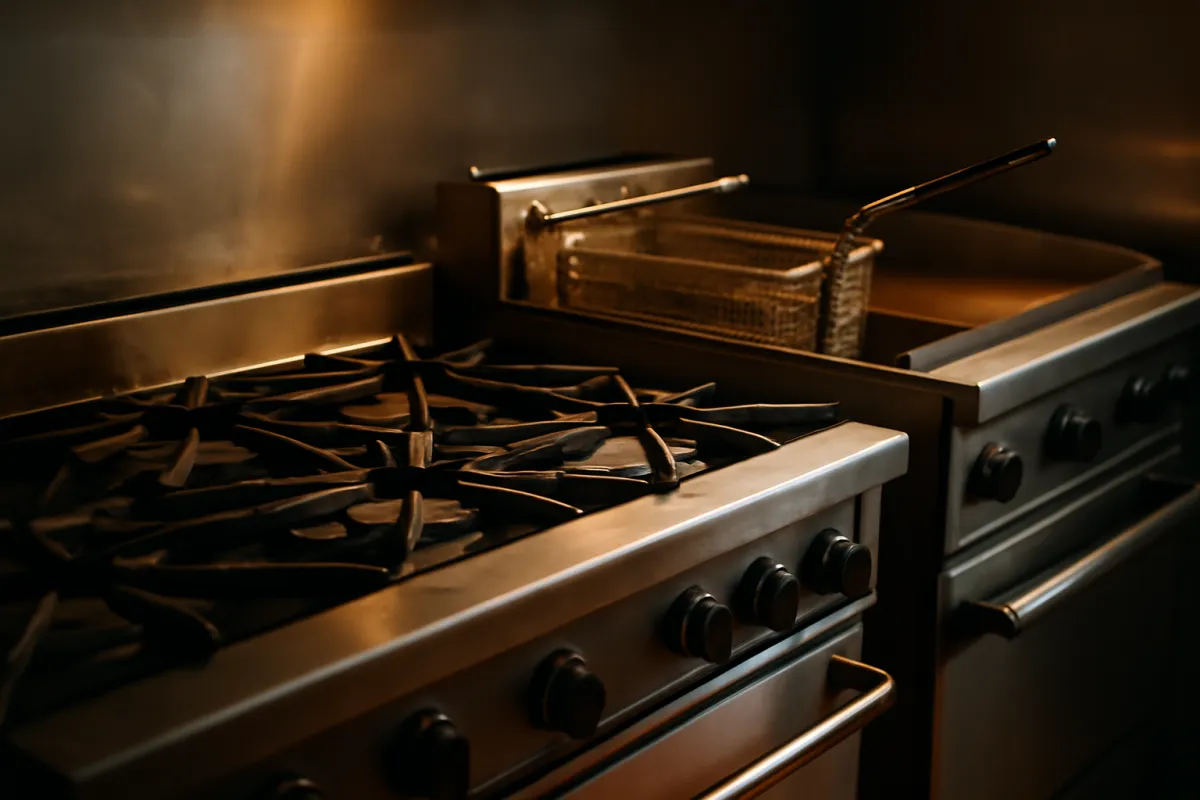
The cooking line is the heart of a hot kitchen and the category most people mean when they say equipment. It typically includes a range with open burners, one or more ovens, a griddle or flat top, a charbroiler or grill, one or more deep fryers, and often a salamander and a hot-holding cabinet. Illustratively, a lean counter line of a range, a single fryer and a griddle can be assembled for a low-to-mid five-figure sum, while a full-service line with multiple ovens, a combi, a broiler and a fryer battery runs into the high five figures once every station is counted. In the worked full-service budget below that line comes to about $58,000, which makes it the largest single category in that kitchen.
The lever here is the menu, again. Every cooking method you offer adds a piece of equipment and, just as importantly, adds to the hood above it, because the hood has to cover the whole line. A tight menu that fries and grills needs a shorter line and a smaller hood than one that also bakes, broils and steams, which is why menu discipline shows up twice in the budget. Gas against electric matters too, because it decides whether you pay for a gas connection sized to the load or for heavier electrical service and the panel to feed it. Price the line by station, size the hood to cover it, and let the menu rather than the showroom decide how long it needs to be. Our commercial oven cost rundown is the place to see how much of that line one appliance class can absorb.
Refrigeration: walk-ins and reach-ins
Refrigeration is usually the second-largest equipment category, and for many kitchens it carries the most risk, because a refrigeration failure spoils inventory and can shut the kitchen down for a service. The category spans the walk-in cooler and freezer, reach-in refrigerators and freezers on the line, undercounter and prep-table units, and any specialised piece the menu demands. Illustratively, a walk-in cooler sits in the low five figures and a walk-in freezer somewhat higher, reach-ins add several thousand each, and a full restaurant package comfortably reaches the low-to-mid tens of thousands once every zone is counted. In the worked budget below it comes to $42,000. Our commercial refrigerator cost and commercial freezer cost rundowns break the class ladder down piece by piece.
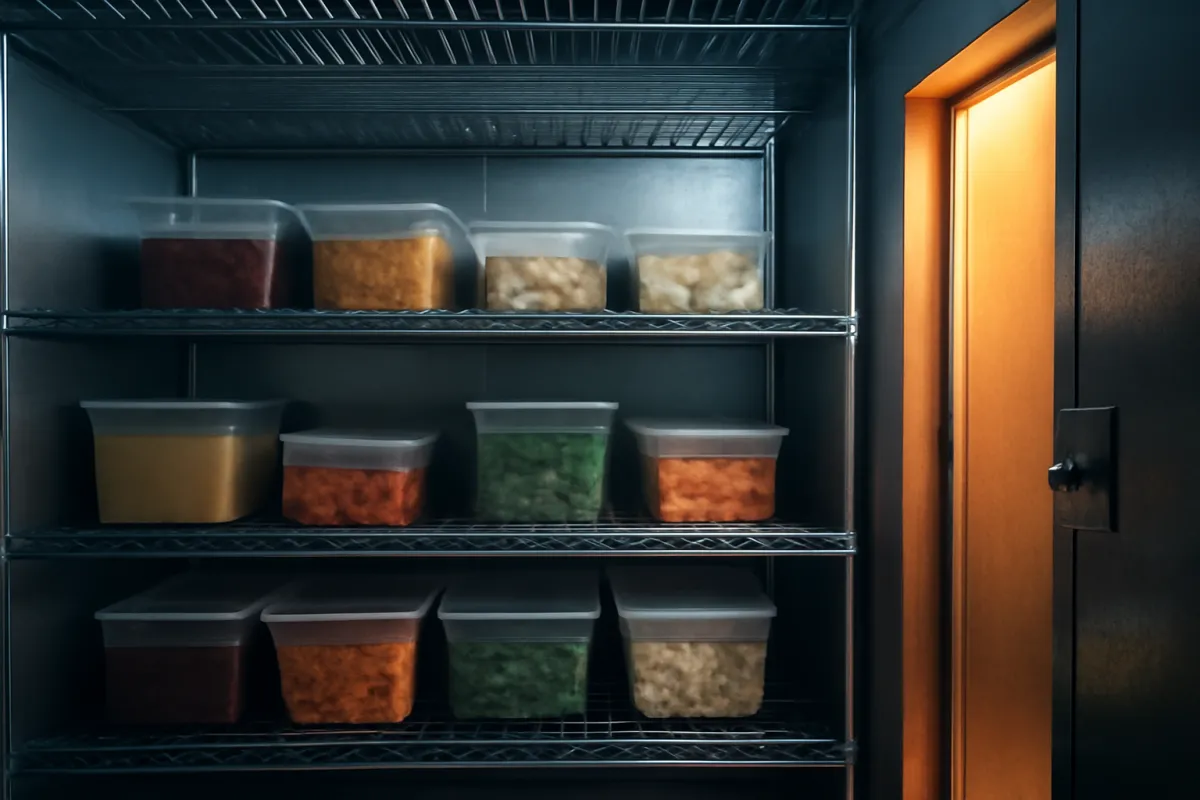
This is where the used-against-new decision matters most. A stainless prep table lasts decades and costs little to service, but a refrigeration compressor is a wear item with a finite life, and a used walk-in with a tired compressor can turn into a failure and a load of ruined stock at the worst possible moment. Our used-versus-new equipment case study runs the cost-per-working-year math that decides these calls, and refrigeration is the classic place where paying more up front for reliability earns its keep. There is also a sizing trap worth naming: a walk-in you never fill still costs its full purchase price and most of its running cost, so size the cold storage to your delivery schedule rather than to your ambitions, a discipline our restaurant inventory rundown puts numbers behind.
Prep equipment: tables, mixers, and slicers
Prep equipment is the workbench of the kitchen, the gear that turns raw ingredients into service-ready components before the cooking line ever fires. The category includes stainless prep tables and work surfaces, a mixer sized to the menu, a slicer, food processors, scales, and any menu-specific machine such as a dough sheeter, a proofer or a vegetable prep unit. Illustratively, prep for a small delivery kitchen is a low four-figure line, while a full-service kitchen with a bakery or a heavy prep programme spends five figures on mixers and specialised machines. The worked budget below puts it at $17,000, most of which is the mixer and the slicer rather than the tables.
This is one of the safest categories to control, because most prep equipment is simple, durable and cheap to service, which makes quality used units a genuine bargain. Stainless tables, shelving and sinks are effectively commodities that last decades, and a used mixer or slicer from a reputable dealer often carries most of its working life ahead of it at a steep discount. The lever, once more, is the menu: a focused menu needs fewer specialised machines, while a sprawling one multiplies the prep gear along with everything else. Buy the tables and shelving used, size the mixer to the volume you actually run rather than the volume you hope for, and resist the specialised machine you will use twice a week until the throughput justifies it. Our guide to where to buy restaurant equipment walks the channels where those used bargains actually live.
Warewashing: the dishmachine and sinks
Warewashing is the category that never makes the marketing photos and never stops running, and skimping on it is a fast way to bottleneck a busy kitchen. It includes a dishmachine, sized from an undercounter unit for a small kitchen through a door type to a rack conveyor for a high-volume one, a multi-compartment pot sink, a dedicated hand sink, a mop sink, and the pre-rinse sprayer and disposal that feed the machine. Illustratively, an undercounter machine is a low four-figure line, a door type runs higher, and a conveyor for a high-volume kitchen reaches the low tens of thousands, with sinks, a booster heater and plumbing adding a real line on top. Our commercial dishwasher cost rundown prices the machine classes against each other.
The hidden cost in warewashing is not the machine, it is the plumbing and the hot water. A dishmachine needs the right water temperature or a chemical sanitising cycle, adequate drainage, and often a booster heater that is its own appliance with its own hookup. Which sinks your jurisdiction expects, where they have to sit, and what water temperatures it will inspect for are decided by your local health authority rather than by a catalogue, so get the fixture schedule confirmed by them before the plumbing is roughed in. Our health inspection rundown explains how that conversation usually goes. Size the machine to the covers you expect at peak rather than the average, because a kitchen that cannot clean fast enough during rush is a kitchen that runs out of plates exactly when it is busiest.
Ventilation, the hood, and fire suppression
Here is the category that surprises nearly every first-timer, and the one whose true size only appears once installation is counted: the ventilation package. A kitchen with a cooking line that throws grease-laden vapour needs an exhaust hood over that line, and with the hood comes makeup air to replace what is exhausted, ductwork to carry it out, and a fire-suppression system over the cooking equipment. Illustratively, the hood itself ranges from a few thousand dollars for a small wall-mount unit to the high teens of thousands for a large canopy, with suppression, makeup air, duct and installation adding as much again. In the worked full-service budget below the hardware comes to $25,000 and the duct run, roof curb and tie-in add $10,000, for roughly $35,000 installed. Our commercial kitchen hood cost case study prices that package on its own.
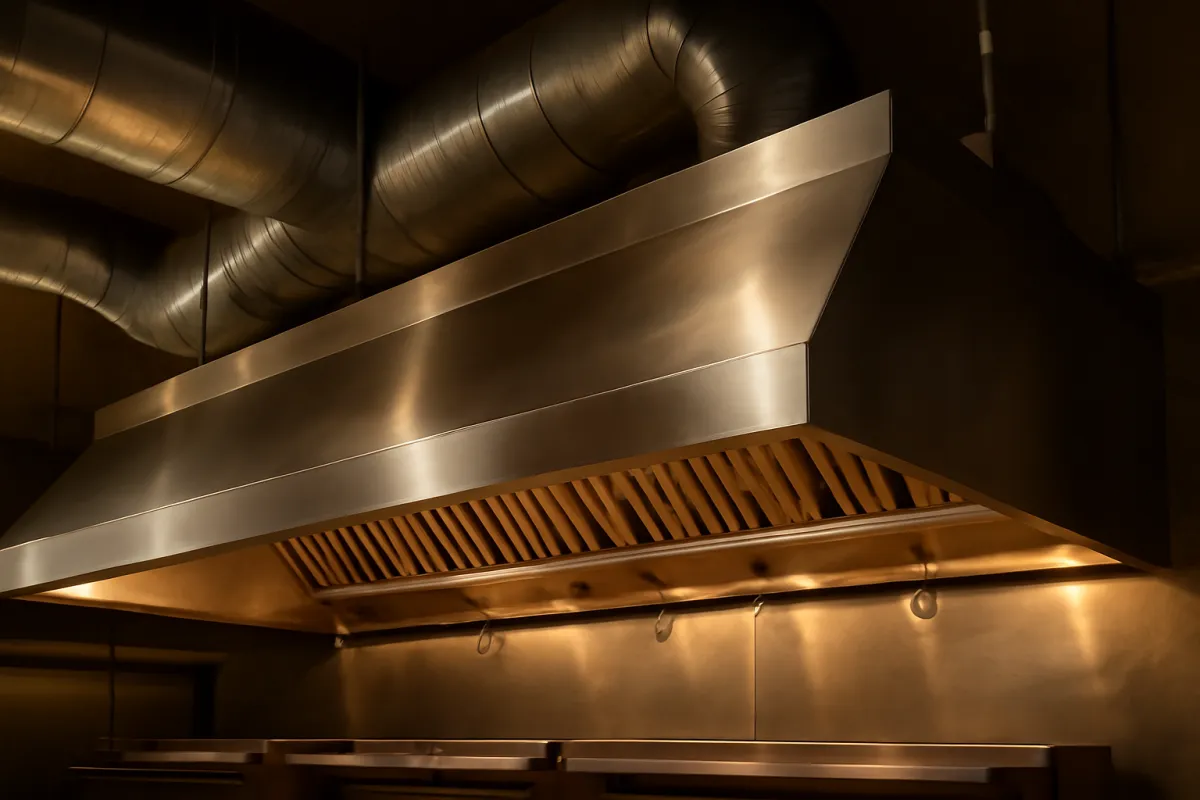
The reason this line is so volatile is that it is deeply site-specific. Cost turns on the length of the cooking line, the height and path of the duct run to the roof, whether the building already has a usable shaft, and what your jurisdiction has adopted and how it reads it. Hood classification, capture velocity, suppression coverage, access panels and cleaning intervals are all matters your local mechanical, fire and health authority decides, and neighbouring towns can land differently on the same kitchen. Do not take a supplier’s word for whether a package satisfies your building. Ask the authority having jurisdiction what it will inspect, have a licensed mechanical contractor walk the space, and price the package against that answer. This is also why a former restaurant with a hood already in place can be dramatically cheaper to equip than a bare shell, and why the ventilation conversation belongs in the first meeting rather than the last.
Smallwares and storage
Smallwares are the thousand small items a kitchen cannot cook a single plate without: pots, pans, sheet trays, knives, cutting boards, whisks, tongs, thermometers, food containers, and the racks and shelving that hold it all. Individually each item is cheap, which is exactly why the category is so easy to underestimate, but a full kitchen needs so many of them that the total is a real four-to-five-figure line. The worked budget below puts smallwares and storage at $8,000 for a full-service kitchen and $2,500 for a small delivery one, and in both cases the number is built from hundreds of items rather than a handful.
The practical trap is that smallwares are consumed and lost constantly, so the opening buy is only the start. Pans wear, sheet trays warp, knives dull and walk away, and containers crack, which means smallwares belong in the operating budget as well as the startup one. The lever is standardisation: a kitchen that settles on a few pan sizes and one container system buys in bulk, replaces easily and wastes less than one with a drawer full of one-off tools. Buy smallwares to the menu, buy shelving and storage used, and treat the category as a steady recurring line rather than a one-time purchase you make and forget. Our cost to open a coffee shop case study counts the same items among the opening supplies a new operator has to stock before day one.
Commercial kitchen equipment cost by category, for a new restaurant kitchen
Stack the categories together and the commercial kitchen equipment cost for a new restaurant kitchen resolves into an orderly picture, which is exactly the view a first-time operator needs before signing anything. The cost to equip a new restaurant kitchen from a bare shell splits into a cooking line carrying the ranges, ovens, fryers and grills; a refrigeration package led by the walk-ins; a prep station of tables, mixers and slicers; a warewashing setup of a dishmachine and sinks; a ventilation package of hood, suppression, makeup air and duct; the smallwares and storage; and the installation and hookups that connect all of it to the building. Each category scales with the menu, and the sum of the categories rather than any single appliance is the number that lands on the business plan.
Read by category, the pattern is consistent across concepts. The cooking line and refrigeration are the two largest equipment lines. The ventilation and install group is the one first estimates most often omit, and it is why a budget assembled from appliance quotes alone runs roughly a third short. Prep, warewashing and smallwares fill out the remainder and are where most of the safe savings live. A new restaurant kitchen pays for all of it at once, which is why building from a shell costs more than taking over a former food space that already carries a hood, gas and electrical service, and floor drains.
Our commercial kitchen equipment list sets out the types, sizes and specs inside each category so the checklist is concrete before you price it, our what is a commercial kitchen rundown explains what separates one from a domestic kitchen in the first place, and our restaurant business plan walkthrough shows where the equipment total belongs inside the wider plan a lender will read. Run your own concept and size through the companion beside this rundown to watch the category totals resolve into one planning number.
Commercial kitchen cost breakdown: where the budget goes
Zoom out from the individual categories and the shape of a cooking-kitchen budget comes into focus. The cooking line and refrigeration together lead. The ventilation and installation group is a larger share than most people expect but smaller than the cooking line in a big kitchen. Prep, warewashing and smallwares fill out the rest. The stacked bar below shows the split of the illustrative full-service budget priced further down, and the point of it is proportion rather than precision.
Commercial kitchen cost breakdown, by group
Illustrative split of the $200,000 full-service kitchen priced below, summing to 100 percent.
Three tenths of the budget is the group nobody photographs. In a smaller kitchen that share rises rather than falls, because the hood barely shrinks when the cooking line does.
The lesson from the split is where to spend your attention. An operator agonising over which range to buy is optimising part of the largest slice while the ventilation and installation group, three tenths of the budget, gets one line and a nasty surprise. Get the hood, the hookups and the refrigeration right and the appliance choices become manageable decisions inside a sound plan. Run your own split through the equipment ROI calculator to see how your numbers stack against this shape, and adjust the concept and size in the companion beside this rundown to watch the total move.
Code, inspection, and who actually decides
A great deal of published advice about commercial kitchens states requirements as though they were universal. They are not. Hood classification and capture requirements, fire-suppression coverage and inspection intervals, gas fitting and the certification of whoever performs it, the sinks a kitchen must have and where they sit, floor and wall finishes, grease interceptor sizing, and which equipment listings or certifications a health department will accept are all set locally, by whichever codes your jurisdiction has adopted, in whichever edition, with whatever local amendments it has layered on top. On the food-safety side, the FDA publishes the FDA Food Code as a model for local jurisdictions, and its Food Code adoption page lists which state agency oversees restaurants where you are. Two towns twenty minutes apart can inspect the same kitchen to different standards, and neither an article nor a dealer’s brochure can tell you which one applies to you.
That is not a reason to ignore the subject, it is a reason to route it properly. The practical sequence is short. Ask your local building and health departments, before you sign a lease, what they require for a kitchen of your menu in that specific unit, and get the answer in writing or at least in a dated email. Engage a licensed mechanical contractor for the hood and duct, a licensed electrician for the service, and a licensed plumber or gas fitter for the connections, and let each of them price against what the authority actually said rather than against a generic spec. Ask your dealer which listings or certifications a piece carries and then confirm with the health department that those are the ones it accepts, because a sticker on a machine is not a promise that your inspector will sign it off.
Budget for the inspection process itself as well as the equipment. Plan reviews, permits, re-inspections and the small remedial work that follows a first walkthrough are normal, not a sign that something went wrong, and operators who leave no room for them end up paying in delayed opening weeks rather than dollars. Our health inspection rundown covers what those visits usually look at, and our restaurant lease negotiation rundown covers how to keep the landlord responsible for the parts of the building that should be theirs.
New versus used or refurbished equipment
Once the equipment list is set, the next question is whether to buy new, used or refurbished, and the honest answer is almost always a mix decided category by category. Much of a kitchen is simple, durable, easily serviced gear that carries most of its working life ahead of it even at second hand: stainless prep tables, shelving, sinks, dish racks and many gas cooking appliances are the obvious candidates, and liquidators, auctions and closing kitchens are full of them at a steep discount. Buying these used is one of the safest and largest levers on the whole budget, and it is the lever to pull first when a quote comes back over budget.
The categories where new or near-new earns its premium are the ones with a compressor, a motor under heavy load or complex electronics, refrigeration above all. A used walk-in with a tired compressor can cost more in one failure and one ruined load of stock than the sticker ever saved. Refurbished, meaning professionally rebuilt and sold with a warranty, is the genuine middle path and often the best value in exactly the categories where used-as-is is too risky. Our used-versus-new equipment case study turns this into a number, the cost per working year, that settles each call on its own merits rather than on instinct.
Two practical cautions apply to any used purchase. First, ask what the machine will need to be connected legally in your jurisdiction, because an older unit may lack a listing your health department wants or a feature your local code now expects, and that answer comes from the authority rather than the seller. Second, price the risk. A used unit without warranty carries a repair exposure that belongs in the comparison, and if you would not be able to absorb a failure in month three, that is information about which side of the decision you are on.
Buy versus lease for kitchen equipment
With the equipment priced and the new-or-used mix chosen, the next question is how to pay for it, and for a new kitchen the answer often turns on cash preservation rather than the total cost of the gear. Buying outright is usually cheaper over the life of equipment you run hard, because you avoid the financing premium and keep the asset, which is the conclusion our buy-versus-lease equipment case study reaches for high-utilisation equipment. But buying a full kitchen outright consumes a large slug of cash at the precise moment a new restaurant is most fragile, draining the working capital that carries the business through its slow opening months.
That tension is why leasing or financing the kitchen package is so common for new operators specifically. Spreading the cost into monthly payments keeps cash in reserve and lengthens the runway that survival depends on, and the premium paid for that flexibility can be worth far more than its dollar cost when the alternative is opening with an empty cushion. The framing is not that leasing is cheaper. It is that a startup values cash on hand more highly than a stable business does.
There is a middle path worth naming, because most operators end up on it without planning to. You can split the package: buy the cheap durable items outright in cash, since financing a stainless table over five years is absurd, and finance or lease only the heavy, long-lived pieces whose useful life matches the term. That keeps the monthly payment attached to assets that will still be earning when the last payment clears. Our rundown on leasing restaurant equipment walks the mechanics of the lease side, and the equipment ROI calculator will show you what each path does to the monthly.
Equipping a former food space versus a bare shell
Of all the levers on the equipment budget, the condition of the space is the largest one that has nothing to do with the equipment. A former restaurant may already carry a hood and duct path, gas service sized for a cooking line, an electrical panel with capacity to spare, floor drains and a grease interceptor. A bare retail box or a former office carries none of it, and every one of those has to be built before a single appliance can be switched on. That difference sits almost entirely inside the ventilation and install group, which is the group most likely to be missing from an early estimate in the first place.
The trap is that a former food space is not automatically a bargain. An inherited hood may be the wrong length for your line, sized for a different exhaust volume, or old enough that your authority will want it reworked before it signs off. Inherited refrigeration may be at the end of its compressor life. Inherited plumbing may not match the fixture schedule your health department expects for your menu. The right way to value a former food space is to have your own contractor and, where possible, your own inspector look at what is actually there and tell you what stays, what gets reworked and what gets replaced. A written scope from that walkthrough is worth more than any discount the landlord claims.
The negotiating consequence is straightforward. If the inherited infrastructure is genuinely usable, it is worth real money and it should shape both what you offer and what you ask the landlord to warrant. If it is not, you are taking a bare shell at a former-restaurant price, and the lease should reflect that. Our restaurant lease negotiation rundown covers how the improvement allowance and the condition warranties usually get written, and our restaurant location rundown covers how to weigh a cheap shell against an expensive turnkey space.
Equipment cost by concept, in detail
The concept-by-concept figures deserve a closer look, because each format carries a different equipment logic rather than simply a different size.
The coffee shop, near $45,000. A beverage-led kitchen spends most of its money on the bar. Illustratively, a two-group dual-boiler espresso machine near $14,000, two grinders near $4,000, an ice machine near $4,000, undercounter and back-bar refrigeration near $5,000, a glasswasher near $3,000, prep tables and shelving and sinks near $4,000, smallwares and storage near $3,000, and install and hookups near $8,000. The reason it clears $45,000 rather than $65,000 is that a shop which only steams, brews and toasts may not need a grease hood at all, a question its local authority settles. Add a fryer or a griddle and the whole ventilation package arrives with them, which is the single largest cost consequence of a menu decision a cafe can make. Our commercial espresso machine cost case study prices the bar that dominates this format, and our coffee shop startup walkthrough covers the rest of the opening around it.
The ghost kitchen, near $65,000. Delivery-only, no dining room, no front-of-house finishes, but the same cooking line, refrigeration and hood its menu demands. Priced line by line further down, and the striking feature is that the ventilation and install group is a larger share here than in a full-service kitchen.
The quick-service counter, near $95,000. A real fry-and-grill line, a small walk-in with reach-ins on the line, a door-type or undercounter dishmachine, and a full canopy with suppression. Our restaurant equipment financing case study prices a counter kitchen at roughly this scale line by line and then finances it end to end, which is the natural next read once you have a total.
The full-service restaurant, near $200,000. The longest hot line, multiple refrigeration zones, a prep or bakery area, a full warewashing station, and the heaviest hookups. Priced line by line below.
The food truck compresses a kitchen into a few feet and carries its own generator, propane, on-board water tanks and a compact hood, which is why our food truck startup case study prices the truck and its kitchen as one number rather than two. In every format the same principle holds: list what the menu cooks, and the equipment cost follows.
Energy efficiency and long-run operating cost
The purchase price is the entry ticket rather than the full cost, because a commercial kitchen is one of the most energy-intensive spaces a small business runs. The cooking line, the refrigeration compressors, the water heater, the dishmachine and the hood’s makeup air all draw energy every hour the kitchen is open, and the difference between an efficient appliance and a thirsty one compounds across years of service. Illustratively, a more efficient fryer, refrigerator or combi oven can cost more up front and still cost less over its life once the energy is counted, which is why a sticker is a poor guide to the true cost of a machine.
This is where the total-cost-of-ownership lens earns its keep. Better insulation on a walk-in, a fryer that recovers temperature faster and burns less between drops, and a hood control that ramps exhaust to demand rather than running flat out all day each trim the operating bill in a way no spec sheet’s purchase price shows. Hood control in particular is worth pricing seriously, because exhausting conditioned air all day and then paying to condition its replacement is one of the quietest recurring costs in the building.
The practical move is to compare equipment on lifetime cost, meaning purchase plus energy plus maintenance across the years you will actually run it, rather than on the price tag alone. A kitchen equipped slightly more expensively but far more efficiently can be the cheaper kitchen by year three. The equipment ROI calculator is built to weigh exactly that trade between a higher purchase price and a lower running cost.
What the kitchen costs to run after the install
The equipment budget ends on opening day. The kitchen’s costs do not, and the operators who get blindsided are usually the ones who priced the purchase carefully and the aftermath not at all. A working commercial kitchen carries a recurring bill made of several parts, and every one of them is predictable enough to plan for.
Energy and water are the largest. The cooking line, refrigeration, water heating and the makeup air run whenever the kitchen does, and a kitchen running long hours can spend more on energy in a few years than it spent on some of the appliances producing the demand. Hood cleaning and filter service is the next line, and it is a recurring scheduled cost rather than a one-off, at intervals your local fire authority sets according to how much grease your menu throws. Fire-suppression inspection and recharge follows the same pattern: periodic, scheduled by your authority, and cheap compared with what it exists to prevent.
Then comes maintenance. Refrigeration wants coil cleaning and gasket checks, fryers want filtration and boil-outs, dishmachines want descaling, gas equipment wants burner and pilot service, and every one of those is cheaper on a schedule than on an emergency call-out. Our restaurant equipment maintenance schedule sets out what belongs on which cadence. Finally there is replacement: nothing lasts forever, smallwares turn over constantly, and a kitchen with no replacement reserve funds its first compressor failure out of working capital. Budget the running cost alongside the purchase, because total cost of ownership rather than the sticker is what the kitchen actually costs.
Commercial kitchen install price: electrical, plumbing, and gas
The number on the invoice is not the number on the wall, because commercial kitchen equipment has to be installed, and installation is a real and frequently underestimated line. A gas cooking line needs a connection sized to its total load. A heavy electric line needs service and panel capacity. Refrigeration needs power and condensate drainage. The dishmachine needs hot water, often a booster, and a drain. The hood needs its duct run, its makeup air and its suppression tie-in. Every one of those is a licensed trade visit rather than a delivery fee.
Illustratively, in the full-service budget below, installation and hookups including the hood’s duct run come to about $35,000 against roughly $165,000 of equipment invoices, so the install line runs near a fifth of the gear it connects. That share is not a constant. In a bare shell with no gas service, no spare panel capacity, no floor drains and a long roof run it climbs, and in a former food space that already carries the infrastructure it can fall sharply. Anyone quoting you a fixed percentage for install is quoting you a percentage of a building they have not seen.
The single biggest lever on this line is therefore the space rather than the equipment, which is why the lease negotiation and the equipment budget are the same conversation. Get a licensed mechanical and electrical contractor into the actual unit before you sign, ask them for a written scope rather than a number over the phone, and treat that scope as the install line in your budget. Our cost to open a coffee shop case study makes the same point about buildouts generally, and our restaurant startup costs breakdown shows how the buildout and the equipment columns interact on the wider budget.
Warranties and service contracts
A commercial kitchen is a fleet of machines that run hard every day, and how you handle their failure is a budget decision in its own right. Most new equipment carries a manufacturer warranty, and beyond it sit extended warranties and service contracts that convert the variable risk of a breakdown into a predictable annual line. For the failure-prone, business-critical categories, refrigeration and the dishmachine above all, a contract that guarantees fast response can be worth far more than its cost, because a dead walk-in during service is spoiled inventory and a closed kitchen rather than a repair bill.
The judgment is where to buy coverage and where to self-insure. A stainless prep table needs no service contract, and a low-cost, easily replaced appliance may be cheaper to run to failure and swap than to cover. But equipment whose failure stops the kitchen or spoils food is exactly where a warranty earns its keep, and it is a natural companion to the used-against-new decision, because a used unit without warranty carries a risk you should price rather than ignore.
Two things are worth checking before you sign any coverage. Ask what response time is actually promised and what happens if it is missed, since a contract that guarantees a visit within a week is not protecting a walk-in. And ask what voids it, because many are voided by missed routine maintenance, which means the contract and the maintenance schedule have to be run together. Our used-versus-new equipment case study shows how to fold repair exposure into the cost-per-year math so the warranty question is answered by the same number that chose the equipment.
Financing the equipment package
Beyond the single buy-or-lease call sits the larger question of how the whole package gets funded, because a full kitchen is rarely paid for out of pocket. The common sources are an equipment loan secured by the machines themselves, an equipment lease, a general small business loan, a line of credit, and personal capital, each carrying a different cost and a different set of strings. An equipment loan is often the natural fit precisely because the equipment secures it, which tends to make the terms more favourable than unsecured borrowing. Our equipment financing explainer covers how rates, terms and total cost interact, and our restaurant equipment financing case study covers how a package actually gets funded, which lenders serve this market, and what a kitchen costs priced and financed line by line, so you can see the whole sequence run once.
The discipline that keeps financing from becoming a trap is to decide on the total cost of the money over its term rather than on the monthly payment in isolation, and to match the term of the loan to the life of what it funds. Financing a walk-in or a cooking line over its useful life is sound. Financing smallwares or a few months of supplies on a multi-year loan means paying interest on things long gone. If you are also raising for the wider opening, our small business loan rundown covers the general-purpose route.
Above all, do not borrow so aggressively that the payment becomes part of a monthly burn the young kitchen cannot carry, because a heavy debt service can turn a survivable slow patch into a fatal one. Fund the equipment with a mix you can service on a realistic revenue ramp rather than an optimistic one, and use the equipment ROI calculator to check that the payment fits the cash the kitchen can actually produce.
Depreciation, ROI, and the payback line
Every dollar spent equipping a kitchen is a capital investment, which means it should be judged by what it returns and how long it takes to pay back. Kitchen equipment depreciates over a useful life, and the honest way to think about its cost is per working year rather than as a lump sum on day one, the exact framing our used-versus-new equipment case study uses to compare a new machine against a used one. An appliance that costs more but lasts longer or runs cheaper can be the better buy on a per-year basis even when its sticker is higher.
The return side is where the equipment connects to the business. Our espresso ROI case study shows how one machine’s throughput and margin build toward covering its cost, and the same logic scales to a whole kitchen: the equipment exists to produce covers at a margin, and the faster and more reliably it does so, the shorter its payback. That is also why capacity bought too early is expensive twice, once in the purchase and once in the years it sits underused.
How any of this is treated for tax is a separate question with its own rules, and those rules change, vary by jurisdiction and depend on your entity and your circumstances, so it belongs with a qualified accountant rather than in a cost rundown. What belongs here is the operating logic: price the kitchen on payback rather than on the invoice, and the expensive-but-efficient choice often wins.
How to read an equipment quote before you sign
Quotes for the same kitchen can differ enormously without either one being dishonest, because they include different things. Reading them properly is a skill worth having before the first one arrives.
Start by checking scope rather than price. Does the quote include delivery to the room, uncrating and removal of packaging, set-in-place and levelling, and final connection, or does it end at the kerb? Kerbside delivery of a walk-in is a very different purchase from an installed walk-in. Then check what trades are excluded. Most equipment quotes exclude gas fitting, electrical work and plumbing, and expect you to bring your own licensed trades, which means the difference between two quotes may simply be who is carrying that work.
Check the ventilation scope with particular care, because it is where the largest omissions hide. A hood quote that covers the canopy and filters but not the makeup air unit, the duct run, the roof penetration and curb, the fan, the suppression system, the tie-in to the gas shut-off, or the balancing and commissioning is a partial quote for a package that only works complete. Ask for the missing items to be listed explicitly as exclusions so you can price them separately rather than discovering them later.
Then check the commercial terms: lead times and what happens if they slip, deposit and payment schedule, who owns the risk in transit, warranty start date, whether the warranty is parts only or parts and labour, and who performs warranty service locally. A warranty backed by no local service agent is close to worthless in a kitchen. Finally, ask for the quote to be broken out line by line rather than as a package price, because a lump sum cannot be compared, negotiated or value-engineered, and a line-by-line quote can be all three. Our rundown on where to buy restaurant equipment covers how the channels differ on exactly these terms.
Where to save, and where not to
Every equipment budget is a series of choices about what to trim, and the good news is that the safe cuts and the dangerous ones are easy to tell apart.
The safe places to save are the durable, simple items that do not touch food safety or reliability. Buy quality used stainless prep tables, shelving, sinks and dish racks. Buy many gas cooking appliances used from a reputable dealer with a service history. Keep the menu tight so you buy fewer specialised machines, since every cooking method you drop removes an appliance and shortens the hood above it. Buy the capacity you need this year rather than the capacity you hope for in year three, and take a former food space seriously if what it carries is genuinely usable. Each of those trims real money without weakening the kitchen underneath.
The dangerous cuts show up in a spoiled walk-in, a failed inspection or a delayed opening. Economising on refrigeration invites the compressor failure that ruins a load of inventory at the worst moment. Undersizing the ventilation or thinning the suppression package is a safety decision dressed as a budget decision, and it is also the one most likely to be caught before you can open. Cheap or unlicensed electrical and gas work is a false economy that fails inspection or, worse, fails in service. And cutting the hot water or drainage under the warewashing creates a bottleneck that costs labour every single shift.
The rule is short enough to keep on a sticky note: save on the boxes and the tables, never on the cold chain, the ventilation, or the hands that connect them. Cut the simple, keep the safety-critical, and where you are not sure which one a line is, ask your inspector rather than your dealer.
A ghost kitchen equipment budget, line by line
Put the framework on a small kitchen first. This is an illustrative delivery-only kitchen with a fry-and-grill menu, no dining room and no front counter, built into a shell that has power and water but no hood. Every figure is a planning shape rather than a quote.
Cooking line, $20,000. A six-burner range with an oven base at $5,500, a full-size convection oven at $5,500, a griddle at $3,500, a single-vat gas fryer with filtration at $3,400, and a hot-holding cabinet at $2,100.
Refrigeration, $12,000. A reach-in cooler at $3,500, a reach-in freezer at $4,500, a refrigerated prep table at $3,000, and an undercounter unit at $1,000. No walk-in, because the delivery schedule is tight and the footprint is small.
Ventilation hardware, $14,000. A wall canopy hood at $9,000, a fire-suppression system at $3,500, and makeup air at $1,500.
Installation and hookups, $8,000. Duct run and tie-in, gas and power connections, delivery and set-in-place.
Prep, $2,500. Stainless tables, shelving, scales and a small mixer.
Warewashing, $6,000. An undercounter dishmachine at $4,500, plus a multi-compartment pot sink, a hand sink and a pre-rinse at $1,500.
Smallwares and storage, $2,500.
Total, $65,000. Now read the shape. The cooking line and refrigeration come to $32,000, just under half. The ventilation package and the hookups come to $22,000, which is nearly $2,000 more than the entire cooking line and about a third of the whole budget. Prep, warewashing and smallwares come to $11,000. That is the ghost-kitchen lesson in one number: a hood is close to a fixed cost, so shrinking the kitchen raises the ventilation share rather than lowering it.
The consequence is a genuine strategic choice. Renting a licensed shared commissary that already has a hood and warewashing can remove that $22,000 group and part of the refrigeration from the opening budget entirely, which is why our commercial kitchen rental rundown and our ghost kitchen walkthrough treat that decision as the first one a delivery-only operator should make rather than the last.
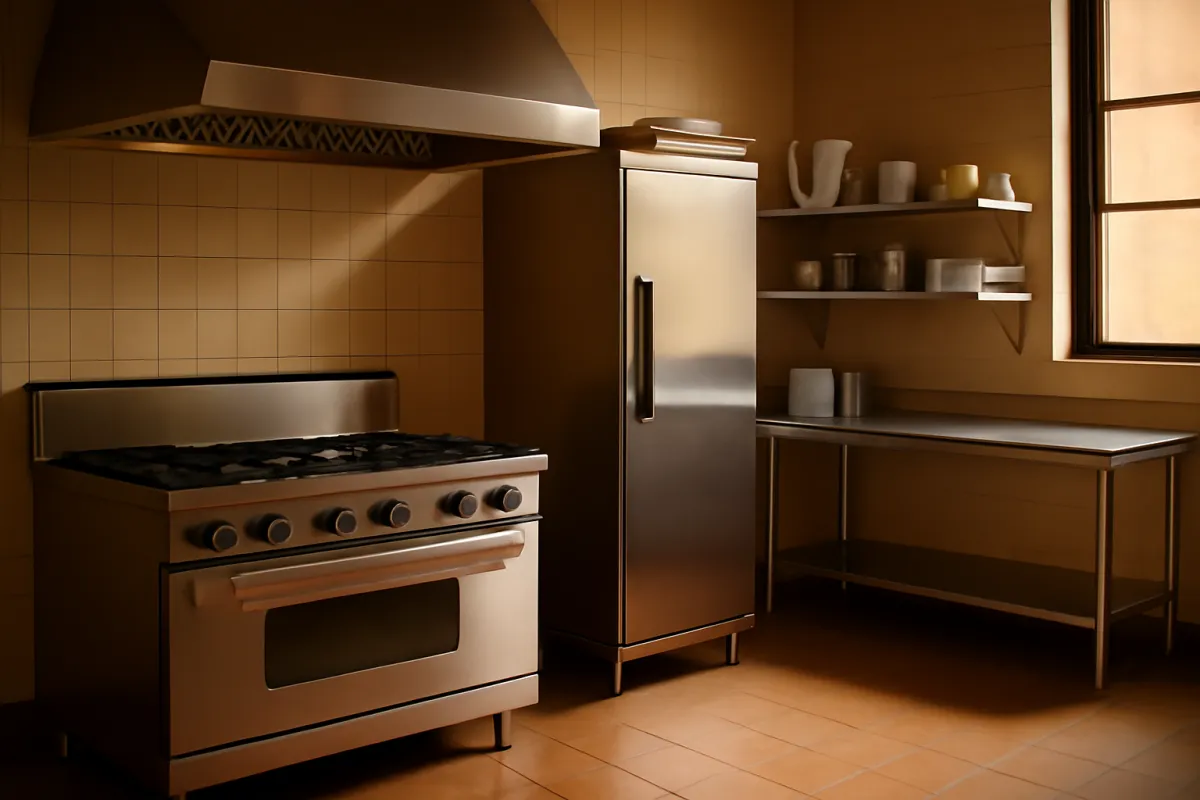
A full-service kitchen equipment budget, line by line
Now the other end of the spectrum. This is an illustrative full-service restaurant kitchen with a long hot line, a bakery-capable prep area, multiple refrigeration zones and a full warewashing station, built into a bare shell. Again, planning shapes rather than quotes.
Cooking line, $58,000. A six-burner range with an oven base at $5,500, a full-size convection oven at $5,500, a six-pan combi oven at $22,000, a charbroiler at $4,500, a griddle at $3,500, a two-vat gas fryer battery with filtration at $12,500, and a salamander with a hot-holding cabinet at $4,500.
Refrigeration, $42,000. A walk-in cooler at $12,000, a walk-in freezer at $16,000, two reach-ins at $8,000, and two refrigerated prep tables at $6,000.
Prep, $17,000. Stainless tables, shelving and sinks at $6,000, a planetary mixer at $7,000, and a slicer, processors and scales at $4,000.
Warewashing, $15,000. A door-type dishmachine at $8,000, plus a booster heater, a multi-compartment pot sink, a hand sink, a mop sink, a pre-rinse and a disposal at $7,000.
Ventilation hardware, $25,000. A wall canopy hood over the line at $14,000, a fire-suppression system at $6,000, and a makeup air unit at $5,000.
Smallwares and storage, $8,000.
Installation and hookups, $35,000. Hood duct run, roof curb and suppression tie-in at $10,000; gas line and heavy electrical service at $12,000; plumbing, drainage, floor sinks and the booster tie-in at $8,000; delivery, rigging, set-in-place and final connections at $5,000.
Total, $200,000. Read the shape and three things stand out. First, the cooking line and refrigeration come to $100,000, exactly half the budget, so in a large kitchen the appliances really are the biggest slice. Second, the ventilation package comes to $25,000 in hardware plus about $10,000 of its own installation, so roughly $35,000 installed, which is more than any single appliance in the kitchen including the $22,000 combi oven, but well short of the $58,000 cooking line as a whole. Third, installation and hookups at $35,000 sit against about $165,000 of equipment invoices, so the install line runs near a fifth of the gear it connects.
Compare that against the ghost kitchen and the pattern is clear. The full-service kitchen is roughly three times the total, but its ventilation and install share is 30 percent against the small kitchen’s 34 percent. The hood scales far less than the menu does, which is why small kitchens feel disproportionately expensive to equip and why a shared commissary changes the arithmetic so completely. Run your own concept and size through the companion beside this rundown and watch the same three lines move.
A sequence for pricing your own kitchen
The order in which you do this matters more than most people expect, because several of these steps constrain the ones after them.
Write the menu first, in enough detail to list every cooking method it uses. Turn that list into an equipment list by station, using our commercial kitchen equipment list for the types and sizes inside each category. Size the hood to the line you have just listed rather than to the room, because the line drives the canopy and the canopy drives the duct.
Then, before you sign anything, ask your local building and health authorities what they require for that menu in that specific unit, and get a licensed mechanical and electrical contractor to walk the space and give you a written scope. Those two answers convert the largest unknown in the budget into a number.
Only now start collecting equipment quotes, line by line, and read them against the checklist above. Decide new against used category by category rather than as a single policy. Add the install scope, the smallwares, and a contingency, because opening budgets that carry none are the ones that borrow at the worst moment. Then decide how to fund the total, matching the term to the life of what it funds.
Finally, put the running cost beside the purchase, because the kitchen you can afford to buy and the kitchen you can afford to operate are two different tests and both have to pass. Run the whole thing through the equipment ROI calculator and the companion beside this rundown before you commit.
The bottom line
How much does it cost to equip a commercial kitchen? Whatever the menu demands, and the menu is the answer to almost everything. Illustratively, a coffee kitchen near $45,000, a ghost kitchen near $65,000, a quick-service counter near $95,000 and a full-service restaurant kitchen near $200,000, and the gap between them is more cooking equipment, more refrigeration and a bigger hood with heavier hookups behind it rather than a fancier version of the same appliance. The cooking line and refrigeration are the biggest slices in a large kitchen. The ventilation and install group is the biggest surprise in every kitchen, and its share rises as the kitchen gets smaller.
The operators who equip a kitchen well do four things in order. They price the concept and its categories honestly rather than quoting an average for a kitchen. They get the hood, the hookups and the required fixtures confirmed by their own authority and their own licensed contractors before they sign a lease, because that is the only place those answers exist. They spend their attention on ventilation, refrigeration and connection rather than agonising over which range to buy. And they judge the whole package on payback and total cost of ownership rather than on the invoice, funding it with a payment the young kitchen can actually carry.
Choose new or used category by category with our used-versus-new equipment case study, weigh how to pay for it with the buy-versus-lease case study, see a kitchen priced and financed end to end in our restaurant equipment financing case study, price the whole opening with our cost to open a coffee shop case study, and run your own equipment budget and its payback through the equipment ROI calculator so the total to equip is a plan rather than a surprise.
Written for the operator costing a kitchen rather than for anyone selling one appliance at a time: this rundown is educational material, not financial, tax, legal or business advice, and it recommends no specific concept, brand, dealer, contractor or lender. Every dollar figure, concept range and percentage split here is an illustrative sketch meant to teach how the categories add up, and a real kitchen is priced by its own menu, its own space, and how much the building already carries. Nothing here states what any code requires of you: hood classification, fire suppression, gas fitting, equipment listings, sinks and inspection intervals are set by whichever rules your jurisdiction has adopted, and only your local building, fire and health authorities can tell you what applies to your unit. Get those answers from them in writing, price the work with licensed contractors on the actual space, and put a qualified professional between you and anything you sign.
Frequently asked questions
How much does it cost to equip a commercial kitchen?
Illustratively, a beverage-led coffee kitchen can be equipped for something in the mid forties of thousands, a delivery-only ghost kitchen for something in the mid sixties, a quick-service counter kitchen for something in the mid nineties, and a full-service restaurant kitchen for around two hundred thousand once the cooking line, refrigeration, prep, warewashing, smallwares, the ventilation package and the hookups are all counted. Those are planning shapes rather than quotes, and the reason the spread is so wide is that the menu sets the equipment list and the equipment list sets the number. A kitchen that fries, grills, bakes and steams needs more machines and a longer hood than one that assembles and reheats. Price the concept you are actually opening, total the categories underneath it, and treat every published average with suspicion, because an average of four different capital projects describes none of them.
How much does it cost to equip a new restaurant kitchen?
A new restaurant kitchen built from a bare shell is priced by its menu and its space rather than by a fixed price for a kitchen, so treat any single figure as a shape. Illustratively, a quick-service kitchen commonly lands in the mid five figures to low six figures and a full-service kitchen around two hundred thousand once every category is counted, with installation, electrical, plumbing and gas work adding roughly a fifth on top of the equipment invoices in a friendly space and considerably more in a hostile one. A bare shell costs more than a former food space, because a former restaurant may already carry a hood, the heavier gas and electrical service, and the floor drains that a shell has to build from nothing. Total the categories underneath your own menu rather than reaching for an average, and get the hookups priced by a licensed contractor on the actual space before you sign a lease.
What does commercial kitchen equipment cost by category?
Read by category, commercial kitchen equipment cost breaks into six equipment lines plus an installation line, and the proportions are steadier than the totals. In the illustrative full-service budget priced further down, the cooking line and refrigeration together take about half the money, the ventilation package and the hookups take about three tenths, and prep, warewashing and smallwares take the remaining fifth. The ventilation and install group is the one first estimates most often leave out entirely, which is why a budget assembled from appliance quotes alone tends to run about a third short of the real number. Every category scales with the menu, so a kitchen that fries, grills and bakes pays more in every line than one that only assembles and reheats. Price the categories your menu actually cooks, and see our commercial kitchen equipment list for the types, sizes and specs inside each one.
What equipment does a commercial kitchen need?
The standard restaurant equipment list runs across six categories, and a working kitchen needs some of each scaled to its menu. The cooking line covers the commercial kitchen cooking equipment most people picture: a range, one or more ovens, a griddle or flat top, a charbroiler and deep fryers. Refrigeration covers walk-in coolers and freezers plus reach-ins and refrigerated prep tables. Prep covers stainless tables, a mixer, a slicer, processors and scales. Warewashing covers a dishmachine, a multi-compartment pot sink, a dedicated hand sink and a mop sink. Ventilation covers the exhaust hood, the makeup air, the ductwork and the fire-suppression system over a cooking line. Smallwares and storage finish the list with pans, sheet trays, knives, containers and shelving. Which of those your jurisdiction will actually sign off on, and in what configuration, is a question for your local health and building authority rather than for any checklist, so confirm the required fixtures with them before you buy.
What is the most expensive part of a commercial kitchen?
It depends on the size of the kitchen, and the honest answer is more useful than the usual one. In the illustrative full-service budget below, the cooking line is the largest single category at roughly $58,000, refrigeration is second at $42,000, and the ventilation package comes to about $35,000 once its duct run and tie-in are included. So ventilation does not beat the whole cooking line in a big kitchen, but it does beat any single appliance on it, including the combi oven. In the smaller ghost-kitchen budget the ranking flips: the installed ventilation package at roughly $22,000 outruns the entire $20,000 cooking line, because a hood is closer to a fixed cost than a scaled one. That is the real lesson. Ventilation is not always the biggest line, but it is reliably the biggest surprise, and the smaller your kitchen the larger its share.
How much does a commercial kitchen hood and fire suppression system cost?
Illustratively, the hood itself can run from a few thousand dollars for a small wall-mount unit to the high teens of thousands for a large canopy over a long line, with the fire-suppression system, the makeup air unit, the ductwork and the installation adding as much again. In the full-service budget priced below, the hood, suppression and makeup air come to about $25,000 in hardware and the duct run, roof curb and tie-in add about $10,000, for roughly $35,000 installed. The figure is highly site-specific because it turns on the length of the cooking line, the height and path of the duct run, whether the building already has a usable shaft, and the rules your jurisdiction applies. Hood classification, suppression coverage and inspection intervals are all decided by your local mechanical, fire and health authority rather than by a supplier's brochure, so get the requirements in writing from them and price the package against those before you commit to a space.
Should I buy new or used commercial kitchen equipment?
The useful answer is category by category rather than yes or no. Simple, durable, cheaply serviced gear is where used and refurbished win easily: stainless prep tables, shelving, sinks, dish racks and many gas cooking appliances have most of their working life ahead of them at a steep discount, and that is also where you can save without weakening the kitchen. Where new or near-new usually earns its premium is anything with a compressor, a motor under heavy load or complex electronics, refrigeration above all, because a tired compressor is a spoiled-inventory failure rather than a repair bill. The same split answers the saving question: trim the boxes and the tables, keep the menu tight so you buy fewer specialised machines, and do not economise on the cold chain, the ventilation or the hookups. Our used-versus-new equipment case study runs the cost-per-working-year math that settles each call.
How much do installation, electrical, plumbing, and gas hookups add?
Enough to break a budget assembled from appliance quotes alone. In the illustrative full-service kitchen below, installation, hookups and the hood duct run come to about $35,000 against roughly $165,000 of equipment invoices, so the install line runs near a fifth of the gear it connects. In a bare shell with no gas service, no heavy electrical panel, no floor drains and a long roof run, that share climbs, and in a former food space that already carries the infrastructure it can fall sharply. The lever is the space rather than the equipment, which is why the lease negotiation and the equipment budget are the same conversation. Have a licensed mechanical and electrical contractor walk the actual unit before you sign anything, and treat their written scope as the real install number rather than a percentage from an article.
How much is a commercial kitchen?
Read as one number, a commercial kitchen is priced by the menu it has to cook rather than by the room it sits in, so the useful answer is a set of shapes. Illustratively, a beverage-led coffee kitchen lands near $45,000 all in, a delivery-only ghost kitchen near $65,000, a quick-service counter kitchen near $95,000, and a full-service restaurant kitchen near $200,000, each figure being that menu's equipment invoices plus the ventilation package and the hookups that connect them to the building. A bare shell costs more than a former food space, because the shell has to build the hood, the duct, the heavy electrical service and the drainage from nothing. Price your own menu category by category and get the hookups scoped in writing by a licensed contractor on the actual unit, because those two steps convert the largest unknown in the budget into a number.
What does the commercial kitchen install price cover?
The commercial kitchen install price is the work that turns delivered equipment into a kitchen the authorities will sign off, and it is a separate scope from the equipment invoices. It normally covers the hood duct run, the roof curb and the fire-suppression tie-in, the gas line and the heavier electrical service the cooking line needs, the plumbing, drainage, floor sinks and any booster tie-in for the dishmachine, and the delivery, rigging, set-in-place and final connections. In the illustrative full-service budget priced below, that scope comes to about $35,000 against roughly $165,000 of equipment invoices, so the install line runs near a fifth of the gear it connects, and it runs higher in a bare shell than in a former food space. Most equipment quotes exclude the trades entirely and stop at the kerb, so read the scope before you compare two numbers, and have licensed trades price the actual unit.
How much does ghost kitchen or food truck equipment cost?
A ghost kitchen is delivery-only with no dining room, so it saves enormously on the front of house while still needing the cooking line, refrigeration and ventilation its menu demands. The illustrative ghost-kitchen budget priced below comes to about $65,000, of which roughly a third is the ventilation package and the hookups, a higher share than a full-service kitchen carries because the hood barely shrinks even when the line does. Renting space in a licensed shared commissary can remove that whole group from the opening budget, which is often the single largest lever a delivery-only operator holds. A food truck compresses a kitchen into a few feet and carries its own generator, propane and on-board tanks, which is why our food truck startup case study prices the truck and its kitchen as one number. Both formats show the same thing: equipment cost tracks the menu, not the dining room.