
What's on this page
- What a commercial fryer costs
- Illustrative cost by fryer type
- The classes of commercial fryer
- Open pot fryers and where they win
- Tube fryers and the breading problem
- Flat bottom fryers and delicate product
- High efficiency and infrared burner fryers
- Pressure fryers and the chicken premium
- Countertop fryers and the small volume case
- Gas versus electric commercial fryers
- Fry pot capacity and what a pound of oil buys
- Recovery time, the capacity limit nobody prices
- Ventilation and the hood a fryer forces on you
- Fire suppression and the wet chemical system
- Gas line, electrical service, and the install work
- Delivery, setting, casters, and the restraining cable
- Where the first fryer dollar goes
- Oil consumption and what it actually costs
- Filtration and the payback on a filter machine
- Energy and the running cost
- Cost of ownership per production hour
- New versus used and refurbished fryers
- Warranty, service, and the parts that fail
- Lease versus buy on a fry station
- Common mistakes that inflate the number
- A worked example: a restaurant and a chicken concept
- The bottom line
Short answer: Illustratively, a countertop electric fryer runs near $1,100, an open-pot gas fryer near $1,900, an electric floor fryer near $2,800, a tube gas fryer near $3,400, a flat-bottom gas fryer near $3,800, a high-efficiency gas fryer near $5,200, a two-vat battery with built-in filtration near $12,500, and a pressure fryer near $22,000. Ventilation and fire suppression together cost far more than the fryer, and oil is the largest recurring line.
A fryer is the cheapest major appliance on most cook lines and one of the most expensive positions to build. The machine can be had for the price of a good work table, but it drags a hood, a duct run, a fan, makeup air, a wet chemical fire suppression system, a gas line or a heavy circuit, and a lifetime supply of oil along behind it. That gap between the sticker and the station is where fry budgets go wrong.
This case study prices the fryer itself by class and capacity, then prices everything the fryer obliges you to buy, and finally converts the whole thing into a cost per production hour so you can compare a nineteen hundred dollar open pot fryer against a twenty two thousand dollar pressure fryer honestly. Every figure here is an illustrative planning shape rather than a quote. If you want the same arithmetic on your own vat count and hours, the equipment ROI calculator and the companion beside this case study run it live.
Key takeaways
- Fryers span roughly twenty to one. Illustratively a countertop electric fryer runs near eleven hundred dollars, an open pot gas fryer near nineteen hundred, an electric floor fryer near twenty eight hundred, a tube gas fryer near thirty four hundred, a flat bottom gas fryer near thirty eight hundred, a high efficiency gas fryer near fifty two hundred, a two vat battery with built in filtration near twelve thousand five hundred, and a pressure fryer near twenty two thousand.
- Ventilation and fire suppression together cost far more than the fryer. On the worked example here, a thirty four hundred dollar fryer carries a seventy six hundred dollar hood package and a thirty nine hundred dollar wet chemical system.
- Oil is the largest recurring line, not energy. The illustrative single vat example spends about three thousand seventy five dollars a year on oil and filter media against about fourteen hundred seventy on gas.
- Filtration is the highest return habit on a fry station. Daily filtering roughly halves oil spend on the illustrative figures, which pays for a filter cart in well under two years on a single vat and under a year on two.
- Judge the station on cost per production hour, not on sticker. The illustrative single vat example lands near two dollars twenty five an hour all in, and ten years of running cost outweighs the installed package by more than three to one.
What a commercial fryer costs
How much does a commercial fryer cost? Illustratively, a countertop electric fryer commonly runs near eleven hundred dollars, an open pot gas floor fryer near nineteen hundred, an electric floor fryer near twenty eight hundred, a fifty pound tube gas fryer near thirty four hundred, a flat bottom gas fryer near thirty eight hundred, a high efficiency gas fryer near fifty two hundred, a two vat battery with built in filtration near twelve thousand five hundred, and a pressure fryer near twenty two thousand. Those are machine prices for new units of ordinary specification.
The reason an average fryer price is useless is that the machine is a minority of the money. A fryer is the single appliance that forces the heaviest ventilation duty in a kitchen, because it puts grease laden vapor into the air rather than dry heat. It is also the appliance that fire codes single out, since hot oil is the fuel behind the most common and most destructive kitchen fires. Price the class, then the ventilation and suppression package, then the oil, and the number becomes a plan rather than a guess. Our commercial oven case study makes the same argument about a different box, and the fryer version is sharper still.
Illustrative cost by fryer type
Lay the classes on one axis and the decision starts to explain itself. The chart below sketches illustrative purchase figures across the common commercial fryer types, from a countertop electric box to a pressure fryer. Treat them as planning shapes. Any specific machine can land well outside its band depending on capacity, fuel, burner design, controls, build quality, and whether filtration is built in.
Illustrative machine cost by fryer type
Typical purchase cost for a new fryer of each class, before ventilation, suppression, and install. Shape, not a quote.
The pressure fryer costs roughly twenty times the countertop unit, and the gap is a sealed cooking vessel and the product it makes possible, not a nicer version of the same pot. Pick the class from the menu first.
Notice how tight the middle of that range is. Between an open pot gas fryer and a high efficiency gas fryer there is under thirty five hundred dollars of machine price, and yet those two choices produce very different energy bills, recovery behavior, and oil lives over a decade. That is the whole reason to price a fry station on hours rather than on the purchase order. Run your own class and vat count through the companion beside this case study and the band collapses into a single planning number.
The classes of commercial fryer
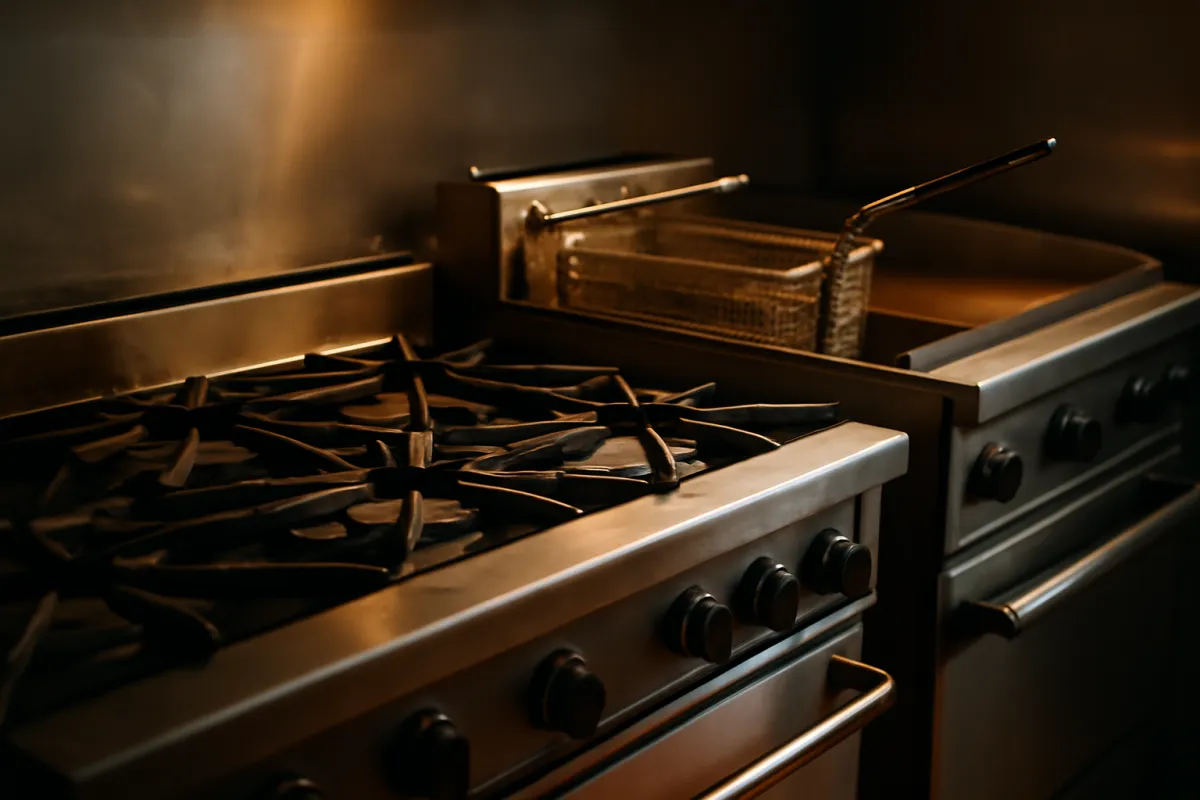
Fryers separate on one question: where does the heat enter the oil? Open pot fryers heat the vat from outside its walls. Tube fryers push heat exchanger tubes through the oil itself. Flat bottom fryers leave the vat completely unobstructed. Electric fryers drop elements straight into the oil. Pressure fryers seal a lid over the vat so the cooking happens above atmospheric pressure. Every price, cleaning routine, and oil life difference downstream comes from that one design choice.
The second question is format. Countertop fryers sit on a stand or a counter and serve low volume. Floor fryers stand on legs or casters and are the standard restaurant unit. Batteries are two or more vats built as one assembly, usually sharing a filtration drawer and a common cabinet, which is both cheaper per vat and tidier under a hood than separate machines pushed together.
The third is capacity, measured in pounds of oil the vat holds. Fifteen, thirty, forty, fifty, sixty five, and eighty pound vats are the common rungs. Capacity sets output, oil cost, and recovery, and it is the number that should come off your menu rather than off a price list.
Open pot fryers and where they win
An open pot fryer has nothing inside the vat. Burners or elements sit outside the pot walls and heat them from the sides, leaving an interior you can reach into with a brush and clean in minutes. That simplicity is why open pot units are the cheapest floor fryers on the market, illustratively near nineteen hundred dollars for a forty pound gas model.
The tradeoff is heat transfer. Heating oil through a pot wall is less direct than heating it from tubes running through the oil, so open pot fryers generally deliver a smaller share of their burner input into the food and recover a little slower after a heavy drop. On the illustrative figures used here, an open pot gas fryer runs about forty six cents an hour in energy against about forty two cents for a comparable tube fryer, which is small money per hour and real money per decade.
Open pot suits clean frying. French fries, wings, and similar product that sheds relatively little debris do not need a deep cold zone to protect the oil. If the menu is mostly clean product and the budget is tight, the open pot fryer is the honest answer rather than the cheap one.
Tube fryers and the breading problem
A tube fryer runs steel heat exchanger tubes horizontally through the oil, with the burners firing into them. Heat enters the oil from inside the oil rather than through the pot wall, which raises transfer efficiency and shortens recovery after a big drop. Illustratively a fifty pound tube gas fryer runs near thirty four hundred dollars, a meaningful step up from open pot.
The reason most heavily breaded menus buy tube fryers is the cold zone. Because the tubes sit above the bottom of the vat, the oil beneath them stays substantially cooler than the cooking zone. Breading crumbs, batter fragments, and debris sink into that cool layer and stop cooking instead of carbonizing in hot oil. Carbonized crumbs are what darkens oil, drives off flavor, raises smoke, and forces early changes.
That means the extra fifteen hundred dollars of machine price buys oil life, not just recovery speed. On a menu that sheds a lot of breading, a tube fryer with a deep cold zone and a daily filter routine will run noticeably more days per oil change than an open pot doing the same work, and oil is the largest recurring line in the whole station.
Flat bottom fryers and delicate product
A flat bottom fryer has no tubes, no elements in the oil, and no cold zone, just a smooth uninterrupted vat floor. It exists because some product cannot survive obstructions. Donuts, tempura, funnel cakes, beer battered fish, and other floating or loose battered items need a clear vat they can move across without catching on anything, and they need an operator able to skim the surface freely.
Illustratively a flat bottom gas fryer runs near thirty eight hundred dollars, above a tube fryer of similar capacity, because the design has to deliver even heat across a wide unobstructed floor rather than through convenient tubes. Energy use lands close to a tube fryer, near forty four cents an hour on the figures used here.
The catch is oil life. With no cold zone, everything the batter sheds stays in the cooking oil until somebody removes it, so flat bottom stations live and die on skimming discipline and on filtering. If your concept is donuts or battered fish, this is not an upgrade decision. It is the only fryer that does the job, and the oil budget should be written accordingly.
High efficiency and infrared burner fryers
High efficiency fryers use redesigned burners, often infrared or ribbon style, along with better insulation and larger heat exchange surface, to put more of the fuel into the oil and less up the flue. The premium is real, illustratively near fifty two hundred dollars for a fifty pound gas unit against thirty four hundred for a conventional tube fryer of the same capacity.
Whether the premium pays depends entirely on hours. On the illustrative figures used throughout this case study, a high efficiency fryer runs about thirty one cents an hour in energy against forty two for a standard tube fryer, a saving of about eleven cents. At thirty five hundred production hours a year that is roughly three hundred eighty five dollars, so the eighteen hundred dollar premium returns in a bit under five years.
Push the hours to a chicken concept running eleven hours a day and the same premium returns in a little over four years instead. Adding a second vat does not speed that up on its own, because two vats double the premium and the saving together. Only hours move the payback. That is the general rule for efficiency premiums on any appliance: they are priced in dollars but paid in hours, so they make sense for high utilization stations and rarely for a fryer that runs a lunch rush and then idles.
Pressure fryers and the chicken premium
A pressure fryer seals a lid over the vat so steam released by the food raises the pressure inside. Cooking above atmospheric pressure moves heat into the product faster at a lower oil temperature, which is why the category exists at all: it is the machine behind the bone in fried chicken tradition, producing a shorter cook and a different moisture result than any open fryer can.
Illustratively a fifty pound pressure fryer runs near twenty two thousand dollars, roughly six times a comparable open fryer. You are buying a pressure vessel with a sealed lid, a locking mechanism, a pressure relief system, and controls that keep all of it inside safe limits, plus a service and inspection regime that an open fryer does not carry.
Nobody buys a pressure fryer to save money on frying. It gets bought because the product it makes is the concept, and if that is your concept the machine is not optional. Budget for the gasket and lid hardware as consumables, and for a service relationship with somebody who genuinely knows the platform, because a pressure fryer down on a Friday is a closed menu rather than a slow one.
Countertop fryers and the small volume case
A countertop fryer is a small vat, usually electric, usually between eight and eighteen pounds of oil, that plugs in and sits on a counter or a stand. Illustratively near eleven hundred dollars for a fifteen pound unit, it is by far the cheapest way to get fried product on a menu.
It is also the easiest to size wrong. A small vat has very little thermal mass, so a basket of frozen product drops the oil temperature hard and takes a long time to recover. The result is soggy product, longer ticket times, and an operator who compensates by frying smaller batches, which makes the bottleneck worse. Countertop fryers work when frying is a garnish on the menu, not when it is the menu.
The other consideration is that a countertop fryer still produces grease laden vapor and still needs to sit under proper ventilation with suppression coverage in most jurisdictions. A cheap machine placed outside a hood is not a saving. It is a code problem and an insurance problem waiting for an inspection.

Gas versus electric commercial fryers
Electric fryers put their elements directly in the oil, so almost all of the energy drawn ends up in the oil rather than going up a flue. Gas fryers lose a meaningful share of their burner input to exhaust. On energy units consumed, electric wins comfortably. On money, it usually does not, because a unit of energy delivered as electricity typically costs several times what the same energy costs delivered as gas.
On the illustrative figures used here, a fifty pound tube gas fryer runs about forty two cents an hour in energy while a forty pound electric floor fryer runs about sixty seven cents. Those figures assume commonly seen commercial rates and will invert wherever gas is expensive or power is cheap, so pull your own numbers off a recent bill rather than trusting any published comparison.
The install side is where the decision often gets made for you. Gas needs a supply line sized for the total input rating of everything on the line plus adequate combustion air, and an undersized line starves every appliance during the rush. Electric needs a dedicated heavy circuit, often three phase, and a panel with spare capacity. Whichever the building already has in abundance is usually the cheaper answer regardless of running cost, which is the same conclusion our commercial kitchen equipment case study reaches across the whole cook line.
Fry pot capacity and what a pound of oil buys
Fryer capacity is quoted in pounds of oil, and that number does more work than any other spec on the sheet. It sets how much product you can drop at once, how far the temperature falls when you do, how long recovery takes, and how much money sits in the vat at every moment.
A commonly cited planning rule is that a fryer produces roughly one and a half to two times its oil weight in finished product per hour under steady conditions. On that basis a fifty pound vat sketches out near seventy five to one hundred pounds an hour, and a fifteen pound countertop unit near twenty two to thirty. Treat it as a sanity check rather than a spec, because product type, from load temperature, and operator discipline all move it substantially.
Work from your peak hour, not your average. Convert the busiest hour on your projected menu into pounds of fried product, apply the rule, and buy the vat count that clears it with headroom. A bottleneck at the fryer taxes every service for the life of the restaurant, while the price difference between a one vat and a two vat station is paid once. Our restaurant equipment list walks the same sizing logic across the rest of the room.
Recovery time, the capacity limit nobody prices
Recovery is how quickly the oil returns to setpoint after a load of cold product goes in, and it is the real limit on a fry station. A vat that reads three hundred fifty degrees on the dial but spends four minutes of every eight below three hundred is not cooking at three hundred fifty. It is producing pale, greasy product, because food absorbs more oil at lower temperatures.
Three things set recovery: the burner or element input rating, how efficiently that input reaches the oil, and the thermal mass of the oil itself. Bigger vats recover better for the same load because there is more hot oil to buffer the cold drop. Tube and high efficiency designs recover better than open pot for the same input. Undersized vats fail on all three counts at once.
Nothing on a price list shows you this. It surfaces in service, in longer ticket times and product complaints that nobody traces back to the purchase order. The practical defense is to size on peak load rather than average, and to fry in the batch size the vat can actually hold rather than the one the basket physically fits.
Ventilation and the hood a fryer forces on you
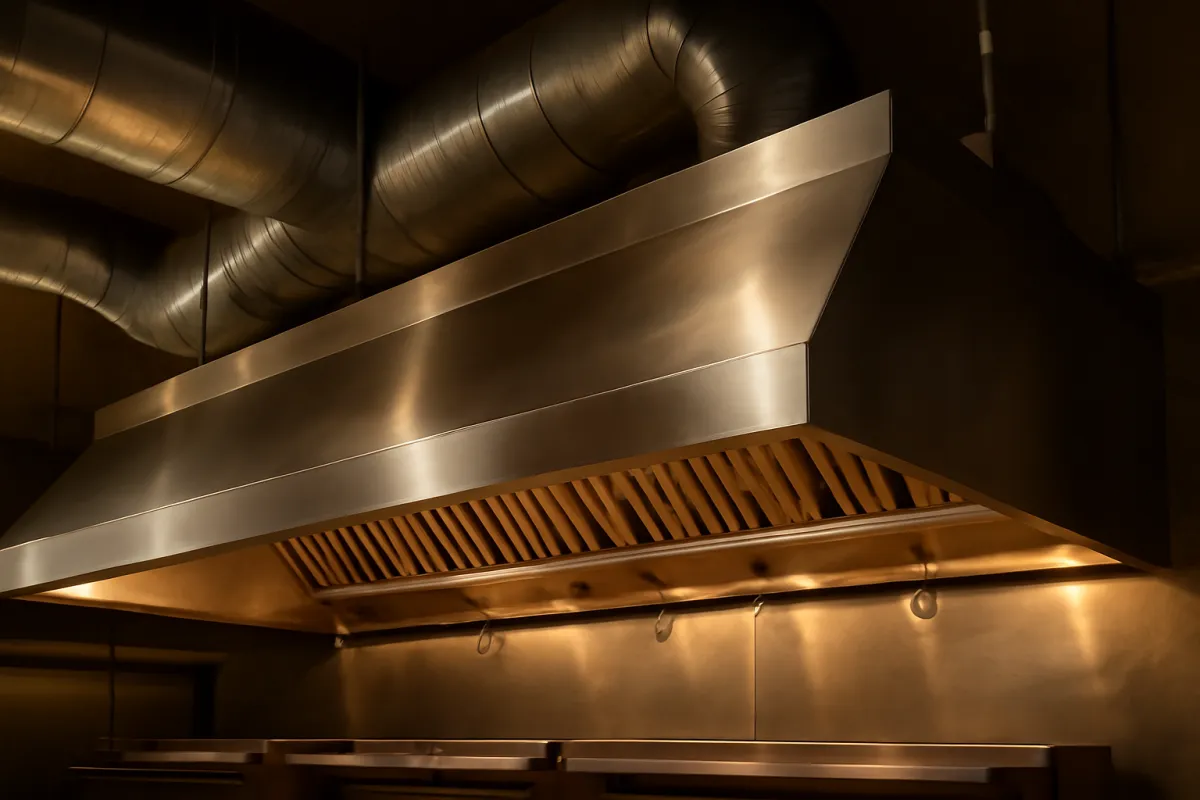
A fryer produces grease laden vapor, which is a different ventilation problem from an oven producing hot air. The hood has to capture it, the baffle filters have to strip grease out of it, the duct has to carry it without accumulating a fuel layer, and the fan has to move it at a rate the code sets for that appliance category. Makeup air then has to replace everything the fan removes, or the building goes negative and the exhaust stops working.
On the illustrative worked example in this case study, the ventilation package for a single fryer position runs near seventy six hundred dollars covering hood, baffles, duct, fan, and makeup air provision. That is more than twice the fryer under it. Adding a second vat to the same hood adds far less, illustratively about fourteen hundred, because the expensive part is the system rather than the linear foot.
The number that changes everything is whether a compliant hood with spare capacity already exists over the position. Slotting a fryer under an existing system with room and coverage is a small job. Building the system from nothing is the largest line in the project. Our commercial kitchen hood case study prices that package properly, and it is worth reading before you sign for the fryer.
Fire suppression and the wet chemical system
Hot oil is the reason commercial kitchens have engineered fire suppression at all. A wet chemical system sits in the hood with nozzles aimed at each appliance, a detection line above the cook line, and a mechanism that on activation discharges agent, shuts off fuel to the appliances, and shuts down or interlocks the exhaust. Illustratively the suppression line on a single fryer position runs near thirty nine hundred dollars, with each additional vat adding roughly eleven hundred.
The part operators consistently miss is that suppression is engineered to an appliance layout, not to a room. Nozzles are placed and sized for what sits under them. Swap a fryer for a griddle, move a fryer eighteen inches, or add a vat, and the system has to be reviewed and often re piped, even if the appliance is used and the hood is untouched.
Add to that a periodic inspection requirement, commonly semiannual, and a recharge cost after any discharge. None of this is optional and none of it is negotiable with an inspector. Fire, mechanical, and building codes differ by jurisdiction and change over time, so your local authority having jurisdiction is the only source of truth about what applies to your room.
Gas line, electrical service, and the install work
A gas fryer needs a supply line sized for its input rating, and that sizing is a whole line calculation rather than a per appliance one. If the fryer, the range, the oven, and the griddle all fire at once during the rush, an undersized line starves every one of them and the symptom looks like slow appliances rather than a plumbing problem. Illustratively, gas work for a single fryer position lands near sixteen to eighteen hundred dollars where the line is nearby and adequate, and far more where it is not.
An electric fryer needs a dedicated circuit, frequently three phase, with breaker and conductor sizing to match. Where the panel has spare capacity that is straightforward work, illustratively a few hundred dollars more than the gas equivalent. Where the panel is full, the number leaves the appliance budget entirely and becomes a service upgrade.
Both paths also need a shutoff, a connector rated for the appliance, and inspection. The honest planning move is to have a licensed contractor look at the actual room before you commit to fuel, because the building usually decides this question more firmly than the running cost comparison does.
Delivery, setting, casters, and the restraining cable
The small install lines are individually trivial and collectively real. A floor fryer arrives crated and heavy, has to come through doors that may not be wide enough, and has to be set level so the oil sits evenly across the vat and drains properly. Legs or casters get fitted, the appliance gets positioned with the clearances the manufacturer and the code require to combustibles and to neighboring equipment, and it gets connected.
If the fryer sits on casters, it needs a restraining cable or chain so it cannot roll away from its gas connector, and the connector itself has to be the right rating and length. This is a small part with an outsized role, because a fryer that rolls out on a flexible connector is exactly the failure mode the requirement exists to prevent.
On the illustrative worked example, delivery, setting, leveling, casters, restraint, and the gas connection together with the line work run near twenty two hundred fifty dollars. Measure the path into the room before the order goes in, because a machine that will not fit through the door is a rigging bill nobody budgeted.
Where the first fryer dollar goes
Zoom out and the fryer is a small slice of its own budget. The stacked bar below splits the first year of the single fifty pound tube gas fryer worked example used later in this case study: the fryer at thirty four hundred dollars, ventilation at seventy six hundred, fire suppression at thirty nine hundred, gas work and install at twenty two hundred fifty, and the first year of running cost at six thousand one hundred fifty five, for a first year total near twenty three thousand three hundred five.
Where the first fryer dollar goes
Illustrative first-year split for the single tube gas fryer worked example, summing to 100 percent.
The fryer is one seventh of its own first year. Ventilation and suppression together are half, and the running slice repeats every year for the life of the station.
Two things follow from that shape. First, shopping hard on the fryer while accepting whatever the ventilation quote says is optimizing the smallest slice. Second, the running band is the one that compounds: by year three the cumulative running cost has passed the entire installed package, and by year ten it is more than three times it. That is the total cost of ownership lens that runs through all of our equipment coverage, and the fryer is the appliance where it bites hardest.
Oil consumption and what it actually costs
Oil is the line most fry station budgets omit and the line that ends up largest. Illustratively, frying oil runs near a dollar twenty a pound, so a fifty pound vat costs about sixty dollars to fill. That is not a large number until you multiply it by how often the vat gets emptied.
Oil dies from three causes acting together: heat, which oxidizes it; water released by the food, which hydrolyzes it; and debris, which carbonizes and accelerates everything else. Filtering attacks the third cause directly and slows the other two. On the illustrative figures here, a filtered fifty pound vat gets changed about every eight operating days and an unfiltered one about every four or five.
Over a three hundred fifty day year that is roughly forty four changes filtered against roughly seventy four unfiltered. At sixty dollars a fill that is about twenty six hundred twenty five dollars against about forty four hundred sixty, before filter media. Add roughly four hundred fifty dollars a year of media on the filtered side and the comparison is about three thousand seventy five dollars against about forty six hundred, a gap near fifteen hundred dollars a year on one vat. Menus that shed heavy breading run dirtier than that; clean fry menus run cleaner.
Filtration and the payback on a filter machine
Filtration means pumping the oil out through a filter medium, cleaning the vat, and returning the oil, ideally at the end of every service day. It can be done with a portable filter cart shared across a line, with a filtration drawer built into a fryer battery, or by hand with a pot and a filter cone, which works but rarely survives contact with a tired closing crew.
The arithmetic is straightforward. On the illustrative figures above, daily filtration saves about fifteen hundred dollars of oil a year per fifty pound vat. A portable filter cart in the low thousands therefore pays for itself in under two years on a single vat. Run two vats and the saving roughly doubles while the cart cost does not, which pulls payback under a year. That is why filtration is standard equipment on any station running more than one fryer.
The unpriced benefits matter too. Cleaner oil smokes less, which lowers grease loading on the hood and stretches the interval between hood cleanings. It produces more consistent color, which is a quality control win that shows up in complaints rather than in a ledger. And it reduces the number of times somebody handles fifty pounds of hot oil, which is a safety benefit worth having on its own terms.

Energy and the running cost
Fryers are lighter energy users than ovens per hour, but they run long and they idle hot. A vat held at temperature all afternoon between rushes draws a meaningful idle load doing nothing, which is why the cheapest energy saving available on any fry station is a schedule: bring vats up late, shut them down early, and consolidate onto one vat when volume drops instead of holding two half used.
On the illustrative figures used throughout this case study, an open pot gas fryer runs about forty six cents an hour in energy, a tube gas fryer about forty two, a flat bottom gas fryer about forty four, a high efficiency gas fryer about thirty one, an electric floor fryer about sixty seven, a countertop electric fryer about twenty eight, and a pressure fryer about fifty two. Local rates move all of these, so substitute your own.
Then add the ventilation the fryer obliges you to run. On the single vat example that is about twenty two cents an hour covering exhaust and makeup air fan energy plus the periodic hood and duct cleaning that keeps the system safe and legal. A second vat adds about six cents. Ventilation energy is genuinely part of the fryer’s running cost even though it never appears on the fryer’s spec sheet.
Cost of ownership per production hour
Cost per production hour is the number that compares a cheap fryer against an expensive one honestly, because it folds everything the station consumes into one figure you can multiply by hours. Build it from five components: oil, energy, ventilation, service and parts, and the installed package amortized over the years you expect to keep it.
On the illustrative single vat example, a fifty pound tube gas fryer running ten hours a day for three hundred fifty days covers thirty five hundred production hours. Oil at about eighty eight cents an hour, energy at forty two, ventilation at twenty two, and service and parts at twenty four make one dollar seventy six an hour of running cost, or six thousand one hundred fifty five dollars a year. Spread the seventeen thousand one hundred fifty dollar installed package over ten years and ownership adds about forty nine cents an hour, for about two dollars twenty five all in.
Run the same arithmetic on a busier two vat chicken concept and the shape changes: a larger package, more hours, far more oil, and an all in figure near three dollars fifty one an hour. Neither machine wins in the abstract. The point is that this is the only comparison that survives contact with a real kitchen, because it prices idle time, oil, ventilation, and install work that a sticker price ignores completely.
New versus used and refurbished fryers
Used fryers are cheap and plentiful, because fry stations get replaced whenever a concept changes. A used floor fryer can often be had for a fraction of new, which looks like the easiest saving in the kitchen. It sometimes is. It sometimes is not, and the difference is one component.
The vat is the machine. Burners, thermostats, high limit switches, igniters, and controls are all replaceable parts with normal service lives. A vat that has thermally cycled for a decade and is starting to weep at a weld is the end of the appliance, because hot oil escaping onto a kitchen floor is a safety event rather than a repair ticket. Inspect the vat, the welds, and the drain valve before anything else, and see the machine come up to temperature and hold it.
Also remember what a used price does not touch. On the worked example, the fryer is fourteen percent of the first year. Buying that fourteen percent at half price saves seven percent of the project while the ventilation, suppression, and install work stay exactly the same, and suppression may need re engineering for the swapped appliance anyway. Our used versus new equipment case study sets out the cost per working year math that decides this properly.
Warranty, service, and the parts that fail
Fryer warranties commonly separate the vat from everything else, and the vat term is the one to read. A longer vat warranty is a manufacturer telling you what it believes about its own welds, which is more informative than any brochure claim. Parts and labor coverage on the rest of the machine matters less, because those parts are cheap and widely available.
What actually fails, roughly in order of frequency, is unglamorous: thermostats drifting out of calibration so the dial and the oil disagree, high limit switches tripping or failing, igniters and pilot assemblies on gas units, drain valves seizing or leaking, and elements on electric units. None of these are expensive parts. All of them are downtime if nobody local stocks them.
That makes the service network the real question rather than the warranty document. Before buying any class of fryer, ask who services it in your area, what their response time looks like on a Friday night, and whether they stock thermostats and igniters for that platform. A cheaper machine nobody nearby services is more expensive the first time it goes down mid service. The same logic governs the rest of the room in our restaurant equipment buying channels coverage.
Lease versus buy on a fry station
A single fryer is usually too small to finance on its own, but a fry station with its hood, suppression, gas work, and install is a five figure project and routinely gets folded into a wider equipment package. That is the level at which the lease versus buy question is actually asked.
The honest comparison is the total cost of the money against what that cash would earn or protect if it stayed in the business. Leasing preserves working capital during the period when a new operation needs it most, can bundle service, and spreads the cost across the years the equipment earns. Buying ends the payments sooner and leaves an asset with a residual value, though a used fryer’s residual is modest and should not carry the argument.
Watch the term against the life. Financing a ten year station over a short term makes monthly payments look bad; stretching a short lived asset over a long term means paying for something after it has gone. Our lease versus buy payback math works this through with real arithmetic, and our restaurant equipment financing case study covers the funding routes. Tax treatment differs by situation and changes over time, so put a qualified accountant between you and the assumption.
Common mistakes that inflate the number
The first is budgeting the fryer and discovering the station. A fryer quote that arrives without hood, suppression, fuel work, and install alongside it is not a fry station budget, it is one line of one. Ask for the whole position priced together before the first number goes into a plan.
The second is undersizing on price. A single vat that saves two thousand dollars up front and then bottlenecks every dinner service costs that saving back in slow tickets and remade product within the first year, and keeps costing it. Size on the peak hour.
The third is treating oil as a supply cost rather than an equipment decision. Oil outspends energy on most fry stations, and the equipment choices that determine oil life, cold zone design, filtration, and vat sizing, are made once at purchase and then paid for every week for a decade.
The fourth is ignoring the suppression consequences of any change. Moving a fryer, adding a vat, or swapping appliance types triggers a suppression review, and it is cheaper to know that before the equipment arrives than after an inspector arrives. The fifth is skipping the filtration habit because the closing crew is tired, which quietly doubles the oil bill.
A worked example: a restaurant and a chicken concept
Take a single fifty pound tube gas fryer in a restaurant, running ten hours a day, three hundred fifty days a year, with a hood built from nothing. Illustratively the fryer is thirty four hundred dollars, the ventilation package seventy six hundred, the fire suppression thirty nine hundred, and gas work with delivery, setting, and restraint twenty two hundred fifty, for an installed package near seventeen thousand one hundred fifty.
Running cost across thirty five hundred production hours: oil and filter media about three thousand seventy five dollars, gas about fourteen hundred seventy, ventilation about seven hundred seventy, and service and parts about eight hundred forty, for about six thousand one hundred fifty five a year. That is one dollar seventy six an hour running, plus forty nine cents of ownership, for about two dollars twenty five all in. First year total is about twenty three thousand three hundred five, and ten years is about seventy eight thousand seven hundred.
Now a fried chicken concept with two high efficiency gas vats running eleven hours a day. Fryers at ten thousand four hundred, ventilation nine thousand, suppression five thousand, and install work near twenty nine hundred make a package near twenty seven thousand three hundred. Across thirty eight hundred fifty hours, oil and media run about six thousand one hundred fifty, energy about twenty three hundred eighty seven, ventilation about ten seventy eight, and service about eleven fifty five, for about ten thousand seven hundred seventy a year, or three dollars fifty one an hour all in. First year lands near thirty eight thousand one hundred and ten years near one hundred thirty five thousand.
The comparison is the lesson. The chicken concept spends about three times the restaurant’s money on machines, but only about one and a half times as much on the installed package and about one and a half times as much per production hour, because ventilation, suppression, and install work scale far more gently than machine price does. Run your own vat count and hours through the equipment ROI calculator to see where your station lands.
The bottom line
How much does a commercial fryer cost? Illustratively eleven hundred dollars for a countertop electric unit, nineteen hundred for an open pot gas fryer, twenty eight hundred for an electric floor fryer, thirty four hundred for a tube gas fryer, thirty eight hundred for a flat bottom, fifty two hundred for a high efficiency gas unit, twelve thousand five hundred for a two vat battery with filtration, and twenty two thousand for a pressure fryer. Around every one of those sits a ventilation and suppression package that usually costs more than the machine, and behind that an oil bill that repeats every week for a decade.
Operators who buy a fry station well do three things in order. They convert the peak hour into pounds of product and buy the vat count that clears it, because a bottleneck is paid every service while the price difference is paid once. They budget the position rather than the appliance, pricing hood, suppression, fuel, and install from the first draft. And they judge the whole thing on cost per production hour, where oil, energy, and ventilation dwarf the sticker several times over.
Place the fry station inside the whole room with our commercial kitchen equipment case study, price the ventilation properly with our commercial kitchen hood case study, weigh a used machine with our used versus new equipment case study, and check the plate side of the arithmetic with our food cost percentage method, so the fryer budget arrives as a plan rather than a surprise.
This case study was written for an operator costing a fry position, and it is educational material rather than financial, tax, legal, engineering, or fire protection advice. It names no brand, model, dealer, installer, insurer, or lender. Every fryer price, ventilation figure, suppression band, oil rate, energy rate, hourly figure, and percentage split appearing above is an illustrative sketch built to show how a fry station is priced and run, and a real machine is quoted on its own class, capacity, fuel, and room. Hood design, exhaust rates, makeup air, wet chemical suppression, gas piping, electrical capacity, clearance to combustibles, appliance listing, oil handling, and used oil disposal are governed by local mechanical, fire, plumbing, electrical, and health codes that vary by jurisdiction and change over time, and your local authority having jurisdiction is the only body that can tell you what applies to your kitchen. Fuel and oil prices move constantly and by region, so gather quotes from licensed contractors and current pricing from your own suppliers, and put a qualified professional between you and any purchase, lease, or installation you commit to.
Frequently asked questions
How much does a commercial fryer cost?
Illustratively, a small countertop electric fryer commonly runs near eleven hundred dollars, an open pot gas floor fryer near nineteen hundred, an electric floor fryer near twenty eight hundred, a fifty pound tube gas fryer near thirty four hundred, a flat bottom gas fryer near thirty eight hundred, a high efficiency gas fryer near fifty two hundred, a two vat battery with built in filtration near twelve thousand five hundred, and a pressure fryer near twenty two thousand. That is roughly a twenty to one spread, because the word fryer covers a countertop box and a sealed pressure vessel that cooks bone in chicken. The machine is also the smallest part of the decision. Ventilation and fire suppression routinely cost more than the fryer under them, and oil costs more than either over a decade.
Is a gas or electric commercial fryer cheaper?
Neither wins everywhere, because the answer is set by local fuel prices and by what the building already has. Electric fryers transfer more of their input energy into the oil, so they use fewer units of energy per pound of product, but a unit of electricity usually costs several times what the same energy costs as gas. On the illustrative figures used in this case study, a fifty pound tube gas fryer runs about forty two cents an hour in energy while a comparable electric floor fryer runs about sixty seven cents, and that ordering flips wherever gas is expensive or electricity is cheap. The install side matters just as much: gas needs a supply line sized for the burner input and combustion air, while electric needs a heavy circuit and a panel with room for it.
What is the difference between an open pot and a tube fryer?
An open pot fryer heats the vat from burners or elements outside the pot walls, leaving the inside of the vat smooth with no obstructions. A tube fryer runs heat exchanger tubes through the oil itself, which transfers heat faster and builds a deeper cold zone underneath where crumbs settle out of the hot oil. Open pot suits clean frying, french fries and similar product that sheds little debris, and it is the easier vat to clean. Tube fryers suit heavily breaded product, because the cold zone below the tubes catches the crumbs that would otherwise burn, darken the oil, and shorten its life. Flat bottom fryers have no tubes and no obstruction at all, which is what delicate battered product and donuts need.
How much does it cost to install a commercial fryer?
The fryer itself is usually the cheapest line in its own installation. On the illustrative worked example in this case study, a thirty four hundred dollar tube fryer carries a seventy six hundred dollar ventilation package, a thirty nine hundred dollar fire suppression system, and roughly twenty two hundred fifty dollars of gas work, delivery, setting, and restraint, for an installed package near seventeen thousand one hundred fifty. Existing hood capacity and an existing suppression system change that picture completely, because adding a fryer under a hood that already has room and nozzles over the position is a fraction of building the system from nothing. Fire suppression is the line most often forgotten, and it is the one no inspector will let you skip.
How much oil does a commercial fryer use in a year?
Oil volume is set by vat size, by how much debris your product sheds, and above all by whether you filter. On the illustrative figures used here, a fifty pound vat holds about sixty dollars of oil at roughly a dollar twenty a pound, a filtered vat gets changed about every eight operating days, and an unfiltered one every four or five. Over a three hundred fifty day year that is roughly three thousand seventy five dollars of oil and filter media with daily filtration against roughly forty six hundred dollars without it. Those are planning shapes rather than quotes, because oil prices move, menus differ enormously in how dirty they run, and a fryer cooking clean fries will always outlast one cooking heavily breaded product.
Is a fryer filtration machine worth it?
On most fry stations the arithmetic favors filtering, and the payback gets faster the more vats you run. Using the illustrative figures in this case study, daily filtration on a single fifty pound vat saves roughly fifteen hundred dollars of oil a year, so a portable filter cart in the low thousands pays for itself in under two years. Run the same comparison on a two vat station and the saving roughly doubles while the cart cost does not, which pulls payback under a year. Filtration also buys things that do not show up in the oil line at all: more consistent product color, less smoke, and less grease loading on the hood, which stretches the interval between expensive cleanings.
How long does a commercial fryer last?
A well maintained floor fryer commonly gives a decade or more of service, and the failure that ends it is usually the vat rather than the burner or the controls. Vats fail at welds and seams after years of thermal cycling, and a weeping vat is the end of the machine because oil on a hot floor is a safety event, not a repair ticket. Controls, thermostats, high limit switches, and igniters are all replaceable parts with a normal service life measured in years. Treat ten years as a reasonable planning horizon for a new floor fryer used in a busy kitchen, and treat a used machine as having however many working years its vat has left, which nobody can promise you.
Should I buy or lease a commercial fryer?
A fryer alone is usually too small a purchase to justify financing on its own, but a fry station with its hood, its suppression system, and its install work is a five figure project and commonly gets folded into a wider equipment package. The honest comparison is total cost of the money against what the cash would earn or protect elsewhere, not monthly payment against sticker price. Leasing preserves working capital and can bundle service, while buying ends the payments and leaves you an asset with a residual value. Tax treatment of equipment purchases and leases differs and changes over time, so ask a qualified accountant about your own situation rather than assuming what applied last year still applies.