
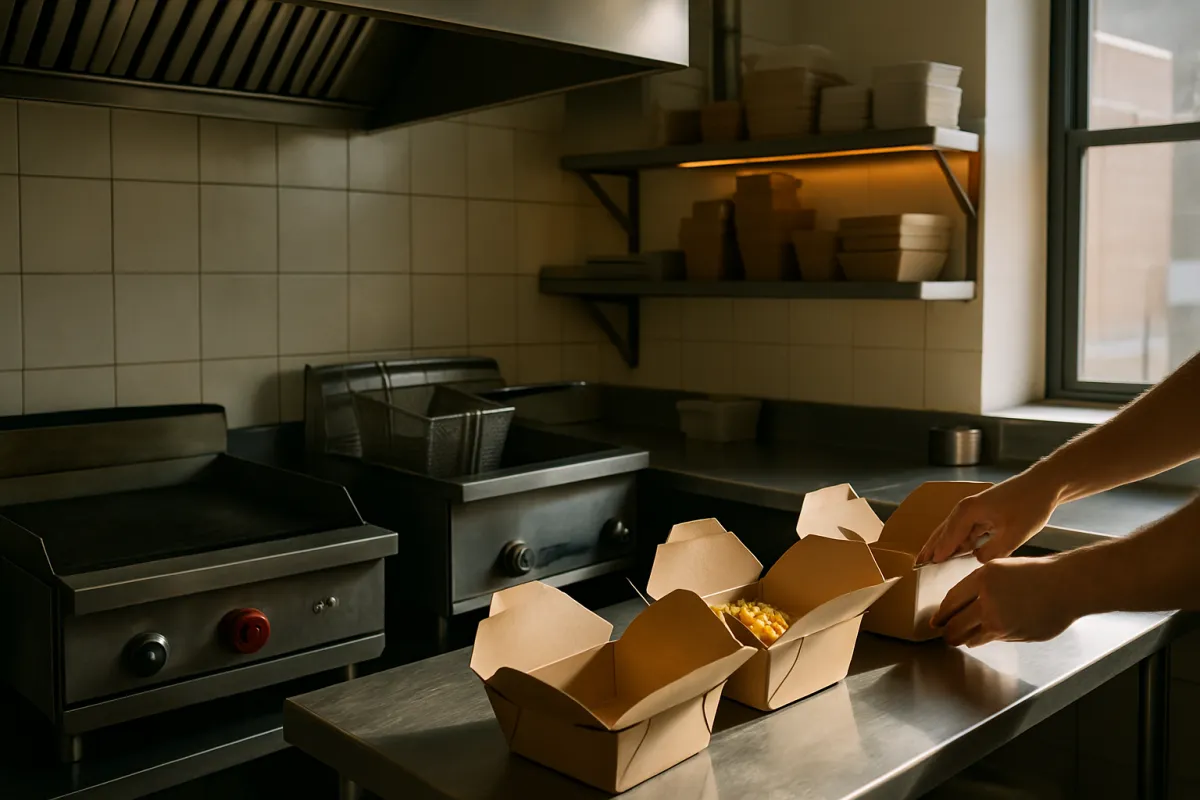
What's on this page
- Before you start
- How a ghost kitchen differs from a restaurant with a dining room
- Step 1: Choose your ghost kitchen model
- Step 2: Validate the menu against delivery
- Step 3: Secure the space and clear the licensing
- Step 4: Specify equipment for throughput and holding
- Step 5: Set up the platforms and your own ordering channel
- Step 6: Price for the commission, not like a restaurant
- Step 7: Run the operation on delivery metrics
- Where every dollar of a delivery order goes
- What order value and direct orders do to monthly profit
- A worked example: one delivery-only kitchen, end to end
- Ghost kitchen startup costs, line by line
- Packaging is part of the recipe, not an afterthought
- The virtual brand route in more detail
- Staffing a kitchen with no front of house
- The commission treadmill and how operators get off it
- When a ghost kitchen is the wrong answer
- Common mistakes that sink delivery-only kitchens
- Troubleshooting: what to do when the numbers go wrong
- Your ghost kitchen launch checklist
- The bottom line
Short answer: Start a ghost kitchen by choosing the model first: a virtual brand run from an existing kitchen's slack capacity is the lowest-risk entry, a shared commissary seat is the common middle, and your own leased space is a restaurant-scale project without the dining room. Then build a menu that travels, and price for the platform commission, because on an illustrative $28 order at 25 percent, $7.00 leaves before you buy an ingredient.
Starting a ghost kitchen is often sold as the cheap way into food service, and the first half of that claim is true. Take away the dining room and you take away the rent for seats, the front-of-house payroll, the furniture, the bathrooms and most of the buildout that makes opening a restaurant so expensive. What almost nobody explains before you sign up is what replaces those costs. Every order arrives through a platform that takes a percentage of it, and that percentage is not a fixed cost you eventually grow past. It is a permanent share of revenue that gets larger in absolute terms every time you sell more. That single structural difference is why a delivery-only kitchen has to be planned differently from a restaurant, not just planned smaller.
This rundown walks the launch as seven steps, in the order that protects your money: choose the model, validate the menu against delivery, secure the space and clear the licensing, specify the equipment, set up the platforms and your own ordering channel, price for the commission, then run the operation on delivery metrics. For the fixed-location version of the same project, our walkthrough on opening a restaurant covers what a dining room adds, and our rundown on commercial kitchen rental prices the shared space most delivery-only operators start in. You can size your own version of the numbers below with the equipment ROI calculator as you read.
Key takeaways
- Removing the dining room removes rent and front-of-house labour, then replaces them with a commission on every order. Commission is a percentage of revenue, so unlike rent you never grow past it.
- Choose the model before anything else. A virtual brand run out of an existing kitchen's slack capacity is the lowest-risk entry; a shared commissary seat is the common middle; your own leased space is a restaurant-scale project without the dining room.
- Travel tolerance kills otherwise excellent dishes. If a plate is only good for the first ten minutes, it is not a delivery item, and packaging is part of the recipe rather than a supply-closet decision.
- Price for the commission rather than pricing like a restaurant and hoping. On an illustrative $28 order at a 25 percent commission, $7.00 leaves before you have bought a single ingredient.
- Average order value and direct orders are the two levers that matter most. In the illustrative case below, a $4 lift in order value or moving one order in five to your own channel each move monthly profit more than any cost cut available to you.
Before you start
The seven steps assume you arrive with four things, and gathering them first is what keeps the expensive steps from being guesses. None of them costs money, and each one closes off a category of mistake that is painful to reverse later.
- A menu concept in one sentence. Who the food is for, what it is, and why someone scrolling a delivery app at 7pm picks it: "loaded rice bowls for weeknight office-district delivery," not "comfort food." Delivery is a scrolling medium, and a concept that cannot be understood from a photo and six words will not be chosen.
- A read on your own delivery market. Open the platforms your customers use, in the postcodes you would actually serve, and look at what already exists, how many kitchens sell your category, and what they charge. This is free research and it is the closest thing to demand evidence you will get before you open.
- A first call to the local health department. Ask what a delivery-only operation needs where you are: the permit type, whether a shared commissary arrangement is recognised, and what the facility itself must hold. Requirements vary by jurisdiction and change, so ask rather than assume.
- An honest cash figure. Know what you can commit and how many months of losses you can carry. The model you can afford is the model you should pick, and picking above your cash is the most common way a delivery-only kitchen closes in its first year.
Set expectations on time and difficulty too. On an illustrative timeline, a virtual brand inside an existing kitchen can be live within a few weeks, a commissary seat commonly takes one to three months once licensing and platform onboarding are counted, and a leased space you build yourself runs on restaurant timelines of six months or more. Difficulty is moderate: the cooking is the easy part, and the hard part is that your entire customer relationship is mediated by software you do not control. Run your own order value, order count and commission rate through the companion beside this rundown to turn the ranges below into your own numbers.
How a ghost kitchen differs from a restaurant with a dining room
The temptation is to treat a delivery-only kitchen as a restaurant with the seats removed, and almost every planning error follows from that assumption. Start with what genuinely goes away. There is no dining room rent, which is usually the largest occupancy line in a restaurant. There are no servers, hosts, bussers or bartenders, which removes a large share of the payroll that our rundown on restaurant labor cost percentage tracks. There is no bar programme, no dining-room buildout, no furniture package and no customer bathrooms. A delivery-only kitchen can occupy a few hundred square feet in a building nobody would want to eat in, and that is the whole cost advantage in one sentence.
Now look at what arrives in their place. Platform commission takes a share of every order. Packaging becomes a real per-order cost that a dining room never carries, because a plate costs nothing to serve and a sealed container costs real money. Marketing on the platforms is priced as more commission rather than as a fixed budget. You lose the walk-in customer entirely, so there is no such thing as passing trade, and you lose the ability to fix a bad experience at the table because you never meet the customer. What you gain in fixed costs you give back in variable ones, and variable costs behave differently.
That difference is the whole planning story. Fixed costs are frightening at low volume and forgiving at high volume, because you spread the same rent over more covers. Variable costs are the reverse: they are gentle at low volume and relentless at high volume, because the tenth thousand order costs you exactly the same share as the first. A restaurant that doubles sales usually more than doubles profit. A delivery-only kitchen that doubles sales doubles its commission bill alongside its food bill, and the profit improves only to the extent that its fixed lines were being spread. Plan for that shape rather than for the restaurant shape.
There is one more difference that is easy to miss and expensive to learn. In a restaurant you own the customer relationship: they know where you are, they can come back, and a regular is an asset you built. On a delivery platform the customer belongs to the platform, and your position in their list is decided by a ranking you do not control. This is why step five insists on your own ordering channel even when it is a small share of volume at first, and why step seven treats your rating as an operating metric rather than a vanity number.
Step 1: Choose your ghost kitchen model
The word “ghost kitchen” covers at least four different businesses with four different balance sheets, and picking the wrong one is the most expensive mistake available at this stage. Take them in order of increasing commitment. A virtual brand runs a delivery-only menu out of an existing restaurant’s kitchen during hours when that kitchen has slack capacity, either your own restaurant or another operator’s under an agreement. The hood, the licence, the equipment and much of the labour are already paid for, so the incremental cost of launching is mostly food, packaging and a little extra prep. This is the lowest-risk entry that exists in this category and it is badly underused by first-timers.
A seat in a shared commissary is the common middle path. You rent a station, a bay or a private room in a licensed commercial kitchen shared with other food businesses, usually with the hood, the fire suppression, the dish area and sometimes the heavy cooking equipment provided. Our rundown on commercial kitchen rental prices this route in detail, and our explainer on what a commercial kitchen is covers the infrastructure you are renting rather than building. A dedicated ghost-kitchen facility is a variant: a building subdivided into small delivery-focused units, often with courier pickup and order management built in, at a higher monthly cost for a more purpose-built space.
Then there is your own leased space, which is a restaurant project with the dining room deleted. You take on the lease, the hood, the gas supply, the grease interceptor, the electrical service and the permits, which means you take on restaurant-scale capital and restaurant-scale timelines. It can be the right answer for an operator with a proven menu and volume that a shared seat cannot handle, and it is almost never the right answer for a first concept. The watch-out at this step is picking the model that flatters the plan rather than the one your cash and your evidence support. Prove the menu in the cheapest model that can prove it, then move up when the order volume forces you to.
Step 2: Validate the menu against delivery
A delivery menu is not a restaurant menu in a box, and this is the step where good cooks most often go wrong. The constraint that decides everything is travel tolerance, meaning how a dish holds up between the moment it leaves your pass and the moment somebody opens the container somewhere else, which on an illustrative basis is commonly twenty to thirty-five minutes once assembly, courier wait and drive time are counted. Anything that depends on being eaten immediately fails that test. Crisp fried items go soft in their own steam, delicate sauces break, greens wilt under anything warm, and anything plated for appearance arrives rearranged.
Test every candidate dish the honest way before it goes on the menu. Cook it, pack it exactly as a customer would receive it, seal it, leave it on a counter for thirty minutes, then open it and eat it cold-ish out of the container with a plastic fork. That is the actual product you are selling, and it is startling how many kitchen favourites do not survive the test. Dishes that pass tend to share traits: they are saucy or braised rather than crisp, they hold heat in mass rather than in a thin layer, they tolerate a few minutes of variance, and they can be assembled in a container rather than arranged on a plate.
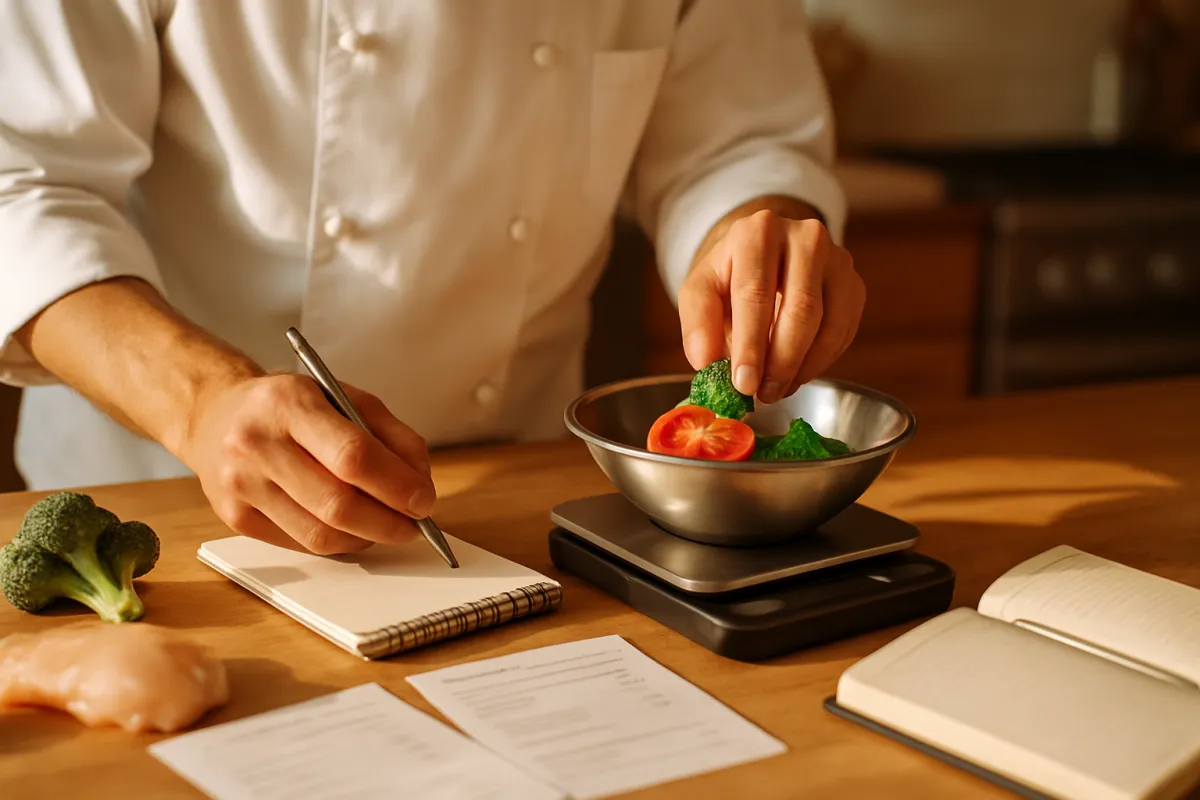
Design the menu short as well as travel-tolerant. A tight list of items that share ingredients cuts food waste, shortens ticket times and makes the prep cycle predictable, all of which feed the metrics in step seven. Build in items that raise the order value naturally, meaning sides, drinks and a dessert that the customer adds without thinking, because average order value turns out to be the single strongest lever you have and it is designed in at this step rather than fixed later. Price each item against a costed recipe from the start, using the method in our rundown on calculating restaurant food cost, and count the packaging in the recipe cost rather than treating it as overhead.
Step 3: Secure the space and clear the licensing
With the model chosen and a menu that survives a container, go and get the space, and treat the licensing as part of the space rather than as paperwork that follows it. In a shared commissary the central document is the commissary agreement, and it deserves a slow read. Check what hours and access you actually get, because a kitchen you can only use between two and six in the morning is a different business from one you can run at dinner. Check what equipment is included and what is yours to bring. Check dry and cold storage allocation, dish access, waste disposal, whether couriers can enter and where they wait, and how the rent escalates.
Then confirm the licensing, which varies by jurisdiction more than any other item on this list. A delivery-only operation generally needs the business registration, a health department permit tied to an inspection of the kitchen it operates from, food-safety certification for whoever runs the line, and in many places a specific recognition that you are operating out of a shared or third-party facility rather than a space you control. Some jurisdictions permit multiple businesses to hold permits against one address and some do not, which is exactly the kind of local rule that decides whether your plan works. Ask the health department directly, in writing where possible, and design the operation around their answer.
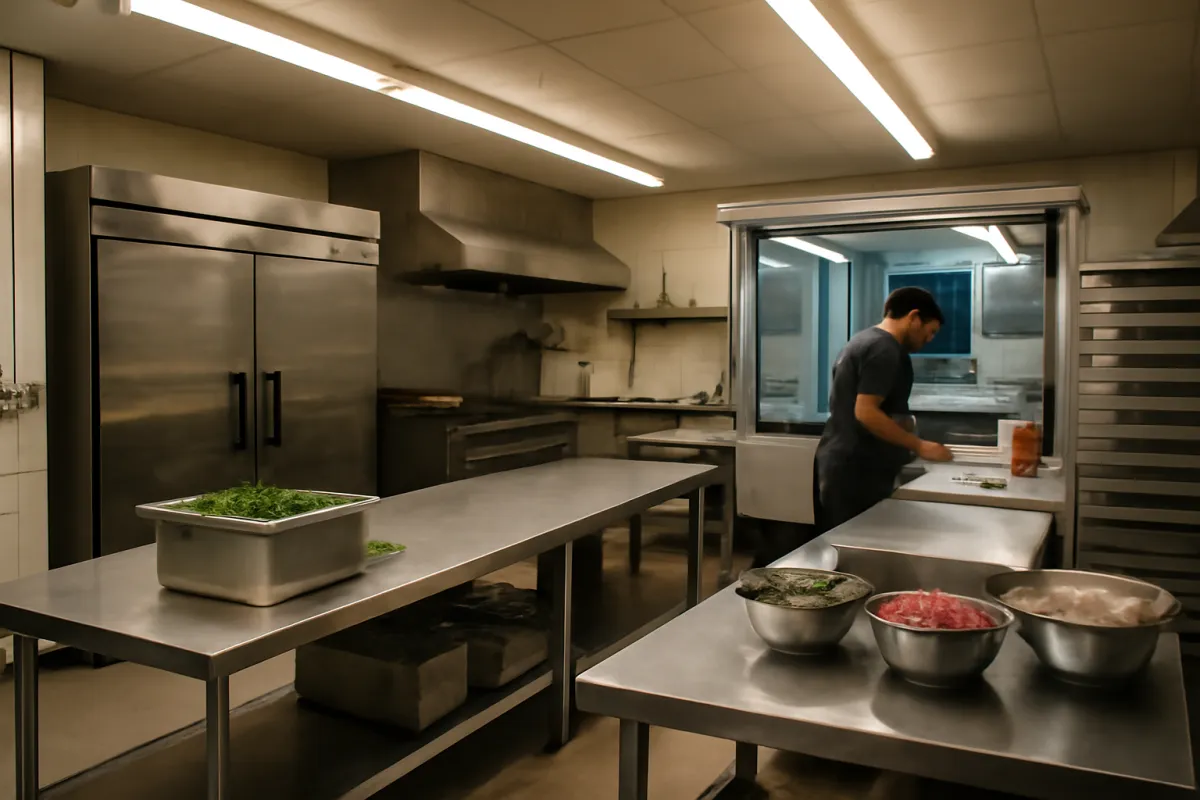
The watch-out here is signing for space before the menu is settled, which is step two for a reason. The menu decides how much cold storage you need, whether you need a fryer bay or a range, how much surface area the packing station requires and how many hours a day you occupy the kitchen. Sign first and you will discover that the seat you rented cannot hold your prep or cannot run your one essential piece of equipment. Illustratively, a commissary seat commonly runs somewhere between roughly $1,000 and $3,500 a month depending on the city, the access and the space, with dedicated ghost-kitchen units typically sitting at the higher end of that shape or above it. Confirm real local numbers before you build a budget on any range.
Step 4: Specify equipment for throughput and holding
Now buy equipment, and buy it against the menu rather than against a mental image of a restaurant kitchen. The delivery-only line is shaped by two things a dining room does not care much about: throughput, meaning how many identical tickets you can push through in the peak hour, and holding, meaning how long finished food can wait safely for a courier who is four minutes away. Those two priorities usually mean fewer pieces than a comparable restaurant, but more capacity in the pieces you keep. One high-output cooking piece the menu genuinely uses beats three specialised pieces it uses occasionally.
Work through the list in the order the food moves. Refrigerated storage sized to your prep cycle comes first, because delivery kitchens live on prepped components assembled to order. Then the one or two cooking pieces the menu requires, sized for peak-hour volume rather than average volume. Then holding: a heated cabinet, a pass shelf or a heat lamp, so a finished order waits at temperature instead of sitting on a cold counter losing quality and losing you a rating point. Then the packing station, which first-timers consistently undersize. It needs enough surface to lay out, fill, seal, bag and label several orders at once without anybody reaching across a hot line.
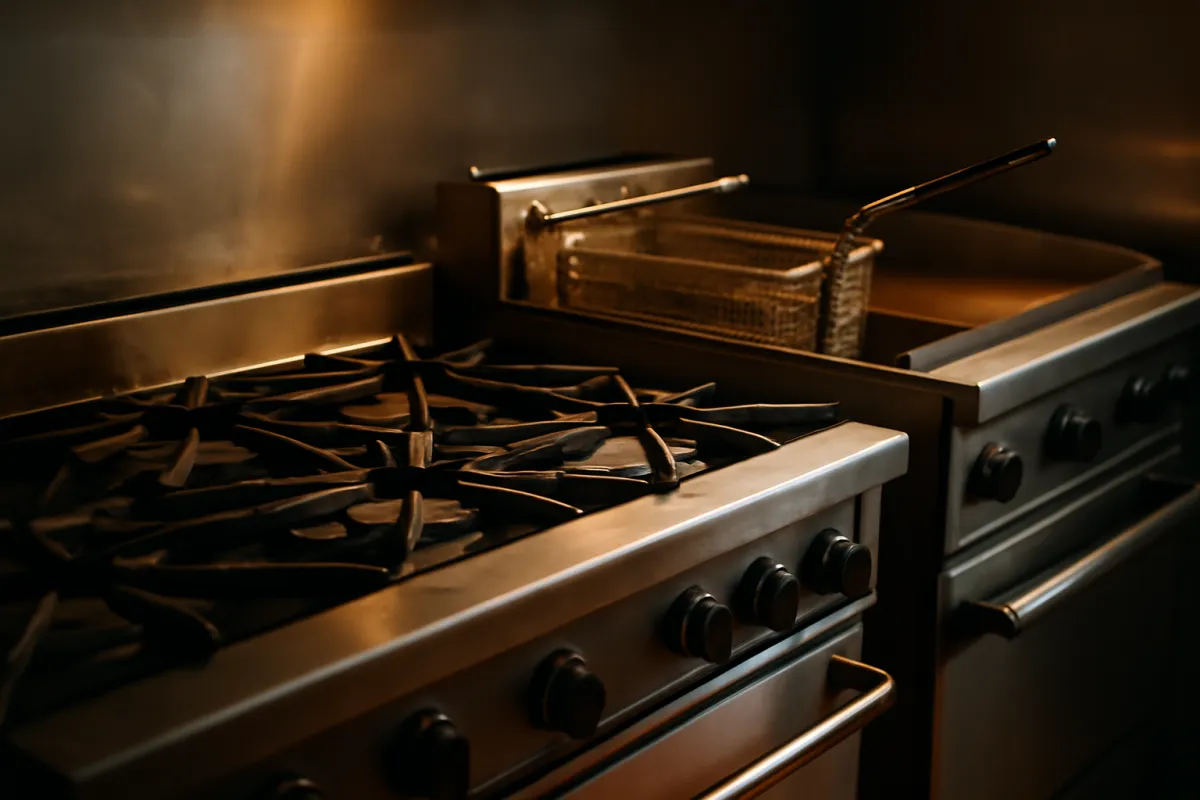
Shared facilities change this calculation in your favour, which is the point of them. When the hood, the fire suppression and often the heavy cooking equipment are provided, your capital shrinks to smallwares, storage, holding and the packing station, and our rundown on commercial kitchen equipment cost gives the price shape for whatever you do have to buy. The watch-out is over-buying against a menu you have not proven. Every piece you own has to be moved, maintained and eventually sold, and equipment bought for a menu item that gets deleted in month three is pure loss. Buy the short list, prove the volume, then add. Run the payback on any piece you are unsure about through the equipment ROI calculator before it goes in the van.
Step 5: Set up the platforms and your own ordering channel
Getting listed is the easy part of this step and the part everyone focuses on. You will register the business, submit the licensing, build the menu with descriptions and photographs, set your hours, connect a tablet or an integration to your point-of-sale, and start receiving orders. Do the photography properly, because on a delivery app the photograph is the storefront, the sign and the window display combined, and a menu shot badly will underperform a worse menu shot well. Set your hours to hours you can genuinely staff, since accepting orders you cannot cook on time is the fastest route to the rating problem in step seven.
The part that matters more, and that most operators postpone until it is too late to matter, is your own ordering channel. That means a simple ordering page you control, on your own domain, taking payment directly, with either your own delivery, a courier service you contract, or pickup. Set it up on day one even though it will start with almost no volume. Every order that arrives through it carries payment processing and delivery cost instead of full platform commission, and on an illustrative basis that gap is the difference between roughly a quarter of the order and something closer to the high single digits.
Then work, patiently, to shift orders across. The tools are unglamorous and they compound: a card in every bag with your own ordering address and a reason to use it, a loyalty or repeat-order incentive that only exists on your channel, a slightly better price or a bigger portion direct, and a genuine reason to come back that the platform cannot replicate. You will not move the majority of your orders and you should not plan to. Moving one order in five is realistic over time and, as the chart below shows, it is worth more to your profit than any supplier negotiation you are likely to win.
The watch-out is treating the platforms as an enemy rather than as a channel with a price. They bring you customers you have no other way to reach, especially in the first months when nobody knows the name. The mistake is not using them, it is depending on them completely and then discovering that a ranking change you cannot see has cut your volume by a third. Use the platforms for reach, use your own channel for margin and for the customers who already like you, and check the mix every month.
Step 6: Price for the commission, not like a restaurant
This is the step that decides whether the business works, and it is the step most often skipped. A restaurant prices a plate at a target food-cost percentage, sets it on the menu and lets the rest of the P&L sort itself out. A delivery-only kitchen cannot do that, because before the food cost is paid, the platform has taken its share of the sale price. Price at restaurant levels and you are paying the commission out of your own margin on every order, forever, on items that looked profitable on the costing sheet.
Run the arithmetic on a single order rather than on a monthly total, because the single order is where the truth lives. Take an illustrative $28 order at a 25 percent commission. The commission is $7.00, so $21.00 reaches you. Food at 30 percent of the menu price is $8.40 and packaging is about $1.10, which leaves $11.50 of contribution to cover kitchen labour, facility rent, utilities, insurance, software and whatever is left over as profit. That $11.50, not the $28, is the number your fixed costs have to come out of, and it is why a menu priced for a dining room produces a delivery business that works hard for nothing.
There are three honest ways to respond and one dishonest one. You can price the delivery menu above your pickup or direct price, which most operators do and most customers understand, as long as the gap is proportionate rather than punitive. You can design the menu so its natural order includes a side and a drink, raising order value against fixed packaging and delivery friction. You can shift mix toward your own channel, where the take rate is far lower. What does not work is quietly shrinking portions, which shows up in ratings within weeks and costs you placement. Our rundown on pricing a restaurant menu covers the underlying method, and the delivery version simply adds the take rate as a cost line before food cost rather than after.
Step 7: Run the operation on delivery metrics
A dining-room restaurant is judged by the room: the noise, the pace, whether the tables turn. A delivery-only kitchen has none of that feedback, so it is judged by three numbers, and if you do not watch them nothing tells you they are slipping until the order count falls. The first is ticket time, meaning the minutes from accepting the order to handing the bag to a courier. Long ticket times mean couriers waiting, food held too long, and late deliveries that the customer blames on you rather than on the traffic. Set an illustrative internal target such as twelve minutes and measure against it every shift.
The second is order accuracy, meaning the share of orders that go out complete and correct. A missing side is a refund, a one-star rating and a customer who does not order again, and in a kitchen with no server to catch it at the pass, accuracy is a process rather than a hope. The fix is boring and it works: a printed ticket taped to every bag, one person responsible for the final check, a sealed bag only after that check, and a weekly count of what went wrong. The third is your rating, which is the metric that silently converts the first two into volume.
That last relationship is the one to internalise. Platforms generally weight ratings, accuracy and lateness when deciding which kitchens appear high in a customer’s list, the exact weighting is not published and changes over time, and the consequence is that a rating decline cuts your placement and therefore your order count without any notification. Treat published thresholds you hear about as rumours and treat your own trend line as the fact. Watch it weekly, respond to the causes rather than to the number, and remember that in this business a quality problem and a marketing problem are the same problem.
The watch-out is running the kitchen on gut feel because the volume feels fine. Delivery volume is a lagging indicator of quality by two or three weeks, so the month you feel comfortable is often the month the damage was already done. Keep a simple weekly sheet: orders, average order value, ticket time, accuracy misses, rating, commission paid, and the share of orders that came through your own channel. Six numbers, once a week, and you will see the problem while it is still cheap. Our rundown on restaurant labor cost percentage covers the staffing side of holding those numbers steady as volume grows.
Where every dollar of a delivery order goes
Before the worked example, look at a single order broken into its parts, because the proportions are the reason this format has to be planned differently. The stacked bar below splits an illustrative $28 delivery order at a 25 percent commission into the four places the money goes, sized by their share of the order. The commission slice is the one with no equivalent in a dining-room restaurant, and it sits ahead of the profit slice by a factor of roughly three.
Where a $28 delivery order goes
Illustrative split of one order at a 25 percent commission, four parts summing to 100 percent.
Drawn from the illustrative kitchen used throughout this rundown: a $28 order, 30 percent food cost, $1.10 of packaging, a 25 percent commission, and $11,100 of monthly fixed costs spread across 1,200 orders a month. The four amounts, $9.50, $9.25, $7.00 and $2.25, sum to the $28 order.
Two things in that split deserve a second look. The commission slice is larger than the entire fixed-operating slice would be in many restaurants, and it is the only slice that cannot be negotiated down by operating better. You can buy food more cleverly, schedule labour more tightly and find a cheaper commissary seat, but the commission stays a fixed percentage of whatever you sell. That is what makes it a treadmill rather than a cost. The profit slice, meanwhile, is thin enough that a two-point slip in food cost or a bad week of refunds erases most of it, which is why the metrics in step seven are not administrative overhead.
What order value and direct orders do to monthly profit
The good news hiding inside that thin profit slice is that the two levers with the most force are both within your control at the menu and the channel, not at the supplier. The bars below run the same illustrative kitchen, 1,200 orders a month against $11,100 of monthly fixed costs, through four scenarios: the baseline, a version where one order in five comes through your own channel, a version where average order value rises from $28 to $32, and a version with both. Each bar is drawn from its share of the largest result.
Monthly profit under four illustrative scenarios
Same 1,200 orders a month and the same $11,100 of fixed costs in every scenario.
Each bar is drawn from its share of the largest result, about $6,166. The direct-order scenario assumes your own channel costs roughly 8 percent all in for payment processing and delivery instead of the 25 percent commission, blending to about 21.6 percent. Order count and fixed costs are identical in all four, so every difference comes from the price of the order or the price of the channel.
Read the ranking rather than the amounts. Moving one order in five to your own channel adds roughly $1,142 a month, which is about 42 percent more profit for a change that costs a card in every bag and a small incentive. Lifting average order value by $4, about 14 percent, adds roughly $2,160 a month, because the fixed lines and the order count do not move at all when the ticket gets bigger. Doing both roughly doubles the profit of the baseline kitchen without selling a single additional order. Now compare that to a supplier negotiation: shaving food cost from 30 percent to 28 percent on the baseline saves about $672 a month. Worth having, and smaller than either lever above.
A worked example: one delivery-only kitchen, end to end
Run the whole thing through once with numbers attached. Take an illustrative operator taking a seat in a shared commissary with a short menu of rice bowls and sides, cooking six nights a week and open thirty days a month. Volume settles at 40 orders a day, so 1,200 orders a month, at a $28 average order value, which makes gross sales of $33,600. All orders arrive through delivery platforms at a 25 percent commission, so $8,400 leaves before anything else is paid and $25,200 reaches the business.
The costs stack up in the order you would pay them. Food at 30 percent of gross sales is $10,080. Packaging at about $1.10 an order across 1,200 orders is $1,320. Kitchen labour, meaning the cooks and the packer who run the line, is $7,400. The commissary seat is $2,400. Utilities, insurance, software and small overhead come to $1,300. That is $22,500 of operating cost on top of the $8,400 commission, against $33,600 of sales, leaving about $2,700 of monthly profit, or roughly 8 percent of gross sales. Over a year that is around $32,400, against a commission bill of about $100,800.
That last comparison is the sentence to sit with. This kitchen pays the platforms roughly three times what it earns, and it is a functioning business rather than a failing one. Its break-even is 11,100 divided by the $11.50 of contribution each order produces, which is about 966 orders a month or roughly 32 a day, so the operator has about a fifth of their volume as headroom before the lights go out. Add the two levers from the previous section and the picture changes materially: at a $32 order value with one order in five arriving direct, the same 1,200 orders produce about $6,166 a month, and break-even falls to roughly 26 orders a day.
Now put the launch cost underneath it. The same operator needed a commissary deposit and first months of rent of about $5,000, roughly $12,000 of equipment beyond what the facility provided, about $2,500 for licensing, permits, formation and food-safety certification, around $4,000 for branding, photography and menu build across the platforms and their own ordering page, about $3,500 of opening inventory and packaging stock, and a working capital runway of about $38,000 to carry the fixed burn and the losses of the ramp. That totals about $65,000, of which more than half is runway rather than assets, and the runway is the line first-timers cut. Size your own version of all of it with the equipment ROI calculator.
Ghost kitchen startup costs, line by line
Take the $65,000 apart, because the shape of it explains what you are actually buying. The largest single line, at about $38,000, is not a thing at all: it is the working capital runway that pays the fixed burn while order volume climbs from nothing to viable. A delivery-only kitchen ramps in the same way a restaurant does, through a period where you are cooking, paying rent and paying cooks against an order count that does not yet cover them, and the platforms will not fill the gap for you. Fund several months of the fixed burn, which in the illustrative case is about $11,100 a month, and treat that as the non-negotiable line.
The asset lines are modest by restaurant standards and that is the point of the format. About $12,000 of equipment covers storage, holding, smallwares and the packing station in a facility that already provides the hood and the fire suppression. The $5,000 deposit and first rent buys access rather than a building. The $2,500 licensing line covers permits, registration and certification, which vary widely by jurisdiction and should be confirmed locally rather than assumed from any published range. Compare all of that to our rundown on restaurant startup costs, where the buildout alone often exceeds this entire launch.
The line first-timers underestimate most, after the runway, is the $4,000 for branding, photography and menu build. On a delivery platform you have no storefront, no sign and no smell coming out of the door, so the photograph and the eight words under it are the entire sales pitch. Underspending there does not save $2,000, it costs order volume in a ranked list where the customer never sees your kitchen. Budget for a proper shoot of every item, written descriptions that say what the dish is rather than what it evokes, and a simple ordering page of your own that works on a phone.
Packaging is part of the recipe, not an afterthought
In a restaurant, presentation costs nothing per plate: the plate is washed and used again. In a delivery-only kitchen, presentation is a consumable you buy for every order, and it is simultaneously a cost line, a quality control and a marketing surface. Illustratively, a container, a lid, a bag, a sauce cup, a napkin set and a seal might run around $1.10 an order, which on 1,200 orders a month is $1,320 and on a year is close to $16,000. That is real money, and cutting it to the cheapest available option usually costs more than it saves.
The quality argument matters more than the cost argument. Vented containers let steam escape so fried items arrive crisp rather than soft. Sauces packed separately arrive as sauce rather than as a soaked base. Compartments keep a hot component away from a cold one. A rigid container survives a courier bag; a flimsy one arrives crushed and generates a refund plus a rating hit. Every one of those decisions is a recipe decision that happens to be made in a supply catalogue, which is why it belongs in step two alongside the cooking rather than in a purchasing decision made later by whoever answers the phone.
Cost it into the dish, not into overhead. If a bowl costs $8.40 of food and $1.10 of packaging, its true cost is $9.50 and it should be priced against $9.50, because the packaging is as unavoidable as the rice. Operators who file packaging under overhead consistently underprice their highest-container items, which are often the ones customers order most. Test the packaging the same way you test the food: pack it, seal it, carry it around for half an hour in a bag, and open it the way a customer will. Then price the result.
The virtual brand route in more detail
The lowest-risk entry to this whole category deserves more than a line in step one. A virtual brand is a delivery-only menu that lives on the platforms and is cooked inside a kitchen that already exists and already holds a licence. If you already run a restaurant, that kitchen is often idle for part of the day and staffed for a peak it does not always hit, and the incremental cost of adding a delivery-only concept to it is mostly ingredients, packaging and a little prep time. If you do not run one, the same arrangement can sometimes be negotiated with an operator who has slack capacity, typically for a share of sales or a flat fee for kitchen hours.
The economics are different in one important way: your fixed costs barely move. In the illustrative kitchen above, $11,100 a month of fixed cost was the reason break-even sat at 32 orders a day. A virtual brand carried inside a working kitchen might add only a few hundred dollars a month of genuinely incremental fixed cost, which means it can break even on a handful of orders a day and can test a concept for months without threatening anything. That is the definition of a cheap experiment, and it is the correct way to find out whether the menu you believe in is a menu people order.
The trade-offs are real and worth naming. You are sharing a line, so your tickets compete with the existing restaurant’s tickets during the same peak, and a busy Friday can wreck both. Your quality is only as good as the attention the host kitchen gives your brand when it is slammed. The permit position for running a second business out of somebody else’s licensed address varies by jurisdiction and has to be confirmed rather than assumed. And a virtual brand built on somebody else’s kitchen can be ended by them, which makes it an excellent test and a fragile foundation. Use it to prove demand, then graduate to a seat of your own when the volume justifies the fixed cost.
Staffing a kitchen with no front of house
Delivery-only staffing looks simple and behaves strangely. The roles reduce to cooking, packing and expediting, and the whole payroll can be two or three people at low volume, which is why the format is attractive. What surprises operators is the shape of the demand: delivery volume is spikier than dining-room volume, because everybody in a postcode decides to eat at roughly the same time and there is no reservation book smoothing it out. You are staffing for a peak that may be ninety minutes long, and being one person short during it produces exactly the ticket-time and accuracy problems that damage your rating.
The role that gets cut first and should not be is the packer, sometimes called the expediter. In a restaurant the server checks the plate before it reaches the table; in a delivery kitchen nobody checks unless you pay somebody to check. One person responsible for reading the ticket, assembling the order, verifying every item, sealing the bag and labelling it is the difference between an accuracy problem and no accuracy problem. At low volume the cook can do it, but the moment tickets overlap, the cook checking their own work is the point where missing items begin.
Because the labour line is small, it is also volatile as a percentage, which changes how you read it. A restaurant tracks labour as a share of sales and expects it to sit in a familiar band, as our rundown on restaurant labor cost percentage sets out. In the illustrative delivery kitchen, $7,400 of labour against $33,600 of sales is about 22 percent, but on the $25,200 that actually reaches you after commission it is closer to 29 percent, and the second number is the one your cash flow feels. Compute your labour percentage both ways, because the after-commission version is the one that has to be affordable.
The commission treadmill and how operators get off it
Call it what it is. Commission is not a fee you pay for a service you use occasionally, it is a partnership in which the platform takes a share of your revenue for as long as your customers arrive through it. That is why the phrase “grow past it” does not apply. Rent gets cheaper per order as volume rises. Equipment gets cheaper per order as volume rises. Commission stays the same share at 40 orders a day and at 400, which means the only ways it gets smaller relative to your business are to raise the value of each order, to change the channel mix, or to negotiate a different tier.
The tier point is worth understanding because it is the one most operators never explore. Platforms typically offer several arrangements at different take rates, with the lower rates attached to pickup orders or to arrangements where you provide your own delivery, and the higher rates attached to bundles including couriers and marketing placement. Whether a lower tier makes sense depends on whether the placement you give up costs you more volume than the commission saves you, which is an experiment you can run rather than a question you have to answer in advance. Confirm the current tiers directly with each platform, since the terms change and no published summary stays accurate.
Then there is the direct channel, which is the only route that changes the structure rather than the rate. Every order that comes through your own page carries payment processing and a delivery cost instead of a full commission, and the gap is large enough that a modest shift in mix outweighs most operational improvements available to you. It is slow work: cards in bags, a repeat incentive, a better price direct, a reason to remember the name. It compounds, though, and unlike a rate negotiation it belongs to you. An operator with a fifth of their volume direct has a different business from one with none, even if the two look identical from the outside.
When a ghost kitchen is the wrong answer
Honesty is worth more than enthusiasm here, so take the cases where this format is a bad fit. If your food’s quality depends on being eaten within a few minutes of leaving the pass, delivery will misrepresent you to every customer you get, and no packaging solves it. If your concept’s appeal is the room, the service or the occasion, delivery strips out exactly what people were paying for. If your price point is low enough that a 25 percent commission plus packaging leaves no contribution, the arithmetic simply does not close, and no volume fixes an item that loses money per order.
There is also a market fit question that has nothing to do with the food. Delivery-only depends on enough households ordering delivery within a radius a courier will cover, at hours you can staff. In a dense area with a strong delivery habit that is a large market. In a spread-out area with a weak one it is a small market with high courier friction, longer travel times and worse food on arrival. Look at the platforms in the actual postcodes you would serve before you assume the demand exists, and count how many kitchens already sell your category there, since the ranked list is a finite piece of real estate.
Finally, be honest about temperament. A delivery-only kitchen is an operations business in which the customer relationship is mediated by software, feedback arrives as a star rating days later, and a change you did not make to a ranking you cannot see can cut your revenue in a week. Some operators find that a clean, focused way to run food. Others find it maddening because the thing they loved about restaurants, the room and the people in it, is exactly what has been removed. If that is you, our walkthrough on opening a restaurant is the format to price instead, and there is no shame in the more expensive answer being the right one.
Common mistakes that sink delivery-only kitchens
These are the failures that show up repeatedly, and every one of them is cheaper to avoid than to fix.
- Pricing the delivery menu like a dining-room menu. The commission comes off the top, so a plate priced at a restaurant's target food cost leaves the kitchen paying the platform out of its own margin on every single order.
- Skipping the travel test. Putting a dish on the menu without packing it, sealing it and eating it thirty minutes later means the customer runs the test for you and reports the result as a rating.
- Treating packaging as overhead. It is a per-order consumable that belongs in the recipe cost, and filing it under supplies means the highest-container items are systematically underpriced.
- Depending entirely on the platforms. No direct channel means no relationship with your own customers and no defence when placement moves against you.
- Undersizing the packing station and cutting the packer. Accuracy is a process, and the person whose only job is to check the bag is the process.
- Underfunding the runway. The format's low capital cost tempts operators to open with almost no reserve, and the ramp still takes months while the fixed burn arrives every month.
- Leasing a space before the menu is proven. The menu determines the storage, the cooking equipment, the hours and the surface area, so signing first means paying for the wrong room.
Troubleshooting: what to do when the numbers go wrong
What if orders are coming in but there is no profit? Run the single-order arithmetic from step six rather than staring at the monthly total. Take your real average order value, subtract your real blended commission, subtract your food cost and your packaging, and see what contribution each order leaves. If contribution per order is below what your fixed costs divided by your order count requires, the problem is the menu price or the order value, not the effort. Fixing volume when the per-order math is broken just loses money faster.
What if the rating is falling and nothing obvious has changed? Look at ticket time first, because lateness and heat loss usually precede a rating slide by a week or two, and both get worse quietly as volume creeps up on the same staffing. Then count accuracy misses for two weeks by hand. Most rating declines trace to one item that travels badly or one shift that is short a person, and both are visible in a weekly sheet and invisible in a monthly one.
What if volume dropped without any change on your side? Assume placement moved before you assume demand did, then check the inputs to placement: rating, accuracy, lateness, hours you were marked available, and whether you were unintentionally paused during a peak. Meanwhile, the direct channel is what limits the damage from a placement change you cannot appeal, which is the argument for building it before you need it rather than after.
What if the commissary seat no longer fits? This is a good problem and it appears as prep spilling into service hours, storage running out mid-week, or your cook waiting for shared equipment. Price the alternatives honestly before you move: a bigger seat, a second seat, a dedicated unit or your own space, each with a step up in fixed cost that raises your break-even order count. Our rundown on commercial kitchen rental covers the comparison, and the equipment ROI calculator will show you what the new fixed cost does to the orders per day you need.
Your ghost kitchen launch checklist
Save this and work it in order:
- Model chosen honestly against your cash and evidence: virtual brand, commissary seat, dedicated unit, or your own lease.
- Concept written in one sentence that survives being read as six words under a photograph.
- Every menu item packed, sealed, left thirty minutes and eaten from the container before it goes on the menu.
- Recipes costed with packaging counted inside the dish cost, not in overhead.
- Local health department asked directly about permits for a delivery-only operation at a shared address.
- Commissary agreement read for hours, access, storage, dish, waste and courier entry, not just the rent.
- Equipment specified to the menu, with holding and a properly sized packing station included.
- Platform listings built with real photography of every item and hours you can genuinely staff.
- Your own ordering page live on day one, with a card in every bag and a reason to use it.
- Menu priced with the commission taken off the top, and the contribution per order calculated.
- Break-even order count known: fixed monthly costs divided by contribution per order.
- Weekly sheet running: orders, average order value, ticket time, accuracy misses, rating, commission paid, direct share.
- Working capital runway funded for several months of the fixed burn, before any optional spending.
The bottom line
A ghost kitchen is not a small restaurant. It is a different business with a different cost structure, and the difference is one line: the dining room’s fixed costs come out, and a percentage of every order goes in. That percentage is why menu design and average order value carry more weight here than in any other food format, and why an operator who obsesses over supplier pricing while ignoring order value is optimising the wrong number. Work the seven steps in order, choose the cheapest model that can prove your menu, and do the single-order arithmetic before you publish a price list.
The operators who make this format work all end up doing the same three things. They build a menu that arrives well rather than one that plates well, they price with the take rate taken off the top rather than bolted on afterwards, and they patiently build an ordering channel of their own so that not every customer they earn belongs to somebody else. Price the space with our rundown on commercial kitchen rental, cost the dishes with our rundown on calculating restaurant food cost, compare the whole thing against a seated concept in our restaurant startup costs rundown, and run your own order value, order count and commission rate through the equipment ROI calculator before you commit a dollar.
This rundown is educational material for operators sizing a delivery-only concept, not financial, legal, tax or business advice, and it recommends no platform, facility, supplier or brand. Every dollar amount, percentage and order count here is an illustrative sketch chosen to show how the arithmetic connects, not a quoted rate or a market average: real commission terms differ by platform, market, tier and negotiation, and real costs differ by city, menu and facility. Health permits, commissary licensing, shared-address rules and delivery regulation vary by jurisdiction and change over time, so confirm the current requirements with your local health department and read every agreement before signing it. Put an accountant and, where a lease or a licence is involved, a qualified professional between you and any commitment you make.
Frequently asked questions
How do you start a ghost kitchen step by step?
The workable sequence is: choose the model, validate the menu against delivery, secure the space and clear the licensing, specify the equipment to the menu, set up the delivery platforms alongside your own ordering channel, price for the commission, then run the operation on delivery metrics. The order matters because each step constrains the next, and the two most expensive mistakes both come from doing them backwards. Signing a facility before the menu is settled buys equipment the menu does not need, and pricing the menu like a dining-room restaurant before you have run the commission math produces items that lose money on every order. Work the seven steps in sequence and the launch is a plan rather than a series of corrections.
How much does it cost to start a ghost kitchen?
It depends almost entirely on which of the four models you pick, which is why the model choice is step one rather than an afterthought. Running a virtual brand out of an existing restaurant's slack capacity can start in the low thousands because the kitchen, the hood and the licence already exist, while a seat in a shared commissary commonly lands in the tens of thousands once you add a deposit, your own equipment, licensing, branding and a working capital runway. An illustrative commissary-seat launch might total around $65,000, with roughly $38,000 of that being runway rather than assets. Leasing your own space and building a kitchen from a bare shell pushes the number into the same territory as a small restaurant build, because the hood, the gas, the grease interceptor and the power become your project.
Are ghost kitchens actually profitable?
They can be, but the profit lives in a narrower band than most first-timers expect, because removing the dining room removes rent and front-of-house labour and replaces them with a commission on every single order. On an illustrative delivery-only kitchen taking 40 orders a day at a $28 average order value, a 25 percent commission is about $8,400 a month, and after food, packaging, kitchen labour, facility rent and overhead the profit might land near $2,700 a month, or roughly 8 percent of sales. That is a real business, but it has no slack in it. The operators who do better are almost always the ones who lifted average order value or moved a meaningful share of orders to their own ordering channel.
How much commission do delivery platforms charge?
Published rates vary by platform, by market, by the tier you sign up for and by what you negotiate, so any single number quoted as the rate is misleading. The band commonly discussed for delivery orders runs from the mid-teens to around thirty percent of the order value, with the lower end usually attached to pickup orders or to arrangements where you handle your own delivery, and the higher end attached to tiers that include the platform's courier network plus marketing placement. Confirm the current rate card and terms directly with each platform before you build a price list on top of it. The important planning point is not the exact number but its shape: it is a percentage of revenue, so it scales with every dollar you sell.
Can you run a ghost kitchen from home, or do you need a commissary?
In nearly all jurisdictions, no: a ghost kitchen has to run from a licensed commercial kitchen, whether that is a shared commissary, a dedicated ghost-kitchen facility, another operator's kitchen under an agreement or your own leased space. Home kitchens are generally not permitted for this kind of operation, and the limited cottage-food rules that exist in some places usually cover shelf-stable items sold directly rather than hot food sold through a delivery platform. Health permitting, commissary licensing and delivery regulation all vary by jurisdiction and change over time. Call your local health department before you commit to any space, and treat their written requirements as the specification the kitchen has to satisfy.
What is a virtual brand and how is it different from a ghost kitchen?
A virtual brand is a delivery-only menu that exists on the platforms but is cooked inside a kitchen that already operates for something else, usually a restaurant with unused capacity during part of the day. A ghost kitchen in the broader sense is any delivery-only food operation, including one with its own dedicated space. The distinction matters because the virtual brand route is the lowest-risk entry: the hood, the licence, the equipment and much of the labour are already paid for, so the incremental cost of testing a concept is mostly food, packaging and a little extra prep time. Many operators use a virtual brand to prove demand for a menu before committing to a facility of their own.
What equipment does a ghost kitchen need?
Specify the equipment to a menu built for throughput and holding rather than for plating, which usually means fewer pieces than a comparable dining-room restaurant needs but more capacity in the pieces you keep. A typical delivery-only line centres on one or two high-output cooking pieces the menu genuinely uses, refrigerated storage sized to your prep cycle, a holding cabinet or heat lamp so finished food waits safely for a courier, and a dedicated packing station with enough surface area to assemble and seal orders without crossing the cook line. Shared facilities often provide the hood, the fire suppression and sometimes the heavy cooking equipment, which is what makes them cheaper to enter. Price the pieces the menu actually requires rather than reproducing a restaurant kitchen you no longer need.
Why do delivery platform ratings matter so much?
Because placement drives volume and ratings feed placement, a rating decline reduces your order count without ever sending you a notice. Platforms generally weight customer ratings, order accuracy and lateness when deciding which kitchens appear high in a hungry customer's list, and the exact weighting is not published and changes over time, so treat any threshold you hear as a working target rather than a published rule. The practical response is to watch the metrics you control every week: ticket time from accept to handoff, the share of orders with a missing or wrong item, and the rating trend. A slide in accuracy shows up as a rating drop a week or two later, and the rating drop shows up as fewer orders after that.