
What's on this page
- What a commercial ice machine actually costs
- Illustrative cost by machine class
- Why the daily production rating is not what you get
- Modular heads, self-contained units, and countertop dispensers
- The bin is a separate purchase
- Ice shapes and why they matter commercially
- Nugget ice and the preference premium
- Flake ice and display duty
- Air-cooled, water-cooled, and remote condensers
- What the installation actually needs
- Water filtration is an operating requirement, not an upsell
- Cleaning and sanitising cadence
- What it costs to run an ice machine per year
- Where the ten-year ice dollar goes
- Cost per hundred pounds of ice
- Making ice versus buying it bagged
- Sizing to your menu and your peak day
- What drives the price inside a class
- New versus used ice machines
- Renting or subscribing instead of buying
- Warranty, the evaporator, and what actually fails
- Permits, health code, and equipment listing
- Dispensers, bagging, and how ice reaches the glass
- A worked example: a cafe and a full-service restaurant
- The bottom line
Short answer: Illustratively, a countertop ice dispenser runs around the low four figures, an undercounter self-contained unit somewhat above that, a mid-size modular cuber head in the mid four figures, and a large modular head approaching five figures. A modular head does not include the bin, water filtration is an operating requirement rather than an upsell, and over ten years the machine, bin, and filtration together are only around a fifth of the total cost.
Ask what a commercial ice machine costs and you will get a machine price, which is the least useful number in the whole decision. Ice is the one piece of kitchen equipment where the box on the counter is frequently the cheapest part of what you are signing up for. The head that makes the ice sits above a bin you buy separately, drinks water you have to treat, rejects heat you have to put somewhere, and demands a cleaning routine that is a food-safety obligation rather than a maintenance suggestion. Add ten years of electricity and water on top and the machine itself often accounts for well under a quarter of the total.
This case study prices ice production the way an operator actually buys it: by class, by rated capacity, by ice shape, by condenser type, and then by what it costs per hundred pounds of ice over a decade. It sits alongside our commercial refrigeration case study and our commercial freezer case study, which price the cold storage either side of it, and our commercial kitchen equipment case study, which places all three inside a whole kitchen budget. Run your own volume as you read with the equipment ROI calculator.
Key takeaways
- Ice machine prices span a wide band. A countertop dispenser runs around the low four figures, an undercounter self-contained unit somewhat above, a mid-size modular cuber head in the mid four figures, and a large modular head approaching five figures, illustratively.
- The headline daily production figure is quoted at a cool test condition. Real output in a hot kitchen with warm supply water is materially lower, and undersizing on the headline number is the most common mistake in this category.
- A modular head does not include a bin. The bin is a separate purchase, and it is the line most often left out of an ice budget entirely.
- Water filtration is an operating requirement, not an upsell. Scale on the evaporator is commonly described as the leading cause of premature failure, and many warranties condition coverage on documented treatment.
- Over an illustrative ten years, the machine, the bin, and the filtration together commonly account for around a fifth of the total. Electricity, water, cleaning, and service carry the rest, which is why cost per hundred pounds of ice is the number that actually compares options.
What a commercial ice machine actually costs
Illustratively, a countertop ice and water dispenser rated near a hundred pounds a day commonly runs around $2,200, a self-contained undercounter unit around $2,600, a modular cuber head rated at 350 pounds a day around $3,600, a nugget head of the same rating around $4,800, a flake head rated at 500 pounds around $5,200, a 500-pound cuber head around $5,000, a 650-pound cuber head around $6,500, and a large head rated near a thousand pounds a day around $9,000. Those are heads and self-contained units, not complete installations.
The complete installation is the number that matters. A modular head needs a bin beneath it, commonly adding somewhere in the region of a thousand to two thousand dollars depending on storage capacity. Every machine needs water treatment, commonly a few hundred dollars of filtration hardware. And every machine needs a water supply, a drain, and a dedicated circuit, which is installation labour rather than equipment.
Put those together and the equipment line for a mid-size modular setup lands well above the head price. That gap is not a hidden fee, it is the shape of the category, and pricing the head alone is the fastest way to be surprised by a quote. Price the head, the bin, the filtration, and the install together or you have not priced an ice machine at all.
Illustrative cost by machine class
Put the classes on one axis and the range is easier to read than any average. The chart below sketches illustrative purchase figures for the machine or head itself across common classes, so the shapes are comparable before bins and filtration are added. These are planning shapes rather than quotes, and any specific unit can sit well outside them.
Illustrative cost by ice machine class
Head or self-contained unit only, before bin, filtration, and installation. Ratings are headline daily production figures. Shape, not a quote.
Note the nugget head against the cuber head at the same 350-pound rating. Shape, not capacity, explains that gap, and it repeats at every size.
Read the shape rather than the individual figures. Two things stand out. Capacity scales the price but not proportionally, so the cost per pound of daily production falls as you go up the range, which is the standard argument for buying one larger machine instead of two small ones. And ice shape is a real price variable in its own right, independent of capacity. Run your own class and volume through the companion beside this case study and the range collapses to one planning number.
Why the daily production rating is not what you get
Every ice machine is sold on a headline pounds-per-day figure, and that figure is measured at a standard test condition with cool ambient air and cool incoming water. A commercial kitchen in August is neither. This is the single most important caveat in the category and the one most often skipped in the sales conversation.
The mechanism is straightforward. An ice machine freezes water by moving heat out of it and rejecting that heat somewhere else. Warmer room air makes the condenser work harder and reject heat more slowly. Warmer supply water means more heat to remove from every pound of ice before it freezes at all. Both effects lengthen the harvest cycle, and a longer cycle means fewer cycles in twenty-four hours, which means fewer pounds.
The practical consequence is that real production in a hot kitchen on a hot day commonly falls meaningfully below the headline number, and it does so exactly on the days when demand is highest. Manufacturers usually publish production at more than one test condition, and the warmer condition is the honest one to size against. Ask for it by name, and treat the headline figure as a laboratory ceiling rather than a promise.
Modular heads, self-contained units, and countertop dispensers
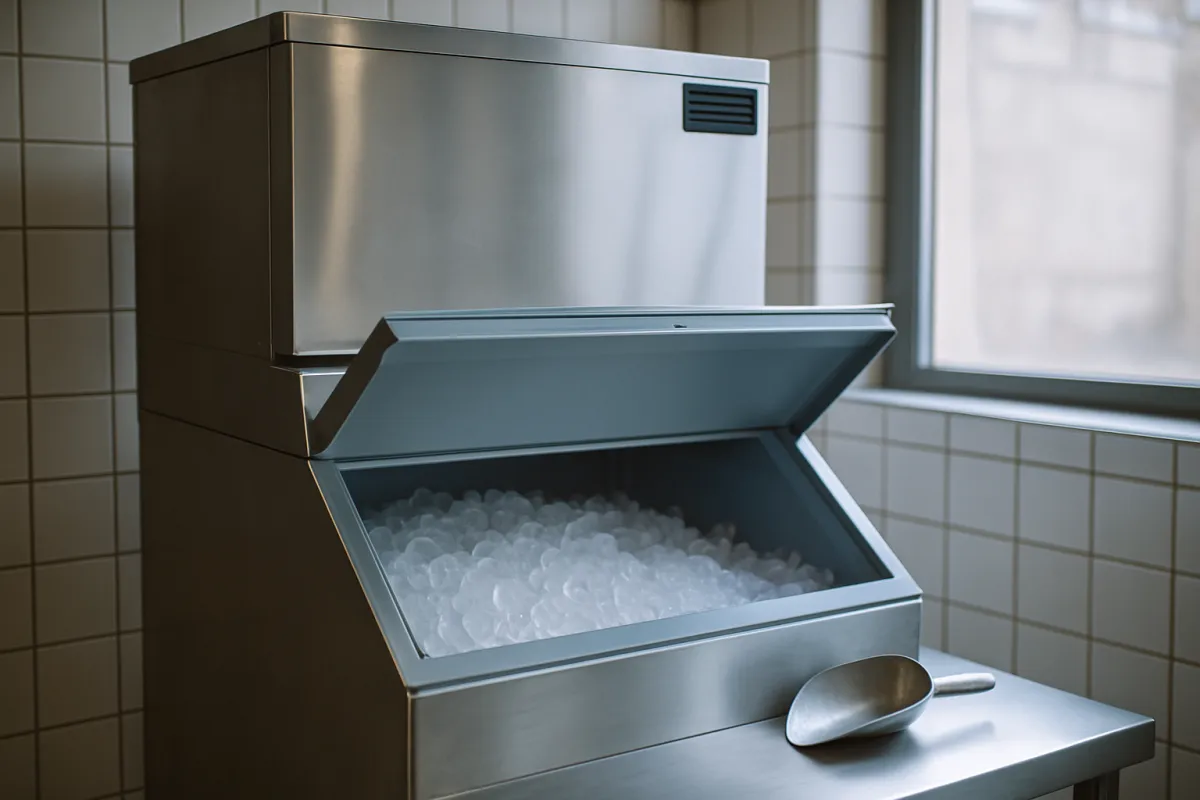
Three physical arrangements cover almost everything sold. A modular head is a machine that makes ice and nothing else, designed to sit on top of a separately purchased storage bin or a dispenser. It is the standard arrangement above roughly two hundred pounds a day, because it lets you match production capacity and storage capacity independently and replace either one without the other.
A self-contained unit combines the ice-making machinery and a small storage compartment in one cabinet, usually undercounter height so it slots into a bar or service counter. It costs more per pound of daily production than a modular head of similar rating, because you are paying for the integration and the packaging, and its storage is limited by definition. In exchange it fits where a modular stack cannot and installs as a single appliance.
A countertop dispenser is the third case: a compact machine that makes a modest amount of ice and delivers it, often with chilled water, through a lever or a touch-free outlet. These suit self-service areas, waiting rooms, and small front-of-house applications where guests take their own ice. They are the smallest capacity and the highest cost per pound of production, justified by placement rather than economics, the same logic our commercial kitchen equipment case study applies to any fixture sized by where it sits.
The bin is a separate purchase
The most commonly missed line in an ice budget is the bin. A modular head is not a complete machine, it is half of one, and the other half is an insulated storage box sized in pounds of ice held. Illustratively, bins commonly price in the region of three dollars per pound of storage capacity, so a 400-pound bin lands near $1,300 and a 700-pound bin near $2,300, with heavier build and larger door hardware moving the figure.
A bin is insulated but not refrigerated, and understanding that changes how you size it. Ice sitting in a bin melts slowly and the meltwater drains away, so a bin is a buffer against peak draw rather than a place to accumulate inventory. Every pound you store overnight is a pound that partially melts, and machines fitted with a bin level control simply stop harvesting when the bin fills, which is exactly what you want.
The common planning rule is that the bin should hold somewhere around half to two-thirds of the machine’s daily production, enough to cover the peak service period while the machine keeps producing. Undersizing the bin on a correctly sized machine produces the same symptom as undersizing the machine: you run out during service. Oversizing it wastes money and floor space on storage that melts.
Ice shapes and why they matter commercially
Ice shape is a commercial decision, not an aesthetic one, and it is the variable that most changes both the machine price and the customer experience. Cube ice, in full and half formats, is the general-purpose commercial shape. It is dense and hard, it melts slowly, it displaces liquid predictably in a glass, and it holds up in a bag, which makes it the default for spirits, mixed drinks, bagged retail sale, and anything that needs to sit in a cooler.
Nugget ice, sometimes called chewable or pellet ice, is made by compressing flaked ice into soft cylinders. It is softer, chews easily, cools a drink faster because of its surface area, and displaces more volume per pound in a cup. It is the standard in healthcare settings for exactly the chewability reason, and it has an outsized following in soft-drink and fast-casual service.
Flake ice is soft, irregular, and made without compression. It packs around irregular shapes, which is why it lives on seafood counters, produce displays, and salad bars, and why it is used for blending applications. It melts fastest of the three, so it is a display and process ice rather than a beverage ice. Choose the shape from the job first, then price the machine, because the shape sets the class you are shopping in.
Nugget ice and the preference premium
Nugget ice deserves its own line because the market prices it differently. A nugget head costs noticeably more than a cuber head of the same rated daily production, illustratively around $4,800 against $3,600 at a 350-pound rating, because the mechanism is more complex: the machine makes flaked ice and then extrudes and compresses it, which is more moving parts doing more work.
The counterargument is customer preference, and it is genuinely strong. Operations that switch to nugget ice frequently report that customers notice and comment, which is unusual for any back-of-house equipment decision. In some formats, cups of ice and refills become a small revenue item in their own right. That preference is why the premium survives.
Two honest caveats keep this from being a blanket recommendation. Nugget ice is softer and less dense, so it melts faster in a drink and a pound of it fills more cup volume, which means you pour less beverage per cup and use more pounds per day for the same service. And nugget machines have more mechanical parts in the ice path, which means more to service over a decade. Price the premium against your own service format, and test the whole ten-year figure in the equipment ROI calculator rather than the sticker alone.
Flake ice and display duty
Flake ice machines are priced on a different logic again. Because flake requires no compression and no individual cube formation, a flake head commonly produces more pounds per dollar of machine than a cuber of similar physical size, illustratively around $5,200 for a 500-pound rating. That looks like a bargain until you notice that flake ice is the least useful ice for a drink.
Its real job is contact cooling. Flake packs tightly around fish, shellfish, and produce, holds them at temperature without bruising, and looks the part on a display counter. A seafood counter, a market-style produce display, or a raw bar consumes flake ice continuously and refreshes it daily, so the machine runs hard and the demand is genuinely large.
That continuous consumption is the thing to budget honestly. A display that is rebuilt every morning throws away yesterday’s ice, so annual pounds produced can be far higher than a beverage program of the same size, which lifts the electricity and water lines rather than the purchase price. If your operation needs both flake for display and cube or nugget for drinks, that is two machines, and pretending one machine can serve both jobs is a decision you will revisit inside a year.
Air-cooled, water-cooled, and remote condensers
Every ice machine has to reject the heat it removes from the water, and how it does that is the biggest single fork in the specification. Air-cooled is the default: a fan pulls room air across a condenser coil and blows the heat back into the kitchen. It is the cheapest to buy, the simplest to install, and it needs only clearance and a clean coil. It is also the option whose output falls the most in a hot room, and the heat it dumps becomes an air-conditioning load somewhere else in the building.
Water-cooled rejects heat into potable water instead, which keeps the kitchen cooler, the noise lower, and the production stable regardless of room temperature. The trade is water. A single-pass water-cooled condenser sends that water to the drain continuously while the machine runs, which can multiply the machine’s water consumption several times over. For that reason, single-pass water-cooled ice machines are restricted or discouraged in some jurisdictions on water-conservation grounds. This varies by location and changes over time, so confirm with your local building authority and water utility before specifying one.
A remote condenser puts the condensing unit outside the building or on the roof, connected by refrigerant lines, so heat and noise leave the kitchen entirely without consuming water. It is the strongest technical answer for large machines and hot kitchens, and the most expensive to install, because you are paying for a line run, mounting, weatherproofing, and often permitted work. Illustratively, remote installation commonly runs a substantial multiple of a simple air-cooled setup.
What the installation actually needs
An ice machine is one of the few pieces of kitchen equipment that needs three services at once, and that is why the install line is larger than operators expect. It needs a potable cold water supply, ideally with a shutoff and a filter head within reach. It needs a drain, usually an indirect drain with an air gap so nothing can siphon back into a machine holding food, and often two drains, one for the machine and one for the bin.
It needs power, commonly a dedicated circuit, and larger machines may need a heavier supply than a standard outlet provides. And it needs clearance, because an air-cooled unit that cannot breathe is a machine working against its own exhaust. Boxing a machine into a cabinet run without the manufacturer’s stated clearance is a reliable way to cut production and shorten the machine’s life at the same time.
Illustratively, a straightforward air-cooled install in a space with water, drain, and power already nearby commonly runs somewhere around fifteen to twenty percent of the machine price. A space with no drain in the right place, a long water run, or a panel that needs work runs considerably more, and a remote condenser installation is a different order of job entirely. Get the site walked before you accept an equipment quote as a project cost.
Water filtration is an operating requirement, not an upsell
If there is one section of this case study worth acting on, it is this one. Municipal water carries dissolved minerals, and when water freezes those minerals do not go into the ice, they concentrate in what remains and plate out as hard scale on the evaporator. The evaporator is the precision surface the entire machine is built around, and scale on it is not cosmetic.
The damage chain is mechanical. Scale insulates the evaporator, so heat moves out of the water more slowly, so the freeze cycle lengthens. Longer cycles mean fewer pounds per day and more kilowatt-hours per pound, so you get less ice and pay more for it. As the deposit thickens, cubes stop releasing cleanly, ice bridges across the grid, and the machine jams. Scale is commonly described in the trade as the leading cause of premature ice machine failure, and it is entirely preventable.
Filtration is therefore an operating requirement with a running cost, not a one-time accessory. A filter head and cartridge system commonly runs a few hundred dollars installed, with replacement cartridges on a schedule set by gallons or by months, illustratively a few hundred dollars a year. Very hard water may justify a softener or a reverse-osmosis stage ahead of the filter, which is a larger investment with a larger payoff. Read your warranty carefully, because coverage is often conditioned on documented treatment and cartridge changes, and skipping them can cost you the compressor claim as well as the machine.
Cleaning and sanitising cadence
Ice is a food. The machine that makes it, the bin that holds it, and the scoop that moves it are all food-contact surfaces, and they are treated that way by health inspectors. That reframing is the reason cleaning cadence belongs in a cost case study rather than in a maintenance appendix.
The job is two chemicals used in sequence and never mixed. A scale remover, typically acidic, strips mineral deposits from the evaporator and the water path. A sanitiser then addresses slime and biofilm, which grow in the bin, on the splash surfaces, and around the door seal, and which are visible as coloured film long before anyone complains. Manufacturers commonly specify the full cycle at least twice a year, and many operations run it quarterly or more often on hard water or in a warm, humid room.
Budget it as labour or as a service call. Illustratively, cleaning and sanitising commonly costs somewhere around a tenth of the machine price per year once you count chemicals and either staff time or a technician visit. Requirements and inspection practice are set by your local health department and vary, so confirm the cadence they expect and the records they want to see rather than assuming the manufacturer’s minimum satisfies them.

What it costs to run an ice machine per year
Running cost has four components and they are easier to reason about per hundred pounds of ice than per year. Electricity comes first, and ice machines are conveniently rated in energy per hundred pounds produced, commonly landing in a range that works out to roughly a dollar of electricity per hundred pounds at typical rates once the bin and ancillaries are included. Nugget and flake machines and very small units sit differently, and your own rate moves everything.
Water comes second, and it is larger than people expect because a machine uses potable water both to make the ice and to purge mineral-laden water from the sump. Illustratively, that works out to somewhere around thirty-five cents per hundred pounds on typical combined water and sewer rates for an air-cooled machine. A single-pass water-cooled condenser can multiply that figure several times over, which is the whole water-cooled trade in one line.
Filter cartridges come third, illustratively a few hundred dollars a year on a mid-size machine. Cleaning, sanitising, and routine service come fourth, and together they are usually the largest recurring line after electricity. Put those on an illustrative mid-size setup producing three hundred pounds a day and the annual figure lands near $2,730: about $1,100 of electricity, $380 of water and sewer, $300 of filter cartridges, $500 of cleaning and sanitising, and $450 of service and parts.
Where the ten-year ice dollar goes
Now follow one machine through a decade instead of an invoice. Take an illustrative modular cuber head rated at 500 pounds a day at $5,000, a 400-pound bin at $1,300, and a filtration system at $500, so $6,800 of equipment. Installation for a straightforward air-cooled setup is around $900, putting the up-front total at $7,700. Running cost at $2,730 a year comes to $27,300 over ten years, and the whole decade lands near $35,000.
Where the ten-year cost of an ice machine goes
Illustrative 500 lb/day modular cuber, 400 lb bin, filtration, producing 300 lb a day. Shares of about $35,000 total.
The machine, the bin, and the filtration together are nineteen percent of the decade. Everything else is what it costs to keep making ice.
That split is the argument of this whole case study in one picture. An operator choosing between two machines on a several-hundred-dollar price difference is arguing about a slice of the smallest segment, while the condenser choice, the water hardness, the room temperature, and the cleaning discipline move the three larger segments. Compare that shape to the equivalent picture in our commercial freezer case study, where energy dominates but the unit still carries a third of the total, and the difference between the categories is clear.
Cost per hundred pounds of ice
Because ice machines differ in shape, capacity, and condenser type, the only clean way to compare them is cost per hundred pounds of ice produced over the machine’s life. Take the illustrative setup above: $35,000 over ten years, producing three hundred pounds a day. That is 1,095,000 pounds, or 10,950 hundred-pound units, and about $3.20 per hundred pounds.
That single number does several useful things at once. It makes a nugget machine comparable to a cuber even though they cost different amounts and produce different volumes. It exposes the operation that bought a thousand-pound machine and uses two hundred pounds a day, because the fixed costs spread over far fewer pounds and the per-hundred figure climbs sharply. And it makes the water-cooled and remote condenser decisions quantitative rather than a matter of preference.
It also reframes the sizing question. Buying more capacity than you use raises your cost per hundred pounds, and buying less than you need costs you service failures on your busiest days. The right size is the one that meets your peak with modest headroom, and the per-hundred-pound figure is the scoreboard that tells you when you have overshot. Run your own volume through the companion beside this case study and it will do that arithmetic on your figures.
Making ice versus buying it bagged
With a per-hundred-pound figure in hand, the make-or-buy comparison becomes simple. Delivered bagged ice is priced per bag and works out per hundred pounds at a substantial multiple of what self-produced ice costs, because you are paying for the manufacture, the packaging, the freight, the delivery frequency, and someone else’s margin. Rates vary widely by market, volume, and season, so price your own rather than trusting a figure from an article.
For an operation using real volume daily, the arithmetic is not close, and that is why nearly every foodservice operation of any size makes its own ice. At three hundred pounds a day, the illustrative all-in cost of self-production works out to roughly $3,500 a year including the amortised machine, and a delivered equivalent typically runs a multiple of that.
Bagged ice still wins in specific situations, and they are worth naming honestly. Very low or highly seasonal volume, where a machine sits idle most of the year. A space with no practical water supply or drain. A temporary or event site. And backup, because a delivery relationship is what keeps you open the day the machine fails. The realistic answer for most operators is both: own the production, keep the phone number.
Sizing to your menu and your peak day
Sizing is where the money is made or lost in this category, and it is done in four steps. Estimate your daily ice pounds from your service, using the trade’s common planning rules of thumb as a starting point rather than a standard, since a restaurant with a fountain drink program, a bar, and a hotel with guest ice all consume very differently per seat or per room. Then adjust for what your menu actually does with ice, because iced beverages, blended drinks, and display ice are wildly different loads.
Second, size to the peak day rather than the average day, because running out on a Saturday costs more than the machine ever will. Third, apply the derate from the production rating section, so the machine you specify meets your peak at realistic room and water temperatures rather than at the test condition. Fourth, size the bin as a buffer for the peak service period, not as a place to accumulate a week of ice.
Those four steps together explain why undersizing is so common. Each one on its own is a small optimism, and stacked they produce a machine that meets the brochure and misses the service. Our restaurant equipment list covers where ice production sits relative to everything else in a kitchen build, and the companion beside this case study will turn your own daily pounds into a class and a bin size.
What drives the price inside a class
Once the class and shape are settled, a short list of variables sets the price inside them. Rated capacity comes first and moves the number most. Ice shape comes second, with nugget and specialty formats commanding a premium over cube at the same rating. Condenser type comes third, with water-cooled and remote variants of the same head priced differently and installed very differently.
Build quality is next, and in ice machines it shows up in specific places: the gauge and finish of the stainless, the quality of the evaporator plating, the water pump and float or sensor arrangement, the controls, and how easily the machine comes apart for cleaning. That last one is worth paying for, because a machine that is quick to clean actually gets cleaned on schedule and a machine that is a two-hour job does not.
Then come the features that touch running cost rather than purchase price: energy efficiency rating, water use per hundred pounds, antimicrobial surface treatments in the ice path, and diagnostics that flag a scaling problem before it becomes a failure. Those attack the seventy-plus percent of the ten-year figure that is not the machine, which is why they are usually worth more than the same money spent on capacity you do not need.
New versus used ice machines
Used ice machines are a genuinely mixed category and deserve more caution than used stainless. The cabinet and the bin are durable and cheap to refurbish. The refrigeration system, the water pump, and above all the evaporator are wear items, and the evaporator is the part whose condition determines whether the machine makes clean ice at rated output or slowly disappoints you.
The specific risk is history you cannot see. A machine that ran for five years on untreated hard water carries scale damage and possibly plating damage on the evaporator, and neither is visible from the front. A machine that sat unused and undrained can carry biofilm in the water path. A used ice machine without a service record is therefore a different proposition from a used prep table, and the price should reflect that.
The reasonable middle ground is a refurbished unit from a dealer who documents what was replaced, ideally including the evaporator condition, the water pump, and the cleaning history, with some warranty attached. Our used versus new equipment case study runs the cost-per-working-year math that decides these calls, and it applies with extra force here because a failed ice machine on a hot Saturday costs a service you cannot deliver.
Renting or subscribing instead of buying
Ice machines are one of the few kitchen categories with a genuine rental and subscription market, and it exists because the ownership burden in this category is unusually heavy. A typical arrangement bundles the machine, the bin, the filtration, the scheduled cleaning, the cartridge changes, and the service response into a single monthly fee, so a failure becomes someone else’s problem rather than a closed bar.
Illustratively, a mid-size modular setup on a rental or subscription arrangement commonly runs somewhere in the low-to-mid hundreds of dollars a month. Compare that to the owned equivalent: on the figures above, the amortised capital plus filtration cartridges, cleaning, and service comes to roughly $2,000 a year, so a rental at $350 a month is around double the owned equivalent per year. Electricity and water sit on your bill either way.
Owning is therefore cheaper over a decade, and renting is cheaper on day one while transferring the failure risk and the maintenance discipline to a contractor. Which is right depends on the same question that decides every equipment financing call: whether cash or risk is your binding constraint. Our lease versus buy case study and our restaurant equipment financing case study run both sides of that comparison in detail.
Warranty, the evaporator, and what actually fails
Warranty structure in refrigeration tells you where the manufacturer thinks the risk lives, and in ice machines the terms usually single out two components: the compressor and the evaporator. That is a useful signal, because those are the two expensive failures. Read the length of each, whether labour is included, who performs the work, and what response time is promised.
Read the conditions with equal care. Ice machine warranties commonly require documented water treatment and cleaning at the specified intervals, and a claim can be declined where scale damage is evident and no treatment record exists. That clause is the reason the filtration section of this case study is not optional advice: skipping a few hundred dollars a year of cartridges can void coverage on a several-thousand-dollar component.
Beyond the factory warranty, a service contract converts unpredictable risk into a predictable annual line. Whether that is a good trade depends on what the machine supports. A countertop dispenser in a waiting room can run to failure. A single machine that supplies every drink in a busy bar is exactly where a contract with a guaranteed response time earns its cost, because the alternative is buying bagged ice at retail in an emergency while the service suffers.
Permits, health code, and equipment listing
Requirements here are set locally and vary, so treat this section as a list of questions to ask rather than a set of answers. Commercial food equipment is commonly expected to carry listing to a recognised sanitation standard, and NSF listing is the one most often referenced for ice machines, but what is actually required and how it is enforced is a local matter.
The installation touches plumbing and electrical work, and in many places that means permits, licensed trades, and inspection. The drain arrangement in particular attracts attention, because an indirect drain with a proper air gap is a backflow protection measure on a machine producing food. A remote condenser adds refrigerant line work and exterior or rooftop mounting, which raises the odds of a permitted job considerably.
Then there is the health department’s ongoing interest. Ice machines are inspected as food equipment, cleaning records may be requested, and the scoop, its storage, and the bin lid all fall inside the inspection. Water-use restrictions on single-pass water-cooled equipment are also set locally and change over time. Confirm all of it with your local health department and building authority before you order, because a machine that has to be relocated or replumbed after inspection is expensive in a way that no quote anticipated. Our commercial kitchen requirements article covers the wider plan-review posture this sits inside.
Dispensers, bagging, and how ice reaches the glass
How ice gets from the bin to the customer is a cost and a food-safety decision that rarely appears in a quote. The default is a scoop, which is cheap and works, and which requires a designated scoop holder outside the bin, a written rule about hands, and a habit of never leaving the scoop buried in the ice. Inspectors look at exactly this.
The alternatives cost money and buy something back. A dispensing head on top of the bin delivers ice into a cup without a scoop, which improves both hygiene and speed at a drink station and adds to the equipment line. A combined ice and beverage dispenser integrates the two at a self-service counter. Touch-free dispensing reduces contact further and is worth pricing where guests serve themselves.
Bagging is the third route, relevant to any operation that sells ice or moves it to another site. A bagging arrangement adds equipment, labour, and frozen storage to hold the bags, so it is a small operation in its own right rather than an accessory, and it needs the frozen storage priced separately in our commercial freezer case study. Decide the delivery method during specification, because retrofitting a dispenser onto a bin you already bought is usually a second purchase.
A worked example: a cafe and a full-service restaurant
Put the framework on two illustrative operations at opposite ends. First a cafe using around fifty-five pounds of ice a day for iced drinks. A self-contained undercounter unit rated near ninety pounds a day at $2,600, filtration at $400, and a straightforward install at about $470 puts $3,470 up front. Running cost is roughly $200 of electricity, $70 of water, $240 of cartridges, $260 of cleaning, and $234 of service, about $1,005 a year. Ten years lands near $13,500, or roughly $6.70 per hundred pounds of ice, which is high because a small machine’s fixed costs spread over few pounds.
Now a full-service restaurant using three hundred pounds a day across the bar, the service well, and the kitchen. A 500-pound modular cuber head at $5,000, a 400-pound bin at $1,300, filtration at $500, and installation at $900 puts $7,700 up front. Running cost is about $2,730 a year, so $27,300 over the decade, and the ten-year total is near $35,000, or about $3.20 per hundred pounds.
The gap between the two per-hundred-pound figures is the real lesson. The restaurant spends more than twice as much in total and less than half as much per pound, because scale spreads the fixed costs of filtration, cleaning, and service across far more ice. That is the same logic our commercial refrigeration case study draws about cost per cubic foot, and it is why the per-unit figure, not the sticker, is the honest comparison in both categories.
The bottom line
What does a commercial ice machine cost? Illustratively, a countertop dispenser around the low four figures, an undercounter self-contained unit somewhat above, a mid-size modular cuber head in the mid four figures, a nugget head noticeably higher at the same rating, and a large modular head approaching five figures. Then add a bin, add filtration, and add an installation that needs water, a drain, power, and clearance, and the equipment line grows well past the head price.
The more useful answer is that the machine is often the cheapest part of the decision. On an illustrative decade, the machine, the bin, and the filtration together are around a fifth of the total, and electricity, water, cleaning, and service carry the rest. Judge ice production on cost per hundred pounds over its life, and the ranking of options frequently changes.
Operators who buy ice well do four things. They size to the peak day and derate the headline production rating, because undersizing is the failure mode of this category. They choose the ice shape from the job rather than from the price list, and pay the nugget premium only where the service format earns it back. They treat water treatment and a cleaning calendar as operating requirements, because scale is preventable and warranty conditions usually say so. And they decide the condenser type with the local water rules, the room temperature, and the installation cost all on the table at once. Place ice inside the whole build with our commercial kitchen equipment case study, compare it against the cold storage either side of it in our commercial freezer case study, and run your own volume through the equipment ROI calculator so the number arrives before the invoice does.
Written for the operator pricing ice production rather than for anyone moving a machine off a showroom floor: this case study is educational material, not financial, tax, legal, engineering, plumbing, or food-safety advice, and it names no brand, dealer, model, installer, or lender. Every purchase band, capacity rating, utility estimate, service figure, and per-hundred-pound calculation printed here is an illustrative sketch built to show how the category is priced and operated, and your real number comes from a quote against your actual volume, water conditions, kitchen temperature, and utility rates. Sanitation listing expectations, plumbing and backflow requirements, permitted work, inspection practice, cleaning records, and any restriction on single-pass water-cooled equipment are decided by your local health department, building authority, and water utility, and they change over time, so ask them directly before you order, and put a licensed refrigeration contractor, a licensed plumber, and a qualified professional between you and any purchase, installation, or financing you commit to.
Frequently asked questions
How much does a commercial ice machine cost?
Illustratively, a countertop ice and water dispenser commonly runs around the low four figures, an undercounter self-contained unit somewhat above that, a mid-size modular cuber head in the mid four figures, a nugget or flake head noticeably higher for the same rated output, and a large modular head approaching five figures. The head is only part of the purchase, because a modular machine needs a storage bin underneath it and both need water treatment, so the equipment line is commonly a third to a half above the head price alone. What separates this category from most stainless in a kitchen is that the machine is often the cheapest part of the ten-year number. Treat any single figure as a planning shape and get a quote on the actual class, capacity, and water conditions you are buying into.
Why is the daily production rating higher than what I actually get?
Headline daily production figures are quoted at a standard test condition with cool ambient air and cool incoming water, and a commercial kitchen is neither of those things. An ice machine makes ice by rejecting heat, so hotter room air and warmer supply water both slow the harvest cycle and cut the pounds produced in twenty-four hours. Real output in a hot kitchen in summer is commonly cited as falling meaningfully below the rating, which is why undersizing is the most common mistake buyers make in this category. Ask the supplier for the production figures at the warmer test condition, not just the headline number, and size against the warmer one.
Does an ice machine come with a bin?
A modular head does not. It is a machine that makes ice and drops it into whatever sits beneath it, so the bin is a separate purchase sized in pounds of storage and commonly adding a meaningful amount to the equipment line. A self-contained undercounter unit does include its own small storage compartment, which is part of why it costs more per pound of daily production than a modular head of similar capacity. Dispensers are a third case, holding a modest amount of ice internally and delivering it through a chute or a touch-free outlet. The bin is the single most commonly forgotten line in an ice machine budget, so price the head and the bin together from the start.
Should I choose air-cooled, water-cooled, or a remote condenser?
Air-cooled is the cheapest to buy and the simplest to install, but it rejects the machine's heat into the room, which raises kitchen temperature, adds an air-conditioning load, and cuts the machine's own output in a hot space. Water-cooled removes that heat with potable water instead, which keeps the kitchen cooler and the output stable, but it consumes water continuously and single-pass water-cooled ice machines are restricted or discouraged in some jurisdictions for water conservation reasons. A remote condenser puts the heat and the noise outside the building entirely and suits large machines and hot kitchens, at a higher installed cost because of the refrigerant line run and the mounting work. Confirm what your local building and health authorities allow before you commit, because the water-cooled option is the one most likely to be limited.
Do I really need a water filter on an ice machine?
Water treatment on an ice machine is an operating requirement rather than an accessory upsell, because dissolved minerals in the supply water plate out as scale on the evaporator, which is the surface the whole machine is built around. Scale insulates that surface, lengthens the harvest cycle, cuts production, raises energy use per pound, and eventually causes ice to bridge and the machine to fail, and it is commonly described as the leading cause of premature failure in this category. Filtration also handles sediment and taste, which matters because ice is a food that goes straight into a customer's drink. Many warranties condition coverage on documented water treatment and cartridge changes, so read those terms before you decide to skip it.
How often does a commercial ice machine need cleaning?
Manufacturers typically specify a full cleaning and sanitising cycle at least twice a year, and many operations run it quarterly because ice is a food and the machine and bin are food-contact surfaces. The job is two distinct chemicals used in sequence, a scale remover to strip mineral deposits from the evaporator and a sanitiser to deal with slime and biofilm in the bin and the splash zone, and they are never mixed. Health inspectors do look at ice machines, and a visibly dirty bin is a finding rather than a housekeeping note. Cleaning frequency and requirements are set locally, so confirm with your health department and follow the manufacturer's stated procedure for the machine you own.
What does it cost to run a commercial ice machine per year?
Illustratively, a mid-size modular setup producing around three hundred pounds a day might run somewhere near eleven hundred dollars a year in electricity, a few hundred in water and sewer, a few hundred more in filter cartridges, and several hundred each in cleaning and routine service, landing in the region of two to three thousand dollars a year all in. The exact figure turns on your electricity and water rates, how hard your water is, how hot the room runs, and how many pounds you actually make rather than the machine's rating. Over a decade the running side commonly comes to several times the purchase price of the machine itself. Confirm your own utility rates on a recent bill rather than assuming an average.
Is it cheaper to make ice or buy it bagged?
For any operation using ice daily in real volume, making it is normally far cheaper per pound once the machine is installed, because the marginal cost of a hundred pounds of ice is electricity, water, and a share of filtration and service rather than a delivered product with packaging and freight in it. Bagged ice delivery is commonly quoted per hundred pounds at a multiple of what self-produced ice costs, though rates vary widely by market and volume, so price your own. Bagged ice still wins in specific cases: very low or seasonal volume, a space with no room or no water and drain access, a temporary site, and as backup when a machine fails. Most operations end up doing both, making their own and keeping a delivery relationship for peaks and outages.