
What's on this page
- The short answer, and why the range is so wide
- Average restaurant opening cost, in context
- Cost to open a restaurant by type
- Opening a small restaurant on a tighter budget
- Fast food and quick service budgets
- The startup cost line items that matter
- Lease and rent, deposits, and the space you sign
- Buildout and renovation
- Kitchen equipment
- Furniture, POS, and the technology stack
- Licenses, permits, and insurance
- Buy vs lease vs franchise
- Leasing versus buying your equipment
- The biggest cost drivers
- Where restaurant startup money goes
- Ongoing monthly costs
- How much cash you really need on hand
- Financing a restaurant
- Whether the restaurant math pays off
- How to reduce restaurant startup costs
- A worked example: one small full-service restaurant
- The bottom line
Ask what it costs to open a restaurant and the honest answer is that it depends more on the format and the space than on any single number, with a food truck opening in the high tens of thousands, a small quick-service spot in the low-to-mid six figures, a full-service restaurant in the mid-to-high six figures, and fine dining reaching seven figures, illustratively. All of those figures can be right at once, which is exactly why the question resists a clean reply. The commercial range everyone pictures, the ovens and the dining room, is real, but the buildout, the rent, and the cash cushion you need to survive the first slow months usually dwarf the appliances.
This rundown prices the whole thing, type by type and line by line: the spectrum from a food truck to a fine-dining room and why the range is so wide, the buildout that is often the largest single cost, the kitchen equipment line, the lease and its deposits, licenses and permits, insurance, furniture, the point-of-sale system, initial inventory, signage, pre-opening labor, and the working capital runway that first-timers underfund more than any other line. It sits alongside our smaller-format siblings on the cost to open a coffee shop and the cost to start a food truck for the lower end of the range, and you can run your own opening budget as you read with the equipment ROI calculator.
Key takeaways
- Format and size decide almost everything. A food truck can open in the high tens of thousands, a small quick-service spot in the low-to-mid six figures, a full-service restaurant in the mid-to-high six figures, and fine dining in seven figures, illustratively.
- For most fixed-location restaurants the buildout, not the equipment, is the largest single line, and a former restaurant costs far less to convert than a bare shell.
- Kitchen equipment is a real and large line, usually second to buildout, and leasing it can preserve the cash a young restaurant survives on.
- Working capital, the runway to survive months of losses before break-even, is the most underfunded line and a leading cause of early closure.
- Restaurants can be profitable, but margins are typically thin, so the plan has to survive on volume and cost control, not on an optimistic ramp.
The short answer, and why the range is so wide
How much does it cost to open a restaurant? Whatever the format and the size demand, and the spread is enormous because those two variables set the scale of every other line. A food truck skips the dining room and most of the rent, a small quick-service counter carries a modest buildout and a compact kitchen, a full-service restaurant pays for a large room, a full commercial kitchen, and the staff to run both, and a fine-dining establishment layers a premium buildout, a deep equipment list, and a large payroll on top of all of it. The same word, restaurant, covers businesses that differ by more than an order of magnitude in what they cost to open.
The reason a single average misleads is that the format is not a small adjustment, it is a different balance sheet. Moving from a truck to a full-service room is not a bigger version of the same purchase, it is a lease, a construction project, a larger crew, and a longer runway. Before pricing a single line item, the most useful thing you can do is decide which format and roughly what size you are actually building, because that decision sets the scale of the total. Run your own type and square footage through the companion beside this rundown, and the wide range collapses into a single planning number for the restaurant you have in mind.
Average restaurant opening cost, in context
Commonly cited averages for a full-service restaurant land in the mid six figures, but the average hides a spread so wide that quoting it without context does more harm than good. A small cafe or a quick-service counter can open for well under that figure, while a large fine-dining room in an expensive market can cost several times more, and both are ordinary restaurants. The national average is a starting ballpark, not a budget, because it blends formats and markets that have almost nothing in common on cost.
What actually drives your number sits below the average: the square footage you lease, how much construction the space needs to become a working kitchen and dining room, the local rent, and the depth of the menu and the equipment it requires. Two restaurants with the same concept can differ by a factor of two depending on whether one inherited a former restaurant’s kitchen and the other converted a bare retail box. Treat the average as a sanity check on the order of magnitude, then build the real number from the buildout, the equipment, and the runway your own space and menu demand. The companion beside this rundown does exactly that, turning your type, size, and buildout level into an illustrative range you can plan against.
Cost to open a restaurant by type
Put the formats on one axis and the point makes itself: the total to open spans a range so wide that an average is close to meaningless. The chart below sketches illustrative all-in figures, meaning everything it takes to open the doors including a working capital cushion, across four common restaurant types. These are planning shapes, not quotes, and a specific project can land well outside them depending on the lease, the market, and how much construction the space needs.
Illustrative startup cost by restaurant type
All-in cost to open, including a working capital cushion. Shape, not a quote.
Fine dining can cost more than ten times a food truck, and the gap is almost entirely buildout, room, and payroll, not the ovens. Pick the type first, then price its lines.
The takeaway is not the exact figures, it is the shape. A commercial range or a walk-in cooler costs roughly the same whether it sits in a small quick-service kitchen or a fine-dining line, yet the total to open varies by an order of magnitude, which tells you the equipment is not where most of the money goes. It goes into the room and the runway. A food truck is the lowest rung on this ladder, and our cost to start a food truck rundown prices that entry point in full for anyone testing a concept before committing to a lease.
Opening a small restaurant on a tighter budget
A small restaurant, meaning a compact quick-service counter, a small cafe, or a limited-menu spot in a modest space, commonly opens in the low-to-mid six figures, illustratively. The smaller footprint cuts several lines at once: less square footage to build out, a shorter equipment list, fewer tables and chairs, and a smaller opening crew. Because size drives the buildout, the rent, and the payroll together, shrinking the footprint is one of the most effective ways to lower the total cost to open without cutting anything customers value.
Going smaller still drops the entry cost further. A takeout-only or ghost-kitchen concept skips the dining room entirely, and a food truck trades the fixed lease for a mobile build and a commissary. Our cost to open a coffee shop rundown prices the smallest fixed-location formats, from a cart to a full cafe, and it is a useful sibling for anyone weighing a compact food concept against a full restaurant. Whatever the size, the discipline holds: price the buildout and the working capital runway first, because a small restaurant that underfunds its cash cushion closes just as surely as a large one that overspends on finishes.
Fast food and quick service budgets
An independent fast-food or quick-service restaurant commonly opens in the low-to-mid six figures, illustratively, with the number driven by the kitchen the menu requires and whether the location includes a drive-through. Quick-service carries a smaller dining room than full-service, which trims the furniture and the floor space, but the kitchen can be equipment-heavy: fryers, griddles, holding equipment, and the ventilation to support them all add up, and a drive-through adds its own construction and technology line. The trade is a leaner front of house against a potentially dense back of house.
A franchise is a different calculation. Buying into a national brand adds an upfront franchise fee, a buildout and equipment package built to the brand’s exact standards, and ongoing royalties and marketing fees as a share of sales, which can push the all-in cost well above an independent quick-service spot. In exchange you get a proven system, brand recognition, and a supply chain, which lowers some of the risk that an independent carries alone. The honest way to price either path is on its specifics, meaning the franchise disclosure document for a brand or the actual buildout quote for an independent, rather than a category average. The equipment side of that kitchen is worth pricing carefully with our commercial kitchen equipment cost rundown before the buildout is finalized.
The startup cost line items that matter
Zoom in on the individual lines and a restaurant budget resolves into a familiar list. The lease deposit and first month of rent come due before you hold the keys. The buildout or renovation converts the space into a working kitchen and dining room. The kitchen equipment package, from the cooking line to refrigeration, is the heart of the operation. Furniture and fixtures fill the dining room, and the point-of-sale and technology stack let the restaurant transact. Initial food and beverage inventory stocks the shelves, licenses and permits make it legal, insurance covers the risk, signage draws the customers, and pre-opening labor pays the crew through training before there is any revenue.
Underneath all of those sits the working capital runway, the cash cushion that carries the restaurant from an empty opening week to break-even. For most fixed-location restaurants the buildout is the largest single line, the kitchen equipment is second, and the working capital runway rivals both, while the smaller lines together form a share as large as any one of them. The surprise for many first-timers is how much of the total lives outside the visible equipment, in the construction that converts the space and the cash that keeps the doors open through the ramp. The sections that follow price each of these lines in turn, starting with the lease that anchors them all.
Lease and rent, deposits, and the space you sign
Rent is a monthly cost, but opening a restaurant front-loads a chunk of it into the startup budget through deposits and the gap before revenue arrives. A commercial lease commonly requires a security deposit, often one to several months of rent, plus the first month up front, and sometimes a personal guarantee from the owner. Many restaurant leases are triple net, meaning the tenant also pays a share of the property taxes, insurance, and common area maintenance on top of the base rent, which can lift the true monthly figure well above the number a first-timer budgeted from the base rate alone.
The lease also shapes every other line in the budget. The condition of the space decides the buildout, so a former restaurant with a kitchen already in place can cost a fraction of a bare shell to open. The length of the buildout period before you can serve means more months of paying rent on a space that earns nothing, which is why a free-rent construction period is worth negotiating hard. The location drives foot traffic and therefore how fast you reach break-even, so a cheap rent in a dead spot can cost more than a higher rent where customers already walk by. Read the lease with the buildout and the runway in the same view, because the rent you sign for sets the monthly burn the working capital has to cover.
Buildout and renovation
For any fixed-location restaurant, the buildout, meaning the leasehold improvements that turn a bare space into a working kitchen and dining room, is usually the largest single cost, and it is the one that varies most between two spaces that look identical from the sidewalk. Plumbing for the sinks and the dish area, electrical heavy enough for the equipment, HVAC, a commercial ventilation hood and fire suppression over the cooking line, a grease trap, code-compliant flooring and surfaces, the dining room finishes, and often a bar all land here. None of it is optional, and all of it is priced by contractors, not by you.
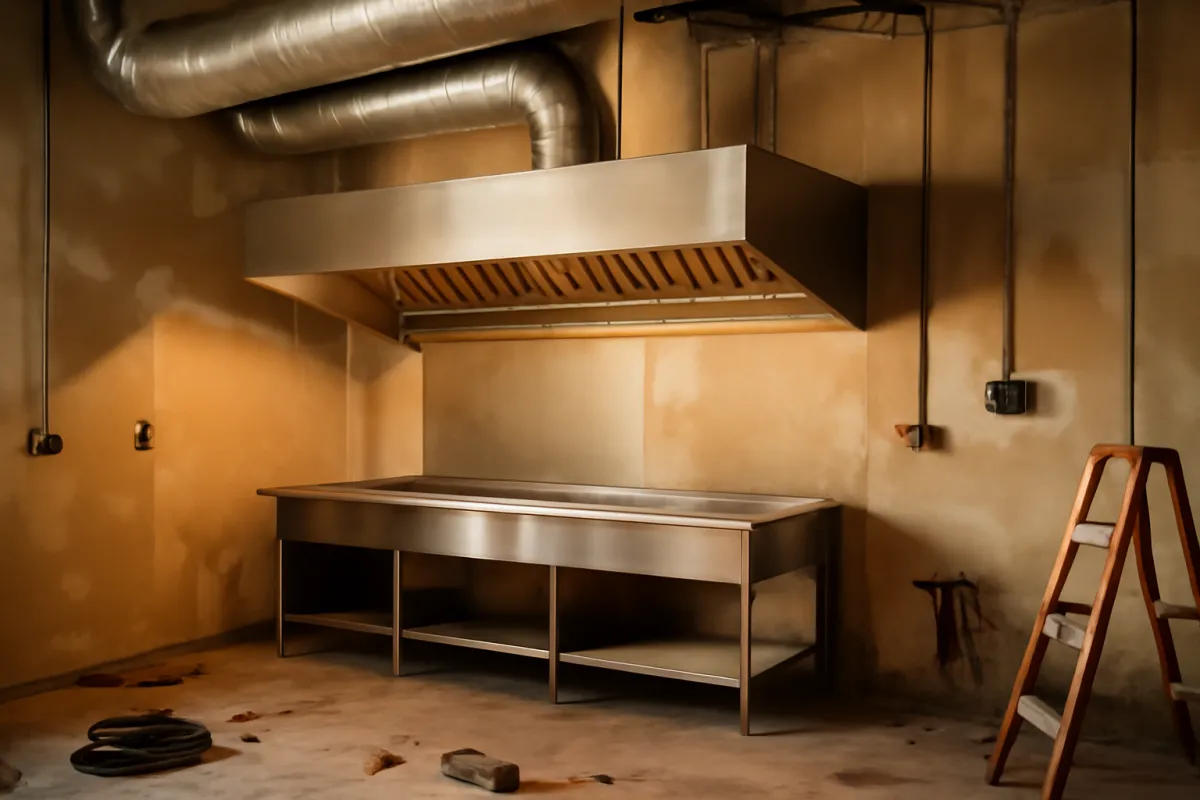
The single biggest lever on this line is the condition of the space you lease. A former restaurant that already has the plumbing, the electrical, the hood, and the grease trap can be opened for a fraction of what a bare retail box or a former office costs to convert, because you inherit the expensive infrastructure instead of building it. This is why the same concept can cost double in one storefront and half in another, and why the lease negotiation and the buildout budget are the same conversation. A landlord contribution toward improvements, called a tenant improvement allowance, can move this line by tens of thousands, so it belongs in the lease talks from the first meeting. Design the buildout to pass the health inspection the first time, because a failed inspection loops straight back into this budget.
Kitchen equipment
Kitchen equipment is the line everyone pictures and usually the second-largest after the buildout, covering the cooking line, refrigeration, the dish area, prep tables, small wares, and the storage a menu demands. Illustratively, a compact quick-service kitchen can be equipped for the low-to-mid five figures, while a full-service or fine-dining kitchen with a broad menu can run well into six figures once the ventilation, the walk-in, and the install are counted. Our commercial kitchen equipment cost rundown prices that package end to end, and it is the piece to read before you set this number, because the appliance stickers are only part of what the kitchen truly costs once the hood, the hookups, and the install are added.
The menu is the strongest lever on this line. Every cooking method your menu adds, whether a fryer, a grill, a wood oven, or a smoker, lengthens the equipment list and enlarges the ventilation hood above it, and a tight, focused menu keeps both short. Refrigeration is the category where a used bargain can turn into an expensive failure, so it deserves care even when the rest of the kitchen is bought secondhand. The equipment line is real and it deserves careful pricing, but keep it in proportion: for a full-service restaurant it is rarely the line that decides whether you can afford to open, and pouring the budget into a showpiece kitchen while the buildout and runway go thin is a classic first-timer error.
Furniture, POS, and the technology stack
For any restaurant with a dining room, furniture and fixtures turn a bare buildout into a room people want to sit in, and this line scales with the square footage and the ambiance you are selling. Tables, chairs, booths, bar stools, lighting, shelving, and the decor that sets the mood all live here, and a fine-dining room that sells the experience spends far more per seat than a quick-service counter where people order and go. This is one of the safest lines to control, because quality used and refurbished furniture costs a fraction of new and looks the same once it is in place, and restaurant liquidators are full of solid tables and chairs at a steep discount.
The point-of-sale system is the cash register of a modern restaurant, and it has shifted from a big one-time hardware purchase toward a smaller upfront cost with an ongoing subscription and a card processing rate on every sale. A typical setup includes terminals, card readers, a kitchen display or printer, and sometimes handheld tablets for table service, plus the monthly software fee. Around the core POS sits the rest of the technology stack: internet service, a reservation or waitlist tool, online ordering, accounting software, and staff scheduling. None of these is large on its own, but together they form a recurring monthly cost that belongs in the burn rate the working capital has to cover, not just the one-time startup budget. Buy the stack that fits how you actually serve, and keep it lean at the start.
Licenses, permits, and insurance
Before a restaurant can legally serve a single plate, it needs a stack of licenses and permits, and the process costs time as well as money. The common list includes a business license, a food service or food establishment permit, a health department permit tied to an inspection, a seller’s permit, a sign permit, a certificate of occupancy after the buildout passes, and, if you serve alcohol, a liquor license that can be a large and slow line on its own in some markets. Fees vary widely by city and state, and illustratively they add up to a modest but real line, though the bigger cost is often the delay, because a permit or inspection that slips by weeks is weeks of rent paid on a closed restaurant.
Insurance is the quieter half of this line and just as necessary. A restaurant typically carries general liability, property coverage, workers’ compensation once it has employees, and often liquor liability if it serves alcohol, along with coverage for the equipment and business interruption. The premiums are an operating cost that also front-loads into the opening budget, and skimping on coverage to save a few dollars a month is a false economy against the risk a busy kitchen carries. Involve the health department, a contractor who knows local food code, and an insurance broker early, so the buildout is designed to pass the first time and the coverage is in place before the doors open.
Buy vs lease vs franchise
There is a decision above all the line items, which is how you enter the business at all: build an independent restaurant from a lease, buy an existing restaurant, or franchise a brand. Leasing a space and building an independent concept gives you full control and the lowest fee structure, but you carry all of the buildout risk and start with no brand or customer base. Buying an existing restaurant can be cheaper and faster than a ground-up buildout because you inherit a working kitchen, a trained crew, and existing customers, though you also inherit whatever reputation and deferred maintenance came with it, so the diligence matters as much as the price.
Franchising sits between the two on risk and above both on some costs. You pay an upfront franchise fee and ongoing royalties in exchange for a proven system, brand recognition, a supply chain, and training, which lowers the odds of the concept failing but raises the fixed cost and constrains your freedom to change the menu or the look. None of the three is universally cheaper, because they price different things: independent buildout trades a lower fee for higher risk, an acquisition trades inherited infrastructure for inherited problems, and a franchise trades fees and control for a system that works. Decide which risk you are best equipped to carry, then price the specific deal in front of you rather than the category.
Leasing versus buying your equipment
Once the equipment budget is set, the next question is how to pay for it, and for a startup the answer often turns on cash preservation rather than the total cost of the gear. Buying equipment outright is usually cheaper over the life of a machine you run hard, because you avoid the financing premium and keep the asset, which is exactly the conclusion our buy-vs-lease equipment rundown reaches for high-utilization gear. But buying consumes cash at the precise moment a new restaurant is most fragile, draining the very working capital that keeps the doors open through the ramp.
That tension is why leasing or financing equipment is so common for restaurant startups specifically. Spreading the equipment cost into monthly payments keeps a large chunk of cash in reserve, lengthening the runway that survival depends on, and the premium you pay for that flexibility can be worth far more than its dollar cost when the alternative is opening with an empty cushion. Our used vs new equipment rundown adds the other half of this decision, showing how a reputable used or refurbished kitchen can deliver most of a new one for a fraction of the price on the durable items. The framing is not that financing is cheaper, it is that a startup values cash on hand more highly than a stable business does. For many first-time owners the answer is to finance or buy used, protect the runway, and upgrade to new equipment once the restaurant stands on its own.
The biggest cost drivers
Three variables move the total cost to open far more than the rest, and understanding them is worth more than pricing any single appliance. The first is location, which sets the rent, the deposit, the local permit and labor costs, and, through the condition of the space, the size of the buildout. A space in a prime district costs more to rent and often more to build to code, while a cheaper location can save on both at the expense of the foot traffic that drives revenue. Location is not one line, it is a multiplier on several.
The second driver is the buildout, which we have seen is usually the single largest line and the one most sensitive to the condition of the space. A former restaurant can cut this line dramatically, while a bare shell can double it, which is why the space you choose is a bigger cost decision than the equipment you put in it. The third driver is the equipment package the menu demands, which a broad or method-heavy menu can inflate quickly. Get these three right, meaning a sensible location, a space that limits the buildout, and a menu that keeps the equipment list disciplined, and the total cost to open stays inside a plan. Get them wrong and no saving elsewhere makes up the difference.
Where restaurant startup money goes
Zoom out from the individual lines and the shape of a full-service restaurant budget comes into focus. The buildout leads, the kitchen equipment follows, the working capital runway rivals both, and the remaining lines together, meaning the lease deposit, furniture, POS, licenses, insurance, inventory, and signage, form a share as large as the equipment. The stacked bar below sketches an illustrative split for a full-service restaurant, and the point of it is proportion, not precision: the kitchen everyone pictures is inside the equipment slice, which is real but not dominant.
Where restaurant startup money goes
Illustrative split for a full-service restaurant, summing to 100 percent.
The kitchen sits inside the 24 percent equipment slice, not at the top of the budget. Buildout and runway together are more than half of what it costs to open.
The lesson from the split is where to spend your attention. An owner obsessing over which range or walk-in to buy is optimizing a quarter of the budget while the buildout and the runway, more than half of it combined, decide whether the restaurant opens on time and survives its first year. Get the location, the space, and the cash cushion right, and the equipment choice becomes a manageable decision inside a sound plan. Run your own split through the equipment ROI calculator to see how your numbers stack against this shape.
Ongoing monthly costs
The cost to open is only half the picture, because the restaurant then has to cover its monthly costs out of revenue, and those costs are what the working capital runway exists to bridge. The big recurring lines are rent, labor, and food cost. Rent is fixed and set by the lease. Labor, meaning the wages, payroll taxes, and any benefits for the front and back of house, is commonly one of the two largest costs and the one owners spend the most effort managing. Food and beverage cost is usually tracked as a percentage of sales, and keeping that percentage disciplined is one of the central skills of running a restaurant profitably.
Beneath those three sit the smaller but constant costs: utilities, which run high in a kitchen full of refrigeration, cooking equipment, and ventilation, along with the POS and software subscriptions, card processing fees, insurance, marketing, repairs and maintenance, and supplies. Together these form the monthly burn, and a new restaurant carries that full burn from opening day while revenue climbs from a slow start. The practical discipline is to model the monthly burn honestly before opening, because that number, multiplied by the months to reach break-even, is exactly the working capital the restaurant needs to survive. Underestimate the burn and the runway runs out early, which is the most common way a restaurant that would have succeeded closes before it gets the chance.
How much cash you really need on hand
Here is the line that closes more restaurants than any single equipment choice, and the one first-timers most reliably underfund: working capital, the cash cushion that covers operating losses until the restaurant breaks even. A new restaurant does not open to a full dining room, it opens to a slow trickle that builds over months as word spreads, and every one of those months the rent, the payroll, the food orders, and the utilities come due whether or not revenue covers them. The money that bridges that gap is working capital, and running out of it is the most common way a restaurant that would have succeeded closes before it gets the chance.
The common rule of thumb is to hold enough cash to cover several months, often three to six or more, of full operating expenses beyond everything spent to build and equip the restaurant. The arithmetic is simple and unforgiving: estimate the monthly burn, meaning rent plus labor plus food cost plus utilities and fees, then multiply by the months of runway you want to survive, and that number is the working capital line. A restaurant that spends its last dollar opening the doors is one slow month from closing them, so fund the runway before the finishes, and treat a faster ramp as upside rather than the plan. The companion beside this rundown turns your type, size, and buildout into a working capital estimate you can size against this rule.
Financing a restaurant
Restaurants are rarely opened on cash alone, so how the whole opening gets funded is its own decision. The common sources are personal savings, a bank or SBA small business loan, an equipment loan secured by the machines themselves, a line of credit for working capital, contributions from friends and family, and sometimes an outside investor or partner who trades capital for a share of the business. Each carries a different cost and a different set of strings, and the right mix depends on how much cash you bring, how much risk you can carry, and what a lender will extend to a business with no operating history.
The discipline that keeps financing from becoming a trap is to decide on the total cost of the money over its term, not on the monthly payment in isolation, and to match the term of any loan to the life of what it funds. Our equipment financing rundown lays out that math in full, and it applies directly to the kitchen: financing equipment over its useful life is sound, while financing perishable inventory or a few months of rent on a long-term loan means paying interest on things long gone. Above all, do not borrow so aggressively that the debt service becomes part of a monthly burn the young restaurant cannot carry, because a heavy loan payment can turn a survivable slow patch into a fatal one. Fund the opening with a mix you can service on a realistic revenue ramp, not an optimistic one.
Whether the restaurant math pays off
Restaurants can be profitable, but the honest framing is that the margins are typically thin and the business is demanding rather than passive. Full-service net margins are commonly cited in the low-to-mid single digits, with quick-service sometimes a little higher, which means a restaurant lives or dies on volume and cost control. Food cost as a share of sales, labor, and rent are the three levers that decide whether the thin margin survives, and a few points of slippage on any of them can erase the profit entirely. This is why the discipline of tracking the monthly numbers matters more in restaurants than in almost any other small business.
The timeline compounds the challenge. Many restaurants take months to a year or more to reach break-even, and a meaningful share close within their first few years, which is precisely why the working capital runway has to be long enough to reach profitability with a cushion to spare. None of this makes a restaurant a bad business, because a well-run restaurant with a disciplined cost structure, a strong concept, and a good location can pay its owner well and build real equity. It makes it a business that rewards preparation and honesty over optimism. Price the opening carefully, fund the runway fully, run the monthly numbers relentlessly, and the thin margin becomes a living rather than a trap.
How to reduce restaurant startup costs
Every startup budget is a series of choices about what to trim, and the safe cuts and the dangerous ones are easy to tell apart. The safest places to save are the visible extras that do not touch quality or reliability. Choose a space that was already a restaurant to inherit the expensive kitchen infrastructure and slash the buildout. Buy quality used or refurbished equipment for the durable items, as our used vs new equipment rundown lays out, and keep the money for the refrigeration where used carries more risk. Furnish the dining room with quality used tables and chairs, keep the opening menu tight to shrink both the equipment and the inventory, and negotiate a landlord contribution toward the buildout.
Starting smaller is the most powerful lever of all. A food truck, a takeout-only kitchen, or a compact quick-service counter opens for a fraction of a full-service room and lets you prove the concept before committing to a large lease, which is why our cost to start a food truck and cost to open a coffee shop rundowns are worth reading as lower rungs on the same ladder. The dangerous cuts are the ones that show up on the plate or in the bank account: cutting corners on code compliance risks a failed inspection, skimping on refrigeration invites spoilage and failure, and thinning the working capital runway to afford nicer finishes is the deadliest cut of all, because it ends the business before it matures. The rule is short enough for a sticky note: cut the room, not the runway.
A worked example: one small full-service restaurant
Put the whole framework on one illustrative budget for a small full-service restaurant in a modest space. The owner leases a 2,000 square foot former retail unit that needs a moderate conversion into a restaurant. The buildout, meaning the kitchen infrastructure, the ventilation hood, the plumbing and electrical, the dining room finishes, and a small bar, runs an illustrative $300,000, the single largest line because the space was never a food business. The kitchen equipment package, from the cooking line to the walk-in and the dish area, comes to $150,000, some of it bought refurbished to protect cash.
The lease deposit and first months of rent add $30,000, furniture and fixtures for the dining room add $40,000, the POS and technology stack plus licenses, permits, and insurance add $35,000, initial inventory and signage add $15,000, and pre-opening labor for hiring and training adds $20,000. That one-time cost totals roughly $590,000. On top of it the owner holds a working capital runway of about $210,000, roughly four months of a $52,000 monthly burn, to survive the ramp to break-even. The all-in cost to open is around $800,000, and the two largest pieces are the buildout and the runway, not the ovens. The gap between this figure and a food truck’s is the whole point: same food service, an order of magnitude apart in cost, and the difference is the room and the runway. Run your own version through the companion beside this rundown, and the plan stops being a guess.
The bottom line
How much does it cost to open a restaurant? Whatever the format and the size demand, and those two variables are the answer to almost everything. A food truck can open in the high tens of thousands, a small quick-service spot in the low-to-mid six figures, a full-service restaurant in the mid-to-high six figures, and fine dining in seven figures, illustratively, and the gap between them is not the kitchen equipment, which costs roughly the same at every scale. It is the buildout, the rent, the payroll, and the working capital runway, the lines that turn a set of appliances into a business.
The owners who open successfully do three things in order. They pick the format and size honestly and price the lines rather than quoting an average. They spend their attention on the buildout and the runway, more than half the budget combined, instead of obsessing over which range to buy. And they fund the working capital to reach break-even with a cushion, because a restaurant that runs out of cash two months early closes anyway. Price the kitchen carefully with our commercial kitchen equipment cost rundown, weigh how to pay for it with the buy-vs-lease and equipment financing rundowns, size the smaller end against our coffee shop and food truck siblings, and run your own opening budget and revenue ramp through the equipment ROI calculator so the total to open is a plan, not a surprise.
Written for the person costing a restaurant, not for anyone selling the dream of one: this rundown is educational material, not financial, tax, legal, or business advice, and it endorses no specific format, vendor, lender, franchise, or location. Every dollar figure, type range, and percentage split here is an illustrative sketch built to teach how the lines add up, and a real project is priced by its own lease, its own space, its own market, and how much construction the restaurant needs. Rents, liquor licenses, permit fees, buildout costs, insurance premiums, and the time to break even vary enormously by city and by site, and restaurant margins are thin and closures common, so gather local quotes on the actual space and equipment in front of you, and put an accountant, a contractor, and your own honest numbers between you and any lease, purchase, or franchise agreement you sign.
Frequently asked questions
How much does it cost to open a restaurant?
Illustratively, a food truck can open in the high tens of thousands, a small quick-service spot commonly lands in the low-to-mid six figures, a full-service restaurant often runs the mid-to-high six figures, and fine dining can reach seven figures. The range is enormous because the format, the size, and the condition of the space decide almost everything. A truck carries no dining room and little rent, while a full-service restaurant pays for a large buildout, a commercial kitchen, a dining room of furniture, and a payroll. Treat any single number as a planning shape rather than a quote, then price the line items under the format you are actually opening.
What is the average cost to open a restaurant?
Commonly cited averages for a full-service restaurant land somewhere in the mid six figures, but the average is close to useless on its own because the spread behind it is so wide. A small cafe or quick-service counter can open for a fraction of that, while a large fine-dining room in an expensive market can cost several times more. The number is driven far more by square footage, how much construction the space needs, and the local rent than by any national average. Use the average to size the ballpark, then build a real budget from the buildout, equipment, and runway your own space demands.
How much does it cost to open a small restaurant?
A small restaurant, meaning a compact quick-service counter, a small cafe, or a limited-menu spot in a modest space, commonly opens in the low-to-mid six figures, illustratively. The smaller footprint cuts the buildout, the equipment package, the furniture, and the payroll all at once, which is why size moves the total more than almost any other choice. Starting even smaller, with a food truck or a takeout-only kitchen, drops the entry cost further, and our rundown on the cost to start a food truck prices that lower rung. The discipline is the same at every size: price the buildout and the runway first, because they decide affordability more than the menu ever will.
How much does it cost to open a fast food restaurant?
An independent fast-food or quick-service restaurant commonly opens in the low-to-mid six figures, illustratively, while a franchise of a national brand can run considerably higher once the franchise fee, the required buildout, and the brand's equipment standards are added. Quick-service carries a smaller dining room than full-service, which trims furniture and floor space, but the kitchen can be equipment-heavy depending on the menu, and drive-through infrastructure adds its own line. A franchise trades a large upfront fee and ongoing royalties for a proven system and brand recognition. Price the specific brand's disclosure document, or the independent buildout in front of you, rather than a category average.
How much money do you need to start a restaurant?
Beyond the one-time cost to build and equip the restaurant, you need enough working capital to cover several months, often three to six or more, of full operating expenses before the restaurant reaches break-even. A new restaurant opens to a slow trickle that builds over months, and every one of those months the rent, payroll, and food orders come due whether or not revenue covers them. Estimate the monthly burn, then multiply by the months of runway you want to survive, and that cushion is the working capital line. Underfunding it is one of the most common and most fatal startup mistakes, because a restaurant that runs out of cash before it finds its footing closes anyway.
What are the startup costs for a restaurant?
The main startup lines are the lease deposit and first rent, the buildout or renovation, the kitchen equipment, furniture and fixtures, the point-of-sale and technology stack, initial food and beverage inventory, licenses and permits, insurance, signage, pre-opening labor, and the working capital runway. For most fixed-location restaurants the buildout is the largest single line, the kitchen equipment is second, and the working capital runway rivals both. The surprise for many first-timers is how much of the total sits outside the visible equipment, in the construction that converts a bare space and the cash cushion that carries the restaurant to break-even. Price each line against your own space, because a former restaurant costs far less to convert than a bare shell.
Is owning a restaurant profitable?
Restaurants can be profitable, but the margins are typically thin, with full-service net margins commonly cited in the low-to-mid single digits and quick-service sometimes a little higher. That means a restaurant lives or dies on volume and cost control: food cost as a share of sales, labor, and rent are the three levers that decide whether the thin margin survives. Many restaurants take months to a year or more to reach break-even, and a meaningful share close within the first few years, which is why the working capital runway matters so much. Owning a restaurant can pay well when it is run tightly and priced honestly, but it is a demanding business rather than a passive one, and the numbers reward discipline over optimism.