
What's on this page
- What a commercial kitchen hood costs
- Illustrative cost by hood and system type
- Type I vs Type II hoods
- The exhaust hood itself
- Makeup air and ductwork
- Fire suppression systems
- Commercial kitchen ventilation as a system
- Where the ventilation dollar goes
- What drives the cost of a commercial kitchen hood
- Installation, the duct run, and the roof
- New versus used hood systems
- Ongoing cost: hood cleaning and inspection
- Sizing the hood to your cooking line
- A worked example: a quick-service and a full-service hood
- The bottom line
Short answer: A commercial kitchen hood is a system, not an item. The exhaust hood, makeup air, grease-rated ductwork, and fire suppression together commonly run from the low five figures for a small line into the mid five figures or beyond for a long one, illustratively. The hood itself is often the smaller part; installation, the duct run to the roof, and makeup air frequently cost as much as the hood or more.
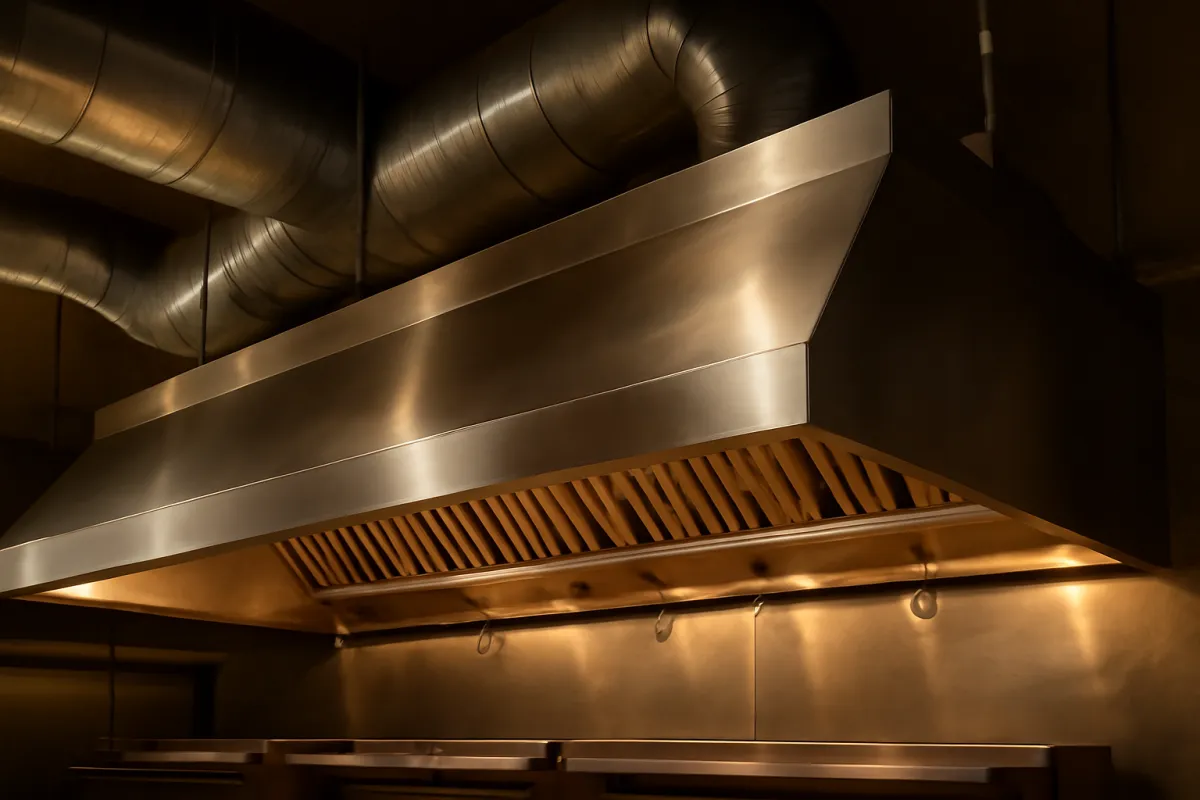
Ask what a commercial kitchen hood costs and the honest first answer is that you are not pricing a hood, you are pricing a system. The stainless canopy over the cooking line is the part everyone points to, but on its own it does very little. To work, it needs a fan sized to the line, ductwork rated for grease that runs all the way to the roof, a makeup air unit that pushes fresh air back in to replace what the hood pulls out, and a fire-suppression system with nozzles aimed at every appliance underneath. Price the canopy alone and you will underestimate the real number by a wide margin, because the parts you cannot see, the shaft, the fan, the makeup air, and the labor to install all of it, usually cost more than the hood itself.
This case study prices the ventilation system piece by piece: the exhaust hood in its Type I and Type II forms, the makeup air and the ductwork that carry the air in and out, the fire-suppression system that code requires over a cooking line, and the installation and duct run that quietly lead the number. It also prices the second cost a hood carries, the recurring cleaning, inspection, and energy that follow it for life, and where the whole package sits inside a kitchen budget. It sits alongside our commercial kitchen equipment case study, which prices the whole kitchen end to end, and it leans on our used-versus-new equipment case study for the honest tradeoff on buying secondhand. Run your own ventilation number as you read with the equipment ROI calculator.
Key takeaways
- A hood is a system, not an item. The exhaust hood, the makeup air, the ductwork, and the fire suppression together commonly run from the low five figures for a small line into the mid five figures or beyond for a long one, illustratively.
- The exhaust hood itself is often the smaller part of the number. Installation, the grease-rated duct run to the roof, and the makeup air frequently cost as much as the hood or more.
- Type I hoods handle grease and carry the expensive parts: fire suppression, rated ductwork, and a fan sized to the line. Type II hoods handle only heat and steam and cost far less.
- The space decides the number. A former food space with a compliant hood and an existing shaft can be dramatically cheaper than a bare shell where the whole system is built from scratch.
- The install is the entry ticket. Cleaning, semiannual suppression inspection, and fan energy are real recurring costs, and the fire-suppression system is never the place to economize.
What a commercial kitchen hood costs
How much does a commercial kitchen hood cost? Illustratively, a small wall-mount exhaust hood commonly runs from a few thousand dollars, a standard wall canopy over a modest cooking line lands in the high four figures to low five figures, and a large island canopy over a full line runs into the tens of thousands for the hood body alone. But that figure is only the visible part of the system, and quoting it as the cost of ventilating a kitchen is the mistake first-timers make most reliably. Add the makeup air, the ductwork, the fire suppression, and the labor to install all of it, and the whole package commonly runs from the low five figures for a short line into the mid five figures or beyond for a long full-service line.
The reason the range is so wide is that a hood is a category of work, not a single product, and most of its cost is site-specific. The same hood model can cost double in one storefront and half in another, because the number turns on the length of the cooking line, the height and path of the duct run to the roof, whether the building already has a rated shaft, and the local mechanical and fire code that governs all of it. This is exactly why a former restaurant, which may already have a compliant hood and shaft in place, can be dramatically cheaper to equip than a bare shell where the whole ventilation system has to be built from scratch, the same lesson our commercial kitchen equipment case study draws about buildouts generally. Price the system, not the canopy, and price it against the actual space. Because the package is this large, it usually rides inside the equipment loan rather than beside it, and our restaurant equipment financing case study shows why folding the hood and install into the financed amount changes the whole deal.
Illustrative cost by hood and system type
Put the pieces on one axis and the point makes itself: the number depends entirely on what you are pricing, the hood body alone or the whole ventilation system. The chart below sketches illustrative figures from a simple Type II hood at the low end, through the exhaust hood in three sizes, up to a complete ventilation package with makeup air, ductwork, fire suppression, and install. These are planning shapes, not quotes, and a specific project can land well outside them depending on the line length, the duct run, and the local code.
Illustrative cost by hood and system type
Hood body alone versus a complete ventilation package. Shape, not a quote.
The complete installed package runs several times the hood body alone, and the gap is makeup air, grease-rated ductwork, fire suppression, and labor. Price the system, not the canopy.
The takeaway is the shape, not the exact figures. A spread this wide tells you that the ventilation budget is a function of the cooking line and the site, not a fixed cost of “a hood,” and that the smartest levers you hold are the length of your cooking line and the condition of the space you take. Run your own line length and space through the companion beside this case study, and the range collapses into a single planning number for the ventilation system you are actually building.
Type I vs Type II hoods
The first fork in any hood decision is Type I versus Type II, and it is the fork that decides most of the cost. A Type I hood is built to capture grease-laden vapor from cooking equipment, the ranges, fryers, griddles, charbroilers, and ovens that throw grease into the air, and it carries all the expensive parts: baffle grease filters, a fan and grease-rated ductwork engineered for the load, and a fire-suppression system with nozzles over every appliance. Because grease is both a cleaning burden and a fire hazard, the code around Type I hoods is strict, and the whole system is heavier, more regulated, and more expensive as a result.
A Type II hood, by contrast, handles only heat, steam, and moisture from equipment that produces no grease, such as a dishmachine, a steam kettle, or some ovens, and it is a much simpler and cheaper device because it needs no grease filters, no fire suppression, and no grease-rated shaft. The practical consequence for your budget is that the Type I system over your cooking line is the number to plan around, while any Type II hood over the dish area or a steam station is a modest add. Since almost every cooking menu produces grease somewhere, most kitchens need a Type I hood over the hot line, and pretending a cheaper Type II will do is a code failure an inspector will catch. Identify which equipment produces grease, put a Type I hood over it, and price the rest accordingly.
The exhaust hood itself
Start with the visible piece, the exhaust hood, because it anchors the system even if it is not always the largest line. The hood is a stainless canopy that hangs over the cooking line to capture the rising plume of hot, greasy air, and it comes in two broad shapes: a wall-mounted canopy that sits against a wall behind the line, and an island canopy that hangs over a cooking line with open sides, which has to capture air from all directions and is therefore larger and more expensive for the same line length. Inside the hood sit the baffle filters that strip grease from the air, a grease trough and cup that catch the runoff, and often integrated lighting.
Illustratively, the hood body runs from a few thousand dollars for a small wall-mount unit into the tens of thousands for a long island canopy, and the price scales with the length of the line it has to cover, the style, and the build quality of the stainless. An island hood costs more than a wall hood of the same length because it works harder to capture the plume without a wall to help it. The hood is also where the whole system’s sizing begins, because the fan, the ductwork, and the makeup air are all sized to move the volume of air the hood is designed to capture. Get the hood length and style right for the actual cooking line, and the rest of the system sizes cleanly off it. Oversize it and you pay for a bigger fan and more makeup air you never needed.
Makeup air and ductwork
Here is where the cost most people forget starts to add up. An exhaust hood pulls a large volume of air out of the building, and that air has to be replaced, or the kitchen goes negative, doors become hard to open, the hood stops capturing properly, and combustion appliances can backdraft. The device that replaces it is the makeup air unit, a fan that draws in outside air, often tempers it so the kitchen is not flooded with freezing or scorching air, and delivers it near the line. Makeup air is not optional on a real cooking hood, and a tempered makeup air unit is a meaningful line of its own, frequently a large share of the whole ventilation number.
The ductwork is the other hidden cost, and it is a bigger one than most first-timers expect. Grease-rated exhaust duct is not ordinary sheet metal: it is welded, liquid-tight, and built to contain a grease fire, and it has to run from the hood all the way to the roof, rising through the building in a rated shaft where floors are involved. The longer and more complicated the path, the more material and labor it takes, which is why a ground-floor kitchen with a short straight run to the roof is far cheaper to duct than an interior space three floors down with a long, dog-legged path to daylight. The exhaust fan on the roof, sized to the hood, sits at the end of that run. Together the makeup air and the ductwork often rival the hood body, and in a difficult space they exceed it, which is why the duct path is a question to ask before you sign a lease, not after.
Fire suppression systems
Over any cooking line, code requires a fire-suppression system, and it is both a genuine safety device and a real line in the budget. The standard for a commercial kitchen is a wet-chemical system: nozzles mounted in the hood are aimed at each appliance and at the plenum and duct, a tank of fire-suppressing chemical sits ready, and the system is tied into an automatic detection line and a manual pull station. When it triggers, it discharges the chemical over the fire and simultaneously shuts off the gas or power to the cooking equipment, which is why the suppression system is wired into the appliances it protects, not just bolted to the hood.
Illustratively, a wet-chemical suppression system commonly runs from the low four figures for a short line into the five figures for a long line with many appliances, because the cost scales with the number of nozzles, the size of the chemical tank, and the tie-ins to the gas shutoff and the building alarm. Installation, permitting, and the initial inspection add to it, and the system must be designed and installed by a licensed contractor to a recognized standard. This is emphatically not the place to economize: an undersized or missing suppression system is a code violation that fails inspection and, far worse, leaves a grease fire on the line with nothing to stop it from becoming a building fire. Price the suppression system as a required part of the hood from the first meeting, and treat it as the safety-critical line it is, the same discipline our commercial kitchen equipment case study applies to the whole ventilation package.
Commercial kitchen ventilation as a system
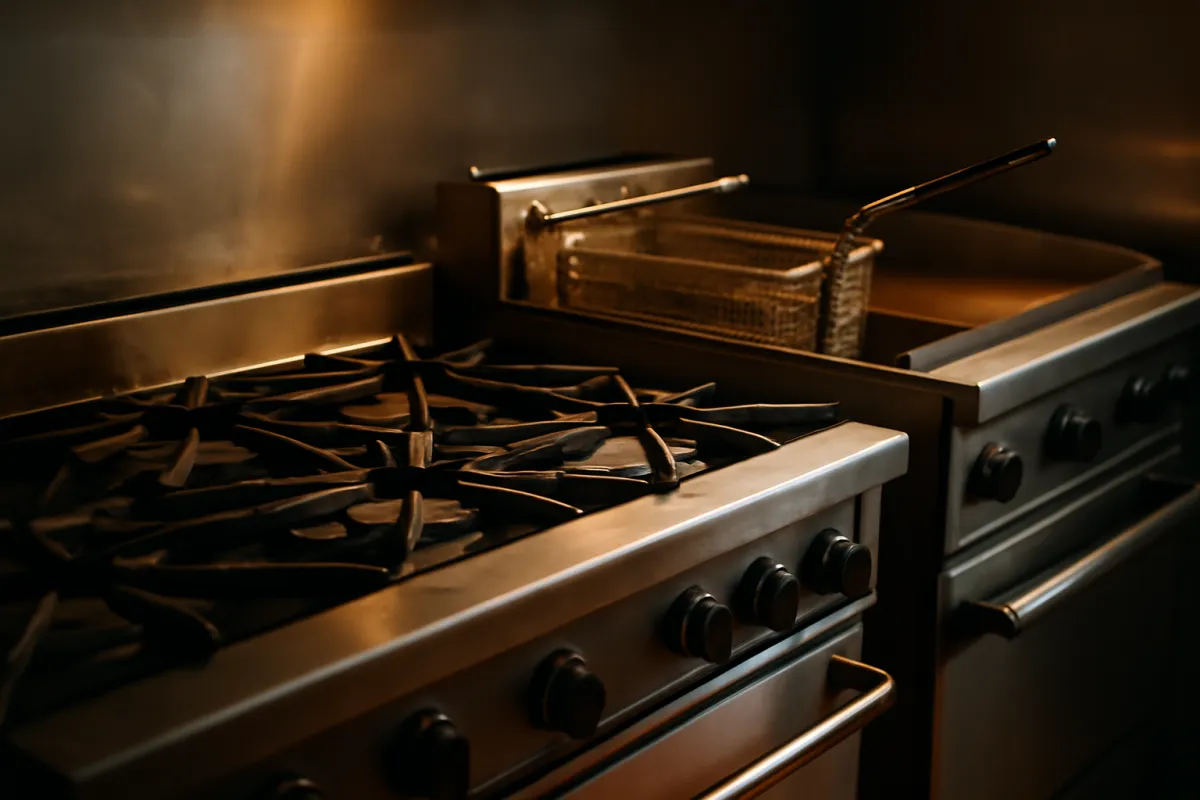
Step back from the individual parts and the crucial point comes into focus: a commercial kitchen ventilation system is a balanced whole, and its cost and its performance both depend on the pieces working together, not on any one component. The hood is sized to capture the plume from the line, the exhaust fan is sized to move that volume of air, the makeup air unit is sized to replace it and keep the building neutral, the ductwork is sized and rated to carry it safely, and the fire suppression is sized to protect every appliance underneath. Change one and you change the others: a longer line needs a bigger hood, which needs a bigger fan, which needs more makeup air, which needs a bigger duct, which needs more nozzles. This is why the whole system scales with the cooking line, and why the line length is the single most useful number to fix before pricing anything.
Because the system is balanced, the wrong place to save is any single part, and the right place to save is the whole scope, meaning a shorter line and a better space. Buying a cheaper hood but skimping on makeup air leaves a hood that cannot capture properly and a kitchen that runs negative, which is a false economy that shows up as smoke on the line and a failed inspection. The system either works as a balanced whole or it does not, and an operator who understands that prices the ventilation as one package sized to the cooking line, rather than shopping the hood, the fan, and the suppression as three separate bargains that do not add up to a working kitchen.
Where the ventilation dollar goes
Zoom in on a complete ventilation package and the shape of the spend becomes clear, and it is not where most people expect. The exhaust hood, the part everyone points to, is often less than a third of the number, while the makeup air, the ductwork, the fire suppression, and the installation labor together make up the rest. The stacked bar below sketches an illustrative split for a full ventilation package, and the point of it is proportion, not precision: the parts you cannot see from the dining room are the bulk of the cost.
Where the ventilation dollar goes
Illustrative split of a complete ventilation package, summing to 100 percent.
The hood body is under a third of the package. Makeup air, ductwork, and the labor to install it all are the larger share, which is why the space and the duct run move the number so much.
The lesson from the split is where your attention belongs. An operator agonizing over which hood brand to buy is optimizing part of the smallest slice, while the makeup air, the duct run, and the installation, which together are most of the budget, get a single line and a nasty surprise. Get the space right, meaning a short duct path and ideally an existing shaft, and the whole package drops. Run your own split through the equipment ROI calculator to see how the pieces stack, and adjust the line length and the space in the companion beside this case study to watch the total move.
What drives the cost of a commercial kitchen hood
Once you know the parts, a handful of factors decide where a specific system lands, and knowing them lets you read a quote rather than just accept it. The length of the cooking line comes first, because it sets the size of the hood, the fan, the makeup air, and the number of suppression nozzles all at once, so a longer line multiplies the whole system. The style of the hood follows: an island canopy costs more than a wall canopy for the same line because it captures from all sides. The duct run is next, and it is the most variable factor of all, because a short straight shot to the roof is cheap and a long, multi-floor, dog-legged path is expensive in both material and labor.
The condition of the space is the factor that swings the number the hardest. A bare shell needs the whole system built from scratch, including cutting the roof and building a rated shaft, while a former food space may already have a compliant hood, a fan, and a shaft in place, letting a new operator inherit the expensive infrastructure. Local mechanical and fire code is the last big driver, because the required exhaust volume, the makeup air rules, the suppression standard, and the inspection regime all vary by jurisdiction and all move the cost. Read the line length, the hood style, the duct path, the space, and the local code together, and a hood quote stops being a mystery and starts being a number you can plan around and compare.
Installation, the duct run, and the roof
The number on the equipment invoice is not the number on the roof, because a hood is installed work as much as it is a product, and installation is frequently the largest and most variable part of the whole budget. The grease-rated ductwork has to be fabricated, welded, and run from the hood to the exhaust fan, the roof has to be penetrated and flashed, a rated shaft has to be built or lined where the duct passes through floors, the exhaust fan has to be mounted and wired, and the makeup air unit has to be set, ducted, and tied into the controls. Every one of those steps is labor on a specific building, which is why two identical hoods can carry wildly different install bills.
The single biggest lever on this line is the path from the hood to the roof. A ground-floor kitchen directly under the roof with a short, straight duct run is the cheap case, while an interior space several floors down, with a long horizontal run and a tall shaft to build, is the expensive one, sometimes doubling the ductwork and labor. This is exactly why the lease negotiation and the hood budget are the same conversation: a space that already has a compliant hood and shaft from a prior restaurant tenant can save a new operator a large fraction of the ventilation cost, a point our cost to open a coffee shop case study makes about buildouts in detail. Involve a mechanical contractor before you sign the lease, price the duct run against the actual space, and treat a former food space with an existing hood as the substantial discount it usually is.
New versus used hood systems
Once the scope is set, the question of buying new, used, or refurbished comes up, and a hood answers it differently from most equipment. The hood body itself, a welded stainless canopy with baffle filters, is durable and simple, so a quality used or refurbished hood from a reputable dealer can genuinely trim the equipment line, the same logic our used-versus-new equipment case study applies across the kitchen. If a used hood is the right length for your line, is in sound condition, and meets the current code, it can be a reasonable buy, and a former restaurant space sometimes hands you a serviceable hood for nothing beyond the lease.
But the hood body is only one slice of the system, and most of the rest is new work regardless of where the hood comes from. The grease-rated ductwork, the roof penetration, the shaft, the makeup air unit, and above all the fire-suppression system are typically fabricated and installed fresh for the specific space, so buying a used hood saves on the smallest part of the budget while the larger install and suppression lines stay the same. There is also a real risk in a used hood that is the wrong size for your line or does not meet the current mechanical and fire code, because a hood that fails inspection saves nothing. The honest rule is that a sound used hood of the right size is a fair saving on the hood body, but the ventilation system as a whole is mostly installed work that a used canopy does not discount.
Ongoing cost: hood cleaning and inspection
The install price is the entry ticket, not the full cost, because a hood carries real recurring obligations for its entire life, and skipping them is both a code violation and a fire risk. Code requires the exhaust system to be professionally cleaned on a schedule set by how heavily the line cooks: a high-volume kitchen with a charbroiler or a wok line may need quarterly cleaning, a moderate kitchen semiannually, and a light-duty operation annually. The cleaning removes the grease that accumulates in the hood, the filters, and the length of the duct, and that grease is exactly what turns a small flare-up into a duct fire if it is left to build. A professional hood cleaning is a recurring bill that scales with the size of the system and the frequency the menu demands.

The fire-suppression system carries its own recurring cost, because code requires a licensed technician to inspect and service it on a schedule, commonly twice a year, and to recharge it after any discharge, so a single kitchen fire that trips the system is a repair line as well as a scare. On top of the service, the exhaust and makeup air fans draw energy every hour the line runs, and a hood that runs flat out all day when the line is idle wastes both electricity and the tempered makeup air it pulls in. A demand-based control that ramps the fan to the actual cooking load is a real way to trim that energy bill, which is why the total cost of ownership, not the install price alone, is the right way to judge a ventilation system, the same lens our commercial refrigerator cost case study applies to equipment that runs constantly. Budget cleaning, inspection, and energy from day one.
Sizing the hood to your cooking line
The single most consequential decision in a hood budget is sizing, and it runs in both directions. An undersized hood cannot capture the plume from the line, which fills the kitchen with smoke and grease, fails inspection, and forces an expensive redo, so undersizing is the more dangerous error. But oversizing has a real cost too, because a hood larger than the line needs a bigger fan and more tempered makeup air, which raises both the install price and the energy bill for the life of the system. The right size captures the line’s plume with the code-required exhaust volume and no more, and it is set by the length and type of the cooking equipment underneath it, not by a round number or a guess.
The lever, once again, is the menu and the cooking line it demands. Every cooking method you add lengthens the line and enlarges the hood, the fan, the makeup air, and the suppression, so a tight menu that fries and grills needs a shorter, cheaper system than one that also bakes, broils, and steams. This is why menu discipline shows up twice in a kitchen budget, once in the cooking equipment and once in the ventilation that has to cover it, a point our commercial kitchen equipment case study makes about the whole kitchen. Fix the cooking line first, size the hood to cover exactly that line, and let a mechanical contractor confirm the exhaust and makeup air volumes against local code, so the system is right-sized rather than guessed. Run your own line length through the companion beside this case study to see how the number moves.
A worked example: a quick-service and a full-service hood
Put the whole framework on two illustrative ventilation budgets at different ends of the cooking spectrum. First the quick-service kitchen. A counter concept with a short cooking line of a range, a fryer bank, and a griddle needs a modest wall canopy hood for an illustrative $7,000, a tempered makeup air unit for $6,000, a short grease-rated duct run to the roof with the fan for $8,000, a wet-chemical fire-suppression system for the line at $4,000, and the installation, roof penetration, and permitting for $9,000. The ventilation package lands around $34,000, and the point is that the hood body, at $7,000, is roughly a fifth of it, while the makeup air, ductwork, suppression, and install make up the rest. A former food space with an existing hood and shaft could cut this by more than half.
Now the full-service restaurant kitchen. A long hot line with multiple ranges, ovens, a broiler, and a fryer bank needs a large island canopy hood for an illustrative $18,000, a larger tempered makeup air unit for $12,000, a longer grease-rated duct run through a shaft to the roof with a bigger fan for $16,000, a larger wet-chemical suppression system with more nozzles at $9,000, and the installation, shaft, and permitting for $20,000. The ventilation package lands around $75,000, and again the hood body is under a quarter of the total, with the install and the duct run leading. The gap between the two examples is the length of the cooking line and the difficulty of the space, not a fancier hood, which is the whole point: the system scales with the line and the building. Run your own line length and space through the companion beside this case study, and the plan stops being a guess.
The bottom line
How much does a commercial kitchen hood cost? Whatever the cooking line and the space demand, because a hood is a balanced system priced on the line it covers and the building it sits in, not a canopy off a shelf. The exhaust hood is frequently the smaller part of the number, while the makeup air, the grease-rated ductwork, the fire suppression, and the installation labor are the larger share, and the difference between a cheap ventilation job and an expensive one is usually the duct run to the roof and whether the space already has a compliant hood in place. Size the system to the cooking line, keep the menu tight to keep the line short, and choose a former food space wherever you can, because that single choice moves the number more than any hood model.
The operators who budget a hood well do three things in order. They price the whole ventilation system, the hood, the makeup air, the duct, the suppression, and the install, rather than the canopy alone, so the number is honest from the first meeting. They involve a mechanical contractor before signing the lease, because the duct path and the existing infrastructure of the space decide most of the cost. And they judge the system on its life, budgeting the cleaning, the semiannual suppression inspection, and the fan energy alongside the install, never economizing on the fire suppression or the sizing that keep the kitchen safe and legal. Place the hood inside the whole kitchen with our commercial kitchen equipment case study, weigh new against used with our used-versus-new equipment case study, price the whole opening with our cost to open a coffee shop case study, and run your own line length and space through the equipment ROI calculator so the ventilation number is a plan, not a surprise.
Written for the operator costing a ventilation system, not for anyone selling one hood off a floor: this case study is educational material, not financial, tax, legal, or business advice, and it endorses no specific brand, contractor, or product. Every dollar figure, size band, and percentage split here is an illustrative sketch meant to teach how a hood and its system are priced, and a real system is quoted by its own cooking line, its own duct path, its own building, and its own local code. Hood, makeup air, ductwork, and fire-suppression requirements are governed by local mechanical, fire, and health codes that vary widely by jurisdiction and change over time, so gather quotes from licensed mechanical and fire-protection contractors and confirm the rules with your local authority on the actual space and equipment in front of you, and put a qualified professional between you and any lease, purchase, or installation you commit to.
Frequently asked questions
How much does a commercial kitchen hood cost?
Illustratively, a small wall-mount exhaust hood commonly runs from a few thousand dollars, a standard wall canopy over a modest cooking line lands in the high four figures to low five figures, and a large island canopy over a full line runs into the tens of thousands. But the hood alone is only part of the number, because a commercial kitchen ventilation system also needs makeup air to replace what the hood exhausts, ductwork to carry grease-laden vapor to the roof, and a fire-suppression system that code requires above cooking equipment. Once those are counted with installation, the whole package commonly runs from the low five figures for a small line into the mid five figures or beyond for a long full-service line. Treat any single figure as a planning shape rather than a quote, because the length of the cooking line, the duct run to the roof, and the local mechanical and fire code move the total more than the hood model.
Why is a commercial kitchen hood so expensive?
A commercial kitchen hood is expensive because it is not one item, it is a system that has to move a large volume of hot, greasy air out of the building safely and pull an equal volume of fresh air back in. The exhaust hood captures the vapor, but it needs a fan sized to the cooking line, ductwork rated for grease that runs all the way to the roof, a makeup air unit that replaces the exhausted air so the building does not go negative, and a fire-suppression system with nozzles over every appliance. Much of the cost is labor and site work: cutting the roof, running the shaft, and tying the suppression system into the gas and the alarm. This is why the same hood can cost double in one space and half in another, and why a bare shell with no existing shaft is the expensive case.
How much does a commercial kitchen fire suppression system cost?
Illustratively, a wet-chemical fire-suppression system for a commercial kitchen commonly runs from the low four figures for a short cooking line into the five figures for a long line with many appliances, because the cost scales with the number of nozzles, the size of the chemical tank, and the tie-ins to the gas shutoff and the building alarm. Installation, permitting, and the initial inspection add to it. On top of the install, code requires a licensed technician to inspect and service the system periodically, commonly twice a year, and to recharge it after any discharge, which is a recurring line rather than a one-time cost. The suppression system is not the place to economize, because it is both a code requirement and the safety device that stands between a flare-up on the line and a building fire.
What is the difference between a Type I and a Type II hood?
A Type I hood is built to capture grease-laden vapor from cooking equipment such as ranges, fryers, griddles, charbroilers, and ovens, and it is the hood that carries grease filters, a fire-suppression system, and welded grease-rated ductwork. A Type II hood handles heat, steam, and moisture from equipment that does not produce grease, such as dishmachines, steam kettles, and some ovens, and it is simpler and cheaper because it needs no grease filters and no fire suppression. The distinction matters for the budget because a Type I system carries all the expensive parts: the heavier hood, the fire suppression, the rated shaft, and the makeup air. If your menu produces grease, and most cooking menus do, you need a Type I hood over that line, and its cost is the number to plan around.
Do I need a commercial hood for my kitchen?
Any commercial kitchen with cooking equipment that produces grease-laden vapor, meaning a range, a fryer, a griddle, a charbroiler, or a similar appliance, needs a Type I exhaust hood over that equipment, and this is a code requirement an inspector will check before the kitchen opens, not an optional upgrade. Equipment that produces only heat and steam, such as a dishmachine or a steam kettle, may need a simpler Type II hood instead. A concept that only assembles, reheats in a countertop unit, or serves cold food may avoid a full hood entirely, which is one reason a beverage-led or delivery-only format can be dramatically cheaper to equip. The safe move is to confirm the requirement with your local mechanical and fire authority on the actual equipment and menu you plan to run, because the code, not the catalog, decides what you need.
How much does hood installation and ductwork cost?
Installation and ductwork are frequently the largest and most variable part of a hood budget, because they are labor and site work rather than a catalog item. The ductwork has to be grease-rated, welded and liquid-tight, and run from the hood all the way to the roof, and the longer and more complicated the path, the more it costs. Cutting the roof penetration, building or lining a rated shaft in a multi-story building, mounting the exhaust fan, and installing the makeup air unit all add labor. Illustratively, installation, ductwork, and the makeup air can add as much as the hood itself or more, especially in a bare shell with no existing shaft. A former restaurant space with a compliant hood and an existing shaft in place is the case where this line shrinks dramatically, which is why the space you choose moves the number as much as the equipment does.
What are the ongoing costs of a commercial kitchen hood?
The install price is only the entry ticket, because a hood carries real recurring costs for its whole life. Code requires the exhaust system to be professionally cleaned on a schedule set by how heavily the line cooks, commonly quarterly for a high-volume kitchen and less often for a light one, to remove the grease that builds up in the hood, the filters, and the duct and that is a fire hazard if left. The fire-suppression system must be inspected and serviced by a licensed technician, commonly twice a year, and recharged after any discharge. The exhaust and makeup air fans draw energy every hour the line runs, and a demand-based control that ramps the fan to the cooking load rather than running flat out is a real way to trim that bill. Budget cleaning, inspection, and energy alongside the install, because the running cost is part of what the hood truly costs.
How can I save money on a commercial kitchen hood?
The safest and largest saving is to choose a former food space that already has a compliant hood, a rated shaft, and the makeup air in place, because inheriting that infrastructure can cut the ventilation line by a large fraction compared with building it from scratch in a bare shell. Keeping the menu and the cooking line tight is the next lever, because a shorter line needs a smaller hood, fewer suppression nozzles, and a smaller fan, and every cooking method you drop shrinks the whole system. Quality used or refurbished hoods from a reputable dealer can trim the equipment cost, though the ductwork, the fire suppression, and the install are usually new work regardless. What you should not cut is the fire-suppression system, the grease-rated ductwork, or proper sizing, because an undersized or non-compliant hood is both a code failure and a fire risk that no saving justifies.