
What's on this page
- Before you start
- Step 1: Choose your catering niche and menu
- Step 2: Write the business plan and startup budget
- Step 3: Register, license, and insure the business
- Step 4: Secure a licensed commercial kitchen
- Step 5: Buy the equipment and build your event kit
- Step 6: Price your menu and build a quoting system
- Step 7: Book your first clients and market locally
- Step 8: Staff, prep, and run your first events
- Startup cost by catering format
- Where catering startup money goes
- A worked example: one caterer’s first busy month
- Common mistakes when starting a catering business
- Troubleshooting: no kitchen, slow bookings, and underpriced quotes
- Your catering startup checklist
- The bottom line
Short answer: Start a catering business in eight steps: choose a niche you can own, put the numbers on paper, register and license the business, lock in a licensed kitchen to cook from, build your equipment kit, price your menus properly, book your first clients, then staff and run events that earn referrals. Illustrative startup cost runs from the low five figures for part-time drop-off catering to six figures with a dedicated kitchen.
Starting a catering business comes down to eight steps in a rough order: choose a niche you can own, put the numbers on paper, register and license the business, lock in a licensed kitchen to cook from, build your equipment kit, price your menus properly, book your first clients, then staff and run events that earn referrals. Follow that chain and you can be cooking for paying clients within a few months, for an illustrative low-five-figure startup cost, a fraction of what a restaurant demands.
The reason catering is the classic first food business is exactly that gap: you rent kitchen time instead of building one, you cook to confirmed orders instead of forecasting walk-ins, and you scale the kit to the bookings. The reason so many catering starts stall anyway is that the steps hide traps a restaurant owner would recognize instantly: cooking from an unlicensed home kitchen, quoting against ingredient cost alone, and booking a season of events priced below what the labor really costs. This walkthrough works each step with an illustrative number and a watch-out, runs one caterer’s first busy month end to end, and sits alongside our rundowns on restaurant startup costs and restaurant profit margin if you want the fixed-location comparison. You can size your own per-event math as you read with the equipment ROI calculator.
Key takeaways
- Starting a catering business is an eight-step chain: niche and menu, plan and budget, licenses and insurance, a licensed kitchen, equipment, pricing, first clients, then staffed events.
- Illustrative startup cost runs from the low five figures for part-time drop-off catering to six figures with a dedicated kitchen. Renting commissary time is what keeps the entry cheap.
- Most health departments require a licensed commercial kitchen. Plan on renting commissary or shared kitchen time, and confirm your local rules before assuming you can cook from home.
- Price per head so food lands near an illustrative 30% of the quote, with labor, rentals, transport, overhead, and profit priced as their own lines. Underquoting labor is the classic margin killer.
- The pipeline ramps slower than the paperwork. Budget a working-capital cushion for a thin first season and treat venue and planner relationships as your main marketing channel.
Before you start
Three things need to be roughly in place before you spend real money, because every later step leans on them. The first is cooking ability at volume: catering is production cooking, forty plates landing hot at the same minute, which is a different skill from cooking well for eight. The second is a niche and a rough menu you can describe in one sentence. The third is enough cash, or income from a day job you keep, to cover the startup kit and a thin first season, because bookings ramp slower than permits.
Here is what you need lined up before step one:
- Volume cooking experience, from a restaurant, institutional kitchen, or serious event practice, or a plan to get it before your first paid event.
- A niche and a draft menu you can say in one sentence, with a target client and an event size range.
- An illustrative budget covering equipment, a vehicle plan, licenses, insurance, kitchen deposits, and several months of cushion.
- Time: a few months from decision to first paid event is a common shape, and the client pipeline takes longer than the paperwork.
Difficulty is moderate: lower than opening a restaurant on cost and risk, but the licensing, the pricing discipline, and the physical grind of event days are real. The steps below assume a lean start from a rented licensed kitchen, which is the standard entry path. Nothing here is professional advice, and every figure is an illustrative planning shape to test against your own market and your own local rules.
Step 1: Choose your catering niche and menu
Start by narrowing, because “caterer” is not a niche, it is a category, and generalists compete on price against everyone. Pick the intersection of what you cook best and who in your market pays reliably: corporate lunch drop-offs, weddings and events, private dinner parties, meal prep for households, or a specific cuisine that your market lacks. Each niche has a different rhythm. Corporate drop-off is weekday, repeatable, and low-service; weddings are weekend, high-ticket, and high-service; dinner parties are small, premium, and personal. The niche decides your menu, your equipment, your staffing, and your marketing, so choose it deliberately rather than defaulting to “whatever anyone books.”
Then build a tight draft menu inside that niche. A short menu you can execute perfectly at volume beats a long one that reads impressively and cooks chaotically. Favor dishes that hold and transport well, tolerate a service window, and share ingredients across the menu so your shopping list stays efficient. Write it as packages with a per-head shape (an illustrative “three-course plated dinner” or “taco bar for 50”) rather than an a la carte sprawl, because packages are how clients buy and how you will quote in step six. Sketch each package’s rough ingredient cost per head now; that number becomes the spine of your pricing later.
Watch out for building the menu around what you love to cook instead of what survives a cambro and a service window. A dish that is perfect at minute zero and sad at minute forty is a restaurant dish, not a catering dish, and discovering that at a paid event costs you the referral that event was supposed to earn. Test every candidate dish the way it will actually be served: cooked at volume, held, transported, and plated on site. The menu that survives that test honestly is your real menu, whatever the first draft said.

Step 2: Write the business plan and startup budget
Put the business on paper before you register anything, because the plan is where optimism gets corrected cheaply. It does not need to be long, but it needs the real parts: the niche and packages from step one, the target market and the competitors already serving it, your pricing shape, how clients will find you, and financial projections built from the bottom up, events per month times revenue per event, against food, labor, kitchen rent, and overhead. Our walkthrough on how to write a restaurant business plan maps the same structure, and a catering plan is the lighter version of it.
The budget is the half that decides whether you can actually start. Price every line: the cooking equipment and smallwares, the transport gear (cambros, coolers, racks), a vehicle or the cost of using yours, the commissary kitchen deposit and first months of rental, licenses, permits, the food manager certification, general liability and commercial auto insurance, a simple website and quoting software, initial marketing, and a working-capital cushion for the months when bookings are thin. As an illustrative shape, a part-time drop-off start can land near $15,000 all in, while a full-service event operation with staff and a dedicated van commonly runs toward $50,000. Model your own version against the calculator as you build the budget.
Watch out for budgeting the kit and forgetting the runway. Catering revenue is lumpy and seasonal, and the first season is usually thin while the pipeline builds, so a budget that spends everything on equipment and assumes immediate bookings is the catering version of the undercapitalized restaurant. Fund several months of the fixed costs (kitchen rental, insurance, vehicle, software) as a real line in the budget. The cushion is what lets you say no to underpriced work in month three, and pricing discipline in a thin month is worth more than any piece of equipment you could have bought with the same money.
Step 3: Register, license, and insure the business
Make the business legal before the first paid event, because catering is a food business and the compliance is not optional. The common sequence: register the business entity (many caterers choose an LLC for liability separation, a decision worth a professional’s input), get the tax registrations, then work the food-specific layer: a food handler or food manager certification for you, a catering or food service permit from the health department, and any local business license your city requires. In most areas the health permit is tied to the licensed kitchen you prepare food in, which is why this step and step four intertwine: you often cannot finish the permit until you have the kitchen.
Insurance is the piece first-timers skip and professionals never do. General liability protects you when a guest claims your food made them ill or a chafing dish burns a tablecloth, and venues routinely require a certificate of insurance naming them as additional insured before you can load in, so you will need the policy to book the work, not just to sleep at night. Add commercial auto coverage for the delivery vehicle, and workers compensation once you have employees. If alcohol is part of your offer, treat it as its own project: a catering liquor permit, where available, is often slow and restrictive, and many caterers sidestep it by partnering with a licensed bar service instead.
Watch out for cooking from your home kitchen because the rules feel like a formality. Most health departments require commercial food preparation in a licensed, inspected kitchen, and while some states run cottage food or home-kitchen programs, they are usually limited to lower-risk foods or capped sales and often exclude full-service catering. Getting caught cooking unlicensed can mean fines and a shutdown, and one foodborne illness claim without insurance can end the business and reach your personal assets. Confirm your local rules with the health department directly, because the requirements vary by county and change over time, and no general list, including this one, substitutes for that call.
Step 4: Secure a licensed commercial kitchen
Lock in your production space, because in most markets this is what makes the whole business legal and it gates the health permit from step three. The standard entry path is renting time in a commissary or shared commercial kitchen: an inspected, licensed space with commercial ranges, ovens, hood ventilation, refrigeration, and washing stations, paid by the hour or by a monthly plan. As an illustrative shape, shared kitchens commonly rent in the tens of dollars per hour, with monthly memberships for regular users, and many offer dry, cold, and frozen storage lockers so you are not hauling everything home between events. Our rundown on commercial kitchen rental prices this whole decision in detail.
Choose the kitchen like the business asset it is. Confirm it holds a current health permit and that your county will attach your catering permit to it. Check the equipment against your menu (a roaster who needs three ovens on a Saturday morning must know how booking conflicts are handled), the storage you can lease, the loading access at 6 a.m., and the distance to the neighborhoods where your events will be. Alternatives exist at both ends: renting a restaurant’s kitchen during its dark hours can be cheaper if the health department approves the arrangement, and a church or event hall kitchen sometimes works where licensing allows. A dedicated leased kitchen is the six-figure end of the spectrum and rarely makes sense before the bookings demand it.
Watch out for signing a monthly kitchen commitment sized to the business you hope for rather than the bookings you have. Hourly rental scales with revenue, which is exactly what a young caterer needs; a fixed monthly plan is cheaper per hour but becomes dead weight in a thin month. Start hourly, move to a membership when your calendar proves the volume, and treat the upgrade to a dedicated kitchen the way our buy versus lease analysis treats any equipment decision: a payback calculation against real utilization, not an aspiration.
Step 5: Buy the equipment and build your event kit
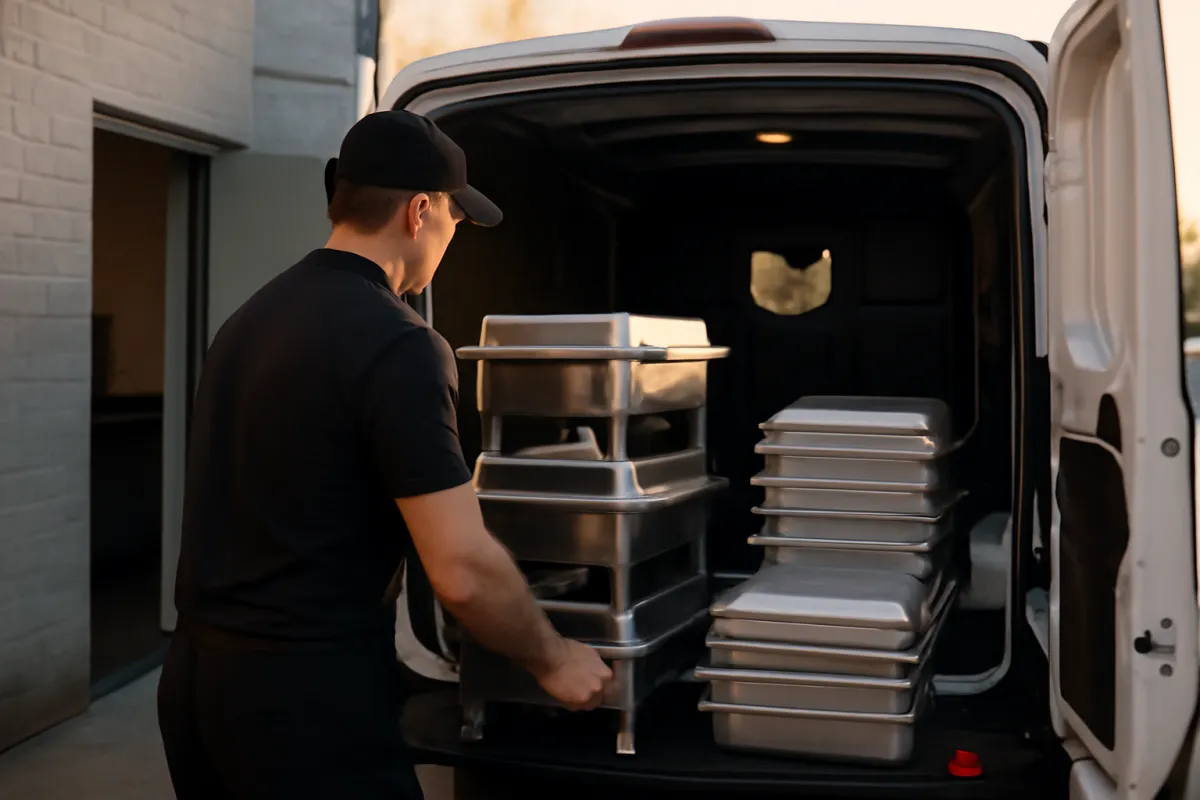
Equip in two layers: the production gear you cook with and the event kit you serve from, and buy both to the menu you actually sell. On the production side, a commissary rental covers the heavy equipment (ranges, ovens, hoods, dish pits), so your own list is the portable layer: pans and hotel pans, knives, containers, a vacuum sealer if the menu warrants it, and the food-safe transport core of insulated carriers, coolers, and sheet-pan racks. On the event side: chafing dishes, serving utensils, beverage dispensers, folding tables, and the linens or platters your niche expects. A drop-off caterer’s kit is small; a full-service wedding caterer’s kit is a small warehouse. Our commercial kitchen equipment list covers the production side line by line.
Spend where failure is expensive and rent where it is not. Holding temperature is the line you never compromise: quality insulated carriers and reliable chafing fuel are cheap insurance against the food-safety failure that ends a young catering brand. Almost everything else flexes. Rent the china, glassware, and specialty pieces per event and bill them to the client, buy used where the smallwares market is deep, and let each booked event justify its own additions to the kit. For the vehicle, many caterers start with a personal SUV or minivan plus rented cargo vans for big events, and buy the dedicated van when the calendar proves it; if a van or a big equipment layer is unavoidable up front, our piece on equipment financing walks how the gear itself can secure the loan.
Watch out for buying the fantasy kit before the first booking. A garage full of chafing dishes sized for 300-guest galas, bought before any gala booked, is the catering version of the over-built restaurant kitchen, and it drains exactly the cushion that step two funded. The discipline that works is the opposite: a lean core kit for your standard package size, rentals for the spikes, and purchases that follow bookings rather than precede them. Run any large purchase through the calculator first, because a piece of equipment that saves hours every week pays back fast, and one that waits for a hypothetical event does not.

Step 6: Price your menu and build a quoting system
Price per head, from the ingredient cost up, and put the whole quote in writing every time. The standard shape: cost out each package’s ingredients per guest, then set the per-head price so food lands near an illustrative 30% of it, with the remaining 70% covering prep and event labor, kitchen rental, transport, overhead, and profit. On that math, a plated dinner costing about $13 per guest in ingredients supports a price in the low forties per head. Then add the lines that are not food as their own items: service staff per hour, delivery fees, rentals passed through with a handling margin, and a service charge if your market uses one. Our walkthroughs on calculating food cost and pricing a menu work the underlying math in detail.
Build the quote as a template, not an improvisation. One spreadsheet or quoting tool that takes guest count, package, staff hours, and distance, and produces a priced, itemized quote, does three jobs at once: it stops you from forgetting cost lines under sales pressure, it makes your pricing consistent across clients, and it looks professional at the exact moment a client is comparing you against an established competitor. Put deposits and cancellation terms in it (a meaningful deposit at booking, commonly nonrefundable inside a cutoff window, is standard in event work) so a cancellation does not leave you holding purchased ingredients and a dead calendar date.
Watch out for quoting against ingredient cost alone, the single most common way new caterers lose money while feeling busy. The forgotten lines are always the same: your own prep hours, the drive, the dishwashing, the kitchen rental hours, the insurance sitting in overhead, and the equipment quietly wearing out. An event that grosses well and nets nothing is worse than no event, because it fills the calendar and funds nothing. Cost one full event honestly, every hour and every mile, before you set your rate card, and revisit the numbers each season, because ingredient prices move and your quotes have to move with them.

Step 7: Book your first clients and market locally
Get the first paid events from close range, then build the channels that compound. The first bookings almost always come from people who already know you: friends, family, colleagues, and their referrals, hired at a real price so the event doubles as a portfolio piece and a testimonial. Photograph everything professionally-adjacent (plated food, buffets, happy rooms), because those photos are the raw material for every channel that follows. Stand up the basics in parallel: a Google Business Profile so “caterer near me” can find you, a simple website with packages, sample menus, photos, and a quote-request form, and listings on whatever event directories your market actually uses.
Then work the relationship channel, because catering is a referral business wearing a marketing costume. Venues, wedding and event planners, corporate office managers, and even non-competing caterers who overflow work are each worth more than any ad budget, because they book caterers repeatedly and their recommendation carries trust you cannot buy. Introduce yourself to venues with a tasting or a drop-off, ask what their preferred-vendor list requires (insurance certificates from step three usually lead the list), and follow up after every event you cater at a venue, because the venue watched you work. Tastings convert: a prospective wedding client who has eaten your food books at a rate no brochure approaches.
Watch out for buying reach before you have proof. Paid ads pointed at a caterer with no reviews, no photos, and no venue relationships convert miserably, and the spend comes straight out of the cushion. The sequence that works is proof first (real events, photographed, reviewed), then presence (profile, website, listings), then relationships (venues and planners), and only then paid reach to amplify what already converts. Expect the pipeline to build over months; the caterers who survive the ramp are the ones whose step-two budget assumed it, and whose pricing did not panic-discount in the thin months.
Step 8: Staff, prep, and run your first events
Run events on a written timeline, because catering execution is logistics wearing an apron. For each booking, work backward from service time: the shopping day, the prep blocks in your rented kitchen, the pack list, the load-in window, the on-site setup, service, and breakdown. Prep everything the venue and the menu allow in the commissary, where your equipment and your dish pit are, and design the on-site work to be finishing and plating rather than cooking from raw. The pack list matters more than it sounds: the item you forgot is the item you cannot fetch when the venue is forty minutes from the kitchen, so build the checklist once and reuse it every event.
Staff per event, and build a reliable on-call bench rather than a payroll. Event staff in catering is commonly gig-based: servers, a bartender where the offer includes one, and kitchen hands for big dates, paid per event and billed to the client as the staffing line from step six. Your bench is a list of people who show up on time, dress the part, and have food handler cards where your county requires them, and it grows the same way your client list does, by referral. Train even casual staff on your service standard and your timeline, because at the event, they are the brand, and classify and pay them correctly, because getting that wrong creates exactly the kind of problem insurance does not fix.
Watch out for overbooking the calendar before the operation can hold it. Two events on one Saturday sounds like growth and executes like a crisis if you own one van, one bench, and one of you. Food safety is the other line that cannot flex under pressure: temperatures held and logged, hot food hot and cold food cold across the drive, and a cooler chain that never breaks, because a single foodborne-illness incident does more damage than a year of slow marketing can repair. Grow the calendar at the pace the kit, the bench, and the systems genuinely support, and let the referral engine from step seven compound on flawless events rather than many events.
Startup cost by catering format
Before the worked example, it helps to see how far the total moves with the format, because the niche you chose in step one sets the scale of everything after it. The chart below sketches an illustrative all-in startup cost, working capital included, across four common entry formats. These are planning shapes, not quotes, and your own number depends on your market, your menu, and how much gear you already own.
Illustrative all-in cost to start, by catering format
Format sets the scale before any line is priced. Illustrative planning figures including working capital, not quotes.
Each bar is drawn from its illustrative figure as a share of the highest, about $120k. The home-based line applies only where a state cottage or home-kitchen program genuinely covers catering, which is uncommon; most lean starts are the drop-off shape, built on rented commissary time. The dedicated kitchen carries the buildout and lease costs the other formats avoid.
The spread is the point: renting kitchen time instead of leasing a kitchen is what keeps the entry in five figures, and the jump to a dedicated space multiplies the cost long before it multiplies the revenue. Compare the far bar to the mid six figures a full-service restaurant commonly needs, per our restaurant startup cost rundown, and the strategic shape of catering becomes obvious: it is the food business you can enter lean and scale with bookings.
Where catering startup money goes
It also helps to see how a single startup budget divides, because the split is not where most first-timers expect. The stacked bar below shows an illustrative breakdown of a full-service catering start built on rented commissary time, and the surprise is how much sits outside the cooking gear: the vehicle, the runway, and the compliance layer together outweigh the kit.
Where a full-service catering startup budget goes
Illustrative split of a full-service start using a rented commissary kitchen. Shares sum to 100.
On this illustrative split, the equipment everyone pictures is less than a third of the budget, while the vehicle, the runway, and the compliance layer together are half of it. A drop-off caterer using a personal vehicle shifts that 20% vehicle slice almost entirely into runway, which is usually the smarter first-year shape.
That split reframes where your attention belongs. The kit is the fun part to shop for, but the runway and the compliance layer are what keep the business alive and legal through the slow ramp, which is why steps two through four spend so long on the budget, the licenses, and the kitchen. Trim the vehicle line by starting with what you drive, keep the kit lean and booking-driven, and protect the runway as the line that buys your pricing discipline.
A worked example: one caterer’s first busy month
Run one realistic month through the whole chain so the pieces connect. Imagine a caterer six months in, following the drop-off-plus-events shape: corporate lunch drop-offs on weekdays, one full-service event most weekends, cooking from a commissary rented by the hour. The month books eight corporate drop-offs at an illustrative $700 each and three Saturday events averaging 60 guests at $45 per head, about $2,700 each. Gross revenue for the month: roughly $13,700.
Now the costs, per the step-six shape. Food runs near 30%, about $4,100 across the month. Event staff for the three Saturdays, two servers each at illustrative gig rates, comes to about $1,400, billed onward to clients within the quoted staffing lines. Commissary time for the month’s prep, around 60 hours at an illustrative $30 per hour, is $1,800. Fuel, disposables, and rentals passed through add perhaps $900. Fixed overhead, insurance, software, phone, and storage locker, runs about $800. Total costs: roughly $9,000, leaving about $4,700 before taxes and the owner’s own unpaid hours, a shade over a third of revenue on paper.
The honest read is what that number contains: the owner worked every prep block, every drive, and every event, so much of that $4,700 is wages for the owner’s labor rather than pure profit, which is exactly the arithmetic step six warned about. The encouraging read is the trajectory: the quoting template held margin on every job, the two venue relationships from step seven produced one of the three Saturday bookings, and the calendar for next month is fuller at the same prices. That is what a healthy ramp looks like: not a windfall, but consistent per-event margin, compounding referrals, and fixed costs a thin month can still cover. Run your own version of this month in the calculator, and treat every figure as illustrative.
Common mistakes when starting a catering business
The failures cluster into a short list of avoidable errors, and knowing them in advance is half the defense:
- Cooking from an unlicensed kitchen. The home-kitchen shortcut risks fines, shutdown, and uninsured liability, and most cottage food programs do not cover full catering. Rent the commissary time; it is the cheap part.
- Quoting against ingredient cost alone. Forgetting prep hours, drive time, kitchen rental, dishwashing, and overhead is how a busy caterer nets nothing. Cost one full event honestly before setting the rate card.
- Buying the fantasy kit first. Equipment sized for the galas you have not booked drains the runway that was supposed to carry the ramp. Buy to bookings, rent the spikes.
- Skipping insurance until "later." Venues require certificates before load-in, so the missing policy costs bookings immediately, and one liability claim without it can end the business.
- Underpricing to win early work. Cheap launch pricing attracts price-shopping clients, anchors your reputation low, and is brutally hard to raise later. Portfolio events for friends can be discounted; the public rate card should not be.
- Overbooking before the operation can hold it. Two events, one van, and one of you is a crisis sold as growth. A flawless smaller calendar out-earns a chaotic full one through referrals.
The through-line is impatience: with the rules, with the pricing math, and with the ramp. The budget cushion, the quoting template, and the booking discipline all defend against the same instinct, which is to sprint before the business can walk.
Troubleshooting: no kitchen, slow bookings, and underpriced quotes
What if there is no commissary kitchen near you? Widen the definition. Restaurants with dark hours, church and event-hall kitchens, food-truck commissaries per our food truck cost rundown, and even fellow caterers with spare capacity all rent licensed space in markets without a formal shared kitchen, provided the health department approves the arrangement. Ask the health department directly what they will permit; inspectors know every licensed kitchen in the county, and the call is free.
What if bookings are slow after three months? Diagnose before discounting. If the quote requests are not arriving, the problem is visibility: push the venue and planner introductions, the reviews, and the photos, because those channels compound and ads do not fix a proof deficit. If quotes arrive but do not close, the problem is conversion: offer tastings, tighten the quote’s presentation, and follow up within a day. Cutting prices is the last lever, not the first, because it converts the wrong clients and anchors you low permanently.
What if you discover you underpriced a signed event? Honor it, execute it flawlessly, and fix the template the same week. A signed quote is a commitment, and the referral value of a perfect event usually outweighs one thin margin. The real fix is upstream: re-cost your packages each season, build the deposit and cancellation terms into every quote, and let the template, not the sales conversation, set the floor.
What if a client cancels late or the event doubles in size? This is what the paperwork in step six exists for. A meaningful nonrefundable deposit inside a cutoff window covers purchased ingredients and the dead calendar date; a written policy for guest-count changes (final counts due by a set date, per-head pricing for additions) turns the doubling event from a crisis into a bigger invoice. If the growth outruns your kit, rent the gap and staff from the bench rather than declining the revenue.
Your catering startup checklist
Save this compact list and work it in order:
- Niche chosen and a short, transport-tested menu written as per-head packages.
- Business plan and line-item budget, with several months of fixed-cost runway funded.
- Business registered; food manager certification earned; health permit application started.
- General liability and commercial auto insurance bound; certificate ready for venues.
- Licensed commissary or shared kitchen secured, hourly first, with storage arranged.
- Lean core kit bought to the standard package size; transport and holding gear quality-first.
- Quoting template built pricing food, labor, rentals, transport, and overhead, with deposit terms.
- Google Business Profile, simple website, and photo portfolio live; venue introductions underway.
- On-call staff bench listed and briefed; pack list and event-day timeline templates written.
- First events booked at full rate card, run on the timeline, photographed, and reviewed.
The bottom line
Starting a catering business is the lean path into professional food service, but only when the steps run in order. Choose a niche and a menu that survives transport, put honest numbers on paper, make the business legal and insured, rent a licensed kitchen instead of building one, buy a booking-sized kit, price every line of every quote, earn the first clients through proof and relationships, and run events on a timeline with a bench you trust. The entry cost, an illustrative low five figures for a lean start, is a fraction of a restaurant’s, and the cook-to-order model wastes less and margins better when the pricing holds.
The operators who make it treat the unglamorous steps as the business. They confirm the rules with the health department instead of assuming, fund the runway before the kit, hold the rate card in thin months, and grow the calendar at the pace the operation can execute flawlessly, because in a referral business, every event is marketing for the next one. Do that, and the ramp compounds: venues call back, planners refer, and the lumpy first season settles into a booked calendar at prices that pay for the next stage, whether that is the dedicated van, the membership kitchen, or eventually the dining room our sibling walkthroughs price. Test your own per-event math in the calculator, and treat every figure here as an illustrative starting point, not a promise.
This walkthrough is educational material for prospective caterers, not legal, financial, tax, or food-safety advice, and it recommends no specific kitchen, insurer, lender, or vendor. Every cost, percentage, and timeline in it is an illustrative planning shape meant to show how the steps and the money fit together; your real numbers depend on your market, your menu, and your local rates. Food business licensing, health-permit, home-kitchen, and alcohol rules differ sharply by city, county, and state and are revised often, so verify every requirement with your local health department and licensing offices before you cook for a paying client. Price your own plan on the space and market in front of you, and put an accountant, an insurance professional, and your local inspector between you and your first event.
Frequently asked questions
What are the steps to start a catering business?
Starting a catering business follows a fairly consistent chain: choose a specific niche and menu, write a business plan with a real startup budget, register the business and get the licenses and insurance, secure access to a licensed commercial kitchen, buy the cooking and transport equipment, build a pricing and quoting system, market to your first clients, then staff and run your first events. The order matters because several steps depend on earlier ones, and in most areas the health permit is tied to the kitchen you cook in, so the kitchen decision gates the licensing. Treat the eight steps as a dependency chain rather than a strict calendar, because a permit queue or a slow first booking season can stretch the timeline. Each step carries its own common failure, which is why this walkthrough pairs every action with a watch-out.
How much does it cost to start a catering business?
Illustratively, a part-time drop-off caterer working out of a rented commissary kitchen can start in the low five figures, a full-service event caterer with staff, rentals, and a delivery vehicle commonly lands in the mid five figures, and building or leasing a dedicated commercial kitchen pushes the total into six figures. Catering starts far cheaper than a restaurant because you rent kitchen time instead of building a dining room, and you buy equipment sized to bookings rather than to a seat count. The big early lines are usually the equipment and smallwares, the vehicle, deposits on kitchen time, licenses and insurance, and a working-capital cushion for the slow ramp. Every figure here is an illustrative planning shape, not a quote, and your real number depends on your niche, your market, and how much gear you already own.
Can you run a catering business from your home kitchen?
In most places, no: health departments generally require commercial food businesses to prepare food in a licensed, inspected commercial kitchen, and a typical home kitchen does not qualify. Some states have cottage food or home-kitchen programs, but they are usually limited to lower-risk foods, capped revenue, or direct-to-consumer sales, and full-service catering often falls outside them. The standard workaround is renting time in a commissary or shared commercial kitchen, which gets you a compliant, inspected space for an hourly or monthly fee without a buildout. Rules vary widely by state and county and they change, so confirm what your local health department allows before you plan around cooking at home.
What licenses do you need to start a catering business?
The common set includes a business registration or license, an employer tax registration if you will have staff, a food service or catering permit from the health department tied to the licensed kitchen you use, a food handler or food manager certification, and general liability insurance, with commercial auto coverage for the delivery vehicle. If you plan to serve alcohol, a separate catering liquor permit or a partnership with a licensed bar service is usually required, and that piece is often the slowest and most restrictive. Event venues frequently ask for a certificate of insurance naming them as additional insured before you can load in. The exact list varies by city, county, and state, so confirm your specific requirements with the local health department rather than relying on any general checklist, including this one.
How do you price catering jobs?
Most caterers price per head: estimate the food cost per guest for the menu, then mark it up so food lands near an illustrative thirty percent of the price, with the rest covering labor, rentals, transport, overhead, and profit. On that shape, a plate that costs about $13 in ingredients supports a price in the low forties per guest, before service staff, delivery fees, and rentals are added as their own lines. The most common rookie error is quoting only against the ingredient cost and forgetting the prep hours, the kitchen rental, the drive time, and the dishwashing, which is how a busy caterer ends up earning less than minimum wage. Build one quoting template that prices every line, and treat all of these figures as illustrative starting points to test against your own market.
How do caterers get their first clients?
First bookings usually come from close range: friends, family, and acquaintances who hire you for a real event at a real price, then refer you onward. A complete Google Business Profile, a simple website with menus and photos, and listings on the event and venue directories your market uses give those referrals somewhere to land. Introducing yourself to venues, wedding planners, and corporate office managers matters more than advertising, because they book caterers repeatedly, and a venue's preferred-vendor list is a durable source of work. Expect the ramp to take months rather than weeks, which is exactly why the startup budget needs a working-capital cushion to carry you through a thin first season.
Is a catering business profitable?
It can be, and the margin shape is usually friendlier than a restaurant's because you cook to confirmed orders instead of forecasting walk-in traffic, so food waste is lower and labor is scheduled per event. Illustratively, a well-priced full-service caterer can hold a net margin in the high single digits to the teens, better than the commonly cited low single digits for restaurants, but the revenue is lumpy and seasonal. The profit lives or dies on pricing discipline: undercharging on labor and forgetting overhead lines erases the margin quietly, one underquoted event at a time. Our companion piece on restaurant profit margin walks the same cost math in a restaurant setting, and every figure in both is illustrative rather than a promise.
How long does it take to start a catering business?
From decision to first paid event, a lean catering start commonly takes a few months: registering the business and getting insured can move quickly, but the health permit, the food manager certification, and finding the right commissary kitchen each add queue time, and building a client pipeline is the slowest part of all. A caterer who already has industry experience and contacts can compress the ramp, while a first-timer in a crowded market should expect the first consistently booked season to arrive over many months, not weeks. The equipment is rarely the bottleneck, because the core kit is small compared to a restaurant buildout. Plan the timeline around the permits and the pipeline, and keep the day job or a cash cushion until bookings are steady.