

What's on this page
- Before you start
- Step 1: Calculate the plate cost
- Step 2: Set your target food-cost percentage
- Step 3: Price with the food-cost method
- Step 4: Cross-check with the contribution-margin method
- Step 5: Account for labor, overhead, and waste
- Step 6: Apply menu psychology
- Step 7: Test, track, and adjust with menu engineering
- Where a menu price’s dollar goes
- Plate cost versus margin at your target food cost
- A worked example: pricing one dish end to end
- Common mistakes when pricing a menu
- Troubleshooting: rising costs, thin popular items, and delivery fees
- Your menu pricing checklist
- The bottom line
Short answer: Price a restaurant menu in seven steps: cost every plate to the ingredient, set a target food-cost percentage, divide plate cost by that target to get a starting price, cross-check the contribution margin in dollars, account for the labor and overhead food cost ignores, apply menu psychology to the final number, then track and adjust with menu engineering. A common full-service target is an illustrative 28% to 35%.
Pricing a restaurant menu comes down to seven steps in a clear order: cost every plate to the ingredient, set a target food-cost percentage, price with the food-cost formula, cross-check that price in dollars of contribution margin, account for the labor and overhead the food cost ignores, apply a little menu psychology to the final number, then track and adjust with menu engineering. Follow that chain and each price on your menu becomes a decision you can defend, rather than a number you guessed and hoped was close.
The reason most menu pricing goes wrong is that it starts in the wrong place. Owners price by copying the restaurant down the street, by rounding up from what feels reasonable, or by fixating on a single percentage while ignoring the actual dollars each plate earns. This rundown builds the price from the bottom up instead, works one realistic dish end to end so the arithmetic is concrete, and flags the mistake hiding in each step. For where menu pricing sits inside the whole business, our walkthrough on how to write a restaurant business plan shows how these prices feed your revenue projections, and you can price a dish as you read with the companion calculator further down the page.
Key takeaways
- Price from cost, not from a guess: cost every plate to the ingredient, then divide by your target food-cost percentage to get a starting menu price.
- A common full-service target food cost is an illustrative 28% to 35%, but it is a deliberate choice set against your own labor, rent, and profit goals, not a universal rule.
- Check every price twice: the food-cost percentage keeps ingredient spend in proportion, and the contribution margin in dollars tells you whether the plate actually pays the bills.
- The single biggest mistake is never repricing when costs rise. A menu frozen while ingredient prices climb quietly erodes the margin it was built on.
- Pricing is a loop, not a one-time task. Track each dish by popularity and margin, and adjust with menu engineering as your sales data comes in.
Before you start
Before you price a single item, three things need to be in front of you, because the whole method leans on them. The first is a set of finalized recipes: standardized, written down, with exact quantities for every ingredient in every dish, because you cannot cost a plate you have not pinned down. The second is current ingredient costs from your actual suppliers, priced to the unit you use, so that a plate cost reflects what you really pay this month rather than a guess from last year. The third is a clear target for your margins, which means knowing roughly what food cost, labor, rent, and profit each need to claim from every dollar of sales.
Here is what you need lined up before step one:
- Standardized recipes for every menu item, with exact ingredient quantities and portion sizes written down and followed in the kitchen.
- Current ingredient costs from your suppliers, converted to the unit each recipe uses (per ounce, per each, per portion), not the case price.
- A target food-cost percentage and a rough sense of your labor and overhead as shares of sales, so the price has something to aim at.
- A little time and a spreadsheet: pricing a full menu carefully is an afternoon of work, and it pays back every service after.
Difficulty here is moderate, and the work is mostly arithmetic and honesty rather than anything technical. Nothing in this walkthrough is financial or business advice, and every figure is an illustrative planning shape you should replace with your own numbers. With recipes, real costs, and a target in hand, the seven steps below turn each dish into a price you can stand behind.
Step 1: Calculate the plate cost
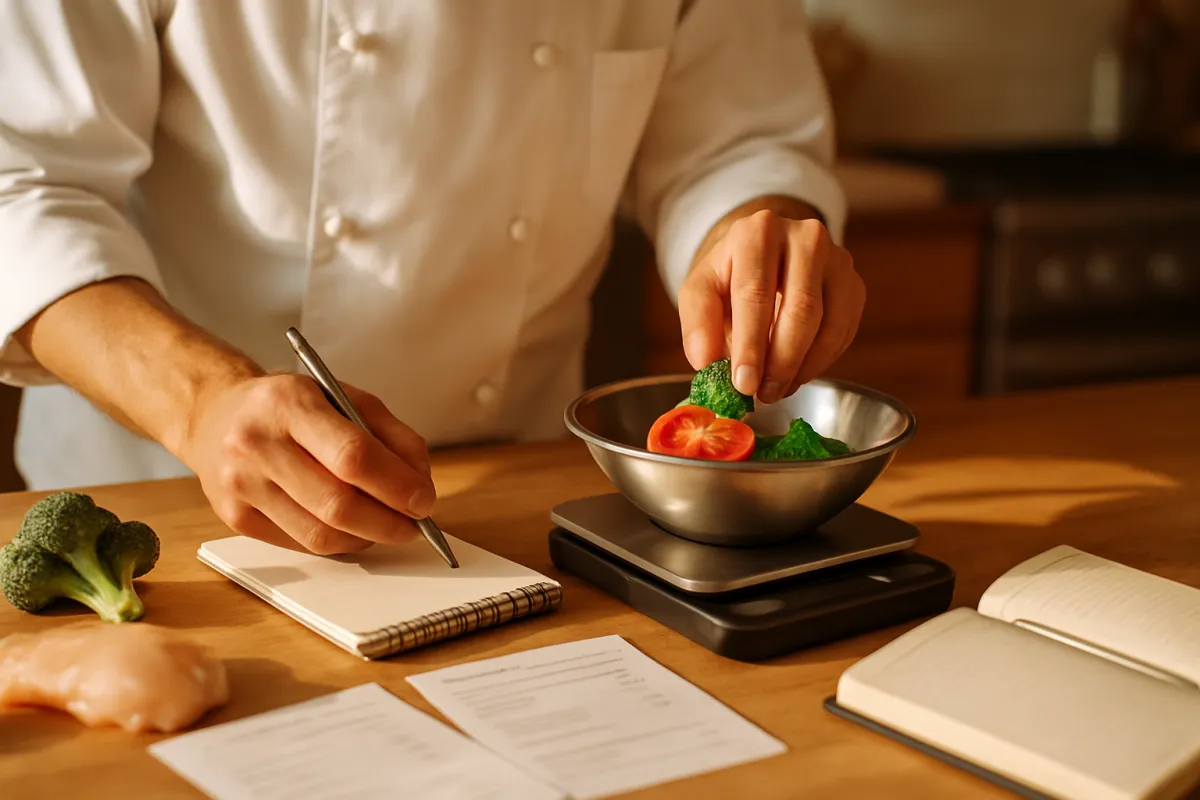
Start by costing each dish down to the plate, meaning the exact dollar value of every ingredient in one served portion. This is the foundation the entire price is built on, and it is the step most often rushed. Take a standardized recipe, list every ingredient it uses, and price each one to the portion the dish actually contains, not the case you bought it in. A case of chicken has a price per pound; your dish uses a portion of one, so you convert the case price down to the cost of that portion. Do this for the protein, the starch, the vegetable, the sauce, the oil, the seasoning, and the garnish, because the small lines add up and the ones people skip are exactly where hidden cost hides.
For an illustrative worked dish, take a roast half-chicken plate. The half chicken portions out to about $2.60, the roast potatoes to $0.55, the seasonal vegetable to $0.65, the pan jus and herbs to $0.30, the cooking oil and seasoning to $0.20, and a small bread and butter service to $0.20. Add those and the plate costs about $4.50 in ingredients. That single number, built from the parts, is what every later step depends on, so it is worth getting right rather than approximating.
Watch out for ignoring yield and waste, because raw cost is not plate cost. Trim, bones, peelings, and spoilage mean you pay for more raw ingredient than lands on the plate, so a protein with heavy trim loss costs more per served portion than its raw price suggests. Fold a realistic yield into the cost of the ingredients that lose weight in prep, or you will systematically under-cost your plates and wonder later where the margin went. Cost what reaches the guest, not what left the supplier.
Step 2: Set your target food-cost percentage
Next, decide what share of each menu price you want the ingredients to represent, because that target is the lever that turns a plate cost into a price. Food-cost percentage is simply the plate cost divided by the menu price: a $4.50 plate sold at $15.00 runs a 30% food cost. Setting the target the other way around, choosing the percentage first, lets you price consistently across the whole menu instead of negotiating every dish from scratch. Many full-service operators commonly aim somewhere in the region of 28% to 35%, but treat that as an illustrative range, not a rule, because the right number is a choice you make against your own costs.
Set the target deliberately by looking at your other big costs. Food, labor, and occupancy are the three claims on every sales dollar, and they trade off against each other. A concept with high labor, think a scratch kitchen with a large brigade, may target a lower food-cost percentage to leave room for the wages, while a streamlined, high-volume format can often carry a higher food cost because it spends less on labor per plate and makes the margin back on turnover. Your target food cost is really a statement about how your whole cost structure fits together.
Watch out for treating one borrowed percentage as gospel. A number that keeps one restaurant healthy can sink another with a different rent, labor model, or volume, so importing a target without checking it against your own profit and loss is guessing with extra steps. Pick a target that leaves enough of every dollar for your real labor, rent, and profit, then confirm it against your actual results once sales come in. The percentage is a tool for consistency, not a guarantee, and it only works when it is set to your own numbers rather than someone else’s.
Step 3: Price with the food-cost method
Now turn the plate cost and the target into a starting price with the food-cost formula: menu price equals plate cost divided by your target food-cost percentage, written as a decimal. It is the fastest, most repeatable way to price a whole menu, because every dish runs through the same rule and comes out in proportion. Run the worked dish through it: the plate costs $4.50 and the target is a 30% food cost, so the price is $4.50 divided by 0.30, which is $15.00. That is the food-cost method’s answer, a defensible starting number generated from your own cost rather than a competitor’s menu or a gut feel.
The reason this method scales is consistency. Apply the same target across the menu and every plate carries its ingredient cost in the same proportion, which keeps the whole menu’s food cost predictable and makes the math easy to audit later. You can also flex the target by category if you choose, holding a tighter food cost on high-cost proteins and allowing a looser one on cheap, high-margin items like sides or drinks, as long as you do it on purpose. The formula does not decide the target for you; it just enforces whatever target you set.
Watch out for treating the formula’s output as the final price. The food-cost method gives you a mathematically clean starting point, but $15.00 exactly is rarely the number that ends up on the menu, and the percentage alone does not tell you whether the plate earns enough real money. Two dishes can both hit a perfect 30% food cost while contributing wildly different dollars per plate, which is the blind spot the next step exists to close. Take the formula’s price as a strong first draft, then carry it into the contribution-margin cross-check before you commit it to print.
Step 4: Cross-check with the contribution-margin method
Before you lock the price, check it in dollars, not just percentages, because a healthy food-cost percentage can still hide a thin plate. Contribution margin is the menu price minus the plate cost: it is the actual money each sale contributes toward covering labor, rent, and profit. For the worked dish, a $15.00 price minus the $4.50 plate cost leaves $10.50 of contribution margin per plate. That $10.50, not the 30% figure, is what actually pays your staff and your landlord, so it is the number worth staring at hardest.
The cross-check matters because percentage and dollars can disagree. Picture a side salad that costs $1.20 to plate and sells for $4.00: its food cost is a tidy 30%, identical to the chicken, but it contributes only $2.80 a plate against the chicken’s $10.50. If your dining room fills up with the low-contribution item, your food-cost percentage looks perfect while your bank balance struggles, because the percentage flatters cheap dishes that earn little real money. Ranking your menu by contribution margin in dollars, alongside the percentage, tells you which plates you actually want to sell and which ones quietly underperform no matter how good their percentage looks.
Watch out for percentage-only thinking, which is one of the most common and expensive pricing errors. Chasing a target food-cost percentage across the board can push you to over-price cheap items that need volume and under-price premium items that could carry more, because the percentage treats a dollar of margin on a soda the same as a dollar of margin on a steak. Use the percentage to set the starting price and keep ingredient spend in check, then use contribution margin in dollars to decide which dishes to feature, reprice, or rework. Two lenses on every price catch what either one alone would miss.
Step 5: Account for labor, overhead, and waste
Step back now and remember what the food-cost method leaves out, because ingredients are only one claim on the menu price. Labor, occupancy, utilities, insurance, waste, and every other operating cost all have to be paid from the same dollar, and a price that covers only the food and a thin margin will not keep the doors open. The point of this step is to make sure the contribution margin from step four is genuinely large enough to cover everything else and still leave a profit, rather than just clearing the ingredient cost.
Think of the menu price as a whole dollar to be divided. On an illustrative full-service breakdown, of every dollar a plate brings in, roughly 30 cents goes to food, about 30 cents to labor, around 25 cents to occupancy and overhead, and the remaining 15 cents or so is profit. On the worked $15.00 chicken, that is about $4.50 of food, $4.50 of labor, $3.75 of overhead, and $2.25 of profit. Seen this way, the $10.50 contribution margin has to stretch across labor, overhead, and profit combined, which reframes whether it is really as comfortable as it first looked. If labor and overhead in your restaurant run higher than this illustration, the same plate needs a higher price or a lower cost to leave any profit at all.
Watch out for pricing as if food cost were the only cost. A menu built to a perfect food-cost percentage can still lose money if labor is heavy, rent is high, or waste is running unchecked, because those costs never appear in the plate-cost math. Labor-intensive dishes deserve special scrutiny: a plate that is cheap in ingredients but demands twenty minutes of skilled hands can be far less profitable than its food cost suggests. Price with the whole cost structure in view, and treat the food-cost percentage as one input into profitability rather than the whole picture.
Step 6: Apply menu psychology
With a cost-justified price in hand, refine the final number and how you present it, because how a price looks affects how it reads. This is the smallest-dollar step and the one to do last, after the math, never instead of it. The most common technique is charm pricing, ending a price just below a round number, so the worked dish might move from a clean $15.00 to $14.95. It is a presentation choice, not a costing one, and it should only ever nudge a price you have already justified, never manufacture one. Confirm the margin still holds after the nudge: at $14.95 the chicken keeps about $10.45 of contribution and a food cost near 30%, so the adjustment is cosmetic rather than costly.
Beyond the digits, the menu layout itself shapes what guests order. Anchoring is the effect where one deliberately expensive item makes the dishes near it feel reasonable by comparison, which can lift what people are willing to spend on the mid-priced plates you actually want to sell. Where an item sits on the page, how it is described, and whether prices are lined up in an easy-to-scan column or woven into the descriptions all influence choice. Many operators avoid a straight, aligned column of prices precisely because it invites diners to shop by price rather than by appetite.
Watch out for letting psychology overrule the math. Charm pricing, anchoring, and layout are ways to present prices you have already justified from cost, not tricks to squeeze in a number the plate cannot support. If you drop a price to $14.95 for the look of it, re-check that the contribution margin still covers labor, overhead, and profit, and if a psychological price would push a dish below a healthy margin, fix the cost or the portion instead of the digits. These techniques are general tendencies, not guarantees, so treat them as a light polish on a sound price rather than the foundation of one.
Step 7: Test, track, and adjust with menu engineering
Finally, treat pricing as a loop rather than a one-time task, and let your real sales data drive the adjustments. Menu engineering is the discipline of tracking each dish on two measures, how popular it is and how much contribution margin it earns, then acting on where each item lands. A common framework sorts dishes into four groups: high-popularity and high-margin items, often called stars; high-popularity and low-margin items; low-popularity and high-margin items; and low-popularity and low-margin items, sometimes called dogs. Plotting your menu this way, once you have a few weeks of sales, turns pricing from a guess into a data-driven routine.
The value is in the response to each quadrant. Protect and feature the stars, the dishes that are both popular and profitable, by giving them prime menu placement. For the popular but thin items, look for ways to lift the margin, whether by a modest price increase, a small portion or recipe adjustment, or a cheaper garnish, because their volume makes even a small per-plate gain add up. Reposition the profitable but overlooked dishes to sell more of them, and fix, re-cost, or retire the items that are neither popular nor profitable. Each move is a small correction, and together they raise the whole menu’s profitability over time.
Watch out for setting prices once and never revisiting them, which is the quiet way margins erode. Ingredient costs drift and sometimes spike, so a dish priced to a 30% food cost last year can slip well above that while the price sits frozen, and only a regular re-cost catches it. Small, periodic adjustments, a re-cost when a key ingredient’s price jumps, a seasonal review of the whole menu, are far easier for guests to absorb than one large, overdue correction. Pricing is never finished; it is a habit of watching the numbers and nudging them back into line.

Where a menu price’s dollar goes
Before the worked example, it helps to see where a menu price actually goes, because the food cost you priced to is only one slice of the dollar. The chart below sketches an illustrative split of a full-service menu price into its four big claims. These are planning shapes, not quotes, and your own split depends on your labor model, your rent, and your volume.
Where a menu price's dollar goes
Illustrative full-service split of a single menu price. The four shares sum to 100 cents.
On this illustrative split, food and labor each take about 30 cents of every menu dollar, occupancy and overhead another 25, and roughly 15 cents is left as profit. On the worked $15.00 chicken plate, that is about $4.50 of food, $4.50 of labor, $3.75 of overhead, and $2.25 of profit. Your real split moves with your labor and rent, and it is why pricing to food cost alone is not enough.
The takeaway is that the food-cost percentage you set in step two controls only one of four slices. Labor and overhead together claim more of the dollar than food does, and the profit slice, the reason the restaurant exists, is the thinnest of all. That is exactly why the contribution-margin cross-check and the whole-cost view in steps four and five matter: they keep the other slices in sight so a plate that looks fine on food cost still leaves something at the bottom.
Plate cost versus margin at your target food cost
It also helps to see a single plate split into its cost and its contribution, because that is the split the food-cost percentage sets. The stacked bar below shows the worked chicken plate at a 30% target food cost: the plate cost is 30 cents of every price dollar, and the contribution margin is the other 70. That contribution is not profit; it is the pool that then has to cover labor, overhead, and profit from step five.
Plate cost vs contribution margin at a 30% target food cost
The worked $15.00 chicken plate, split into ingredient cost and contribution margin. Shares sum to 100.
At a 30% target food cost, ingredients are 30 cents of every price dollar and contribution margin is 70. On the worked plate that is $4.50 of food and $10.50 of contribution. Lower the target food cost and the plate cost slice shrinks while the contribution slice grows, but the whole contribution still has to cover labor, overhead, and profit, not just profit.
The two charts read together. The stacked bar shows a single plate handing 70 cents of every dollar to contribution margin, and the horizontal bars show that same 70 cents being spent down on labor, overhead, and the thin profit that remains. Contribution margin looks generous on its own and modest once the other costs take their share, which is the whole reason to price with both lenses rather than one.
A worked example: pricing one dish end to end
Run the roast half-chicken plate through all seven steps so the arithmetic connects. Step one, the plate cost: the half chicken portions to $2.60, the potatoes to $0.55, the vegetable to $0.65, the jus and herbs to $0.30, the oil and seasoning to $0.20, and the bread and butter to $0.20, for a plate cost of about $4.50, with a realistic yield already folded into the chicken so trim loss is not ignored. Step two, the target: this is a full-service kitchen aiming at an illustrative 30% food cost, a deliberate choice that leaves room for its labor and rent. Step three, the food-cost price: $4.50 divided by 0.30 gives a starting menu price of $15.00.
Step four, the contribution-margin cross-check: $15.00 minus the $4.50 plate cost leaves $10.50 of contribution margin per plate, which comfortably beats the thin margin on the restaurant’s side dishes, so the chicken is a plate worth featuring. Step five, the whole-cost view: on the illustrative split, that $10.50 has to cover about $4.50 of labor and $3.75 of overhead per plate, leaving roughly $2.25 of profit, so the price genuinely pays its way rather than just clearing the ingredients. Step six, the psychology: the kitchen prints the price as $14.95 rather than $15.00, which keeps about $10.45 of contribution and a food cost near 30%, a cosmetic nudge that does not dent the margin.
Step seven, the tracking: after a few weeks, the chicken shows up as both popular and high-margin, a star, so it earns prime placement on the menu, while a low-margin appetizer gets a small price increase and a cheaper garnish to lift its contribution. When the supplier’s chicken price rises months later, a re-cost catches it, the plate cost climbs, and the price or the portion is adjusted before the margin quietly slips. One dish, seven steps, a price built from cost and maintained over time. Price your own dish the same way in the calculator, and remember every figure here is illustrative.
Common mistakes when pricing a menu
The pricing failures cluster into a short list of avoidable errors, and knowing them in advance is most of the defense:
- Guessing prices instead of costing them. Rounding up from what feels reasonable, or pricing on instinct, means you never know whether a plate makes money. Cost every dish to the plate and price from that number, not a gut feel.
- Ignoring yield and waste. Costing the raw ingredient rather than the served portion, and forgetting trim, spoilage, and over-portioning, systematically under-costs plates and hides the real food cost. Cost what reaches the guest.
- Copying competitors blindly. Their rent, portions, purchasing power, and margins are invisible to you, so their price can lose you money. Use the market as a sanity check, not a starting point, and price from your own costs.
- Never repricing when costs rise. A menu frozen while ingredient prices climb slides above its target food cost month by month. Re-cost regularly and adjust before the margin quietly erodes into nothing.
- Percentage-only thinking. Chasing a food-cost percentage while ignoring contribution margin in dollars leads you to over-price cheap items and under-price premium ones. Use both lenses on every price.
- Treating psychology as the price. Charm pricing and clever layout should polish a cost-justified number, not manufacture one. If a presentation price undercuts the margin, fix the cost or the portion, not just the digits.
The through-line across all six is skipping the arithmetic. Guessing, copying, and freezing prices all substitute a shortcut for the plate cost and contribution margin that tell you whether a dish actually earns its place. Do the math once, keep it current, and the common mistakes have nowhere to take hold.
Troubleshooting: rising costs, thin popular items, and delivery fees
What if ingredient costs are rising faster than you can reprice? Re-cost the affected dishes first and act on the biggest movers, because a single ingredient’s spike can push one plate well above its target food cost while the rest of the menu is fine. You have more levers than price alone: a modest portion adjustment, a cheaper garnish or side, a recipe tweak, or a menu change that leans on ingredients whose costs are stable can all protect the margin without a jarring price jump. Small, regular corrections are easier for guests to absorb than one large overdue increase, so watch your key ingredients and nudge early.
What if a dish is popular but barely profitable? This is the classic high-popularity, low-margin item from step seven, and volume is the reason to fix it rather than ignore it. Because it sells a lot, even a small gain in contribution margin per plate compounds quickly, so look at a modest price increase, a portion or recipe adjustment, or a lower-cost component before you consider dropping a guest favorite. The goal is to keep the dish that draws people in while quietly improving what each order contributes, not to punish popularity.
What if you run both a high-end and a casual concept? The method is the same, but the targets differ. A casual, high-volume format can often carry a higher food-cost percentage because it spends less on labor per plate and makes the margin back on turnover, while a labor-intensive, high-end kitchen may target a lower food cost to fund the extra hands and the finish. Set each concept’s target food cost against its own labor and overhead rather than applying one number to both, because the whole point of the target is that it reflects your specific cost structure.
What about delivery and third-party app fees? Price for the amount you actually keep, not the menu price the customer sees, because a platform commission comes straight out of your contribution margin. If a third-party app takes a meaningful cut of each order, a dish priced for your dining room can lose most of its margin once that fee is deducted, so many operators set higher prices on delivery platforms than in-house to protect the plate. Work the contribution-margin math on the net you keep after the commission, and confirm each platform’s specific terms, because they vary.
Your menu pricing checklist
Save this compact list and work it in order for every dish:
- Standardized recipe written down, with exact quantities and portion sizes.
- Every ingredient costed to the served portion, with yield and waste folded in.
- Plate cost totaled from the parts, including oil, seasoning, and garnish.
- Target food-cost percentage set deliberately against your labor and overhead.
- Starting price calculated: plate cost divided by target food-cost percentage.
- Contribution margin in dollars checked, and dishes ranked on it, not just percentage.
- Whole-cost view confirmed: the margin covers labor, overhead, and profit, not just food.
- Final price polished with charm pricing and layout, margin re-checked after the nudge.
- Sales tracked by popularity and margin, dishes sorted into stars and the rest.
- Re-cost scheduled: when a key ingredient jumps and on a regular seasonal review.
The bottom line
Pricing a restaurant menu is not guesswork once you treat it as an ordered method rather than a feel. Cost every plate to the ingredient, set a target food-cost percentage on purpose, price with the food-cost formula, cross-check the result in dollars of contribution margin, make sure that margin covers labor and overhead and still leaves a profit, polish the final number with a little psychology, then track each dish and adjust as your costs and sales move. Each step closes a gap that guessing leaves open, and the biggest gap of all, a menu frozen while costs climb, hides in the habit of pricing once and never looking again.
The operators who price well treat the arithmetic and the upkeep as seriously as the cooking. They cost the plate honestly, including the waste, they read every price through both the percentage and the dollars, they keep the whole cost structure in view rather than fixating on food cost alone, and they revisit their prices on a schedule rather than in a panic. Do that, and each number on your menu becomes a deliberate decision that pays for the ingredients, the hands, the room, and a profit, rather than a hopeful guess. Price your own dishes as you go in the calculator, and treat every figure here as an illustrative starting point, not a promise.
This walkthrough is educational material for restaurant owners and operators, not financial, business, or accounting advice, and it endorses no supplier, platform, or pricing service. Every plate cost, percentage, margin, and price here is an illustrative planning shape meant to show how the steps and the arithmetic fit together, and your real numbers will be set by your recipes, your suppliers, your labor and rent, and your local market. Ingredient costs and third-party platform terms in particular change over time and vary by supplier and region, so confirm the current figures that apply to you before you set a price. Build your prices on your own costed plates, read every price through both food-cost percentage and contribution margin, and revisit them as your costs move.
Frequently asked questions
How do you price a restaurant menu?
You price a restaurant menu by working from cost, not from a guess or a competitor's price. Cost every dish down to the plate, meaning the exact dollar value of every ingredient in one serving, then divide that plate cost by the food-cost percentage you are targeting to get a starting menu price. For an illustrative example, a plate that costs $4.50 in ingredients, priced to a 30% food cost, lands at $4.50 divided by 0.30, or about $15.00. That is only the starting point. You then cross-check the price in dollars of contribution margin, not just as a percentage, adjust for labor and overhead, apply a little menu psychology to the final number, and revisit it whenever your costs move. Every figure here is illustrative, and your own targets depend on your format, your market, and your cost structure.
What is a good food cost percentage for a restaurant?
Food-cost percentage is the share of a menu price that the ingredients cost, and many full-service operators commonly target something in the region of 28% to 35%, though this is an illustrative range rather than a rule. The right number for you depends heavily on your format: a high-volume, low-labor concept can often run a higher food cost because it makes the margin back on volume, while a labor-intensive fine-dining kitchen may aim lower to fund the extra hands. The percentage is a target, not a law of nature, and it should be set deliberately against your own labor, rent, and profit goals rather than copied from a blog. Treat any single number, including these, as a starting assumption you test against your real profit and loss.
What is the food cost formula for pricing a menu item?
The food-cost pricing formula is menu price equals plate cost divided by your target food-cost percentage expressed as a decimal. If a dish costs $4.50 to plate and you target a 30% food cost, the math is $4.50 divided by 0.30, which is about $15.00. To go the other way and check the food-cost percentage of an existing price, divide the plate cost by the menu price, so $4.50 divided by $15.00 is 0.30, or 30%. The formula is only as good as the plate cost you feed it, which is why recipe costing every ingredient, including the oil, the garnish, and the trimming waste, comes first. The formula gives you a defensible starting price; contribution margin in dollars tells you whether that price actually pays the bills.
Should I price by food cost percentage or contribution margin?
Use both, because they answer different questions. The food-cost percentage keeps ingredient spend in proportion to price and gives you a fast, consistent starting number across the whole menu. Contribution margin, the menu price minus the plate cost in actual dollars, tells you how much each sale contributes to covering labor, rent, and profit. Percentage-only thinking can mislead you: a cheap side dish might hit a perfect food-cost percentage while contributing only a dollar or two, and a pricier entree with a slightly higher percentage might contribute far more real money per plate. The discipline is to set the starting price with the percentage, then rank and sanity-check dishes on the dollars of margin they actually put in the till.
How often should I reprice my menu?
Reprice whenever your costs move enough to matter, and review the whole menu on a regular schedule rather than only in a crisis. Ingredient prices drift and sometimes spike, and a menu priced to a 30% food cost a year ago can quietly slip well above that as costs rise while the price stays frozen. Many operators re-cost their key dishes on a regular cadence, for example seasonally or whenever a major ingredient's price changes sharply, and adjust prices or portions in response. The point is not to chase every cent but to avoid the slow, invisible margin erosion that happens when prices never move while costs always do. Small, regular adjustments are easier for guests to absorb than one large overdue jump.
How do I price menu items for delivery and third-party apps?
Price for delivery apps by accounting for the platform's commission before you decide the number, because those fees come straight out of your margin. If a third-party platform takes a meaningful commission on each order, a dish priced for your dining room can lose most of its contribution margin once that fee is deducted, so many operators set higher menu prices on delivery platforms than in-house to protect the margin. Work the contribution-margin math on the net amount you actually keep after the commission, not the gross menu price the customer sees. The goal is that a delivery order still contributes something meaningful after the fee, rather than being sold at or below cost for the sake of volume. Confirm the specific commission terms with each platform, because they vary.
What is menu engineering?
Menu engineering is the practice of tracking each dish by two measures, how popular it is and how much contribution margin it earns, and then acting on where each dish falls. A common framework sorts items into four groups: high-popularity, high-margin dishes (often called stars), high-popularity, low-margin dishes, low-popularity, high-margin dishes, and low-popularity, low-margin dishes (sometimes called dogs). The value is in the response: promote and protect the stars, reprice or re-cost the popular but thin items, reposition the profitable but overlooked ones, and fix or cut the items that are neither popular nor profitable. It turns pricing from a one-time guess into an ongoing loop driven by your own sales data rather than assumptions.
Why shouldn't I just copy my competitors' prices?
Copying a competitor's prices imports their cost structure, portion sizes, and margins, none of which you can see from the outside. Their rent, their labor model, their purchasing power, and their portion sizes may be completely different from yours, so a price that works for them can lose money for you. Competitor prices are useful as a reality check on what your market will bear, a ceiling and a floor to be aware of, but they are not a substitute for costing your own plates. Price from your own numbers first, then glance at the market to make sure you are not wildly out of step, rather than starting from their menu and hoping your costs happen to fit.