
What's on this page
- The seven places to buy restaurant equipment
- Buying channel versus condition: how this differs from used vs new
- New equipment dealers
- Restaurant supply stores and cash and carry warehouses
- Online marketplaces for restaurant equipment
- Used equipment dealers and refurbishers
- Restaurant equipment auctions
- Restaurant liquidations and closing sales
- Private party and classified listings
- What the same equipment costs by channel
- The risk ladder: what the discount buys you out of
- Matching the channel to the equipment category
- Freight, rigging, and delivery: the costs the channel hides
- Warranties, recourse, and paperwork by channel
- Financing by channel
- Timing the purchase
- Inspecting before you buy, channel by channel
- A mixed channel buying strategy for one kitchen
- Common mistakes when buying restaurant equipment
- Red flags in any channel
- The bottom line
Short answer: Restaurant equipment sells through seven channels: dealers, supply stores, online marketplaces, used dealers, auctions, liquidations, and private party, with price and protection falling together down that list. Illustratively, a piece that lists at $10,000 new runs about $5,500 refurbished, $4,500 private party, and $3,000 to $3,500 at auction or liquidation before freight. Buy revenue-critical and sealed-system gear with warranties, and durable simple metal from the cheap channels.
Ask where to buy restaurant equipment and you will get a different answer from every operator you know: one swears by the dealer who designed her kitchen, one has never paid retail in his life and hunts auctions, and one furnished half a cafe from a restaurant that closed two blocks away. All three are right, because restaurant equipment moves through at least seven distinct channels, and each channel sells the same class of gear at a different mix of price, protection, and effort.
This case study maps all seven places to buy restaurant equipment: new equipment dealers, restaurant supply stores, online marketplaces, used equipment dealers and refurbishers, auctions, liquidation sales, and private party listings. It prices what the same piece typically costs in each, what the discount actually buys you out of, which categories belong in which channel, and how a mixed strategy equips one kitchen for far less than any single channel would. The channel question is a different decision from the condition question our used vs new comparison works through, and the two pair together. Run your own numbers as you read with the equipment ROI calculator.
Key takeaways
- Restaurant equipment sells through seven channels: dealers, supply stores, online marketplaces, used dealers, auctions, liquidations, and private party. Price and protection fall together down that list.
- Illustratively, the same piece that lists at $10,000 new commonly runs about $5,500 refurbished, $4,500 private party, and $3,000 to $3,500 at auction or liquidation, before freight.
- The discount is payment for risk you now carry: as-is sales, no warranty, no recourse, and freight and rigging the sticker never shows.
- Match the channel to the category: revenue-critical and sealed-system gear from channels with warranties, durable simple metal from the cheap channels.
- Most kitchens are best equipped from two or three channels at once. The worked example here furnishes a $60,000 list for roughly $44,000, about 27 percent saved.
The seven places to buy restaurant equipment
Lay the channels side by side before choosing among them. New equipment dealers sell current models with full warranties, design help, financing, and installation, at the highest prices on the board. Restaurant supply stores and cash and carry warehouses sell new stock lines with less service and lower prices. Online marketplaces sell new equipment shipped from warehouses, priced competitively but with freight and support that vary by seller. Used equipment dealers and refurbishers sell inspected, often rebuilt gear with limited warranties at a large discount to new. Auctions sell as-is to the highest bidder. Liquidation and closing sales empty a specific restaurant, often at auction-like prices. Private party listings connect you directly with an owner selling a piece.
The pattern that organizes all seven is a single trade: price and protection fall together. Every step down the list hands you a bigger discount and takes away a layer of support, warranty, recourse, or logistics that the more expensive channel included in its price. There is no channel where you get dealer protection at auction prices; a listing that appears to offer that combination deserves suspicion rather than excitement.
That framing turns the question from which channel is best, which has no answer, into which risks you can afford to carry on each specific purchase, which does. The rest of this case study works that question channel by channel, then category by category, and finishes by assembling a whole kitchen across several channels at once. The arithmetic sits on top of the totals our commercial kitchen equipment cost breakdown builds, and the calculator turns any candidate purchase into a payback figure.
Buying channel versus condition: how this differs from used vs new
Two decisions hide inside every equipment purchase, and conflating them causes most of the expensive mistakes. The first is condition: should this piece be new or used, which is a question about depreciation, remaining life, warranty value, and downtime risk. Our used vs new comparison works that decision in full, down to cost per remaining year of life. The second decision is channel: given the condition you want, where do you actually hand over the money, which is a question about price, protection, logistics, and trust.
The two interact but do not collapse into each other. Deciding to buy used still leaves a channel choice with a wide spread: the same used range might cost meaningfully more from a refurbisher with a warranty than at a liquidation two towns over, and the gap is the price of inspection, rebuilding, and recourse. Deciding to buy new also leaves a channel choice, dealer versus supply store versus online, with real money between them. And some channels constrain the condition decision: auctions and liquidations sell almost exclusively used, dealers sell mostly new, while supply stores, marketplaces, and used dealers each occupy one side of the line.
The practical order of operations runs condition first, channel second. Decide with the depreciation math whether each piece on your list should be new, refurbished, or raw used, then pick the channel that delivers that condition at the best mix of price and protection you can absorb. This case study is the second half of that sequence; the used vs new comparison is the first, and neither substitutes for the other.
New equipment dealers
The full-service dealer sits at the top of the price ladder and earns part of that position. A dealership sells current models across the major categories, employs people who design kitchens for a living, arranges delivery, uncrating, installation, and startup, offers financing at the point of sale, and stands behind what it sells with manufacturer warranties and its own service relationships. For a full buildout, the dealer is less a store than a project partner: one accountable party for the equipment package, the site measurements, the code questions, and the delivery sequencing that a construction schedule depends on.
You pay for every layer of that. Dealer pricing on the same model commonly runs the highest of any channel, and the gap to a supply store or marketplace on an identical item is the price of the service wrapper. Whether that premium is worth it depends on how much of the wrapper you will actually use. A first-time operator opening a full kitchen, coordinating a hood install, health inspections, and a hard opening date, often gets real value from a dealer quarterbacking the package. An experienced operator replacing one reach-in with a model they already know is paying for design help they do not need.
Dealers also matter for the categories where fit and code dominate: ventilation hoods, fire suppression, and custom fabrication are dealer territory almost by default, because they are engineered to the space rather than pulled from a shelf. Our commercial kitchen hood cost case study shows why that line is large enough to deserve professional handling. Use the dealer where accountability is worth money, and price the rest of the list elsewhere.
Restaurant supply stores and cash and carry warehouses
One rung down sits the restaurant supply store, in both its physical cash and carry form and its catalog form. These businesses sell new equipment, mostly stock lines and value brands alongside some premium names, with far less wrapped around the sale: you pick it, you pay, and in the cash and carry model you often haul it yourself. Prices land below dealership levels on comparable gear, illustratively by a meaningful margin, because the store is not carrying designers, project managers, and installation crews on every invoice.
Most supply houses sell to anyone, not just licensed businesses, which makes them the default first stop for food trucks, caterers, and small operators who need real commercial gear without a project attached. Our food truck cost case study budgets much of its equipment list from exactly this channel. The stores are also where smallwares live: pans, containers, utensils, and the hundred cheap items that dealers stock reluctantly, priced to move.
The limits are worth respecting. Stock lines mean the store sells what it sells, and matching an exact spec sometimes means ordering elsewhere. Support after the sale is thinner: warranties are the manufacturer’s, service is your problem to arrange, and advice quality swings with whoever is on the floor. For a buyer who knows precisely what they need, none of that costs anything, and the supply store is often the best value in new equipment. For a buyer who does not yet know what they need, the missing guidance can cost more than the dealer premium would have.
Online marketplaces for restaurant equipment
The web moved a large share of new equipment sales onto marketplaces and web storefronts that ship from warehouses rather than showrooms. The strengths are obvious: enormous selection, transparent prices you can compare across sellers in minutes, reviews from other buyers, and pricing that commonly undercuts physical stores because the overhead is lower. For standard items with clear specs, a reach-in of known dimensions, a prep table, a countertop unit, the online channel is hard to beat on price for new gear.
The weaknesses concentrate in three places. Freight is the first: commercial equipment ships heavy, curbside delivery is the default, and getting a six-burner range from the curb through a door and into position is your problem unless you pay for liftgate and inside delivery. Damage in transit is the second: refuse or annotate any delivery with dented packaging, because claims after a clean signature are hard. Support is the third: some online sellers are excellent, some are storefronts with no service capacity, and the difference appears only when something goes wrong. Buying a hood system or anything code-sensitive online without local expertise is a classic way to own equipment an inspector will not pass.
Treat the channel as a price benchmark even when you buy elsewhere. A dealer or supply store quote is negotiable, and the marketplace price for the identical model is the most useful fact you can bring to that conversation. Just compare the whole landed cost, freight, liftgate, inside delivery, and installation included, not the item price alone.
Used equipment dealers and refurbishers
The used dealer is the most underrated channel on the board. These businesses buy equipment from closures, trade-ins, and auctions, inspect it, recondition what needs it, and resell it with some form of limited warranty, commonly 30 to 90 days, sometimes longer on refurbished compressors. Illustratively, prices land around half of new list for cleaned and tested gear, somewhat more for genuinely refurbished pieces, which places the channel squarely between the raw risk of an auction and the full price of new.
What you are buying, beyond the machine, is a filter. The dealer has already rejected the flood-damaged, the burned-out, and the worn-through, and their business depends on not selling junk that comes back. A real refurbisher replaces gaskets, tests compressors under load, rebuilds burners, and will tell you what was done to the specific unit. That work converts the biggest used-equipment risk, unknown condition, into something closer to a known quantity, which is exactly the trade our used vs new comparison prices when it weighs refurbished gear against raw used.
The screen is the same one that separates real refurbishment from a wash and a sticker anywhere: ask what was inspected, what was replaced, and what the warranty covers, in writing. A genuine shop answers in specifics. For refrigeration, ice machines, and dish machines, the categories where hidden wear is most expensive, the used dealer with a warranty is commonly the best value of any channel, new included.
Restaurant equipment auctions
Auctions sit at the cheap, unprotected end of the ladder, and everything about the channel follows from that position. Restaurant equipment crosses the block at general industrial auctions, at dedicated restaurant equipment sales, and increasingly online, where bidding runs for days and the lots sit in a warehouse or in the closed restaurant itself. Illustratively, hammer prices commonly land around a third of new list for ordinary lots, less when a sale is crowded with similar pieces, more when two bidders decide they both need the same range.
The rules of the channel are strict. Lots sell as-is, where-is: no warranty, no recourse, and usually no chance to run anything under load, since the gear sits unplugged on a sale floor. A buyer’s premium, commonly a low double-digit percentage, lands on top of the hammer price, and removal is your job, on the auction house’s schedule, with rigging and freight on your account. Miss the removal window and storage fees or forfeiture follow. None of this is hidden; it is the explicit price of the discount.

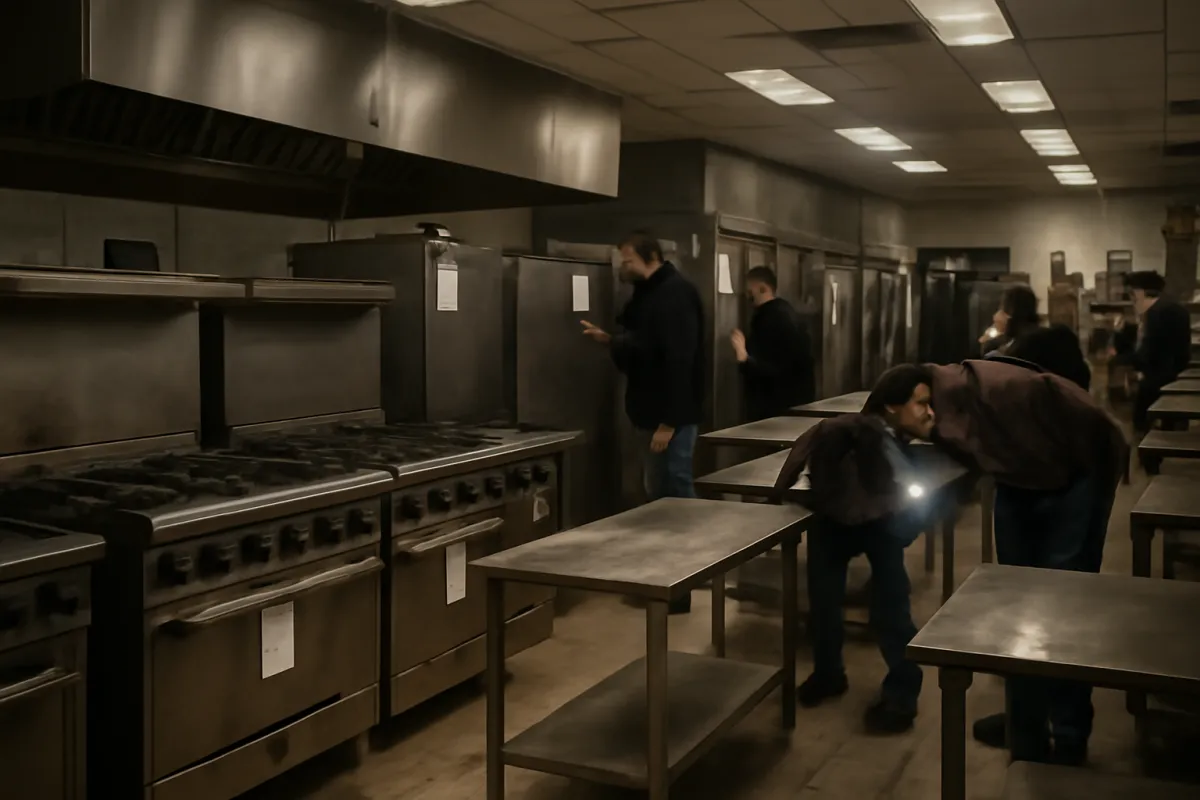
The channel rewards preparation and punishes romance. Attend the preview and inspect like the used vs new comparison teaches, to disqualify rather than confirm. Set a maximum bid from the piece’s value to you, add the premium and freight mentally before raising a hand, and let lots go when the room gets excited, because paying dealer money for auction risk is the worst square on the board. Buyers who hold those lines assemble prep lines, tables, and heavy metal for a fraction of any other channel’s price.
Restaurant liquidations and closing sales
When a restaurant closes, its kitchen has to go somewhere, and the sale that empties it is one of the best-priced events in the equipment market. Liquidations take several forms: a liquidator buys the whole kitchen and resells it, the owner runs an on-site everything-must-go sale, or an auction house sells the location as a single catalog. Prices commonly land in the same territory as auctions, illustratively around a third of new list and sometimes lower, because the seller’s alternative is paying to haul the gear away against a lease deadline.
The channel has two advantages no other offers. First, provenance: you are often buying from the actual kitchen where the equipment worked, sometimes with the owner present, which means you can ask how old the walk-in is, who serviced it, and why the restaurant closed, and judge the answers. A kitchen that failed for location reasons can hold well-maintained gear; one that died slowly may have deferred every repair for a year. Second, package pricing: buying several pieces from one closing kitchen concentrates freight, and sellers cut real money for buyers who take more.
The costs mirror the auction channel and add one: extraction. The buyer commonly uninstalls, which for anything hard-plumbed, gas-connected, or walk-in sized means licensed trades and rigging, priced before you bid rather than after. Add the same as-is, no-recourse posture, compressed timelines, and competition from dealers restocking their own inventory. Liquidations reward buyers who can move fast with cash and a truck, and punish anyone whose opening date depends on winning a specific lot.
Private party and classified listings
The seventh channel is the most direct: an owner selling a piece of equipment straight to you through classified listings, marketplace apps, industry forums, or a sign in a window. Pricing sits between the used dealer and the auction, illustratively a bit under half of new list for presentable gear, because the seller keeps the middleman’s margin but lacks the dealer’s warranty and the auction’s traffic. For a single durable piece, a mixer, a range, a worktable, private party is often the best price a careful buyer can get on used equipment.
Everything depends on the individual seller, which is both the appeal and the hazard. You can meet the machine where it lives, run it under real load, hear its history firsthand, and negotiate directly, none of which an auction allows. You also have no recourse whatsoever after cash changes hands, no filter screening out the flood-damaged, and no institution behind the story you are told. The seller who lets you watch a compressor pull down to temperature and shows you service receipts is the channel at its best; the one who wants a deposit before a viewing is the channel at its worst.
Sensible hygiene keeps the channel safe: inspect in person and under power, pay in ways that leave a record, get a bill of sale with the serial number, and check that the seller actually owns the gear, since leased equipment occasionally gets sold by operators on their way out of business. A lien follows the machine, not the seller. For any purchase large enough to hurt, an hour of a technician’s time before handing over the money remains the cheapest insurance in the deal.
What the same equipment costs by channel
Price the channels against one identical benchmark and the ladder becomes concrete. Take a piece of equipment that lists at an illustrative $10,000 new at a full-service dealer, and follow the same class of machine down the board.
Illustrative price for the same $10,000-list piece, by channel
One benchmark machine, priced across the channels. Planning shapes, not quotes, before freight.
Each bar's width is its price as a share of the $10,000 dealer benchmark. The spread from top to bottom is more than threefold, and every step down trades away a layer of warranty, recourse, or logistics.
Read the chart as a menu of trades rather than a ranking. The $1,500 gap between the dealer and the supply store buys design help, installation, and accountability on a new machine. The $3,000 gap between new at a supply store and refurbished at a used dealer is the depreciation cliff our used vs new comparison maps, minus the refurbisher’s margin for inspection and a short warranty. The further drops to private party, liquidation, and auction pricing buy out the warranty, the filter, and the logistics entirely.
Two cautions keep the chart honest. These are illustrative mid-range shapes: a lightly used current model at a well-attended auction can hammer far above 30 percent of list, and a tired unit at a desperate liquidation can go for less than 20. And the chart shows purchase price only; freight, rigging, repairs, and the value of a warranty move the true totals, which is why the cheapest bar is not automatically the cheapest outcome.
The risk ladder: what the discount buys you out of
Every discount on the chart above has an exact composition, and naming it purchase by purchase is what separates a bargain from a gamble. The dealer price includes five protections: a manufacturer warranty, a seller with service obligations, delivery and installation logistics, recourse if the machine arrives wrong, and a filter that keeps damaged gear out of inventory entirely. Each cheaper channel strips some of those away, and the money you save is precisely the market’s price for the protections you no longer hold.
The supply store and online channels keep the warranty and most recourse but shed the project support and, online, put freight risk partly on you. The used dealer trades the manufacturer warranty for a short house warranty and keeps the filter, which is why it is the safest cheap channel. Private party keeps your ability to inspect under load but deletes recourse and the filter. Auctions and liquidations delete everything at once: no warranty, no recourse, no filter, no logistics, limited inspection. The 70 percent discount at the bottom of the chart is not generosity; it is the sum of every protection you agreed to live without.
The discipline that follows is to price the stripped protections for your situation, not in general. A warranty on a walk-in is worth a lot to a restaurant with one walk-in and nothing to a buyer furnishing a backup line. Recourse matters more the further the seller is from you. Downtime risk, the heaviest weight in the bag, scales with what a dead day costs your operation, the same arithmetic our buy vs lease analysis applies to ownership itself. Carry the risks that are cheap for you to carry, and pay to shed the ones that are not.
Matching the channel to the equipment category
The channel decision is really a category-by-category decision, because the risk that the cheap channels transfer to you lands differently on different classes of gear. The commonly cited map is consistent across experienced buyers, and it follows one principle: the more expensive and invisible a piece’s failure modes, the higher up the protection ladder it should be bought.
Sealed systems top the protection list. Refrigeration, freezers, ice machines, and anything with a compressor hide their condition until they fail, and fail expensively, which is why our commercial refrigerator cost case study treats the used compressor as the classic false bargain. Buy these new, or refurbished from a dealer whose warranty outlives the return trip. Dish machines and combi ovens, heavy on electronics and plumbing, sit beside them. Ventilation hoods and fire suppression belong to the dealer channel for a different reason: they are engineered to the space and gated by inspection, so the cheap channels rarely fit at all.
At the other pole sits the durable, visible metal where used channels shine: ranges, worktables, shelving, sinks, and the simple heavy pieces whose condition a flashlight reveals and whose failures cost a weld rather than a service call. Auctions and liquidations exist for this gear. Between the poles, mixers, slicers, and mechanical smallwares reward the private party inspection under load, and smallwares themselves belong to the supply store, where new is already cheap. The full inventory our commercial kitchen equipment list walks through can be sorted into these three tiers in ten minutes, and that sorted list is the shopping plan the next sections assume.
Freight, rigging, and delivery: the costs the channel hides
The sticker gaps between channels shrink, sometimes sharply, once the equipment has to actually arrive at your door, because the channels bundle wildly different amounts of logistics. A dealer price commonly includes delivery, uncrating, setting in place, and often startup. A supply store price includes a loading dock. An online price includes a truck to the curb. An auction price includes nothing at all: the lot is yours where it stands, and getting it out of the building is your problem, on a deadline.
The numbers are not small. Commercial equipment ships heavy and awkward, and illustratively, freight on a single large piece can run from a few hundred dollars to well over a thousand once liftgate service, inside delivery, and residential-style access are added. Rigging a walk-in out of a closed restaurant, disconnecting gas and refrigerant with licensed trades, and trucking it across town can add four figures to a hammer price that looked like a steal. A $3,000 auction range that needs $700 of transport and a $250 gas reconnect is a $3,950 range, still cheap, but a third less cheap than the bidding felt.
The discipline is to price the landed, installed cost of every candidate before choosing a channel, not after. Get the freight quote before the auction, not after winning; ask the private seller about doorway widths and stairs; add the reconnection trades for anything plumbed or hard-wired. Cheap channels stay cheap for buyers with a truck, a pallet jack, and patience, which is a real and legitimate advantage. For everyone else, logistics is a line item that belongs in the comparison at full weight, because it is the one cost that always favors the expensive channels.
Warranties, recourse, and paperwork by channel
What happens after the money moves is where the channels differ most, and it is worth knowing the norms before you need them. New equipment from any channel carries the manufacturer’s warranty, commonly a year on parts and labor for major categories and longer on components like compressors, though terms vary and deserve reading. The dealer adds its own service relationship on top; the supply store and online channels leave warranty service to the manufacturer’s network, which works fine where that network is dense and badly where it is not. Registering the warranty and keeping the invoice is the whole job on the buyer’s side.
The used channels run thinner. A used dealer’s house warranty, commonly 30 to 90 days, covers less for less time but is real, and the dealer’s interest in its reputation extends a little past the paper. Private party sales are final the moment cash changes hands, whatever was said beside the machine, which is why the bill of sale with serial number, price, and an as-is acknowledgment matters: it documents ownership, protects both parties’ stories, and is the paper a technician or insurer will later ask for. Auctions and liquidations are explicitly as-is, and the terms sheet you agreed to by bidding says so in bold.
Recourse has a quieter cousin worth checking in every used channel: title. Equipment bought on finance carries a lender’s lien until paid off, and a lien follows the machine to its next owner. A lien search is routine for large private purchases, and reputable auction houses and used dealers clear titles before selling. The cost of checking is minutes; the cost of skipping it is occasionally the machine itself.
Financing by channel
How you can pay varies by channel as sharply as price does, and for cash-tight operators the financing question sometimes decides the channel on its own. Dealers and larger supply houses arrange financing at the point of sale, with lenders who like the paperwork: a clean invoice, new collateral with a warranty, and a seller of record. Vendor programs on new equipment sometimes carry promotional rates, and the whole apparatus our restaurant equipment financing case study maps, equipment loans, leases, SBA routes, is built around exactly these purchases.
The cheap channels are cash channels by default. Auctions demand payment within days, private sellers want funds at handover, and liquidators are emptying a building against a lease date; none of them will wait for a loan committee. Financing these purchases means arranging money before the purchase: a pre-approved equipment facility, a line of credit, or a lender who explicitly funds auction buys against a pre-sale approval. Expect used, as-is collateral to price with a higher rate, a shorter term, and a larger down payment where it finances at all, which narrows the sticker gap between the cheap channels and financed new gear, the same effect our equipment financing case study works through on a full kitchen.
The strategic consequence is worth stating plainly: subsidized money on new equipment and expensive money on used can bend the channel comparison, occasionally all the way. A promotional rate at a dealer against cash at an auction is not the same contest as sticker against sticker. Price each candidate with its real financing attached, then compare, and let the calculator translate each version into payback terms before anything gets signed.
Timing the purchase
Every channel has a clock, and buyers who read it pay less in the same places everyone else shops. The used channels move with the restaurant failure cycle: closures cluster after the holidays and at the end of summer in many markets, which stocks auctions, liquidators, and used dealers a few weeks later. A buyer who can wait for that inventory wave chooses among more machines at softer prices; a buyer who must purchase in the thin season competes for less. Watching auction calendars for a month before you need anything teaches the local rhythm faster than any rule of thumb.
New equipment keeps a different calendar. Model updates push superseded units onto clearance, dealer quarters end the way all sales quarters end, with quotas and flexibility, and trade show seasons produce promotions from manufacturers moving the previous line. None of this rivals the used discount in size, illustratively shaving a modest slice off list rather than half of it, but it costs nothing to time a purchase you were making anyway. Floor models and scratch-and-dent units, new machines with cosmetic history, occupy a quiet shelf between channels and price accordingly.
The timing lever cuts the other way with equal force: urgency is the most expensive channel of all. The operator whose only fryer died on Thursday buys whatever is nearest at whatever it costs, and every seller knows it. The cheap channels are only open to buyers with slack, which is an argument for buying replacements a season early for the gear your revenue depends on, and for keeping the backup capacity conversation from our buy vs lease analysis alive before the failure, not after.
Inspecting before you buy, channel by channel
Inspection is the skill that unlocks the cheap channels, and how much of it each channel allows is part of the price. The full method belongs to our used vs new comparison: inspect to disqualify rather than confirm, run gear under load, read hour and wear evidence against the story, treat maintenance records as the best predictor of remaining life, and weigh seller friction as a finding. What changes by channel is how much of that method you get to apply.

Private party allows the whole method, which is the channel’s underrated strength: insist on seeing refrigeration hold temperature, burners light, and motors run warm, and walk when a seller resists. Used dealers substitute their inspection for part of yours; verify it by asking exactly what was tested and replaced, then spot-check. Auctions and liquidations compress everything into a preview: gear sits cold and unplugged, so you are reading gaskets, hinges, burn patterns, corrosion, and smells rather than performance. The rule that follows is mechanical: bid on what you can verify, and price what you cannot verify as broken. If an untested compressor turns out to work, the surprise was in your favor, which is the only direction a surprise should be allowed to run at an auction.
For any single piece expensive enough to hurt, the technician-hour rule survives every channel: a few hundred dollars, illustratively, for a professional opinion before an irreversible purchase remains the best-priced insurance in the equipment market.
A mixed channel buying strategy for one kitchen
Put the whole framework to work on one illustrative kitchen. The equipment list, built the way our commercial kitchen equipment list builds one, prices at $60,000 if every line is bought new at list. A single-channel buyer pays roughly that at a dealer, somewhat less at supply stores. A mixed-channel buyer sorts the list into the three tiers this case study has been assembling, and buys each tier where it belongs.
The critical tier, refrigeration, the dish machine, and the code-bound ventilation work, makes up about 40 percent of the list, $24,000, and gets bought new through a dealer and supply house, full price and full protection. The durable tier, the range line, ovens, mixers, and stainless, lists at about $24,000 and comes from a used dealer, refurbished with a house warranty, at an illustrative 55 percent of list, $13,200. The simple tier, tables, shelving, sinks, and back-of-house metal, lists at $12,000 and gets hunted across an auction and a liquidation at roughly 35 percent of list, $4,200. Freight, rigging, and a repair allowance for the used tiers add about $2,600.
Where the mixed-channel kitchen's ~$44,000 actually goes
Illustrative spend split for the $60,000-list kitchen bought across four channels. Shares sum to 100.
The mixed strategy spends roughly $44,000 to fill a $60,000 list, a saving near $16,000 or about 27 percent, while keeping full protection on every piece whose failure would stop revenue.
The total lands near $44,000 against the $60,000 all-new benchmark: roughly $16,000 saved, about 27 percent, with warranties still standing behind every piece that could take a service down. The exact split is illustrative and yours will differ, but the structure transfers to any kitchen: protection where failure is expensive, discounts where it is not, and logistics priced into every line. The companion beside this case study runs the same arithmetic on your own list and shares.
Common mistakes when buying restaurant equipment
The recurring channel mistakes are consistent enough to list, and most of them are the same error wearing different clothes: reading the sticker as the whole price. Buyers compare an auction hammer price against a dealer quote and forget that one includes delivery, installation, and a warranty and the other includes nothing, so the comparison was never like for like. The fix is mechanical: compare landed, installed, protected cost, with the missing warranty priced onto the cheap side or off the expensive one.
The second family of mistakes is channel-category mismatch. The classic is buying refrigeration at auction because the discount was spectacular, then meeting the compressor repair that erases it; the mirror image is paying dealer prices for worktables and shelving that any liquidation would have supplied at a third of the cost. The map in this case study exists to prevent both directions. Third is ignoring logistics until after the purchase, which converts good hammer prices into mediocre landed prices and occasionally into forfeited lots when the removal window closes.
The fourth mistake is buying on urgency, paying whatever the nearest channel charges because a failure left no slack, which is less a shopping error than a planning one, and the cure is replacing critical gear a season before it forces the issue. The last is skipping the condition decision entirely: the channel question answers where to buy, and only the used vs new arithmetic answers what condition to buy. Buyers who run both decisions, in that order, stop donating money to whichever channel happened to be closest.
Red flags in any channel
Certain findings end a purchase conversation regardless of which channel it happens in. Treat these as walk-away signals rather than negotiating points.
- A price dramatically below the channel’s own norm. Every channel has a floor set by real competition. A listing far beneath it is priced by something you cannot see: damage, a lien, or a seller who does not own the machine.
- Resistance to inspection or to running equipment under power. In any channel that permits testing, an excuse for why the machine cannot be run today is itself the finding.
- No paperwork where paperwork is normal. A dealer without an invoice, a private seller without a bill of sale, an auction house vague about title. The documents are cheap; their absence is information.
- Pressure to commit before you can verify. Urgency is the oldest tool for selling problems, and it appears in every channel: the lot closing in an hour, the other buyer coming at noon, the quote expiring today.
- A story that outruns the evidence. Barely used, always serviced, works perfectly, attached to a machine whose wear says otherwise. When the story and the metal disagree, believe the metal.
- Sellers who cannot say where the machine came from. Provenance matters most in the cheap channels, and a seller with no answer to a simple history question is asking you to buy the answer blind.
None of these requires certainty to act on. The used market compensates buyers for normal, visible risk; a deal that adds concealed risk on top is mispriced by definition, and in every channel there is always another machine.
The bottom line
Where to buy restaurant equipment has a structural answer: seven channels, arranged on a single ladder where price and protection fall together. Dealers and supply stores sell certainty at full price; used dealers sell filtered risk at half price; auctions, liquidations, and private sellers sell raw risk at a third. Illustratively, the same $10,000-list machine spans $3,000 to $10,000 across the board, and every dollar of that spread is a named protection you either keep or sell. The channel question then resolves category by category: full protection for sealed systems and anything whose failure stops revenue, cheap channels for the durable metal a flashlight can judge, and landed cost, freight and rigging included, as the only honest basis for comparison.
Run the condition decision first with the used vs new arithmetic, sort your list into tiers, and buy each tier where it belongs: the worked example here filled a $60,000 list for about $44,000 without giving up a warranty on anything that mattered. Then let the equipment ROI calculator confirm that each piece earns its keep at the price its channel offers. The operators who equip kitchens well are not loyal to any channel; they are loyal to the arithmetic, and they let it choose the door they walk through for every line on the list.
Bought from the floor, the catalog, and the auction block, but written from none of their payrolls: this rundown is educational material, not purchasing, financial, or legal advice, and it recommends no specific seller, marketplace, auction house, or brand. Every price, percentage, and savings figure is an illustrative planning shape, not a quote, and real equipment markets price each machine on its own condition, history, and local competition. Auction terms, warranty coverage, lien rules, and freight costs vary by seller and jurisdiction and change without notice, so verify the terms of any sale in writing, inspect before you commit, and put a qualified technician, and where the money is serious your accountant and attorney, between you and any signature.
Frequently asked questions
Where can you buy restaurant equipment?
Restaurant equipment moves through seven main channels: new equipment dealers, restaurant supply stores and cash and carry warehouses, online marketplaces, used equipment dealers and refurbishers, auctions, restaurant liquidation and closing sales, and private party listings. Each channel sells much of the same gear at a different mix of price, protection, and effort. Dealers and supply stores cost the most and carry the most support; auctions and liquidations cost the least and carry essentially none. Most well-equipped kitchens are built from two or three channels at once rather than a single source, matching each purchase to how critical the piece is.
What is the cheapest place to buy restaurant equipment?
Auctions and restaurant liquidation sales usually produce the lowest prices, with illustrative hammer prices commonly landing around a third of what the same piece lists for new. The discount is real, but it is payment for risk: sales are as-is, inspection is limited, and there is no recourse if the compressor dies a week later. Private party listings and used dealers sit above auctions on price and below them on risk. The cheapest channel for a given buyer is the one whose risks they can actually absorb, which is why the cheapest sticker is not always the cheapest outcome.
How much can you save buying restaurant equipment used or at auction?
Illustratively, refurbished units from a used dealer commonly sell around half of new list, private party pieces a bit below that, and auction or liquidation lots around 30 to 35 percent of new list. On a mixed purchase, the worked example in this case study equips a kitchen listing at $60,000 new for roughly $44,000 by buying the critical pieces new, the durable ones refurbished, and the simple ones at auction, a saving of roughly $16,000 or about 27 percent. Real savings vary widely with category, condition, and freight, so treat every figure as a planning shape rather than a quote.
Is it safe to buy restaurant equipment at an auction?
It can be, for the right buyer and the right equipment. Auction lots sell as-is, usually without the chance to run anything under load, and with no recourse afterward, so the channel suits mechanically simple gear a buyer can judge by eye: tables, shelving, sinks, smallwares, and heavy metal like ranges. It is a poor place to buy anything with a compressor or electronics you cannot test, because a silent walk-in or an unplugged reach-in hides the most expensive failures. Attend the preview, set a maximum bid that reflects the risk, and remember that freight and rigging come on top of the hammer price.
Do restaurant supply stores sell to the public?
Many do. Cash and carry restaurant supply warehouses commonly sell to anyone who walks in, and most online restaurant supply retailers take orders from the public as well, though some dealers focus on commercial accounts. Prices at supply stores typically sit below a full-service dealership on the same class of gear because the store carries stock lines and offers less project support. For an operator who knows exactly what they need, the supply store is often the best mix of new-equipment protection and moderate price; for a full kitchen design with installation, a dealer earns its premium.
What restaurant equipment should you buy new rather than used?
The commonly cited rule is to buy new, or refurbished with a real warranty, wherever a failure stops revenue or where wear is invisible. Refrigeration leads the list, because a used compressor is the classic bargain that turns expensive, followed by ice machines, dish machines, and anything with sealed systems or sensitive electronics. Ventilation hoods and fire suppression are usually bought new because they must fit the space and pass inspection. Durable, simple metal, ranges, worktables, shelving, and sinks, is where used and auction channels shine, since condition is visible and failure is cheap. The full condition decision is its own analysis, separate from choosing a channel.
Can you finance restaurant equipment bought at auction or from a private seller?
It is harder than financing through a dealer. Dealers and supply houses arrange financing at the point of sale, and lenders like the paperwork: an invoice, a warranty, and clean title. Auction and private party purchases usually need cash or a pre-arranged facility, because many equipment lenders hesitate to fund as-is collateral with no invoice trail, and auction payment deadlines are short. Some lenders do fund auction purchases through pre-approval ahead of the sale date. If financing matters to the plan, settle it before bidding, not after winning, and expect used collateral to carry a higher rate and a shorter term.
What is a restaurant liquidation sale and is it a good place to buy?
A liquidation sale disposes of a closing restaurant's equipment, either through a liquidator, an on-site sale, or an auction of the whole location. Prices are commonly among the lowest of any channel, and buying from the actual kitchen means you can sometimes see the gear where it worked. The risks mirror the auction channel: as-is sales, limited testing, no recourse, plus removal, since the buyer often hauls and uninstalls the piece. Liquidations reward buyers who move fast, inspect hard, and can handle rigging. They are a poor first stop for a piece your opening date depends on.