

What's on this page
- What a restaurant equipment maintenance schedule actually is
- Why the ownership phase is the part nobody budgets
- The three sources that should write your schedule
- Daily tasks: the close-down list that does most of the work
- Weekly tasks: the deeper clean nobody has time for
- Monthly tasks: the walkaround that catches the expensive things
- Quarterly and annual tasks: where the technician takes over
- Refrigeration: the class where deferred maintenance costs the most
- Cooking equipment: ranges, ovens, griddles and broilers
- Fryers: oil, filtration and the calibration drift nobody sees
- Ventilation, grease and fire suppression: the code-driven class
- Warewashing: the dishmachine, water and chemical dosing
- Ice machines and beverage equipment
- Espresso and coffee equipment, if you run a beverage program
- Water quality: the single upstream lever on several classes
- What belongs to staff and what belongs to a technician
- How service contracts are usually structured
- How a written schedule protects warranty coverage
- What deferred maintenance costs in downtime
- A worked example: costing a maintenance program for one kitchen
- Where the maintenance money and hours actually go
- Building the schedule: a practical assembly order
- Logging, accountability and who signs off
- Maintenance and the health inspection
- When to repair, when to replace
- Maintenance in a food truck or ghost kitchen
- Common mistakes that quietly break a schedule
- The bottom line
Short answer: A restaurant equipment maintenance schedule has four layers: daily close-down tasks, weekly deeper cleaning, a monthly inspection walkaround, and quarterly or annual work that belongs to a licensed technician. Take intervals from your own equipment manuals, run hours, and local code rather than a generic checklist, keep dated logs to support warranty claims, and expect an illustrative planned program near $10,416 a year on a $160,000 fleet.
Every equipment article ends at the moment the truck leaves. You priced the kitchen, you decided new against used, you argued about financing, the gear arrived, and then the writing stops. What happens next is the part that actually decides whether the equipment was a good buy: the five, ten or fifteen years you own it, run it hard, and either look after it or do not. A restaurant equipment maintenance schedule is the tool that governs that phase, and it is the cheapest asset-protection instrument in the building.
This case study covers the ownership phase our buying and financing work skips. It sets out what belongs on a daily, weekly, monthly and quarterly cadence by equipment class, draws the line between what your staff can safely do and what belongs to a qualified technician, explains the mechanism by which a written record supports a warranty claim, and puts illustrative arithmetic on what deferred maintenance costs in downtime. For the spec reference on what each class contains, keep our commercial kitchen equipment list beside this one; for what the fleet cost to assemble in the first place, our commercial kitchen equipment cost case study is the companion piece. Run your own program cost as you read with the equipment ROI calculator.
Key takeaways
- A schedule has four layers, not one list: daily close-down tasks, weekly deeper cleaning, a monthly inspection walkaround, and quarterly or annual work that belongs to a technician.
- Intervals come from your own equipment manuals, your actual run hours, and local code. Do not copy a frequency from a generic checklist, and never from an article, this one included.
- Staff own cleaning, inspection and reporting. Gas, refrigerant, electrical work, calibration and fire suppression belong to a licensed, qualified technician without exception.
- The record is what supports a warranty claim. Dated logs, service invoices and parts receipts turn a claim from an argument into a formality.
- Illustratively, a planned program near $10,416 a year on a $160,000 fleet is smaller than the margin lost to a handful of unplanned outage days.
What a restaurant equipment maintenance schedule actually is
A restaurant equipment maintenance schedule is a written, dated, assigned plan that says which task happens to which machine at which interval, and who signs that it was done. Each of those four elements is doing work. Written means it survives staff turnover, which in this industry is the single biggest reason institutional knowledge evaporates. Dated means you can prove a pattern rather than assert one. Assigned means a named person rather than the kitchen in general, because a task owned by everyone is owned by no one. Signed means someone put their name against a claim that the work happened.
What it is not is a cleaning rota with a new name. Cleaning is a large share of the hours, but the schedule also carries inspection tasks that produce information, calibration checks that catch drift before it becomes waste, and scheduled technician visits that touch systems staff must never open. A rota tells the closing shift to wipe the fryer. A schedule tells you that the fryer’s oil is being filtered on the right cadence, that its thermostat is reading true against a probe, and that a technician looked at its gas connection on the interval its manual specifies.
The last thing the schedule is not is universal. Two kitchens with identical equipment lists but different volumes need different intervals, because wear tracks run hours rather than calendar days.
Why the ownership phase is the part nobody budgets
Look at how a restaurant opening is planned and the gap is obvious. There is a line for equipment purchase, a line for installation, often a line for financing, and then nothing until the gear breaks. The ownership phase, which is where almost all of the equipment’s total cost of ownership actually accrues, arrives as a series of surprises charged to whatever cash is around that week. Our used-versus-new equipment case study runs the cost-per-working-year math that shows why this is a mistake: working years are not free years, and the machine that lasts twelve years instead of seven usually got there through upkeep rather than luck.
The budgeting gap has a psychological cause worth naming. Buying equipment is a decision with a moment, a quote, a signature and a delivery. Maintaining it is a habit with no moment, no signature and no delivery, which makes it invisible to the part of an operator’s brain that tracks decisions. The result is that maintenance loses every argument against anything with a date on it, right up until a compressor dies on a Friday.
Treating maintenance as a budget line rather than an emergency reserve is the fix. Give it a number, put it in the operating plan next to the other controllable costs in our restaurant profit margin case study, and it starts competing on equal footing.
The three sources that should write your schedule
Your schedule should be assembled from three sources, in this order, and from nothing else.
The first is the manufacturer’s manual for each specific unit you own. This is the only source that knows your machine: which filter it takes, which panel comes off, which surfaces are user-serviceable, what the maintenance section requires to keep coverage intact. Manuals are frequently lost within a year of installation, which is why the first task in building a schedule is usually a scavenger hunt through drawers and manufacturer websites for model-specific documentation. Build a folder, physical or digital, with a manual for every unit before you write a single interval.
The second is your own operating reality. A manual writes its intervals against an assumed duty cycle. If you run a machine harder than that assumption, the interval shortens. A fryer in a kitchen that sells fried food all day is not on the same clock as one that fires twice a service.
The third is local code and your service provider. Certain classes, ventilation and fire suppression above all, are governed by local fire code and by whichever servicing standard your jurisdiction has adopted, and those requirements are jurisdiction-specific and change over time. That is why this case study describes that such requirements exist without naming a frequency: your local fire marshal and your licensed service provider are the authorities, and copying a number from anywhere else is how operators end up out of compliance while believing they are covered.
Daily tasks: the close-down list that does most of the work
The daily layer is where most of the protective value sits, because it stops the accumulation that causes almost every avoidable failure. Grease, limescale, food debris and dust are all cumulative problems, and every one of them is cheap to remove today and expensive to remove in six months.
A daily layer typically covers: wiping and drying all exterior and food-contact surfaces once cooled; degreasing the cooking line, including the sides and backs staff skip; skimming and straining fryer oil; pulling hood baffle filters for washing on whatever cadence your grease load demands; emptying and cleaning floor drains and equipment drain pans; sanitising food-contact parts on slicers, mixers and beverage equipment per the manual; wiping refrigerator and freezer door gaskets so grease does not degrade the rubber; logging every refrigeration unit’s temperature at open and close; and a fast look and listen for anything different.
That last item is the underrated one. The people who use a machine every day are the best sensors you will ever install, and they notice a new rattle, a longer cycle, a door that needs an extra push or a smell that was not there yesterday. What they usually lack is a channel to report it that leads anywhere. Give them one: a line on the close-down sheet, a note to the manager, a photo in the group chat. A reported noise is a cheap repair. An unreported one is a Saturday closure.

Weekly tasks: the deeper clean nobody has time for
The weekly layer is everything that is too involved for a close-down but too frequent for a monthly walkaround. It is also the layer most likely to be quietly abandoned, because it lands on whoever is around rather than on a defined shift, which is why the assembly advice later in this case study is to fix it to the slowest shift of the week and to a named person.
Typical weekly work includes: a deep degrease of the cooking line, including under and behind units on castors that roll out; flushing drain lines with hot water and an appropriate cleaner to prevent the slow blockage that eventually backs up into a walk-in floor; removing and washing removable parts that only come off with tools; descaling routines on anything that boils or steams water, on the cadence your water hardness demands; checking and cleaning door gaskets properly rather than wiping them; emptying and cleaning ice machine bins; and running whatever cleaning cycle your dishmachine and beverage equipment provide.
Weekly is also the right cadence for a short calibration sanity check on the equipment where drift costs you money rather than safety. An oven that reads 20 degrees hot bakes badly and burns product, and a walk-in reading two degrees warm than it holds is a food-safety problem waiting for an inspector. A cheap independent thermometer, placed and read on a weekly rhythm, catches both long before anyone notices a pattern in the waste bin, which is exactly the kind of slow loss our restaurant food waste case study tracks back to equipment rather than to portioning.
Monthly tasks: the walkaround that catches the expensive things
The monthly layer is not primarily cleaning. It is inspection, done with a flashlight, by someone whose job that month is to look at the equipment rather than to use it. Daily users stop seeing their own kitchen after a few weeks, and the monthly walkaround exists to break that blindness.
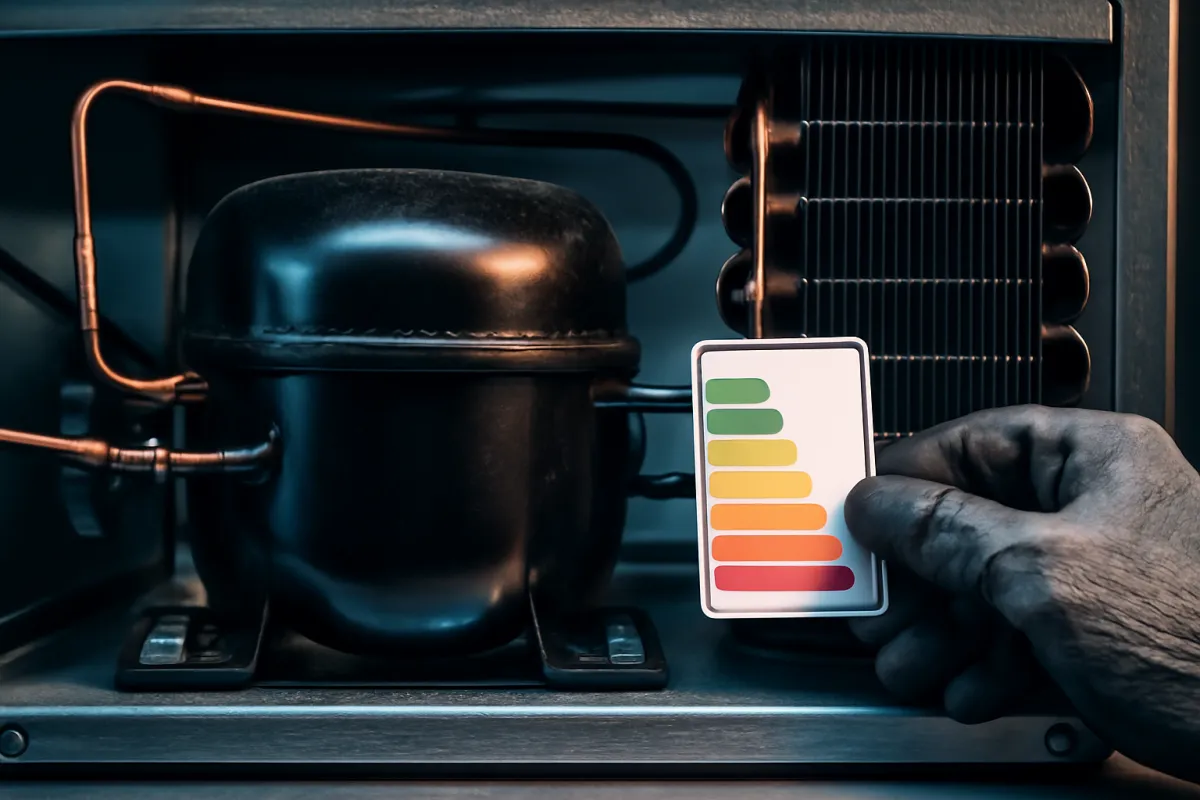
What the walkaround looks for: condenser coils on every refrigerated unit, which clog with dust and grease and are the single most common cause of a refrigeration system working too hard; door gaskets across the whole fleet, checked for splits, hardening and a proper seal against a sheet of paper; hinges and door closers that have dropped, because a door that no longer self-closes is a compressor running all night; castors, feet and levelling, since an unlevel unit drains badly and wears unevenly; visible water where water should not be, which is how you find a slow leak before it finds your floor; frayed cords and scorched outlets, which get reported and never touched by anyone unqualified; and unusual frost or ice patterns inside refrigeration, which point at a door, a defrost cycle or a refrigerant issue.
The output of the walkaround is a list, not a feeling. Three columns: fix now in-house, book a technician, and watch next month. That list is the thing that turns inspection into maintenance, and it is also the paper trail that will matter if you ever make a warranty claim.
Quarterly and annual tasks: where the technician takes over
The quarterly and annual layer is defined less by frequency than by who is allowed to do it. This is the work that requires a licensed or manufacturer-certified technician because it touches gas, refrigerant, sealed electrical systems, or safety controls whose calibration has consequences.
The general shape of technician work across a kitchen fleet includes: refrigeration system checks covering refrigerant charge, compressor performance, defrost operation and electrical connections; gas equipment servicing covering connections, burners, pilots, safety valves and combustion; calibration of thermostats and controls on cooking equipment; dishmachine servicing covering wash and rinse temperatures, chemical dosing, pumps and seals; water treatment system checks and filter changes on whatever schedule your water and volume require; and the ventilation and fire-suppression work described in its own section below.
Two rules matter more than the list. First, the intervals come from the manuals and from your service provider’s read of how hard you run each unit, not from a generic quarterly rhythm applied to everything. Second, every visit produces a document. The invoice, the technician’s notes and any parts list are the record that supports a warranty claim, satisfies an inspector who asks, and gives you a maintenance history when you eventually sell or trade the equipment through one of the channels in our where to buy restaurant equipment case study.
Refrigeration: the class where deferred maintenance costs the most
Refrigeration deserves its own section because it is the class where the consequence of failure is not just a repair bill. A cooking unit that fails takes a station off the menu. A walk-in that fails overnight can spoil a large share of your food inventory, which is a cost that lands entirely outside the repair and lands all at once.
The staff layer here is straightforward and high value: wipe gaskets daily so grease does not attack the rubber, keep the unit loaded in a way that lets air circulate rather than packing it solid, log temperatures at open and close, keep the door closed, and clear the drain so condensate goes where it should. The monthly layer is the condenser coil, which quietly determines how hard the compressor works, and the gasket seal check. The technician layer is everything involving refrigerant, which is not optional advice: refrigerant handling is regulated work and a sealed system is not something anyone unqualified should open.
The economics are the argument. Our commercial refrigerator cost case study and commercial freezer cost case study price what these units cost to buy, and the pattern is consistent: the compressor is the wear item, the compressor’s workload is set by airflow and door discipline, and both of those are maintenance rather than luck. A refrigeration unit that is cleaned and sealed is running a lighter duty cycle every day of its life.
Cooking equipment: ranges, ovens, griddles and broilers
Cooking equipment is more tolerant of neglect than refrigeration, which is exactly why it accumulates the most. Grease builds on and inside these units continuously, and grease is both a fire risk and an insulator that makes equipment work harder and cook unevenly.
The daily layer is degreasing that goes beyond the visible front: the sides, the back, the shelf under the range, the area behind units on castors, the oven interior on whatever cadence your product demands, and griddle surfaces scraped and cleaned to the manufacturer’s method rather than to whatever tool is nearest. The weekly layer is burner ports and pilots checked for even flame and cleared of debris, removable parts pulled and washed properly, and oven door gaskets and hinges checked so heat is not escaping past a seal. The monthly layer is an inspection for cracked grates, warped surfaces and doors that no longer close square.
The technician layer is everything involving gas: connections, valves, pilots, burner adjustment and combustion. There is no in-house version of that work. A staff member who adjusts a gas burner has moved a safety question into an untrained pair of hands, and has probably affected the coverage on a unit that our commercial oven cost case study shows is not a cheap thing to replace early.
Fryers: oil, filtration and the calibration drift nobody sees
Fryers are the class where maintenance shows up directly in food cost, which makes them the easiest place to prove the value of a schedule to a sceptical team. Oil is an ingredient with a purchase price, and filtration extends its usable life. A fryer that is skimmed through service and filtered on a proper cadence goes through less oil than one that is not, and the difference is a real line in your food cost.
The staff layer covers skimming debris during service, filtering on the cadence your volume requires, boiling out on the manufacturer’s method and schedule, keeping the exterior degreased, and checking the oil level so the elements or tubes are never exposed. Fryer work involves hot oil and needs actual training rather than a note on a checklist, so treat the first filtration training as part of onboarding for anyone who will do it.
The invisible problem is thermostat drift. A fryer running hotter than its dial says burns product, degrades oil faster and costs more per basket. A fryer running cold produces greasy food and slower tickets. Neither announces itself, which is why a periodic check against an independent probe belongs on the schedule and why calibration belongs to a technician. Our commercial fryer cost case study covers what these units cost to buy; the oil and the drift are what they cost to run.
Ventilation, grease and fire suppression: the code-driven class
This is the class where this case study will deliberately not give you a number, and the reason is worth stating plainly. Kitchen exhaust system cleaning and fire-suppression system servicing are governed by local fire code and by whichever servicing standard your jurisdiction has adopted. The required frequency depends on your cooking volume and the type of cooking you do, and it varies by jurisdiction and changes over time. Any frequency printed in an article is a guess about your building, and acting on a guess here is how a kitchen ends up non-compliant, uninsured on a claim, or both.
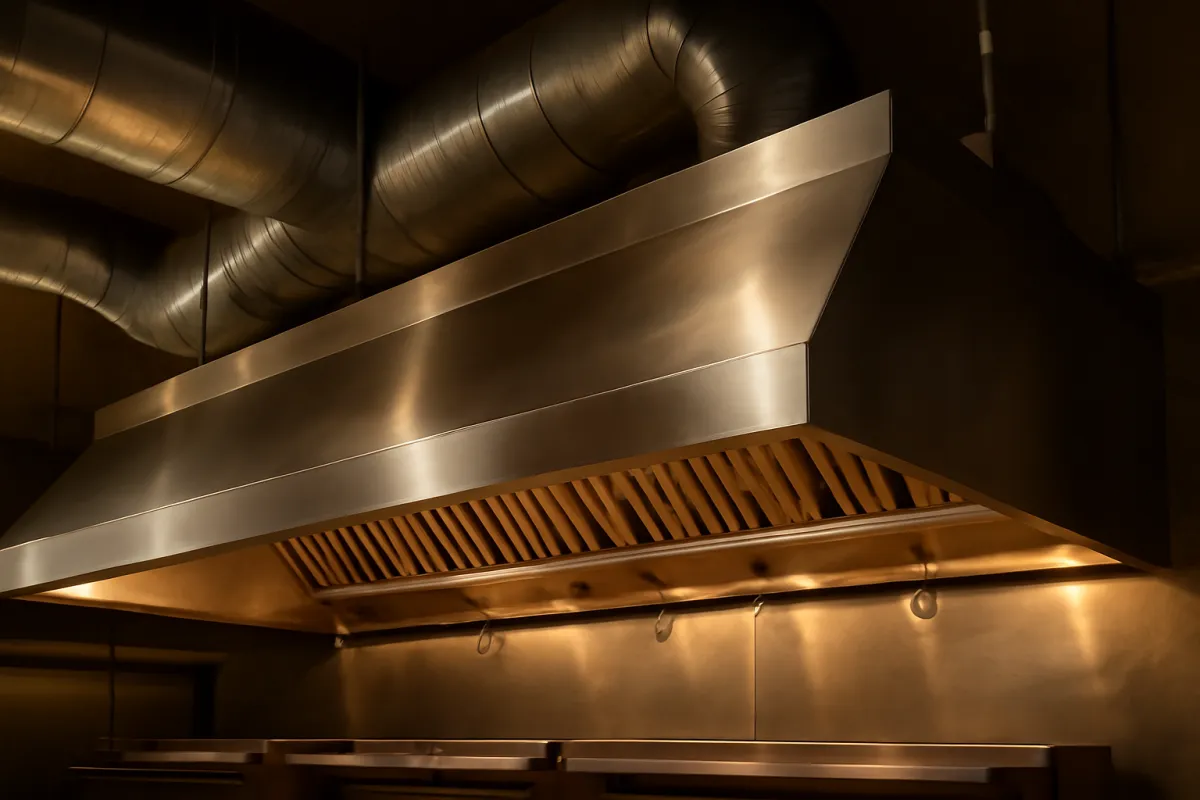
What is safe to say is the shape. There is a staff layer, which is pulling and washing baffle filters on a cadence your grease load sets and keeping the hood surfaces and the area around it clean. There is a certified layer, which is the full exhaust system cleaning of the hood, the duct run and the rooftop fan, performed by a qualified provider who documents the work and typically affixes evidence of the service. And there is a fire-suppression layer, which is inspection and servicing of the suppression system and its nozzles and links by a licensed provider on the interval your code requires.
Ask three parties and you will have the correct answer for your building: your local fire marshal or authority having jurisdiction, your equipment and system documentation, and your licensed servicing provider. Our commercial kitchen hood cost case study covers what this package costs to install, and the servicing that follows is a permanent operating line rather than a one-off.
Warewashing: the dishmachine, water and chemical dosing
The dishmachine is the unit whose failure closes a restaurant fastest, because there is no workaround at volume. Three-compartment sinks exist and will get you through a service in a pinch, but they will not get a busy dining room through a Saturday.
The daily layer is scrapping and pre-rinsing properly, cleaning wash arms and jets that clog with debris, emptying and cleaning the scrap trays and the tank, and running the machine’s own clean cycle at close. The weekly layer is descaling on the cadence your water hardness demands, checking spray nozzles for the blocked jets that produce the dirty plates everyone blames on staff, and inspecting curtains and seals. The monthly layer is a look at door gaskets, hoses and any visible leak.
The technician layer is wash and rinse temperature verification, chemical dosing calibration, and pump and seal service. Dosing matters twice over: too little chemical and you have a sanitation failure, too much and you are pouring money down the drain and shortening the life of the machine and the ware. Temperature and sanitiser concentration are also the things an inspector checks, which is why this section connects directly to our health inspection case study. Our commercial dishwasher cost case study covers the purchase side of the same machine.
Ice machines and beverage equipment
Ice machines are a food-production appliance that most kitchens treat as furniture, and that mismatch is the whole problem. Ice is food. The machine that makes it is a wet, cool environment with a continuous water supply, and it needs cleaning and sanitising on the manufacturer’s schedule rather than when someone notices something.
The staff layer is keeping the bin, scoop and door clean, keeping the scoop out of the ice, and reporting any change in ice clarity, taste, cube shape or production rate. Every one of those is a diagnostic signal: cloudy or small cubes and slow production usually point at scale or a water problem, off taste points at the water supply or a cleaning gap. The scheduled layer is the machine’s own cleaning and sanitising procedure, done to the manual, and the technician layer is the condenser, the water system and the refrigeration side.
Beverage equipment follows the same logic: lines, dispensers and nozzles are food-contact surfaces on a cleaning schedule, and the equipment behind them is on a service schedule. Our commercial ice machine cost case study prices the unit; the cleaning cadence is what decides whether you get its full life or two thirds of it.
Espresso and coffee equipment, if you run a beverage program
If your restaurant runs an espresso program, that machine sits in its own category, because it combines a pressure vessel, a heated water system and food-contact parts that see product every few minutes. It also happens to be one of the most maintenance-responsive machines in the building, in the sense that the difference between a well-kept and a neglected machine is immediately obvious in the cup.
The daily layer is backflushing the group with the manufacturer’s method and detergent, brushing the group head and gasket, soaking portafilters and baskets, wiping steam wands after every use and purging them, and emptying and cleaning drip trays and drains. The weekly layer is a deeper soak of removable parts, a grinder clean and burr check, and a look at gaskets and screens that harden and clog over time. The technician layer is the boiler, the pressure and temperature controls, the pump, and the water treatment that protects all of it.
Scale is the enemy here, which is why water treatment is not optional on this class. Our commercial espresso machine cost case study prices the hardware, and our espresso machine ROI case study runs the payback that only works if the machine survives to the end of it.
Water quality: the single upstream lever on several classes
Water quality is the most under-discussed maintenance lever in a commercial kitchen, and it acts on several classes at once. Hard water deposits scale on every heated surface it touches, which means the dishmachine, the combi oven, the steamer, the ice machine, the espresso boiler and the coffee brewer are all being slowly coated by the same upstream problem. Scale insulates, so heated elements work harder, cycles run longer, energy costs rise, and components fail earlier than they should.
Treatment is a filtration and conditioning question that depends on your local water and your equipment mix, which makes it a conversation with a water treatment provider rather than a purchase you make from a checklist. What belongs on your schedule regardless is the filter change interval, because a filter past its capacity is doing nothing while everyone believes it is working, and filter changes are one of the most commonly missed scheduled tasks in a kitchen.
The reason this section exists is leverage. Descaling routines on five machines are a recurring cost of a problem you can partly solve once, upstream. If several classes in your kitchen are scaling faster than their manuals suggest, the machines are not the issue, and treating them one at a time is treating symptoms. Ask about the water first.
What belongs to staff and what belongs to a technician
The dividing line is not skill, and framing it as skill is how operators get this wrong. It is safety, liability and coverage. Some tasks can be performed by a trained staff member without consequence. Others carry legal, insurance and warranty consequences regardless of how competent the person is.
Staff can own: all cleaning and sanitising, filter washing and replacement where the manual designates it user-serviceable, oil filtration and changes with proper training, drain clearing, gasket washing, condenser coil brushing on unplugged and accessible units, temperature logging, visual inspection, and reporting. That is the large majority of the hours in any schedule.
A qualified technician must own: anything involving gas, anything involving refrigerant, electrical repairs beyond resetting a breaker, fire-suppression systems, calibration of thermostats and safety controls, pressure vessels, and any repair that requires opening a sealed assembly. There is no cost saving that makes an exception worth it. The failure modes are injury, fire, a voided warranty and an insurance claim that gets declined because unauthorised work was performed, and the last of those interacts directly with the coverage questions in our restaurant insurance cost case study.
Write the split into the schedule itself, with a column that says staff or technician against every task. It removes the judgement call from a busy shift.
How service contracts are usually structured
Service arrangements generally fall into three shapes, and understanding them stops you comparing quotes that are not comparable.
Reactive service, sometimes called time and materials, means you call when something breaks and pay for the visit, the labour and the parts. There is no standing fee, response is subject to whoever is available, and emergency or after-hours calls typically cost more than scheduled ones.
Preventive maintenance agreements cover a defined set of scheduled visits on named equipment, usually at a fixed annual or monthly fee, with repairs billed separately and often at a discounted rate. The value is the scheduled visit that happens whether or not anyone remembers, plus documentation, plus a provider who knows your fleet.
Full-coverage or all-inclusive agreements bundle scheduled visits with parts and labour on covered failures, priced higher and with exclusions that deserve careful reading.
What to compare is not the fee. It is the covered equipment list, the response time commitment, what after-hours means and costs, whether parts are included and which are excluded, and who documents the work. A cheap agreement covering the wrong units is more expensive than a dearer one covering the units whose failure closes you. Price it against the total ownership arithmetic below rather than against another quote.
How a written schedule protects warranty coverage
The mechanism is worth understanding because it is frequently described wrongly. A schedule does not extend a warranty. What it does is preserve your ability to make a claim under the warranty you already have.
Manufacturer warranties commonly condition coverage on the equipment being installed correctly, operated as intended, and maintained according to the manual, and they commonly exclude damage arising from neglect, misuse or unauthorised repair. Read that structure carefully and the practical consequence is clear: when a covered component fails, the assessment often turns on whether the required maintenance was performed. Absent a record, the burden of proving it falls on you at the worst possible moment.
So the record is the asset. Dated maintenance logs with names against them, invoices from qualified service providers, receipts for filters and consumables, and photographs where they help all constitute evidence that the conditions were met. Keep them by unit, with the model and serial number, so a claim on one machine does not require a search through everything.
Two cautions. Terms vary by manufacturer, by model and sometimes by dealer, so read the actual document that came with each unit rather than relying on any general description, including this one. And confirm with the manufacturer or your servicing dealer which tasks you may perform in-house, because the boundary between permitted user maintenance and unauthorised repair is set by them, not by you.
What deferred maintenance costs in downtime
Deferred maintenance costs three separate things, and only the first appears on an invoice.
The repair itself is usually more expensive as an emergency than as a scheduled visit, because emergency and after-hours response carries a premium and because a component that fails while running frequently damages others on the way out. The second cost is lost sales, since a station that cannot run means items come off the menu, tickets slow down, or the kitchen closes entirely. The third is inventory, which is refrigeration-specific and lands in a single event.
The chart below puts illustrative figures on what one unplanned outage costs by class, combining the repair, any spoiled inventory, and the contribution lost while the station is down. They are planning shapes rather than quotes, and they assume the illustrative kitchen used throughout this case study: $3,000 of average daily sales and a 40 percent contribution margin, so a full lost service day costs about $1,200 in contribution alone.
Illustrative cost of one unplanned outage, by equipment class
Repair, spoiled inventory and lost contribution combined, for a kitchen at $3,000 average daily sales. Shape, not a quote.
The walk-in leads by roughly double the next class, and almost none of that gap is the repair. It is the inventory that warms up while you wait for a technician.
Read the ranking as a priority list rather than as a budget. The classes at the top of that chart are the ones that earn scheduled attention and, usually, a service agreement. The ones at the bottom can sensibly run on staff tasks plus reactive repair.
A worked example: costing a maintenance program for one kitchen
Take an illustrative full-service kitchen. Its equipment fleet would cost roughly $160,000 to replace, which matches the full-service shape in our commercial kitchen equipment cost case study. It trades 360 days a year at $3,000 average daily sales, so $1,080,000 of annual sales, and it earns a 40 percent contribution on incremental sales, meaning every lost service day costs about $1,200 in margin.
The staff layer costs 6 hours a week across the whole fleet: daily close-down tasks, the weekly deeper clean, the monthly walkaround. At a fully loaded $18 an hour, that is $108 a week and $5,616 a year.
The contracted layer is set at 3 percent of fleet replacement value, covering the critical few: refrigeration, the dishmachine, the hood and fire-suppression servicing, and the main cooking unit. That is $4,800 a year.
Total planned program: $10,416 a year, or 0.96 percent of sales. On that program, assume 3 unplanned lost service days across the year, which is $9,000 of lost sales and $3,600 of lost contribution. Total cost of the maintenance question: $14,016, about $38.93 for every day the doors are open.
Now the comparison that matters. Run the same kitchen reactively at 2 percent of fleet value, $3,200 of service, and assume 6 lost days rather than 3. Program cost falls to $8,816, but lost contribution doubles to $7,200, and the total rises to $16,016. Running full coverage at 4.5 percent, $7,200 of service, cuts downtime to 1.5 days and $1,800 of lost contribution, but the total is $14,616.
The middle option wins on this illustrative arithmetic, and it wins for a reason worth keeping: coverage has diminishing returns because prep tables and shelving do not fail. Change the inputs beside this case study to your own fleet, sales and staffing and watch which of the three shapes wins for you.
Where the maintenance money and hours actually go
The split below breaks the $14,016 total from the worked example into its three components. It is the most useful picture in this case study, because it shows that the largest single component is your own staff’s time rather than anything you write a cheque for.
Where the cost of the maintenance question goes
Illustrative split of the $14,016 annual total from the worked example, summing to 100 percent.
Staff time is the biggest slice and the one that appears on no invoice, which is exactly why it gets cut first and why cutting it moves cost into the 26 percent slice rather than removing it.
There are two lessons in that split. The first is that maintenance is mostly a labour scheduling problem, not a purchasing problem, and it competes for hours you are already paying for in the ratios our restaurant labor cost percentage case study tracks. The second is that the three slices trade against each other rather than adding independently: cut the first two and the third grows. Test that trade on your own numbers with the equipment ROI calculator.
Building the schedule: a practical assembly order
Assembling a schedule from nothing is a weekend of work, and doing it in this order stops it stalling.
Start with an asset list. Every unit, its make and model, its serial number, its purchase or install date, its warranty expiry and its supplier. That list has a second life as an insurance schedule and a depreciation record, so it earns its time immediately.
Second, find the manual for every unit and file it against the asset. This is the slow step, and it is where most attempts stop, so do it first while the enthusiasm holds.
Third, extract the maintenance section from each manual into a single table: task, interval, staff or technician.
Fourth, adjust the intervals for your real duty cycle, shortening anything you run harder than the manual assumes.
Fifth, add the code-driven items by asking your local fire marshal and your servicing provider what applies to your building, and put their answers on the calendar.
Sixth, sort every task into the four layers, assign an owner and a shift to each layer, and put the daily list where the closing shift already signs.
Seventh, decide which units get a service agreement using the outage-cost ranking above, and get quotes on that specific list.
Logging, accountability and who signs off
A schedule with no log is a wish. The log is what makes the schedule real, and it has three jobs: it proves the work happened for warranty and inspection purposes, it shows you which tasks are being skipped, and it builds a history that tells you when a machine is starting to fail.
Keep it simple enough to survive. A daily section on the close-down sheet with initials, a weekly sheet with a named owner and a date, a monthly walkaround form with the three-column output, and a folder of technician invoices by unit. Paper works. A shared spreadsheet works. An app works. What does not work is a system nobody can complete in the ninety seconds available at the end of a shift.
Accountability is the other half. Signatures mean nothing if nobody ever checks them against the equipment, so build in a spot check: once a month, a manager picks two signed tasks at random and looks at the actual machine. That habit is what stops the log becoming a work of fiction, and it is far more effective than lengthening the list.
The third job, history, pays off later. When a unit starts appearing in the log with recurring small problems, that pattern is your early warning that the repair-or-replace question is coming.
Maintenance and the health inspection
A maintenance schedule and a health inspection are looking at overlapping evidence from different directions. The inspector is checking outcomes: holding temperatures, sanitiser concentration, cleanliness of food-contact surfaces, the condition of the physical environment and whether required documentation exists. Your schedule is the process that produces most of those outcomes.
That relationship makes the schedule the cheapest inspection preparation available. Temperature logs are already being kept. Sanitising is already on a cadence. The equipment that would otherwise be cited for grease accumulation, damaged gaskets, non-functioning thermometers or an unclean ice machine is already being maintained. Kitchens that scramble before an inspection are usually kitchens without a schedule, because the scramble is compressing months of skipped work into a morning.
There is also a durable structural point. Equipment in poor repair is itself a citable condition in many jurisdictions, separate from cleanliness, because damaged surfaces cannot be properly cleaned and failing units cannot reliably hold temperature. Our health inspection case study covers what inspectors look at and how the scoring works; the schedule in this case study is the operating habit that keeps most of those items permanently in order rather than periodically fixed.
When to repair, when to replace
Every schedule eventually surfaces a unit that is costing more attention than it returns, and the repair-or-replace question needs a method rather than a mood.
The arithmetic is a cost-per-remaining-working-year comparison, the same frame our used-versus-new equipment case study applies to buying. Take the quoted repair, estimate honestly how many more years the unit has after it, and divide. Compare that against a replacement’s price divided by its expected life. If the repair costs $1,400 on a unit with maybe two years left, that is $700 a working year. If a replacement costs $6,000 with a ten-year expectation, that is $600 a working year, and the replacement wins before you count anything else.
Then adjust for the things the arithmetic misses. Add the downtime risk of an ageing unit using the outage costs above. Add the energy difference, which on old refrigeration can be substantial. Add the food-safety exposure of a unit that struggles to hold temperature. Subtract any residual value if the old unit can be sold or traded.
If replacement wins but cash does not allow it, that is a financing question rather than a maintenance one, and our equipment financing explainer and our restaurant equipment financing case study cover the routes.
Maintenance in a food truck or ghost kitchen
Two formats change the schedule enough to deserve their own note.
A food truck adds a vehicle, a generator, a propane system and constant vibration to every piece of equipment on board. Vibration loosens fittings, wears connections and shakes things out of level in a way a fixed kitchen never sees, so a truck needs a pre-service and post-service inspection layer that a restaurant does not: connections checked, mounts checked, propane system inspected by a qualified person on its own schedule, generator serviced on engine hours rather than calendar weeks. The vehicle itself is a separate maintenance schedule with a separate consequence, since a truck that will not start is a day of zero sales rather than a station down. Our food truck cost case study covers the purchase side of that fleet.
A ghost kitchen changes the ownership question rather than the tasks. If you rent space in a shared facility, the operator usually maintains the building systems and often the fixed equipment, while you maintain whatever you brought. Get that boundary in writing before you sign, because the ambiguous middle, hoods, dishmachines, shared refrigeration, is where disputes live. Our ghost kitchen case study and commercial kitchen rental case study cover the agreements that decide it.
Common mistakes that quietly break a schedule
Six failures account for most abandoned schedules.
Copying a generic checklist instead of reading your own manuals produces intervals that are wrong for your machines and tasks that do not apply, and the mismatch teaches staff to ignore the sheet.
Making the daily list too long guarantees it gets partially completed and then fully abandoned, because a list nobody can finish becomes a list nobody starts.
Assigning tasks to the kitchen rather than to a person means the weekly layer disappears within a month.
Treating the log as the goal rather than the evidence produces signed sheets and dirty condensers, which is worse than no log because it creates false confidence.
Letting staff cross the technician line to save a call risks injury, breaches code and can void the coverage that would have paid for the repair.
Cutting the program in a slow month is the most expensive of the six, because slow months are exactly when the labour hours are available and the downtime, when it arrives, will arrive in a busy one.
The pattern across all six is the same. A schedule fails on ownership and realism, almost never on content, so keep the content honest to your manuals and spend your effort on who does it and when.
The bottom line
The ownership phase is where equipment economics are actually decided, and a maintenance schedule is the instrument that governs it. Build it from your own manuals, your own run hours and your own local code, in four layers: a short daily list on the close-down sheet, a weekly deeper clean owned by a named person on a defined shift, a monthly inspection walkaround that produces a three-column list, and a technician layer for everything touching gas, refrigerant, electrical systems, calibration and fire suppression.
Keep the record, because the record is what supports a warranty claim and satisfies an inspector. Contract the critical few rather than everything or nothing, using outage cost as the ranking. And hold the program through slow months, since the illustrative arithmetic here says a program near $10,416 a year on a $160,000 fleet is cheaper than the margin lost to the outages it prevents.
Price your own version rather than adopting these numbers. Change the fleet value, the sales, the staff hours and the coverage level beside this case study, and check the result against the equipment ROI calculator before you sign any agreement.
Written for the operator who already owns the equipment rather than for anyone selling a service plan: this case study is educational material, not financial, legal, safety or compliance advice, and it endorses no brand, dealer, provider or contract. Every dollar figure, interval shape and percentage split here is an illustrative sketch built to show how the arithmetic works, and your own kitchen is governed by its own equipment manuals, its own warranty documents, its own run hours and its own local authorities. Kitchen exhaust cleaning and fire-suppression servicing frequencies in particular are set by local fire code and the servicing standard your jurisdiction adopts, so confirm them with your fire marshal and a licensed provider. Anything involving gas, refrigerant, electrical systems or safety controls belongs to a qualified technician, never to staff.
Frequently asked questions
What should a restaurant equipment maintenance schedule include?
A workable schedule has four layers rather than one list. The daily layer is close-down work that staff already touch: wiping and drying surfaces, emptying grease traps in fryers, pulling and washing hood baffle filters, sanitising food-contact parts, and checking that every refrigerated unit is holding temperature. The weekly layer goes one level deeper, into drain lines, door gaskets, descaling routines and the parts that come out for a proper wash. The monthly layer is a walkaround with a flashlight, looking for the slow problems staff stop seeing: condenser coils clogging with dust, gaskets splitting, hinges dropping, water pooling where it should not. The quarterly and annual layer belongs to a qualified technician, because it touches gas, refrigerant, electrical connections and calibration. Build the four layers from your own equipment manuals rather than from a generic checklist, because the manufacturer is the only source that knows your specific machine.
How often should commercial kitchen equipment be serviced?
There is no single answer that is safe to give, and anyone quoting one number for all equipment is guessing. Service intervals are set by three things: the manufacturer's own manual for that model, how hard you actually run the machine, and any local code requirements that apply to the class. A fryer in a high-volume quick-service kitchen and the same fryer in a low-volume bistro do not wear at the same rate, so the calendar interval that fits one is wrong for the other. The honest method is to open the manual for each unit, write down what it says, then shorten the interval for anything you run harder than the manual assumes. For hood cleaning, fire-suppression servicing and anything else your local fire code touches, the interval is set by that code and by the servicing standard your jurisdiction adopts, so ask your local fire marshal and your licensed service provider rather than copying a frequency from an article.
What maintenance can restaurant staff do themselves?
Staff can safely own everything that is cleaning, inspection and reporting, which is most of the work by hours. That means daily wipe-downs and sanitising, pulling and washing hood baffle filters, filtering and changing fryer oil once trained, clearing floor and equipment drains, washing door gaskets, brushing condenser coils where they are reachable and the unit is unplugged, logging temperatures, and reporting anything that sounds, smells or feels different. What staff must never own is anything behind a panel that carries gas, refrigerant, high voltage or a sealed control: gas connections and burner adjustment, refrigerant circuits, electrical repairs, fire-suppression systems and calibration of safety controls all belong to a qualified, licensed technician. The dividing line is not skill, it is liability and safety. A staff member who opens a panel to save a service call can void coverage, break code and get hurt.
Does a maintenance schedule protect my equipment warranty?
It can help, but the mechanism is worth understanding rather than assuming. Manufacturer warranties commonly require that the equipment be installed correctly, used as intended and maintained as the manual specifies, and they commonly exclude damage caused by neglect, misuse or unauthorised repair. That is why the record matters as much as the work: when a claim is assessed, the question is usually whether you can show the required maintenance happened. A dated log, service invoices from a qualified provider and receipts for filters and parts are what turn a claim from an argument into a formality. Read the actual warranty document that came with each unit rather than relying on a general rule, because terms vary by manufacturer, by model and sometimes by dealer, and confirm with the manufacturer or your servicing dealer which tasks you are allowed to perform in-house without affecting coverage.
How much does restaurant equipment maintenance cost per year?
Costs vary too widely for a real average, so the useful thing is a planning shape rather than a figure. Illustratively, for a kitchen with an equipment fleet worth roughly $160,000 to replace, a planned service budget of around 3 percent of that fleet value, near $4,800 a year, plus about 6 staff hours a week at a fully loaded $18 an hour, near $5,616 a year, gives a total program around $10,416. Against illustrative annual sales of $1,080,000 that is under 1 percent of revenue. Your own number depends on how much equipment you own, how hard you run it, how much your staff can safely do and what your local market charges for service. The point of the arithmetic is not the total, it is the comparison: the program cost is usually smaller than the cost of the downtime it prevents.
What does deferred maintenance actually cost a restaurant?
It costs three things at once, and only one of them shows up as a repair bill. First is the repair itself, which is usually more expensive when it happens as an emergency than as a planned visit, because emergency response carries a premium and a failed part often takes others with it. Second is lost sales, because a station that cannot run means dishes come off the menu or the kitchen closes. Third is inventory, which is the one that stings on refrigeration, since a walk-in that fails overnight can spoil a large share of your food cost in one go. Illustratively, at $3,000 of average daily sales and a 40 percent contribution margin, each lost service day costs about $1,200 in contribution before you pay anyone to fix anything. Three such days a year is $3,600 of margin gone, which is most of a planned service budget.
Should I sign a service contract or just call when something breaks?
Neither extreme usually wins, which is what makes this an interesting decision rather than an obvious one. Purely reactive service is cheap until it is not: you save the contract fee and pay it back in emergency premiums, longer outages and shorter equipment life. Full coverage on every unit is the opposite failure, because you end up paying scheduled visits on prep tables and shelving that almost never fail. The middle path is to contract the critical few, meaning the units whose failure closes a station or spoils inventory, and to run everything else on staff tasks plus reactive repair. Refrigeration, the dishmachine, the hood and fire-suppression system, and whichever cooking unit your menu cannot run without are the usual candidates for coverage. Price it as total cost, contract plus expected downtime, rather than as a contract fee in isolation.
How do I keep a maintenance schedule from being ignored after two months?
Attach it to a shift that already happens rather than creating a new event. Daily tasks belong on the close-down checklist that a closing manager already signs; weekly tasks belong on the slowest shift of the week and go to a named person, not to the kitchen generally; monthly tasks belong to the manager doing the walkaround with the inventory count. Schedules die when they are owned by everybody, when they are stored somewhere nobody opens, and when nobody checks that a signature means the work happened. Keep the daily list short enough to finish, put one name against every task, and spot-check by inspecting the actual equipment rather than the sheet. Anything that survives its first busy Saturday because it is part of the shift, rather than in addition to it, tends to survive the year.