

What's on this page
- How much does a food truck cost
- The price spectrum: trailer, used truck, new custom build
- Illustrative food truck prices by option
- What actually drives a food truck’s price
- New custom build: the top of the range
- Buying a used food truck
- New versus used: the core tradeoff
- New vs used food truck cost side by side
- Concession trailers: the lower-cost path
- Leasing or renting a food truck
- The truck or vehicle itself
- The kitchen build-out
- Cooking equipment and refrigeration
- The wrap and signage
- Permits, licensing, and inspections
- POS and the payment stack
- Initial inventory and opening supplies
- Where the money in a food truck build goes
- Financing a food truck purchase
- Ongoing costs of owning a food truck
- The commissary kitchen requirement
- Food truck cost: startup versus ongoing
- How much does it cost to start a food truck
- Working capital: the runway people underfund
- Break-even and payback
- Is a food truck worth it
- Food truck options at a glance
- A worked example: pricing two food trucks
- The bottom line
Short answer: Illustratively, a food truck costs anywhere from the low tens of thousands of dollars for a used concession trailer to well past $130,000 for a new custom build with a full kitchen. The rig you choose, new custom versus used truck versus trailer versus lease, sets the scale of every other line, and for most first-time buyers a sound used truck with a working kitchen is the far cheaper, lower-risk way in.
How much does a food truck cost? Illustratively, anywhere from the low tens of thousands for a used concession trailer to well past $130,000 for a new custom build with a full kitchen, and every number in that range can be true depending on what you buy. A food truck is really two purchases stacked into one, a commercial vehicle that has to run reliably and a commercial kitchen that has to pass a health inspection, so the price swings enormously between a hand-me-down rig with a working kitchen and a purpose-built one designed to your menu. The truck everybody pictures is real, but the option you choose, new custom versus used truck versus concession trailer versus a lease, decides most of what you will pay. And how much it costs to start a food truck is a larger number again, because the rig is one line in a launch that also carries permits, a commissary, insurance and a cash runway.
This cost breakdown prices the truck itself, option by option and line by line: the spectrum from a used trailer to a new custom build and why the range is so wide, what actually drives the price, the new-versus-used decision, the concession-trailer and leasing paths, and the big cost buckets that make up any build, meaning the vehicle, the kitchen build-out, the cooking equipment, the wrap, the permits, the point-of-sale, and the opening inventory. It then prices the rest of the launch that a rig alone does not cover: the commissary kitchen health code usually requires, the working-capital runway that carries the truck to break-even, and the total it takes to start a food truck rather than merely to buy one. For the launch as a sequence of steps rather than a budget, read it beside our walkthrough on how to start a food truck. Run your own numbers as you read with the equipment ROI calculator.
Key takeaways
- A food truck's price spans a wide illustrative range, from the low tens of thousands for a used concession trailer to past $130,000 for a new custom build, because the truck and its built-in kitchen are two purchases in one.
- The option you choose, new custom versus used truck versus trailer versus lease, sets the scale of every other number, so decide which rig you are buying before you price a single line.
- For most first-time buyers, a sound used truck with a working kitchen is the far cheaper and lower-risk way in, and the mechanical inspection matters more than the sticker.
- The big cost buckets in any build are the vehicle, the kitchen build-out, the cooking equipment, the wrap, the permits, the POS, and the opening inventory, and the truck plus its kitchen dominate the total.
- The purchase is only the entry ticket: the commissary, the insurance and the working-capital runway decide whether the truck survives its ramp, so price the whole launch rather than the rig alone.
How much does a food truck cost
The short answer is that there is no single number, only a range set by the option you buy, and the honest first move is to say which rig you are pricing. At the low end sits a used concession trailer, a towable kitchen with no engine of its own, which removes the most expensive mechanical parts from the purchase. A step up is a basic used truck bought mostly for its running condition, then a used truck already built out for the kind of food you want to serve, so the expensive kitchen is inherited rather than installed. Above those sit a retrofit, where you buy a sound bare truck and build the kitchen to your menu, and finally a new custom build, a purpose-designed rig with a new kitchen and no operating history behind it.
Each rung up the ladder multiplies the price, and the multiplier is not gentle. Moving from a used trailer to a new custom build is not a bigger version of the same purchase, it is a different balance sheet, with a longer build time and a much larger loan. The single most useful thing you can do before pricing a line item is decide which option you are actually buying, because it sets the scale of everything that follows. The rest of this cost breakdown works through those options and then through the cost buckets that make up any of them.
The price spectrum: trailer, used truck, new custom build
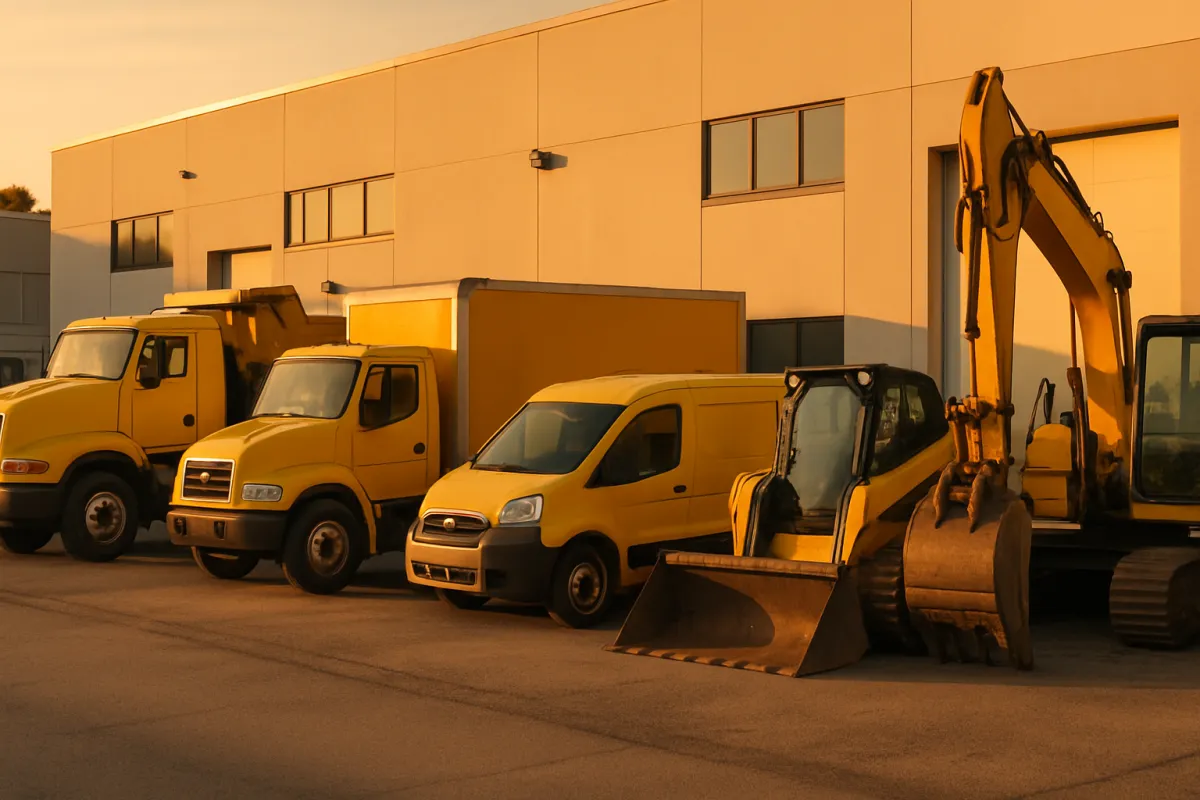
Put the common options on one axis and the point makes itself: the price to acquire a food truck spans a range so wide that quoting an average is close to useless. A used concession trailer and a new custom build are not two prices for the same thing, they are different products serving the same food, one stripped of an engine and one carrying a new vehicle and a new kitchen at once. Between them sit the used trucks, where the biggest variable is how much working kitchen comes with the rig, and the retrofit, where you pay for a sound shell and then build the kitchen from scratch.
The reason the spectrum matters is that it reframes the question. Instead of asking what a food truck costs, ask what the cheapest reliable option is that fits your menu and your plan, because a trailer that cannot serve your food is not a bargain and a custom build you cannot fund is not a plan. The condition of a used rig, the completeness of its kitchen, and the ambition of a custom build move the price more than any other factor, which is why two buyers serving similar food can pay figures that sit an order of magnitude apart. Decide where on this spectrum your plan actually lives before you fall for a specific truck.
Illustrative food truck prices by option
The chart below sketches illustrative prices to acquire the rig itself across the common options, meaning the truck or trailer and whatever kitchen comes with it, before the finishing lines like the wrap, the permits, and the opening inventory. These are planning shapes, not quotes, and a specific purchase can land well outside them depending on the truck’s condition and how much kitchen it carries. The point is the proportion between the options, not the exact figures.
Illustrative price to acquire a food truck by option
Cost of the rig and its built-in kitchen, before wrap, permits, and inventory. Shape, not a quote.
The new custom build costs several times the used trailer, and the gap is almost entirely the vehicle and the kitchen inside it. Pick the option first, then price its lines.
The takeaway is the shape, not the exact numbers. The wrap, the permits, and the POS cost roughly the same whichever option you start with, yet the price to acquire the rig varies several-fold, which tells you the vehicle and its kitchen are where the money concentrates. Run your own option, build-out, and finishing budget through the companion beside this cost breakdown, and the range collapses into a single number for the rig you are actually buying.
What actually drives a food truck’s price
Underneath the option you choose, a handful of factors set the price, and knowing them lets you read a listing or a build quote with clear eyes. The first is the vehicle itself: the age, mileage, engine, and transmission of a used truck, or the chassis and build cost of a new one. A truck is a commercial vehicle before it is a kitchen, and a sound drivetrain is worth paying for because a breakdown takes the whole business off the road. The second is the kitchen inside it: how much cooking equipment, refrigeration, ventilation, and power the rig carries, and whether that equipment is new, used, or absent and waiting to be installed.
The third driver is the menu the rig is built for, because a griddle-and-fryer concept needs a fraction of the equipment and power that a full multi-station kitchen demands, and every appliance adds cost, weight, and electrical load. The fourth is condition and completeness: a turnkey rig that passes inspection today commands a premium over a project truck that needs work, and that premium is often worth it for a first-time buyer who cannot absorb a long build. The last is simply new versus used, the single largest lever of all, which the next two sections take in turn. Read any food truck price as the sum of these drivers rather than a single sticker, and a confusing range starts to make sense.
New custom build: the top of the range
A new custom build anchors the top of the price range because it carries the full cost of a new vehicle plus a new kitchen designed to your exact menu. You specify the chassis, the layout, the equipment, the ventilation, and the power, and a builder assembles a rig with no operating history and no wear, which is both the appeal and the reason it is expensive. Illustratively a new custom build runs into six figures and can climb well past $130,000 once the equipment and finishes are added, and the build itself takes time, often months, during which the money is committed but the truck earns nothing.
The case for a new build is real for some buyers. A proven concept expanding to a second or third rig, an operator with a menu that demands a specific layout, or a business that will run the truck hard for many years can all justify the premium, because a purpose-built kitchen works better and lasts longer than a compromise. The case against it for a first launch is equally real: it is the most expensive way to test a concept that may still change, it ties up cash a young business needs, and it removes the option to walk away cheaply if the plan does not work. The honest framing is that a new build is a commitment to a settled concept, not a way to discover one.
Buying a used food truck
For most first-time buyers, a used truck is the far cheaper and lower-risk way in, and the used market is wide, from bare project trucks to fully built rigs a previous operator has moved on from. The appeal is obvious: a rig a few years old can deliver most of the working life of a new one at a fraction of the price, and a used truck that already has a working kitchen lets you skip the expensive build-out entirely. The same cost-per-working-year logic our case study on used versus new equipment applies to machines applies to the truck itself, and for a first launch, preserving cash usually beats owning the newest rig.
The catch with used is mechanical, and it is a real one. A truck is a vehicle first, and an engine, transmission, or generator failure does not just cost money to fix, it takes you off the road and kills revenue while it is down. That is why the inspection matters more than the sticker: a pre-purchase check of the drivetrain, the generator, the propane system, and the kitchen equipment by someone who knows trucks is cheap insurance against a rig that looks fine and is not. The other risk is a kitchen built for someone else’s menu, which may need modification to serve yours. Buy the used truck that has been maintained and fits your food, not the cheapest one on the listing, and treat a clean inspection as the price of entry.
New versus used: the core tradeoff
Once you know roughly what you want to serve, the sharpest lever on the price is whether you buy new or used, and the tradeoff is the same one that runs through every equipment purchase: cost and risk against certainty and fit. A used rig costs far less and preserves cash, but it carries the previous owner’s wear and a kitchen you may not have chosen. A new build costs the most and ties up capital, but it arrives clean, laid out to your menu, and backed by whatever warranty the builder offers. Neither is universally right, and the correct answer depends on how settled your concept is and how hard you will run the truck.
For a first launch, the balance usually tips toward used, because a first truck is exactly the moment to preserve cash and prove the concept before committing to the top of the range. A used rig lets you test the menu, the locations, and the business itself for a fraction of the outlay, and if the concept evolves, you have not locked six figures into a kitchen built for the old plan. For a proven operator expanding a settled concept, the balance can tip the other way, because the certainty and the fit of a new build pay off across many years of hard use. The discipline is to name which situation you are in honestly, rather than buying new for the shine or used for the sticker alone.
New vs used food truck cost side by side
Put the new vs used food truck cost on one line each and the tradeoff stops being abstract. On the illustrative figures this cost breakdown uses throughout, a built-out used truck with a working, inspected kitchen lands near $60,000 to acquire, while a new custom build with a kitchen designed to your menu lands near $130,000, roughly double before anything is added. Both paths then carry a broadly similar finishing budget, because a wrap costs what a wrap costs whether the panel under it is two years old or brand new, and the same is true of the POS, the permits, and the opening inventory.
Follow the two paths all the way to an outfitted rig and the gap holds. The used path in the worked example above comes to about $81,000 all in: $55,000 for the truck, $12,000 refreshing equipment and adding small wares, and $14,000 for the wrap, the POS, the permits, and the inventory. The new-build path comes to about $155,000: $130,000 for the rig, $8,000 filling in what the build did not include, and $17,000 of finishing. That is roughly $74,000 of difference for the same food served out of the same window, and essentially all of it sits in the vehicle and the kitchen.
What the extra money buys is worth naming plainly rather than dismissing. A new build arrives with no wear, no previous owner’s shortcuts, a layout matched to your menu, and usually a builder’s warranty, which lowers the odds of an early breakdown that takes the truck off the road. A used rig carries the opposite profile: much lower cash out, an unknown maintenance history, and a kitchen someone else specified. The honest way to read the two columns is as risk priced in cash. You can pay roughly $74,000 to remove mechanical uncertainty and get a purpose-built kitchen, or keep that money as runway and spend a fraction of it on a hard pre-purchase inspection, a maintenance reserve, and the modifications your menu needs.
For most first launches the second column wins, because the runway is what carries a truck through the months before sales cover costs, and a used rig that has been maintained can deliver most of a new one’s working life. For a proven operator adding a second or third truck, the first column starts to win, because the fit and the years of hard use justify the premium. Price both columns for your own menu, then choose the one your cash position can actually support.
Concession trailers: the lower-cost path
A concession trailer is the option that most changes the price, because it removes the engine, transmission, and drivetrain from the purchase entirely. Instead of a self-propelled truck, you tow a kitchen behind a vehicle you may already own, which strips out the most expensive and failure-prone mechanical parts and drops the entry price toward the bottom of the range. Illustratively a used concession trailer can start in the low tens of thousands, well under a comparable truck, and even a new trailer often costs less than a used truck because there is no vehicle drivetrain to pay for or maintain.
The tradeoff is mobility and convenience. A trailer has to be towed and parked, which means a tow vehicle, a hitch rated for the load, and more effort to set up and break down at each location, and some events and permits treat trailers differently from trucks. A trailer also cannot reposition quickly during a service, so it suits fixed or semi-fixed spots better than a truck that chases events across a city. For a buyer whose plan lives at a regular location, a market, a lot, or a brewery, a trailer can be the smartest way to spend the least on the rig and put more of the budget into the kitchen and the runway. Weigh the lower price against the towing logistics and the fit to how you actually intend to operate.
Leasing or renting a food truck
Buying is not the only way onto the road. Some operators lease or rent a food truck, paying a monthly or seasonal fee instead of a large upfront purchase, which trades ownership for a much smaller entry cost and the option to walk away. Leasing suits a specific set of situations: testing a concept for a season before committing, covering a short-term event or catering contract, or bridging the gap while a purchased or custom-built rig is being prepared. Illustratively, a lease turns a five- or six-figure purchase into a recurring payment, which preserves cash but builds no equity and usually costs more per operating month than owning a rig you keep.
The logic mirrors the buy-versus-lease decision that runs through all commercial equipment: leasing wins when utilization is uncertain or short, and owning wins when you will run the asset hard for years. For a food truck, the honest read is that leasing is a way to test or bridge, not usually the cheapest way to run a settled business, because a rig you lease season after season eventually costs more than one you would have bought. If the concept is proven and you intend to operate for years, buying almost always wins on total cost; if you are still learning whether the business works, a lease can be worth its premium for the option to stop. Match the choice to how certain your plan is.
The truck or vehicle itself
Whatever option you choose, the vehicle is the largest single line for nearly every build, and it is the line that varies most between two buyers serving the same menu. On a used rig you inherit both the vehicle and whatever kitchen it carries, for better and worse, so the condition of the engine and the state of the equipment matter as much as the asking price. On a new build you pay for a new chassis and specify the rest. On a trailer you skip the drivetrain but still pay for a sound, roadworthy towable box. In every case the vehicle is the foundation the kitchen bolts into, and a weak foundation is expensive to discover later.
The practical discipline is to price the vehicle and its kitchen as one number, because a cheap truck with a kitchen you have to rip out and rebuild is not the bargain the sticker suggests, and an expensive truck with a kitchen that fits your menu perfectly may be the better value. Read the vehicle line as two questions at once: will it run reliably for the years you intend to operate, and does the kitchen it carries fit the food you plan to serve? A yes to both is worth paying for; a no to either turns a low price into a hidden cost. The vehicle is where the money concentrates, so it deserves the most scrutiny before any smaller line.
The kitchen build-out
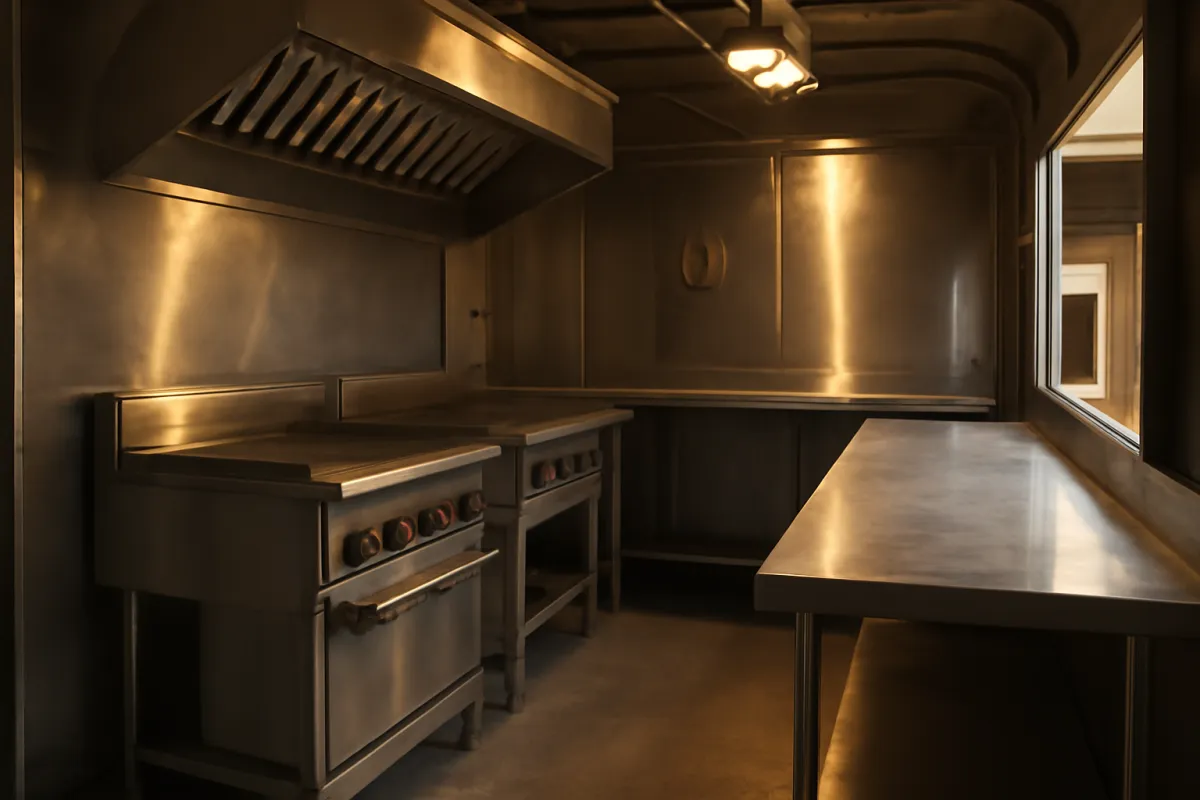
Inside the truck sits a dense stack of commercial kitchen equipment, and on a bare or retrofit build, the cost of installing it is a major line in its own right. The build-out turns a bare box into a working kitchen: the cooking line, refrigeration, prep counters, sinks, and shelving all have to fit into a space measured in a few dozen square feet, which makes it a tight and expensive puzzle. The lines first-timers most often miss are the ones the fire code cares about: the ventilation hood, the automatic fire-suppression system, and the electrical or gas power to run everything. Any truck with a cooking line that produces grease-laden vapor generally needs a commercial hood and a suppression system, and both are code-required, inspected, and rarely cheap.
Power is the other quiet line. A food truck runs its kitchen off a generator, a battery system, propane, or some combination, and sizing that power to the equipment is both a cost and an engineering problem, because a griddle, a fryer, refrigeration, and lighting draw more than a small generator can carry. Illustratively, the equipment and build-out is a mid four-figure to high five-figure line depending on the menu and whether you buy new or used, and a tight menu is the strongest lever on it, because fewer dishes mean fewer appliances, less power, and a simpler build. If you buy a used rig with a working kitchen, you inherit this line; if you buy a bare shell, you pay it in full. Price the hood, the suppression, and the power first, because they are the lines that most often turn a build-out estimate into a bigger final bill.
Cooking equipment and refrigeration
Whether it comes built into a used rig or added to a bare one, the cooking equipment and refrigeration are the heart of the kitchen and a significant share of the cost. The cooking line, meaning the griddle, range, fryer, oven, or the specific equipment your menu demands, is the obvious part, but refrigeration and freezing are just as important and just as space-constrained, because a truck has to hold a day’s cold inventory in a fraction of a restaurant’s footprint. Every appliance is a decision that repeats the two questions that run through all equipment buying: new or used, and buy or finance.
This is where our equipment case studies apply directly, because a truck kitchen is a stack of those decisions. Our used-versus-new equipment case study is the frame for whether each piece should be bought new or used, and financing the kitchen can preserve the cash a young truck lives on, which our restaurant equipment financing case study works through in full. The lever, again, is the menu: a focused concept needs fewer appliances, which lowers the equipment line, the power line, and the weight the truck has to carry. Price the kitchen to the food you will actually sell, not to a kitchen you overbought hoping to serve everything, because unused equipment on a truck is cost and weight with no return.
The wrap and signage
A food truck sells partly on how it looks, because the truck is the sign, the storefront, and the marketing all at once. The wrap, meaning the printed vinyl graphics that cover the exterior, turns a plain rig into a recognizable brand, and it is a line unique to mobile food that a fixed cafe does not carry in the same way. Illustratively, a full professional wrap is a four-figure line depending on the size of the truck and the complexity of the design, and it covers the design work, the printing, and the application. A customer at the curb decides in seconds whether the rig looks like food they want, and a clean, coherent wrap does real work in that moment.
Beyond the wrap sits the rest of the branding: the logo, the menu boards mounted at the service window, and the small touches that make the truck feel finished and trustworthy at a glance. The honest framing is that branding matters more for a truck than for many businesses, because the rig is doing the marketing every hour it is parked, so the wrap earns its place in the budget. It is still a place to be efficient rather than lavish, because a strong simple identity beats an expensive muddled one, and a wrap can always be upgraded once sales support it. Budget the wrap properly as marketing that pays its way, and keep the rest of the branding lean until the truck has proven its crowd.
Permits, licensing, and inspections
Before a truck can legally serve a single plate, it needs a stack of permits and licenses, and the process costs time as much as money. The common list includes a business license, a food handler or food manager certification, a mobile food vendor permit, a health department permit tied to an inspection, a fire safety permit for the cooking and suppression system, and parking or vending permits for the spots where you operate, plus a commissary agreement in many places. The SBA’s licenses and permits page covers which licenses come from federal agencies and which from your state or locality. Fees vary widely by city and state, and illustratively they add up to a real four-figure line, though the bigger cost is often the delay, because a truck cannot earn while a permit or inspection is pending.
Requirements differ not just by state but by city and even by the specific event or location you want to serve, so confirm your local rules rather than assuming a number from anywhere else applies. A rig permitted in one jurisdiction may need a fresh permit to cross into the next, which is why mapping the full stack for the places you actually intend to operate belongs before the purchase, not after it. The practical move is to involve the local health and fire authorities early so the rig is set up to pass the first inspection rather than reworked to pass the second. The FDA’s Food Code adoption page lists the state and territorial agencies that oversee food service if you are not sure which one that is. Compliance is not a line to trim, because a failed inspection or a missing permit is far more expensive than doing it right once, and it is one of the lines this cost breakdown flags as strictly local: confirm the current rules where you will operate.
POS and the payment stack
The point-of-sale system is the cash register of a modern food truck, and it has shifted from a big hardware purchase toward a smaller upfront cost with an ongoing subscription and a card-processing rate. A typical setup is a tablet or terminal, a card reader that works on the move, a receipt printer, and sometimes a customer-facing display, plus the monthly software fee and the processing rate that follows every sale. Illustratively, the hardware is a modest startup line, while the real cost lives in the transaction fees, which are an operating cost that quietly taxes every plate you sell.
Around the core POS sits the rest of a food truck’s tech: a mobile hotspot or data plan so the card reader works wherever you park, a location or event tool so customers can find you, accounting software, and possibly online ordering. None of these is large on its own, but together they form a recurring monthly cost that belongs in the operating burn, not just the one-time purchase budget. Because a truck moves, reliable connectivity matters more than it does for a fixed cafe, since a card reader that drops offline at a busy event is lost sales. Buy the POS that keeps working on the move, keep the stack lean, and watch the processing rate, because a fraction of a percent on every sale adds up across a season.

Initial inventory and opening supplies
A truck cannot open with empty shelves, so the first order of food, packaging, disposables, and cleaning supplies is a startup line that follows the purchase. Illustratively, the opening inventory for a food truck is a modest four-figure line, and it recurs as an operating cost the moment you start serving, so it also feeds the cash you need to keep restocking before sales catch up. Perishable ingredients in particular have to be bought ahead of demand you cannot yet predict, which makes early inventory a place where cash goes out before it comes back.
The lever here is the menu, as it is nearly everywhere in a food truck budget. A tight, focused menu means fewer ingredients to stock, less spoilage on items that do not sell, and a smaller opening order, while a sprawling menu multiplies the inventory and the waste. Packaging and disposables, meaning the containers, wraps, napkins, and utensils every order goes out in, are easy to underestimate because they are cheap per unit and consumed constantly, so budget them as a steady recurring cost from the first day. Many trucks open deliberately narrow and expand the menu once they learn what their crowd actually buys, which protects both the inventory line and the equipment behind it. The opening order is small next to the truck, but it is the line that turns a bought rig into a working one.
Where the money in a food truck build goes
Zoom out from the individual lines and the shape of a food truck build comes into focus. The vehicle and its kitchen lead by a wide margin, the cooking equipment and refrigeration follow, and the finishing lines that everyone remembers, the wrap, the POS, the permits, and the opening inventory, together make up the smallest slice. The stacked bar below sketches an illustrative split for the cost to buy and outfit a rig, and the point of it is proportion, not precision: the lines a buyer tends to obsess over are inside the smallest block.
Where the money in a food truck build goes
Illustrative split of the cost to buy and outfit a rig, summing to 100 percent.
The vehicle and the kitchen together are three-quarters of the outfitted cost. The wrap and the POS that buyers agonize over are inside the smallest slice.
The lesson from the split is where your attention leaks. A buyer comparing wrap designs or POS brands is optimizing the edges while the vehicle and the kitchen, three-quarters of the cost, decide whether the rig runs reliably and cooks the menu. Get the truck and its kitchen right and the finishing lines fall into place inside a sound budget. Run your own split through the equipment ROI calculator to see how your numbers stack against this shape, and remember that this split is the build only: the ongoing costs and the working-capital runway sit on top of it.
Financing a food truck purchase
Food trucks are rarely bought with cash alone, and the question of how to pay for the rig is nearly as important as the price itself. The common sources are an equipment or vehicle loan secured by the truck, a small business loan (the SBA’s loan programs page covers the government-guaranteed kind), a lease, a line of credit, or personal savings, and most launches use a mix. Financing spreads a large upfront cost into monthly payments and keeps a chunk of cash in reserve, which matters because a young truck lives on that reserve through its slow early months, but it adds an interest premium and a payment that becomes part of the monthly burn.
The discipline that keeps financing from becoming a trap is the one our case study on equipment financing lays out in full: decide on the total cost of the money over its term, not the monthly payment in isolation, and match the term of any loan to the useful life of what it funds. Financing a truck over its useful life is sound, while stretching a short-term rig or a few months of supplies onto a long loan means paying interest on things long since consumed. Above all, do not borrow so aggressively that the debt payment turns a survivable slow patch into a fatal one. Weigh the financing premium against the survival value of the cash it preserves, and for many first-time buyers the answer is to finance the truck, protect the runway, and buy the next rig outright once the business stands on its own.
Ongoing costs of owning a food truck
The purchase price is only the entry ticket, and a food truck carries recurring costs a fixed restaurant never sees in the same form. It is a vehicle, so it burns fuel driving between the commissary, the serving spots, and the events, and it runs its kitchen off a generator and propane that have to be refilled. It is a food business, so it needs a commissary kitchen that health code often requires, insurance on both the vehicle and the operation, food and supplies, and POS processing fees on every sale. And it is a machine that wears, so it needs maintenance on both the truck and the equipment, the line most often skipped until it is a breakdown instead of a service.
Illustratively, these operating costs are a real monthly line that scales with how much you cook and how far you drive, and the commissary and the insurance in particular are fixed monthly bills that belong in your burn from day one, not just the purchase budget. The commissary is a recurring rent from a few hundred to well over a thousand dollars a month depending on your city, and insurance scales with the coverage and where you operate. The working-capital runway that carries these costs until sales catch up is priced further down in this cost breakdown, and if you rely on shared kitchen space, our commercial kitchen rental case study prices that line specifically. Budget the ongoing costs alongside the purchase, because they decide whether the truck is affordable to run, not just to buy.
The commissary kitchen requirement
Here is the line first-time buyers most reliably forget, and it is not on any listing: the commissary kitchen. In most jurisdictions, health code requires a licensed commercial kitchen where you prep food, store inventory, fill and empty water tanks, and often clean the truck, because a truck on its own is not treated as a complete food operation. The commissary is not a one-time purchase, it is a recurring monthly rent, which means it belongs in the operating burn from the first month rather than in the budget for the rig.
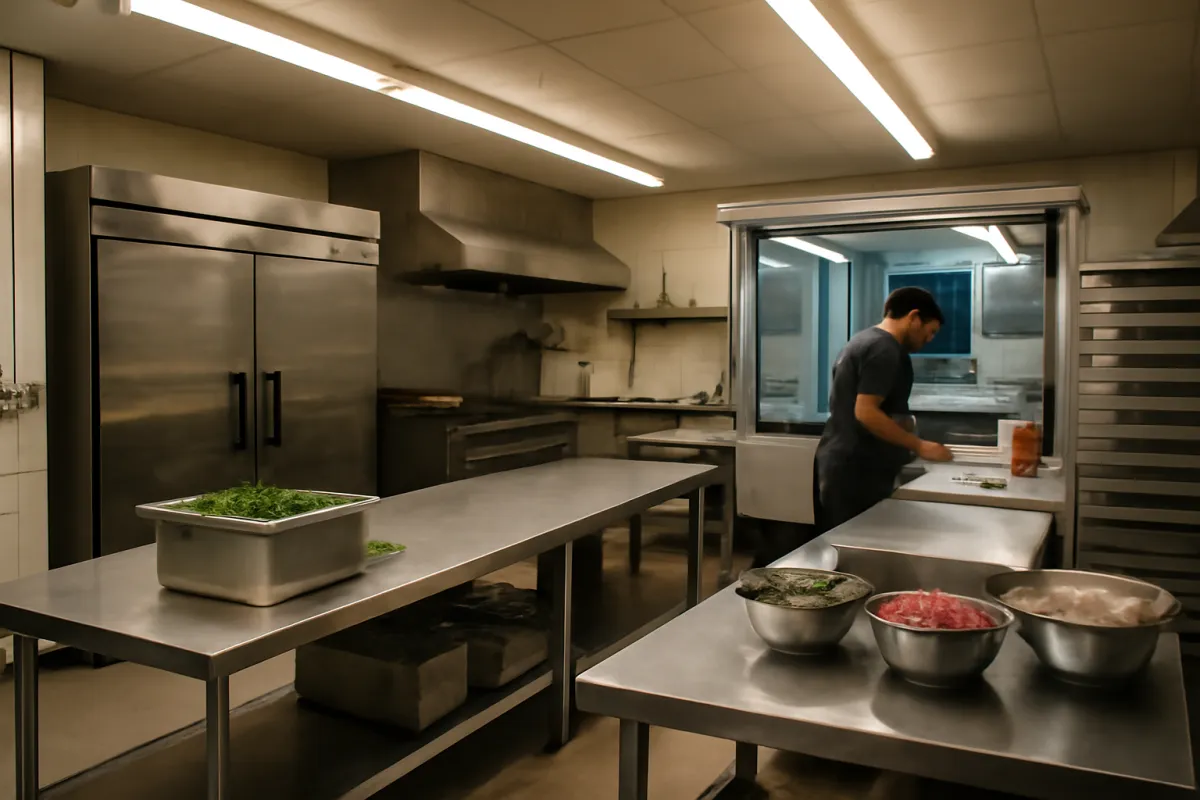
Illustratively, commissary rent runs from a few hundred to well over a thousand dollars a month depending on your city and how much space and access you need, and it can be split with other operators or taken as off-hours time in an existing restaurant kitchen. The exact requirement is local, so confirm what your own health department expects before you build a plan that assumes the truck is self-contained. Our commercial kitchen rental case study prices that line in full, including the storage and insurance that usually ride on top of the headline rate. A plan that leaves the commissary out is not just short a line, it is short a legal requirement and a fixed monthly bill that quietly shortens the runway.
Food truck cost: startup versus ongoing
Almost every food truck cost question gets asked about the startup number and answered as if that were the whole bill, which is why the split between one-time and recurring belongs in the budget from the start. The startup side is the list this cost breakdown has been pricing: the rig and its kitchen, the build-out, the wrap, the permits, the POS hardware, and the opening inventory, paid once and largely financeable. The ongoing side is everything that comes back every month whether you have a good week or a rained-out one, and it is funded from sales or from the runway, not from a loan.
| Line | Startup, one time | Ongoing, every month |
|---|---|---|
| Truck or trailer and its kitchen | The largest single line | Maintenance and repairs |
| Kitchen build-out and equipment | Paid at purchase or fit-out | Servicing, parts, replacements |
| Wrap and signage | Paid once, refreshed rarely | Touch-ups only |
| Permits and licensing | Initial fees and inspections | Renewals, often annual |
| POS and connectivity | Hardware up front | Software fee and processing on every sale |
| Commissary kitchen | Deposit or first month | Rent, a fixed monthly bill |
| Insurance | Down payment or first premium | Vehicle and business coverage |
| Fuel, propane, generator | First fill | Scales with driving and cooking |
| Food and packaging | Opening inventory | Restocked continuously with sales |
Read the right column as the truck’s real cost of existing. The fixed part of it, meaning commissary rent, insurance, POS software, and a maintenance reserve, keeps running on a day you never open the window, and illustratively it can total from the high hundreds to a couple of thousand dollars a month depending on your city and your coverage. The variable part, meaning fuel, propane, food, packaging, and card processing, only appears when you trade, which is the healthier kind of cost because it arrives alongside the revenue that pays for it.
The reason this split matters more for a truck than for a fixed cafe is the shape of the fixed column. A commissary agreement and a commercial vehicle policy are bills a home cook does not imagine when pricing a rig on a listing site, and a loan payment on a financed truck joins them the month after purchase. Add those together and a budget built purely around the purchase price can be short by a meaningful amount every month before a single plate is sold.
The practical move is to build two budgets rather than one. Budget A is the cash to buy and outfit the rig, which is what most of this cost breakdown prices and what the companion beside it estimates. Budget B is the monthly burn multiplied by the months you expect it to take before sales cover costs, which is the working-capital runway the next section sizes and the companion beside this cost breakdown adds to your total. Buyers who fund Budget A and skip Budget B own a truck they cannot afford to operate, which is the most common and most avoidable way a food truck purchase fails.
How much does it cost to start a food truck
How much does it cost to start a food truck, as opposed to buying one? Take the all-in cost to buy and outfit the rig, which is what the split above prices, then add the cash the truck has to live on until sales cover its costs. A truck does not open to a full window on day one. It finds its spots and its crowd over months, and through every one of those months the commissary rent, the insurance, the fuel, the propane, the food and any loan payment come due whether or not the sales are there yet. The money that bridges that gap is working capital, and it is part of the cost to start, not an optional extra.
The arithmetic is simple and the discipline is in doing it honestly. Take the outfitted cost of the rig, estimate the monthly burn, meaning the fixed bills plus the variable cost of trading, then multiply that burn by the months of runway you intend to hold, and add the two together. Illustratively, a single-truck operation might carry something in the region of $6,000 a month of combined fixed and variable burn once the commissary, the insurance, the POS fees, the fuel and propane, the food and a maintenance reserve are counted, though the real figure moves a long way with your city, your coverage and how many days a month you actually trade.
Run that on the two rigs priced later in this cost breakdown and the shape appears. The used path is about $81,000 to buy and outfit; hold four months of runway at that illustrative burn and the total to start is roughly $105,000. The new custom build is about $155,000 outfitted; hold six months, on the grounds that a larger investment deserves a longer ramp, and the total to start is roughly $191,000. In both cases the runway is a fifth to a quarter of the launch, and it sits entirely outside the buy-and-outfit split charted above. Set your own option, outfit budget and runway in the companion beside this cost breakdown to see your own total to launch.
Working capital: the runway people underfund
Working capital closes more food trucks than any equipment choice, and it is the line first-timers most reliably underfund. The failure is not dramatic. A buyer spends the last available dollar on a better rig, a bigger wrap or one more piece of kitchen equipment, opens with almost nothing in reserve, then meets an ordinary bad month, a rained-out event run, a mechanical repair, a permit delay, and has no cash to absorb it. The truck that would have worked parks for good, not because the concept was wrong but because the cushion was missing.
The common rule of thumb is to hold enough cash to cover several months, often three to six or more, of full operating costs beyond everything spent to buy and build the truck. Which end of that you need depends on how predictable your first season is: a truck with booked catering work and a standing commissary lot needs less cushion than one hunting for spots. Two things make the runway longer than a first plan assumes. A financed rig adds a loan payment to the burn from the month after purchase, and a new build usually takes longer to reach steady sales than a used rig bought into an established route, because the money went into the truck rather than into the ramp.
The practical order is to fund the runway before the finishes. If the budget will not stretch to both a better rig and a real cushion, the cushion wins, because a modest truck with cash behind it survives a bad month and a beautiful one without cash does not. Decide the months you need, price them at your own burn rather than an optimistic one, and treat a faster ramp as upside rather than the plan.
Break-even and payback
The cost question and the return question are two halves of the same equation, because every dollar spent to launch is spent to reach the day the truck covers its own costs. Break-even is the month where sales equal the total monthly cost of trading. Payback is the longer horizon over which accumulated profit repays what it took to start. The runway exists precisely to carry the truck from its first serving day to break-even with a cushion to spare, which is why the total to start and the months to break-even have to be modeled together rather than one after the other.
The revenue side is where this arithmetic closes. Estimate the plates you can turn on a good serving day, the margin left on each one after food and packaging, and the number of good days you can realistically string together in a month, and that is the monthly contribution. Set it against the monthly burn from the section above, and the gap tells you how many months of runway you actually need. Our espresso machine ROI case study runs the same volume-and-margin logic on a single machine, and the equipment ROI calculator lets you put your own volume and margin against the purchase. Fund enough months to reach break-even plus a margin of safety, and the truck gets room to find its footing before the cash runs out.
Is a food truck worth it
A food truck can be a lower-cost way into food service than a bricks-and-mortar restaurant, because the vehicle replaces a build-out and a long lease, but whether it is worth it depends entirely on the numbers behind the rig, not the romance of it. The purchase is the entry ticket; the return comes from finding reliable locations, turning enough good tickets per serving day, and keeping the ongoing costs below the revenue the truck produces. A rig that sits in a driveway because it never found its spots is a heavy asset that is hard to sell, so the honest test is whether you can fund the purchase and the ramp and still reach break-even with a cushion.
The way to answer it is to price the truck against a realistic sales plan rather than a hopeful one. Estimate the plates you can turn on a good serving day, the margin per plate, and the number of good days you can string together in a month, then set that against the monthly burn of commissary, insurance, fuel, and any loan payment. If the revenue clears the burn with room to spare within a runway you can fund, the truck can be well worth it; if it does not, no purchase price is low enough to fix a plan that cannot cover its costs. The equipment ROI calculator lets you run the revenue side against the purchase, so the decision rests on arithmetic instead of optimism.
Food truck options at a glance
Pulling the options together makes the tradeoffs easy to compare at a glance. The table below sets each path against an illustrative cost to acquire the rig and the buyer it tends to suit, so you can find where your plan sits before pricing the details. The figures are planning shapes, not quotes, and a real purchase is set by the condition of the specific rig and the market you buy in.
| Option | What you get | Illustrative cost to acquire | Best suited to |
|---|---|---|---|
| Used concession trailer | A towable kitchen, no engine or drivetrain | ~$15,000 and up | Fixed or semi-fixed spots, the lowest entry price |
| Used truck, basic | A running rig with a minimal or dated kitchen | ~$35,000 | Buyers who will lightly outfit and test a concept |
| Used truck, built-out | A running rig with a working, inspected kitchen | ~$60,000 | First-timers who want the cheaper, faster way to serve |
| Retrofit a bare truck | A sound shell built out to your menu | ~$85,000 | Buyers with a specific menu and time to build |
| New, custom build | A new vehicle and a new kitchen to spec | ~$130,000 and up | Proven concepts and multi-rig operators |
| Lease or rent | Use of a rig for a monthly or seasonal fee | Recurring payment, little down | Testing a concept or bridging to a purchase |
The table is a map, not a verdict. The right row is the one where the cost you can fund meets the reliability and the kitchen your menu actually needs, which for most first-time buyers is a sound built-out used truck or a trailer rather than the top or the bottom of the range. Read across the row you are drawn to, confirm the rig delivers what the column promises, and then price its lines with the rest of this cost breakdown.
A worked example: pricing two food trucks
Put the framework on two illustrative purchases that sit near opposite ends of the spectrum. First the used-truck path. A buyer finds a sound used truck with a working kitchen for an illustrative $55,000, spends $12,000 refreshing the equipment and adding small wares the previous menu did not need, and budgets $14,000 for the wrap, the POS, the permits, and the opening inventory. The all-in to buy and outfit the rig is about $81,000, the truck and its kitchen are the largest lines by far, and the finishing budget is a small slice on top, exactly the shape the split above predicts.
Now the new-build path. A custom rig with a new kitchen designed to the menu runs an illustrative $130,000, another $8,000 fills in equipment and small wares the build did not include, and the wrap, the POS, the permits, and the opening inventory add $17,000, for an all-in of about $155,000. The gap between the two examples is the whole point: same food, same finishing lines, roughly $74,000 apart, and the difference is almost entirely the vehicle and the kitchen inside it. Neither number yet includes the working-capital runway that carries the truck to break-even, which at an illustrative $6,000 a month of burn adds about $24,000 over four months to the used path and about $36,000 over six months to the new build, for totals to start of roughly $105,000 and $191,000. Run your own option and outfit budget through the companion beside this cost breakdown, and the purchase stops being a guess.
The bottom line
How much does a food truck cost? Whatever the option demands, and the option is the answer to most of it. A used concession trailer can get you a kitchen for the low tens of thousands, a sound built-out used truck for the mid five figures, and a new custom build past $130,000, illustratively, and the gap between them is the vehicle and the kitchen bolted inside it, not the wrap or the POS. Decide which rig your plan actually lives on before you fall for a specific truck, because that choice sets the scale of every other number in the budget.
The buyers who spend well do three things in order. They pick the option honestly against their menu and their cash, inspect a used rig hard or accept the premium of a new build on purpose, and price the vehicle and its kitchen as one number. They keep the finishing lines, the wrap, the POS, the permits, and the inventory, in proportion, because those are the smallest slice. And they price the whole launch rather than the rig, adding the commissary, the insurance and a real working-capital runway before they commit, because the cost to start a food truck is always the larger of the two numbers. And they price the purchase against the ongoing costs and a realistic sales plan, because the rig is only the entry ticket to a business that has to cover its own burn. Weigh new against used with our used-versus-new equipment case study, decide how to pay for it with the buy-versus-lease and equipment financing case studies, and run your own purchase and sales plan through the equipment ROI calculator so the price you pay is a decision, not a surprise.
Written for the person pricing a rig, not for anyone selling one: this cost breakdown is educational material, not financial, tax, legal, or business advice, and it endorses no specific truck, trailer, builder, vendor, or lender. Every dollar figure, price range, and percentage split here is an illustrative sketch meant to teach how the cost of a food truck adds up, and a real purchase is set by the condition of the specific rig, the menu you build for, the market you buy in, and the health and fire code you have to satisfy. Permit and licensing requirements, commissary rules, insurance minimums, and wrap and equipment costs vary widely by jurisdiction and by rig, so confirm the mobile-food rules and the current fees in every place you intend to operate, gather local quotes on the actual truck and equipment in front of you, and put an accountant, a mechanic, and your own honest numbers between you and any purchase or loan you sign.
Frequently asked questions
How much does a food truck cost?
Illustratively, a used concession trailer can be had for the low tens of thousands, a used truck with a working kitchen commonly lands in the mid five figures, and a new custom build with a full kitchen can run past $130,000 once the vehicle, the build-out, and the finishing lines are added. The range is wide because a food truck is really two purchases stacked together, a commercial vehicle and a commercial kitchen, and both swing enormously between a hand-me-down rig and a purpose-built one. Treat any single figure as a planning shape rather than a quote, because the condition of the truck, the menu you are building for, and whether you buy new or used move the total more than almost anything else. Price the option you are actually buying, then stack the line items underneath it.
Is it cheaper to buy a new or used food truck?
For most first-time buyers, a used truck with a sound engine and a working kitchen is far cheaper than a new custom build, often by a large multiple, because a new build carries the full cost of a new vehicle plus a new kitchen designed to your menu. A used truck lets you test the concept before committing to the top of the range, and the same cost-per-working-year logic our used-versus-new equipment case study applies to machines applies to the truck itself. The real risk with used is mechanical: an engine, transmission, or generator failure takes the truck off the road entirely, so a pre-purchase inspection matters more than the sticker price. Many buyers start on a proven used rig and only order a custom build once the cash flow and the menu are settled.
What is the cheapest way to get into a food truck?
A used concession trailer is usually the lowest-cost entry, because it removes the engine, transmission, and drivetrain from the purchase entirely and leaves you towing a kitchen behind a vehicle you may already own. Illustratively a used trailer can start in the low tens of thousands, well under a self-propelled truck, though you trade away the mobility and the all-in-one convenience of a truck. Beyond a trailer, the next cheapest paths are a basic used truck bought for its running condition and lightly outfitted, or leasing a rig for a season to test a concept before buying. The honest tradeoff is that the cheapest option up front is rarely the cheapest to run if it breaks down or does not fit the menu, so weigh the purchase price against reliability and the kitchen you actually need.
How much does the kitchen build-out inside a food truck cost?
The kitchen build-out, meaning the cooking line, refrigeration, ventilation hood, fire suppression, and power that turn a bare truck into a working kitchen, is illustratively a mid four-figure to high five-figure line depending on the menu and whether you buy new or used equipment. A griddle, fryer, and range are modest next to the hood and the automatic fire-suppression system, which are code-required and rarely cheap, and the generator or power setup to run it all is its own line. Our used-versus-new equipment case study and our buy-versus-lease case study both apply directly here, because a truck kitchen is a dense stack of commercial equipment where the new-versus-used and finance-versus-buy decisions repeat on every appliance. A tight menu is the single strongest lever on this line, because fewer dishes mean fewer appliances and a simpler build.
How much does it cost to wrap a food truck?
A full professional vinyl wrap is illustratively a four-figure line, and it scales with the size of the truck and the complexity of the design because the price covers the artwork, the printing, and the application. The wrap is a line unique to mobile food, since the truck is the sign, the storefront, and the marketing all at once, and a clean, coherent wrap does real work in the seconds a customer decides whether the rig at the curb looks like food they want. It is still a place to be efficient rather than lavish, because a strong simple identity beats an expensive muddled one. Budget the wrap properly as marketing that pays its way, and keep the rest of the branding lean until sales support more.
Can you finance a food truck?
Yes: food trucks are commonly financed through equipment or vehicle loans secured by the truck itself, small business loans, or leases, and financing the purchase is the norm rather than the exception for launches. The discipline that keeps financing sound is the one our equipment financing case study lays out: decide on the total cost of the money over its term, not the monthly payment in isolation, and match the term of the loan to the useful life of the truck. Financing spreads a large upfront cost into monthly payments and preserves the cash a young business lives on, though it adds an interest premium and a payment that becomes part of the monthly burn. Do not borrow so aggressively that the debt payment turns a survivable slow month into a fatal one.
What are the ongoing costs of owning a food truck?
Beyond the purchase, a food truck carries recurring costs a fixed restaurant does not see in the same form: fuel to drive it, propane and generator fuel to run the kitchen, commissary rent that health code often requires, insurance on both the vehicle and the business, maintenance on the truck and the equipment, POS processing fees on every sale, and the food and supplies to serve. Illustratively these operating costs are a real monthly line that scales with how much you cook and how far you drive, and they are easy to underestimate from a budget built around the one-time purchase of the truck. The commissary and insurance in particular are fixed monthly bills that belong in your operating burn from day one. Our case study on the cost to start a food truck prices the whole launch, including the working-capital runway that carries these costs until sales catch up.
Is buying a food truck worth it?
A food truck can be a lower-cost way into food service than a bricks-and-mortar restaurant, because the vehicle replaces a build-out and a long lease, but worth it depends entirely on the numbers behind the rig, not the romance of it. The purchase is only the entry ticket: the return comes from finding reliable locations, turning enough good tickets per serving day, and keeping the ongoing costs below the revenue the truck produces. Illustratively, many trucks take several months to a year or more to reach the point where sales cover costs, so the honest test is whether you can fund the purchase and the ramp and still reach break-even with a cushion. Price the truck against a realistic sales plan, not a hopeful one, and it can be worth it; buy on optimism and it is a heavy asset that is hard to sell.
How much more does a new food truck cost than a used one?
Set the two side by side and the gap is large: an illustrative built-out used truck near $60,000 against a new custom build near $130,000 is roughly double before a single finishing line is added, and once the wrap, the POS, the permits, and the opening inventory go on top, an outfitted used path near $81,000 sits about $74,000 under an outfitted new build near $155,000. Almost the entire difference is the vehicle and the kitchen bolted inside it, because the wrap, the POS, the permits, and the inventory cost roughly the same either way. What the extra buys is a clean drivetrain with no operating history, a kitchen laid out to your exact menu, and whatever warranty the builder offers, which is genuine value for a settled concept run hard for years. What it costs is cash a first launch usually needs for its runway, so most first-time buyers find the used path is the better trade and the new build is what a proven concept graduates to.
How much does it cost to start a food truck?
More than the rig, and the gap is the part first plans miss. The cost to start is the all-in cost to buy and outfit the truck plus the working capital that carries it until sales cover its costs. Illustratively, the used path priced in this cost breakdown is about $81,000 to buy and outfit; hold four months of runway at a rough $6,000 a month of combined burn and the total to start is near $105,000. The new custom build is about $155,000 outfitted; hold six months and the total is near $191,000. Every one of those figures is a planning shape rather than a quote, and the burn in particular swings a long way with your city, your insurance and how many days a month you actually trade. Price your own rig, then add the months of cushion you would need to survive a slow first season.
How much working capital do I need to start a food truck?
The common rule of thumb is enough cash to cover several months, often three to six or more, of full operating costs on top of everything spent to buy and build the truck. The arithmetic matters more than the rule: estimate your own monthly burn, meaning commissary rent, insurance, POS fees, fuel and propane, food and packaging, any payroll, a maintenance reserve and any loan payment, then multiply it by the months you expect to need before sales cover costs. A financed rig needs a longer runway than a cash-bought one because the payment joins the burn immediately, and a new build usually needs longer than a used rig bought into an established route. Fund the cushion before the finishes, because a modest truck with cash behind it survives a bad month and an expensive one without cash does not.
Do I need a commissary kitchen for a food truck?
In most places, yes, though the requirement is set locally rather than nationally. Health code commonly requires a licensed commercial kitchen where you prep food, store inventory, fill and empty water tanks, and often clean the truck, because a truck by itself is not treated as a complete food operation. The important part for a budget is that it is a recurring monthly rent rather than a one-time purchase, so it belongs in the operating burn from the first month. Illustratively it runs from a few hundred to well over a thousand dollars a month depending on your city and the space and access you need, and it can often be split with other operators or taken as off-hours time in an existing restaurant kitchen. Confirm what your own health department requires before you plan around a truck that is self-contained.
How long until a food truck breaks even?
There is no honest general answer, because break-even is the month your sales equal your monthly cost of trading, and both sides of that are yours. What is general is the method. Estimate the plates you can turn on a good serving day, the margin left after food and packaging, and the number of good days you can realistically string together in a month, and that is your monthly contribution. Set it against the monthly burn of commissary, insurance, fuel, propane, supplies and any loan payment. The gap between them tells you how long the runway has to be, and it is the reason the total to start and the months to break-even have to be planned together. Fund enough months to reach break-even with a margin of safety, and treat a faster ramp as upside rather than as the plan.
What is the ongoing food truck cost each month after you buy the rig?
Separate the one-time food truck cost from the recurring one and the second list is the one that decides whether the truck survives: commissary rent, insurance on both the vehicle and the business, fuel for driving, propane and generator fuel for cooking, maintenance on the truck and the equipment, POS software and card processing, and the food and packaging behind every order. Illustratively, the fixed part of that list, meaning commissary, insurance, software, and a maintenance reserve, can run from roughly the high hundreds to a couple of thousand dollars a month before you buy a single case of food, and it scales with your city, your coverage, and how far you drive. Food, packaging, and processing then move with sales rather than sitting flat. The practical discipline is to write the monthly burn down before the purchase, because a rig you can afford to buy and cannot afford to run is the most common way a food truck budget fails.