
What's on this page
- What a commercial dishwasher costs
- Illustrative cost by dishmachine class
- The classes of commercial dishwasher
- Undercounter dishwashers and glasswashers
- Door type dishwashers, also called hood type
- Conveyor and flight type dishmachines
- High temp vs low temp sanitizing
- What the booster heater costs and why
- Chemical cost and the sanitizer contract
- What drives the cost of a commercial dishwasher
- Installation: electrical, plumbing, and drain
- Ventilation and the condensate hood
- Water treatment and hard water
- Where the dishmachine sits in the equipment budget
- Water, sewer, and energy: the running cost
- Total cost of ownership per rack
- Sizing the machine to your rack volume
- New versus used dishmachines
- Lease versus buy, and the chemical program machine
- Service, parts, and the maintenance you actually do
- The dish area around the machine
- Labor, and the number the machine really moves
- Common mistakes that inflate the number
- A worked example: a cafe and a full-service restaurant
- The bottom line
Short answer: Illustratively, a glasswasher runs a few thousand dollars, an undercounter commercial dishwasher mid four figures, a door-type machine high four figures to low five figures, a rack conveyor into the low tens of thousands, and a flight-type machine into the mid five figures, before installation. Class is set by peak racks per hour, not budget, and ten years of water, energy, chemical, and service cost roughly ten times the machine.
Ask what a commercial dishwasher costs and you get a number that is almost useless, because the word covers a box that tucks under a bar and a rackless conveyor that two people feed continuously through a dinner rush. Both are commercial dishwashers. One is a mid four figure purchase you wheel into place, the other is a mid five figure machine that arrives in sections and reshapes a room. Between them sit the door type machine that most restaurants actually buy and the rack conveyor that a high volume operation graduates to. The class you need is decided by racks per hour, not by budget, and getting that one decision right is worth more than any negotiation on price.
This case study prices the dish area end to end: the machine classes from glasswasher to flight type, the high temp versus low temp sanitizing choice and what it does to the booster heater, the energy line and the chemical bill, the installation that electrical, plumbing, drainage, ventilation, and water treatment quietly add, and the total cost of ownership measured the way an operator should measure it, per rack. It sits alongside our commercial kitchen equipment case study, which prices the whole kitchen end to end, and our restaurant equipment list, which places the dish area among everything else a kitchen needs. Run your own rack volume as you read with the equipment ROI calculator.
Key takeaways
- Dishmachines span a huge range. Illustratively a glasswasher runs a few thousand dollars, an undercounter machine mid four figures, a door type high four figures to low five figures, a rack conveyor into the low tens of thousands, and a flight type into the mid five figures.
- Class is set by peak racks per hour, not by budget. One class too small costs labor every service, two classes too large ties up capital and floor space.
- High temp sanitizes with heat and needs a booster heater, low temp sanitizes with chemicals and does not. High temp pays in energy, low temp pays in chemical, and on illustrative figures the two land within a couple of cents per rack of each other.
- Installation is the underestimated line: a dedicated circuit, hot water, a drain with correct indirect waste, often a condensate hood, and in hard water areas a softener. The space you choose moves this more than the machine model does.
- Judge a dishmachine on cost per rack over its life, not on sticker. On the illustrative worked example here, ten years of water, energy, chemical, and service costs roughly ten times the machine itself.
What a commercial dishwasher costs
How much does a commercial dishwasher cost? Illustratively, a commercial glasswasher commonly runs around three thousand dollars, an undercounter dishmachine near forty five hundred, a door type or hood type machine near eight thousand, a rack conveyor near twenty two thousand, and a flight type machine for a very large operation near fifty five thousand. Those are machine prices for a new unit of ordinary specification, and the eighteenfold spread between the ends of that list is the reason an average price tells you nothing. You are not choosing a price point, you are choosing a class of machine, and the class is decided by how many racks an hour you have to move.
Machine price is also only the opening line. A dishmachine has to be wired, plumbed, drained, and in most cases vented, and in hard water areas it needs treated water to survive. It also consumes water, sewer capacity, energy, and chemical every single rack for its whole life, and those recurring lines add up to far more than the purchase over a decade. That is the same lesson our commercial refrigerator case study draws about a compressor that never sleeps, and it applies with even more force here, because a dishmachine burns hot water rather than just holding cold air. Price the class, then the install, then the racks, and the number becomes a plan.
Illustrative cost by dishmachine class
Put the classes on one axis and the decision explains itself. The chart below sketches illustrative purchase figures across the common commercial dishwasher classes, from the glasswasher that lives under a bar to the flight type machine that a hotel or a large institution runs. These are planning shapes rather than quotes, and any specific machine can land well outside them depending on capacity, sanitizing method, build quality, and whether a booster heater is built in.
Illustrative machine cost by dishwasher class
Typical purchase cost for a new machine of each class, before install. Shape, not a quote.
The flight machine costs roughly eighteen times a glasswasher, and the gap is throughput and continuous duty, not a fancier version of the same box. Pick the class from your peak racks per hour first.
The shape is the lesson. A spread this wide tells you that the dish budget is a function of throughput, not a fixed cost of owning a dishwasher, and that the smartest lever you hold is buying the class that matches your busiest hour rather than the one that matches your comfort with the price. Run your own machine class and rack volume through the companion beside this case study, and the range collapses into a single planning number for the dish area you are actually building.
The classes of commercial dishwasher
Before pricing any single machine it helps to see the whole family, because buying the wrong class is a more expensive mistake than paying a little too much within the right one. The glasswasher is a compact machine built specifically for stemware and bar glass, running short cycles at gentle pressure so glasses come out clear rather than etched. The undercounter dishmachine is the general purpose small machine, a box roughly the size of a domestic dishwasher that takes a standard rack and slides under a counter. The door type machine, which the trade also calls a hood type or pass through, has a hood you lift to load a rack from one side and unload it to the other, and it is the machine most full service restaurants actually buy.
Above those sit the conveyor machines. A rack conveyor pulls loaded racks through wash, rinse, and sanitize zones on a chain, so the crew loads at one end and unloads at the other without ever starting a cycle. A flight type machine, sometimes called a rackless conveyor, drops the racks entirely: ware is placed directly onto a moving belt of pegs, which is why it moves the most volume per person and why it costs the most. Each class carries a different footprint, a different utility draw, and a different price, and the menu, the seat count, and the service pattern decide which one belongs in your room.
Undercounter dishwashers and glasswashers
At the small end sit the undercounter machine and the glasswasher, and for a lot of concepts they are the entire dish plan. An undercounter dishmachine takes a standard rack, runs a cycle of a couple of minutes, and is commonly rated around thirty racks an hour under realistic conditions, which is enough for a cafe, a bar, a small quick service kitchen, or a satellite station in a larger operation. Illustratively it lands near forty five hundred dollars new, and a dedicated glasswasher tuned for stemware lands nearer three thousand because it is smaller and does a narrower job.
The appeal of these machines is that they fit where the work is and demand relatively little of the building. They still need a dedicated circuit and a proper drain, so they are not appliances you simply plug in, but the install is modest next to anything larger. The tradeoff is throughput and recovery: an undercounter machine that is keeping up during a slow lunch will fall behind by the second seating on a busy Friday, and once the dish area falls behind, it stops the flow of clean ware to the line and forces the kitchen to buy its way out with extra plates. That is the shape our coffee shop opening case study sketches for a beverage led concept, where a glasswasher and an undercounter machine genuinely are enough.
Door type dishwashers, also called hood type
The door type machine is the workhorse of the American restaurant dish area, and it goes by several names that all describe the same thing: door type, hood type, and pass through. You lift a hood, slide a loaded rack in from the dirty side, drop the hood, and the cycle runs, then you lift the hood again and push the rack out onto the clean table. Illustratively it lands near eight thousand dollars new for a straight through machine of ordinary specification, with corner units and machines with built in boosters costing more. It is commonly rated around fifty to sixty racks an hour, which covers the great majority of full service restaurants.
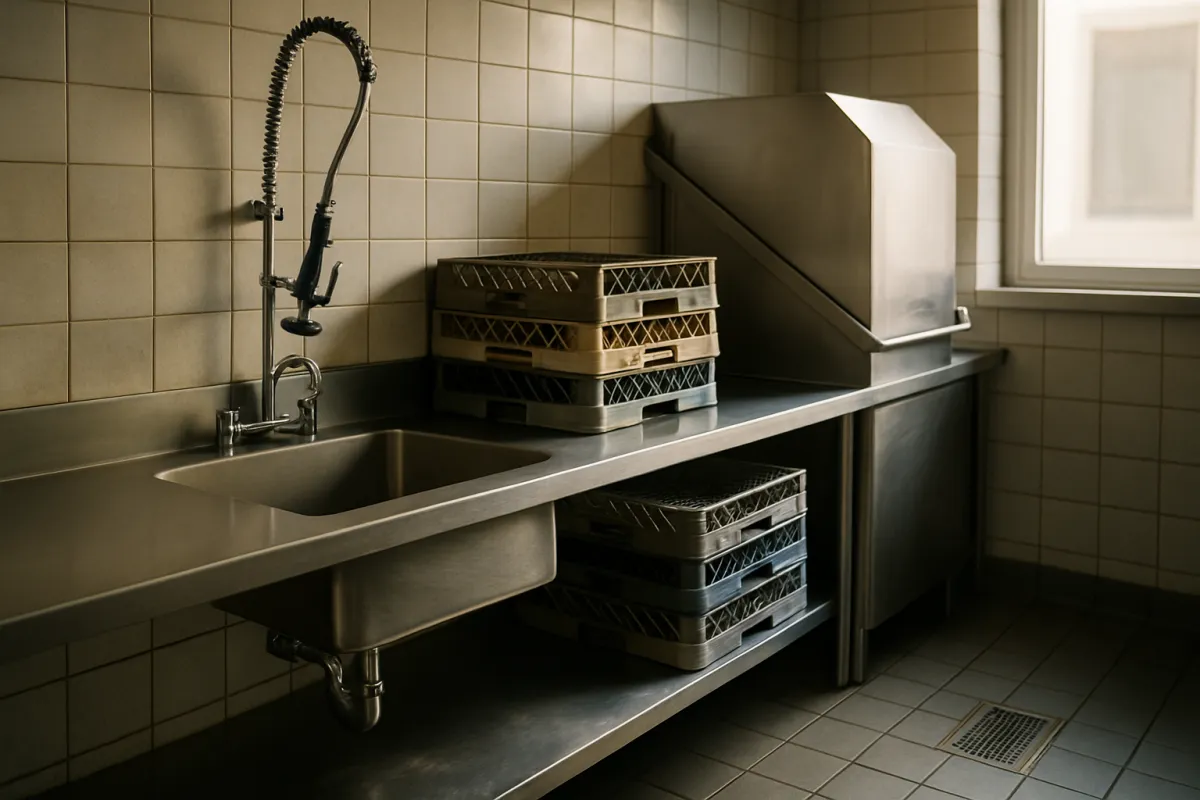
What you are really buying at this class is a dish table system, not just a machine. A door type machine works properly only when it sits between a soiled dish table long enough to hold the racks coming back from the floor, a pre-rinse sprayer or a scrapping trough to clear food waste, and a clean table with enough length to hold racks while they steam dry. Buy the machine without the tables and the pre-rinse, and the room does not work, which is why the honest budget for a door type installation is always meaningfully more than the machine sticker. Our restaurant equipment list places those tables and sinks in the wider equipment plan.
Conveyor and flight type dishmachines
Above the door type, the logic changes from cycles to continuous flow. A rack conveyor moves loaded racks through the machine on a chain at a steady speed, so the limiting factor becomes how fast people can load and unload rather than how fast a cycle finishes. Illustratively it lands near twenty two thousand dollars for a single tank machine, and multi tank machines with separate wash, power rinse, and sanitize sections cost more. Throughput commonly runs well into the hundreds of racks an hour, which is why the conveyor is the machine a banquet operation, a large casual restaurant, or a high volume cafeteria buys.
The flight type machine, or rackless conveyor, is the top of the class. Ware is loaded directly onto a moving belt with pegs and rails that hold plates upright, which removes the racking step entirely and lets a small crew move an enormous amount of ware. Illustratively it lands near fifty five thousand dollars and rises sharply with length and with options such as blower dryers and heat recovery. These machines are long, heavy, and utility hungry, and they are a construction decision rather than an equipment purchase: the room, the floor drains, the ventilation, and the electrical service all have to be designed around them. Very few independent restaurants ever need one, and pricing one into a plan that does not need it is a classic way to sink a budget.
High temp vs low temp sanitizing
Every commercial dishmachine sanitizes one of two ways, and this single choice cascades through the machine price, the electrical service, the energy bill, the chemical bill, and the ventilation. A high temp machine sanitizes with heat, running a very hot final rinse, and because building hot water usually arrives cooler than the rinse needs, it relies on a booster heater to make up the difference. A low temp machine sanitizes chemically, dosing a sanitizer into a cooler final rinse, so it needs no booster and generally draws far less power.
The purchase difference is real: a low temp machine of a given class commonly costs less than its high temp equivalent, sometimes noticeably less, because it does not carry the booster or the heavier electrical package. The running difference runs the other way. High temp spends more on energy and less on chemical, low temp spends much less on energy and considerably more on chemical, and on the illustrative per rack figures used in this case study the two land within a couple of cents of each other. Neither is universally cheaper, which is why the decision should be made on the operational differences rather than on a rule of thumb.
Those operational differences matter. High temp machines produce a lot of steam, which usually means a condensate hood over the machine, and the ware comes out hot enough to flash dry, which speeds turnaround. Low temp machines produce less steam and are gentler on the electrical service, but the sanitizer chemistry can be harsh on aluminum, some plastics, and silverware over time, and ware comes out wetter and needs longer to dry. Sanitizing temperatures and chemical concentrations are set by local health codes and vary by jurisdiction, so confirm the requirement that applies to you with your local health department rather than with a catalog.
What the booster heater costs and why
The booster heater is the part of a high temp installation that surprises buyers, because it is not always included and it is not always small. Its job is to take building hot water, which commonly arrives at a temperature suitable for hand sinks, and raise it to the much hotter final rinse a high temp machine needs. Some door type and conveyor machines can be ordered with a booster built in, which folds the cost into the machine price and simplifies the install. Others require an external booster sized to the machine’s rinse flow and to how cold the incoming water actually is.
Illustratively an external booster adds a four figure sum to the package, and the real cost is often the electrical capacity behind it rather than the unit itself, because a booster is a substantial load that may push the dish area onto a larger circuit or, in an older building, onto a panel that does not have room. Undersizing the booster is a common and expensive mistake: the machine runs, the cycle completes, but the rinse never quite reaches temperature, which is a sanitation failure that an inspector will find. Size the booster to the machine and to the coldest incoming water temperature the building actually delivers in winter, and let a licensed electrician confirm the service can carry it before the machine is ordered.
Chemical cost and the sanitizer contract
Chemical is the line operators forget when they compare machines, and on a low temp machine it is the single largest consumable. Every rack consumes detergent, rinse aid, and in a low temp machine a sanitizer, all metered by pumps that draw from containers under the dish table. On the illustrative figures used here, chemical runs about five cents a rack on a high temp machine and about eleven cents a rack on a low temp machine, and at a realistic annual rack count that difference alone is worth thousands of dollars a year.
Chemical is usually supplied under an ongoing relationship rather than bought off a shelf, and the terms of that relationship deserve as much scrutiny as the machine quote. A supplier typically provides the dispensing pumps, sets the dose rates, and services the machine, and prices the chemical to cover all of it. The cheapest quoted price per container is not the same as the cheapest cost per rack, because dose rate, water hardness, and how often the machine is delimed all move consumption. Ask any supplier to quote cost per rack at your water hardness and your volume, hold them to it, and you will compare offers on the number that actually hits your profit and loss.
What drives the cost of a commercial dishwasher
Once the class is chosen, a handful of factors decide where a machine lands inside its range. Capacity comes first, because racks per hour is the specification you are really paying for, and a machine rated for double the throughput costs meaningfully more in every class. Sanitizing method follows, since a high temp machine carries a booster and a heavier electrical package. Build quality is the factor buyers most often underrate: heavier gauge stainless, better door seals, robust wash arms, and serviceable pumps are what separate a machine that runs a decade from one that becomes a service call every month.
Beyond those sit the options that quietly add up. A built in booster, a corner or pass through configuration, a ventless or energy recovery design that condenses steam and reduces the ventilation requirement, a built in disposer or scrapping system, an extended wash cycle for pots and pans, and drain water heat recovery all cost money up front and change the running cost afterwards. Controls matter too, because a machine that monitors and displays actual rinse temperature makes the daily sanitation check quick and honest. Read capacity, sanitizing method, build, and options together, and the price stops looking arbitrary.
Installation: electrical, plumbing, and drain
The invoice for the machine is not the number that shows up in the dish room, because a dishmachine has to be connected to the building in four ways at once. It needs a dedicated electrical circuit of the correct voltage and phase, sized for the machine and for the booster if there is one. It needs a hot water supply at adequate temperature, pressure, and flow, because a machine starved of flow will not fill or rinse properly. It needs a drain arranged the way local plumbing code requires, which commonly means an indirect waste to a floor sink rather than a direct connection. And it usually needs a vent for the steam it produces.
Illustratively, installing an undercounter machine in a bare space commonly runs from roughly a thousand dollars into the low thousands, a door type machine from the low to high four figures, and a rack conveyor into the tens of thousands once dish tables, a disposer or scrapping trough, and ventilation are counted. On the worked example later in this case study, a door type installation lands near four thousand dollars. The biggest single lever is the condition of the space: a former food space with an existing dish area, a floor sink, and a vent lets you inherit expensive infrastructure, exactly the point our commercial kitchen equipment case study makes about buildouts generally. Plumbing and electrical requirements are governed by local codes, so have a licensed plumber and electrician price the actual room.
Ventilation and the condensate hood
A high temp machine dumps a substantial amount of hot, moist air into the room every time the hood lifts, and that steam has to go somewhere. Left alone it condenses on ceilings, corrodes fixtures, and makes the dish area miserable to work in, which is why dish areas commonly carry a condensate hood over the machine. This is not the same as the grease hood over a cooking line: a dishmachine produces heat and moisture rather than grease laden vapor, so it typically falls into the lighter hood category that carries no grease filters and no fire suppression, which is why it costs far less than a cooking hood. Our commercial kitchen hood case study prices both categories and explains where the line between them sits.
The cost consequence is worth planning for. A condensate hood plus its duct run and fan is a real four figure to five figure line depending on the run to the roof and the building, and it is easy to miss when the budget is built around a machine price. There is a way around it: ventless and condensing machines capture and condense their own steam rather than releasing it, which can remove the hood requirement in some installations and recover some heat into the incoming water at the same time. Those machines cost more to buy, and whether they satisfy your local mechanical code is a question for the authority having jurisdiction rather than for a catalog. When a hood run would be long or difficult, the ventless premium can easily pay for itself.
Water treatment and hard water
Hard water is the quiet destroyer of dishmachines, and in much of the country it is the difference between a machine that lasts a decade and one that limps. Dissolved minerals precipitate out when water is heated, forming scale on heating elements, wash arms, jets, and interior surfaces. Scale insulates the elements so the machine works harder for the same temperature, blocks jets so the wash pattern degrades, and eventually burns out elements outright. On the ware side, hard water leaves spots and film on glassware that no amount of rewashing fixes, which is a service problem in any operation that sells drinks in clear glass.
The remedies are a water softener for the machine supply, which removes hardness minerals before they reach the heater, and for glassware, a reverse osmosis or deionizing polish that produces spot free results. Illustratively a softener sized for a dish area is a four figure line and a glassware polishing system adds another, plus salt or filter cartridges as a recurring cost. Whether you need either depends entirely on local water, which is why testing hardness before you specify the machine is cheap insurance. In a hard water area, treatment is not an upgrade, it is part of the install, and skipping it converts a capital saving into a maintenance bill and a shortened machine life.
Where the dishmachine sits in the equipment budget
Zoom out and the dishmachine is rarely the largest line in a kitchen, usually sitting well behind the cooking line, the ventilation package, and refrigeration. But it is one of the lines where the sticker price is most misleading, because the recurring consumption is so heavy. The stacked bar below splits the first year of a door type installation on the illustrative worked example used later in this case study: the machine at eight thousand dollars, the install at four thousand, and the first year of running cost at eleven thousand eight hundred and eighty, for a first year total near twenty three thousand nine hundred.
Where the first dishmachine dollar goes
Illustrative first-year split for the door type worked example, summing to 100 percent.
Half the first-year cost is consumption, and that half repeats every year. Over ten years the running lines outweigh the machine and its install roughly ten to one.
That is the whole argument for judging a dishmachine on cost per rack rather than on price. In year one the machine looks like the main event at about a third of the total. By year three the cumulative running cost has passed the machine and the install combined, and by year ten it dwarfs them. A machine that costs more up front but uses less water per rack, recovers heat, or runs at a lower chemical dose is frequently the cheaper machine well before its life is over, the same total cost of ownership lens that runs through all of our equipment coverage.
Water, sewer, and energy: the running cost
Three utilities meet in a dishmachine. Water arrives, energy heats it, and sewer carries it away, and you pay for all three on every rack. A modern door type machine commonly uses around a gallon of final rinse water per rack, and older machines can use several times that, which is why rinse consumption is one of the first specifications to check on a used machine. Water and sewer are usually billed together, and in many jurisdictions the sewer charge is the larger of the two, so the true cost of a gallon is higher than the water rate alone suggests.
Energy is the bigger line on a high temp machine, because heating water is expensive and the booster is doing exactly that on demand. The tank heaters that hold wash water at temperature also draw power all day whether racks are moving or not, which is why idle time matters and why leaving a machine hot and empty for hours between services is a real cost. On the illustrative figures used here, a high temp door machine spends about six cents a rack on energy and two cents on water and sewer, while a low temp machine spends about two cents on energy and the same two on water. Local rates vary enormously, so use the shape and substitute your own utility rates when you can.
Total cost of ownership per rack
Cost per rack is the number that lets you compare a cheap machine against an expensive one honestly, because it folds everything the machine consumes into one figure you can multiply by volume. Build it from five components: water and sewer, the energy to heat that water, chemical, routine service and parts, and the machine itself amortized over the years you expect to run it. On the illustrative figures used throughout this case study, a high temp door type machine runs about two cents a rack in water and sewer, six cents in energy, five cents in chemical, and two cents in service, for fifteen cents of running cost. Spread an eight thousand dollar machine over ten years at seventy nine thousand two hundred racks a year and ownership adds about a cent, for roughly sixteen cents a rack all in.
Run the same arithmetic on a low temp machine and the components shuffle: two cents of water, two cents of energy, eleven cents of chemical, two cents of service, seventeen cents of running cost, and about eighteen cents all in once a cheaper machine is amortized. High temp wins narrowly on these particular numbers, but the margin is thin enough that local electricity and chemical pricing can flip it. The lesson is not that one method wins, it is that the per rack lens is the only comparison that survives contact with reality, and that it also prices the things that never appear on a quote, like a machine that uses half the rinse water of another. Run your own class, volume, and sanitizing method through the equipment ROI calculator to see how fast a more efficient machine repays its premium.
Sizing the machine to your rack volume
The sizing mistake that costs the most is sizing to average volume. A dish area that keeps up with an average day will drown on the busiest hour of the busiest night, and when the dish area drowns, the whole kitchen slows: servers wait for plates, bartenders wait for glasses, and cooks wait for pans. The right method is to count peak racks per hour, not daily racks. Estimate the racks your busiest hour produces across plateware, glassware, flatware, and the smallwares a machine can handle, add the racks that come back all at once when a seating turns, and compare that peak against the class ratings.
Rated throughput deserves a discount when you apply it. Manufacturer ratings assume continuous, perfectly timed operation, and a real dish area has interruptions, scraping, unloading, and a human being who occasionally has to do something else. As a planning habit, assume a machine delivers meaningfully less than its rating in daily use and size accordingly. Illustratively that means treating an undercounter machine as roughly thirty racks an hour, a door type as fifty to sixty, and a rack conveyor as well into the hundreds. If your peak sits near the top of a class, buy the next class up, because the labor cost of a chronically slow dish area recurs every single service while the price difference is paid once.

New versus used dishmachines
Used dishmachines are plentiful, because restaurants close and dish areas get rebuilt, and a used door type machine can cost a fraction of new. The savings are real, and for an operator with more time than capital a well chosen used machine is a legitimate way to open. But dishmachines carry specific used risks that differ from most equipment. Scale damage is often invisible from outside and shows up as elements that fail within months. Pumps, wash arm bearings, and door seals wear in ways a five minute inspection will not reveal. And a machine that has been sitting dry for a year has seals that may have hardened.
The practical approach is to buy used from a dealer who has actually tested and refurbished the machine rather than from a listing that says it was working when removed, and to insist on seeing it run and reach temperature before money changes hands. Check the rinse water consumption specification too, because an older high consumption machine can quietly cost more per rack for its whole life than the purchase saved. Our used versus new equipment case study works through the cost per year math that makes this decision numerically rather than emotionally, and our note on where to buy restaurant equipment covers the channels where used machines actually surface.
Lease versus buy, and the chemical program machine
Cash on day one is the scarcest resource in a new kitchen, and a dishmachine competes with the buildout, the cook line, and the working capital reserve for it. Leasing or financing converts a lump sum into a monthly line, which can be exactly right when the alternative is opening underfunded. Our lease versus buy case study works through the payback math, and our equipment leasing walkthrough covers the mechanics of getting it done.
The dish area also has an arrangement of its own that deserves a clear eyed look: the chemical program machine. In this arrangement a chemical supplier places a dishmachine in your kitchen at little or no upfront cost, in exchange for a term commitment on detergent, rinse aid, and sanitizer, usually bundled with service on the machine. For a small operation with no capital it can be a genuinely useful deal, because it removes the purchase, the install coordination, and the service risk in one move.
What it is not is free. The machine is paid for through the chemical price across the term, which is precisely why cost per rack is the comparison to run. Take the program’s all in cost per rack, including chemical, service, and the implicit machine payment, and set it against buying the machine outright and sourcing chemical competitively at the same volume. At low volume the program often wins on convenience and cash flow. At high volume the arithmetic frequently favors owning, because the chemical premium scales with every rack while a purchase does not. Read the term length, the volume minimums, the price escalation clause, and the exit conditions before signing, and treat it as the financing decision it actually is.
Service, parts, and the maintenance you actually do
A dishmachine runs in the harshest environment in the kitchen: hot, wet, chemical laden, and used constantly by people in a hurry. Things wear. Door seals, wash arm bearings, curtains on a conveyor, drain valves, and dispensing pumps are all consumables on a long enough timeline, and the machines that fail early are almost always the ones nobody delimed. Illustratively, budgeting a couple of cents a rack for service and parts is a reasonable planning figure, which on a busy restaurant is well over a thousand dollars a year and rises as the machine ages.
The maintenance that actually extends life is unglamorous and daily. Empty and clean the strainers and scrap trays every shift, because food debris left in the tank is what fouls pumps. Delime on a schedule set by your water hardness, not by whether the machine looks dirty. Clean the wash and rinse arms so the spray pattern stays complete. Check that the machine reaches its rated temperatures every day and write it down, which is both good practice and the record an inspector may ask for. And keep a relationship with a service company before you need one, because the day the machine stops is not the day to start calling around.

The dish area around the machine
The machine is the expensive object, but it only works inside a system, and budgeting the machine alone is how dish areas end up dysfunctional. A working dish area needs a soiled dish table long enough to hold the racks arriving from the floor at the worst moment of service, a pre-rinse sprayer or a scrapping trough with a disposer or a solids collector to clear food waste before the rack goes in, and a clean table with enough length for racks to sit and steam dry before anyone touches them. It also needs a three compartment sink for the wares a machine cannot handle, shelving for clean ware, and floor drainage that copes with a wet room.
Illustratively, tables, sinks, sprayers, and shelving add a four figure sum to a small dish area and considerably more to a large one, and it is money that buys throughput as directly as the machine does. A machine rated for sixty racks an hour that sits between two short tables will never achieve sixty racks an hour, because the crew spends its time shuffling racks rather than loading them. Design the room for flow in one direction, dirty in one end and clean out the other, and give both ends enough table. Our restaurant equipment list itemizes the dish area alongside every other station, and our commercial kitchen requirements note covers the sinks and surfaces a compliant kitchen has to have.
Labor, and the number the machine really moves
Nobody buys a dishmachine to save on machines. They buy it to save on labor, and labor is the largest cost in the dish area by a wide margin. That is the frame that makes an expensive machine rational: a conveyor that lets one person do what two people did on a door type machine repays its premium in wages far faster than it repays it in water. Run the arithmetic on your own wage rate and the hours the dish station is staffed, and the class decision often stops being close.
The same logic works in the other direction and is worth being honest about. If your volume genuinely does not justify a second dish person, a bigger machine saves you nothing on labor and only adds capital, utilities, and floor space. The machine that pays is the one that changes the staffing plan or removes a bottleneck that was costing service. Price the labor first, then the machine, using the same payback discipline our equipment financing case study applies to a whole kitchen package, and our restaurant hiring walkthrough for what a dish station actually costs to staff.
Common mistakes that inflate the number
A few errors show up repeatedly in dish budgets, and all of them are avoidable. The first is pricing the machine and forgetting the room: no tables, no pre-rinse, no disposer, no shelving, and a hood nobody costed. The second is sizing to average rather than peak volume, which produces a machine that is adequate on a Tuesday and a bottleneck on a Saturday. The third is skipping water treatment in a hard water area, which converts a saved four figure sum into elements, service calls, and a shortened machine life.
The fourth is choosing a sanitizing method on a rule of thumb rather than on the arithmetic, usually by assuming low temp is cheaper because the machine costs less, without pricing the chemical that follows it for a decade. The fifth is signing a chemical program without reading the term, then discovering the exit cost when volume grows enough that owning would have been cheaper. And the sixth is placing the machine where the plumbing was convenient rather than where the flow works, which costs a little labor on every rack for the life of the room. Every one of these is cheaper to fix on paper than in stainless.
A worked example: a cafe and a full-service restaurant
Put the framework on two illustrative dish budgets. First the cafe. A beverage led shop with light food needs glasses, cups, and a modest amount of plateware, so a low temp undercounter machine at an illustrative $4,500 with a straightforward install at around $2,800 covers it. Call the volume 60 racks a day over 340 days, which is 20,400 racks a year. At low temp per rack figures of two cents water and sewer, two cents energy, eleven cents chemical, and two cents service, running cost is seventeen cents a rack, or about $3,468 a year. Add the machine amortized over ten years and the all in figure lands near nineteen cents a rack, with a first year total near $10,800. That is the shape behind our coffee shop opening case study.
Now the full service restaurant. A busy dining room needs a high temp door type machine at an illustrative $8,000, and the install, including the circuit, the plumbing, the indirect waste, and a condensate hood, lands near $4,000. Call the volume 220 racks a day over 360 days, which is 79,200 racks a year. At high temp per rack figures of two cents water and sewer, six cents energy, five cents chemical, and two cents service, running cost is fifteen cents a rack, which is $1,584 of water and sewer, $4,752 of energy, $3,960 of chemical, and $1,584 of service, for $11,880 a year. The machine spread over ten years adds about a cent, for roughly sixteen cents a rack all in.
Stack the years and the argument completes itself. Year one totals $8,000 of machine plus $4,000 of install plus $11,880 of running, or $23,880. Ten years totals $8,000 plus $4,000 plus $118,800, which is $130,800, and the running lines outweigh the machine and its install roughly ten to one. That is why a machine that uses less rinse water per rack, recovers heat from its own drain, or runs at a lower chemical dose deserves a premium, and why the sticker is the least interesting number on the quote. Run your own volume and class through the companion beside this case study, and the dish area stops being a guess.
The bottom line
How much does a commercial dishwasher cost? Whatever your peak racks per hour demand, and that single specification answers most of the question. Illustratively a glasswasher runs near three thousand dollars, an undercounter machine near forty five hundred, a door type near eight thousand, a rack conveyor near twenty two thousand, and a flight type near fifty five thousand, with install adding from the low thousands to the tens of thousands depending on the class and on what the space already has. High temp sanitizes with heat and pays in energy, low temp sanitizes with chemical and pays in chemical, and the two land close enough per rack that the operational differences, steam, drying, and ware compatibility, should usually decide it.
The operators who buy a dishmachine well do three things in order. They count peak racks per hour and buy the class that clears it with room to spare, because a slow dish area taxes every service forever while the price difference is paid once. They budget the room, not the machine, pricing the tables, the pre-rinse, the drain, the vent, and the water treatment that make the machine actually deliver its rating. And they judge the purchase on cost per rack over its whole life, where water, energy, chemical, and service outweigh the sticker many times over. Place the dish area inside the whole kitchen with our commercial kitchen equipment case study, price the ventilation with our commercial kitchen hood case study, weigh new against used with our used versus new equipment case study, and run your own rack volume through the equipment ROI calculator so the dish budget is a plan rather than a surprise.
Written for the operator costing a dish room, not for anyone moving one machine off a warehouse floor: this case study is educational material, not financial, tax, legal, or business advice, and it names no brand, dealer, chemical supplier, or lender. Every machine price, install band, per rack figure, and percentage split appearing here is an illustrative sketch built to teach how a dishmachine is priced and operated, and a real machine is quoted on its own class, its own throughput, its own utilities, and its own room. Sanitizing temperatures, chemical concentrations, drainage arrangements, ventilation, and dish area layout are governed by local health, plumbing, mechanical, and electrical codes that differ by jurisdiction and change over time, and your local health department and building authority are the only authorities on what applies to you. Water, sewer, energy, and chemical pricing vary widely by location and by contract, so gather quotes from licensed suppliers and installers on the actual room in front of you, and put a qualified professional between you and any purchase, lease, chemical agreement, or installation you sign.
Frequently asked questions
How much does a commercial dishwasher cost?
Illustratively, a commercial glasswasher commonly runs around the low three to four figures, an undercounter dishmachine lands in the mid four figures, a door type or hood type machine sits in the high four figures to low five figures, a rack conveyor runs into the low tens of thousands, and a flight type machine for a very large operation reaches the mid five figures. The spread is wide because the word dishwasher covers everything from a box under a bar to a rackless conveyor that a crew feeds continuously. Machine price is also only part of the number, because electrical work, plumbing, drainage, a booster heater, ventilation, and sometimes water treatment ride alongside it. Treat any single figure as a planning shape rather than a quote, and price the class of machine your rack volume actually demands.
What is the difference between a high temp and a low temp commercial dishwasher?
A high temp machine sanitizes with heat, using a very hot final rinse that usually requires a booster heater to raise the incoming hot water to rinse temperature. A low temp machine sanitizes chemically instead, dosing a sanitizer into a cooler final rinse, which means no booster and a lower purchase price. The tradeoff shows up in the running cost: high temp spends more on energy and less on chemical, low temp spends less on energy and noticeably more on chemical, and on illustrative figures the two often land within a couple of cents of each other per rack. High temp machines also produce more steam, which usually means a condensate hood, while low temp chemicals can be harder on some wares. Temperature and sanitizer requirements are set by local health codes, so confirm what your jurisdiction requires with the local health department rather than assuming.
How much does it cost to install a commercial dishwasher?
Installation is the line first-time buyers underestimate most, because a dishmachine needs a dedicated electrical circuit, a hot water supply at the right temperature, a drain with the correct indirect waste arrangement, and often a vent. Illustratively, installing an undercounter machine in a bare space commonly runs from roughly a thousand dollars into the low thousands, a door type machine from the low to high four figures, and a rack conveyor into the tens of thousands once the dish tables, the disposer, and the ventilation are counted. The single biggest lever is the space itself: a former food space with an existing dish area, drainage, and a vent can cut the install line dramatically compared with plumbing and wiring a corner from scratch. Get a licensed plumber and electrician to price the actual room before you commit to a machine class.
Do I need a booster heater for a commercial dishwasher?
A booster heater raises incoming hot water to the final rinse temperature a high temp machine needs, and whether you need a separate one depends on the machine and on how hot your building hot water actually arrives. Many door type and conveyor machines can be ordered with a built-in booster, which folds the cost into the machine price, while others require an external booster sized to the machine and the incoming water temperature. A low temp machine sanitizes with chemicals rather than heat, so it generally does not need a booster at all, which is a large part of why it costs less to buy. Illustratively, an external booster commonly adds a four-figure sum to the package plus the electrical capacity to run it, and undersizing it is a common cause of a machine that never quite reaches temperature.
How much does it cost to run a commercial dishwasher per rack?
The honest way to judge a dishmachine is cost per rack, which folds water, sewer, the energy to heat that water, detergent, rinse aid, sanitizer, and routine service into a single number. On the illustrative figures used in this case study, a high temp door type machine lands near sixteen cents a rack all in, and a low temp machine of the same class lands near eighteen cents, because the chemical line more than replaces the energy the booster saves. At an illustrative 220 racks a day over 360 days, that is roughly 79,200 racks and an annual running cost near twelve thousand dollars. Your own number depends heavily on local water, sewer, and electricity rates, on chemical pricing, and on how disciplined the crew is about full racks, so treat the shape as the lesson rather than the cents.
Is it cheaper to lease a commercial dishwasher?
Leasing lowers the cash you need on day one and converts a lump sum into a predictable monthly line, which matters most when the same cash is competing with a buildout and a working capital reserve. A very common arrangement in the dish area is the chemical program machine, where a chemical supplier places a machine at little or no upfront cost in exchange for a term commitment on detergent, rinse aid, and sanitizer, plus service on the machine. That can be a genuinely good deal for a small operation with no capital, but the machine is not free, it is paid for through the chemical price over the term. Compare the all-in cost per rack under the program against buying outright and sourcing chemicals competitively, and read the term, the minimums, and the exit conditions before signing anything.
What size commercial dishwasher do I need?
Size the machine to peak rack volume, not to average daily volume, because the dish area either keeps up with the busiest hour of service or it becomes the bottleneck that stalls the line. Count the racks your busiest hour actually produces, including glassware, plateware, and the pots and pans that a machine can handle, then compare that against the racks per hour a machine class is rated to deliver under realistic conditions rather than laboratory ones. Illustratively, undercounter machines and glasswashers commonly handle around thirty racks an hour, door type machines roughly fifty to sixty, and rack conveyors well into the hundreds. Buying one class too small costs you labor and turnaround every single service, while buying two classes too large ties up capital and floor space you could have spent on the cook line.
How long does a commercial dishwasher last?
A well-maintained commercial dishmachine commonly runs for many years, often in the range of a decade or more, and the machines that fall short usually die of scale, neglect, or chemical damage rather than of age. Hard water is the quiet killer: scale coats heating elements and wash arms, forces the machine to work harder, and eventually cooks the elements, which is why water treatment is a maintenance decision as much as a spotting one. Daily deliming, cleaning the wash arms and strainers, and checking that the machine actually reaches its rated temperatures extend service life more than any purchase decision does. Budget for a service relationship from day one, because a dishmachine that stops mid service does not just cost a repair bill, it stops the flow of clean ware to the line.