
What's on this page
- What a commercial freezer actually costs
- Illustrative cost by freezer type
- Why freezing costs more than refrigerating
- Chest freezers and the low end of the category
- Undercounter and worktop freezers
- Reach-in freezers by section count
- Glass-door merchandising freezers
- Blast chillers and shock freezers are a different category
- Walk-in freezers are a construction project
- What goes into a walk-in freezer quote
- Self-contained versus remote condensing
- Defrost systems and why they matter
- Door heaters, gaskets, and cold loss
- Energy consumption and why door discipline dominates it
- Where the ten-year freezer dollar goes
- What drives the cost of a commercial freezer
- Maintenance items that actually fail
- New versus used commercial freezers
- Installation, clearance, and the electrical supply
- Permits, health code, and equipment listing
- Sizing a freezer to your menu and delivery schedule
- Cost of ownership per cubic foot
- Warranty, service contracts, and the compressor
- A worked example: a small cafe and a full-service kitchen
- The bottom line
Short answer: Illustratively, a chest freezer runs in the low four figures, a single-section reach-in freezer in the mid four figures, and a walk-in freezer from the high four figures for the box and system into the mid five figures installed. Freezing is a harder duty than refrigerating, so a freezer commonly draws half again to double the electricity of a cooler the same size, and over ten years energy often exceeds the purchase price.
Industrial freezer cost and commercial freezer cost are the same question asked two ways. Ask what either one costs and the number that comes back depends almost entirely on which freezer you mean. A chest freezer in a bakery back room, an undercounter freezer tucked beneath a prep station, a stainless reach-in freezer anchoring the cook line, a glass-door merchandiser selling frozen desserts to customers, a blast chiller pulling hot batches through the danger zone, and a walk-in freezer you step inside are all “commercial freezers,” and they span a range wider than most categories in a professional kitchen. The stainless reach-in most operators picture sits somewhere in the middle of that range, and it is rarely the line that leads the budget.
This case study prices frozen storage class by class and then prices the part that surprises people: what it costs to keep something frozen for ten years. Freezing is a harder duty than refrigerating. The compressor is larger, the insulation is thicker, the unit has to defrost itself on a schedule, the door frames often carry heaters, and every one of those facts shows up on the utility bill. It sits alongside our commercial refrigeration case study, which prices the cooler side of the same cold chain, and our commercial kitchen equipment case study, which places both inside a whole kitchen budget. Run your own numbers as you read with the equipment ROI calculator.
Key takeaways
- Frozen storage spans a huge range. A chest freezer runs in the low four figures, a single-section reach-in in the mid four figures, and a walk-in freezer from the high four figures for the box and system into the mid five figures installed, illustratively.
- Freezing is a harder duty than refrigerating, so a freezer commonly draws something like half again to double the electricity of a cooler the same size. Running cost per cubic foot, not sticker price, is where the two categories separate.
- Over an illustrative ten-year life, energy is usually the largest single slice of what a freezer costs, often exceeding the purchase price outright.
- A walk-in freezer is a construction project rather than an appliance purchase: panels, an insulated floor, a refrigeration system, condensing-unit placement, drainage, and in many jurisdictions a permit and a plan review.
- Used refrigeration carries more risk than used stainless, and a freezer is the riskiest corner of it, because a failed compressor spoils frozen inventory instead of merely warming it.
What a commercial freezer actually costs
Illustratively, a commercial chest freezer commonly runs in the low four figures, an undercounter freezer somewhat above that, a single-section reach-in freezer in the mid four figures, a three-section reach-in toward the high four figures, a glass-door merchandising freezer in the mid four figures, a blast chiller into the low five figures, and a walk-in freezer from roughly the high four figures for the box and system into the mid five figures once it is built and installed. That one sentence spans more than a tenfold difference, which is exactly why an average price for “a commercial freezer” tells you nothing useful.
The reason the range is so wide is that freezer is a category, not a product. It contains a chest box that plugs into a standard outlet and a refrigerated room assembled on site from insulated panels with a refrigeration system sized by an engineer. Those two things share a purpose and share almost nothing else: not the electrical supply, not the installation, not the permitting posture, not the service relationship. Price the job first, then the class of equipment that does it, and the range collapses into a number you can actually plan around.
Illustrative cost by freezer type
Put the classes on one axis and the point makes itself. The chart below sketches illustrative purchase figures across the common freezer types, from a chest box at the low end to an installed walk-in at the top. These are planning shapes, not quotes, and a specific unit can land well outside them depending on capacity, build quality, and the state of the space it goes into.
Illustrative cost by freezer type
Typical purchase cost for a standard-size unit of each class. The walk-in figure is installed. Shape, not a quote.
The installed walk-in runs roughly fourteen times the chest freezer, and the gap is volume, insulation, and a refrigeration system sized for a room, not a nicer version of the same box.
Read the shape rather than the individual figures. A spread this wide tells you the frozen-storage budget is a function of the class and capacity your menu demands, not a fixed cost of “a freezer,” and that the strongest lever you hold is buying the storage you will actually fill. Run your own class and size through the companion beside this case study and the range collapses to a single planning number.
Why freezing costs more than refrigerating
The through-line of this whole case study is that freezing is a harder duty than refrigerating, and every price difference between a freezer and a cooler traces back to that. A cooler holds a temperature modestly below the kitchen around it. A freezer holds one far below it, and heat leaks in through walls, floor, gaskets, and every open door in rough proportion to that temperature difference. A bigger gap means more heat to remove, which means a physically larger compressor, a lower-temperature refrigeration system, and more hours of run time for the same cabinet volume.
That cascades into hardware. Insulation gets thicker, which eats interior volume, so a freezer of the same exterior size holds less product than the cooler version. The evaporator has to be defrosted on a cycle, because moisture that enters with warm air freezes onto the coil and chokes airflow. Door frames and, on some designs, the glass itself carry small heaters so gaskets do not freeze to the frame and glass does not fog over. None of these exist on a standard cooler, and all of them cost something to buy and something to run.
The practical consequence is the one operators feel: a freezer of a given size commonly costs somewhere around twenty to forty percent more to buy than the cooler equivalent and, illustratively, half again to double as much to run. Buying decisions that ignore the second number are looking at part of the picture, which is the same lesson our commercial refrigeration case study draws on the cooler side and the equipment ROI calculator is built to test.
Chest freezers and the low end of the category
The cheapest real commercial frozen storage is the chest freezer: a top-opening insulated box, commonly running around an illustrative $1,300 for a solid mid-capacity unit, that plugs into a standard circuit and needs nothing more than floor space and clearance. It is popular for good reasons. Cold air is denser than warm air, so a top-opening lid loses far less cold than a front-opening door, which is why a chest freezer is often the cheapest thing in the kitchen to run per cubic foot of storage.
The tradeoffs are ergonomic rather than thermal. Product goes in and out over a lip, deep stock ends up buried under shallow stock, and rotation discipline is genuinely harder than on a shelf you can see. Baskets help and organized par levels help more, but a chest freezer is bulk storage, not line storage, and treating it as line storage produces both a slow service and a forgotten layer of inventory at the bottom.
For a small bakery, a cafe, or a truck operation working out of a commissary, a chest freezer plus one undercounter unit can be the entire frozen-storage package. That is a real answer, not a compromise, and it is the shape behind the lightest kitchen builds our commercial kitchen equipment case study prices out. Buy the chest freezer for bulk and hold-back stock, and spend the rest of the budget on the storage that actually sits where the cooks are working.
Undercounter and worktop freezers
Above the chest box sit the undercounter and worktop freezers, commonly running around an illustrative $2,200 for a compact single-section unit and higher for wider two-section models. These are built to slot beneath a prep surface or a service counter, which puts frozen product exactly where the work happens without eating floor area. In a bar, a dessert station, or a coffee shop with a frozen-beverage program, that positioning is worth more than the raw capacity.
They are also the class where installation errors bite hardest. An undercounter unit lives in a cabinet run, often with warm equipment on either side, and its condenser has to breathe. Boxing one in without the clearance the manufacturer specifies makes the compressor work against its own exhaust, which raises the energy bill and shortens the unit’s life. Front-breathing designs exist precisely for tight installs and are worth the premium in a cabinet run.
Capacity is the honest limitation. An undercounter freezer holds a fraction of what a reach-in does, so it supplements bulk storage rather than replacing it. Price it against the station it serves, not against total inventory, and treat the storage it buys as the most expensive per cubic foot in the building, justified by where it sits rather than by what it holds.
Reach-in freezers by section count
The reach-in freezer is the general-purpose frozen storage of a commercial kitchen, and it prices roughly by section count. Illustratively, a single-section unit runs around $4,500, a two-section unit around $6,500, and a three-section unit around $8,500, with glass doors, better hinges, and heavier gauge stainless pushing each band upward. Compare those to the cooler versions of the same cabinets and the freezer premium is visible at every size, which is the compressor and the insulation showing up on the invoice.
Section count is not the only variable that matters. Top-mount and bottom-mount compressor placement changes both the usable interior and the maintenance experience. A top-mount pulls cooler air from higher in the room and keeps the condenser away from floor dust, which suits a busy kitchen. A bottom-mount is easier to service and keeps the center of gravity low, but it sits in the dirtiest air in the building, so the condenser coil needs cleaning more often. Neither is universally right.
The reach-in earns its price because it puts frozen product within arm’s reach during service. A cook cannot walk to the walk-in every time a ticket lands, so reach-in freezers hold what the line burns through in a shift while bulk storage sits behind them. Size the reach-in count to peak service throughput rather than to total inventory, and let the cheaper storage carry the bulk.
Glass-door merchandising freezers
A merchandising freezer is a different purchase with a different justification: it is a sales fixture that happens to be refrigeration. Illustratively, a single-door upright glass merchandiser commonly runs around $6,000, with multi-door models and low-profile island cases running higher. You are paying for the glass, the lighting, the shelving presentation, and the anti-condensate heating that keeps the glass clear enough for a customer to see the product.
That last item is the reason a merchandiser is more expensive to run than a solid-door freezer of the same volume. Glass insulates far less well than an insulated panel, so heat leaks in continuously, and the heaters that keep the glass from fogging or frosting are a deliberate, ongoing energy draw. Better units run those heaters only when humidity conditions call for them rather than continuously, and that control is a meaningful part of the price difference between a cheap merchandiser and a good one.
The purchase only makes sense if the case sells. A merchandiser that faces customers and moves frozen desserts, novelties, or grab-and-go product earns its energy bill through margin. The same case parked in a back room as storage is simply the most expensive freezer you could have bought. Judge it as a fixture with a sales lift attached, which is the same discipline the equipment ROI calculator applies to any piece of gear that is supposed to pay for itself.
Blast chillers and shock freezers are a different category
Blast chillers and shock freezers do not belong on the storage list at all, and treating them as expensive freezers is the most common misunderstanding in this category. A storage freezer holds product that is already frozen. A blast chiller or shock freezer moves hot or ambient product through the temperature range where bacteria multiply fastest, quickly, using very cold air moved at high velocity across the food. The goal is elapsed time, not holding temperature.
That difference in job explains the price, commonly around an illustrative $12,000 for a mid-capacity unit and considerably more for large-format or roll-in models. The refrigeration system is oversized relative to the cabinet because it has to remove a large heat load in a short window, the airflow engineering is more demanding, and better units include probes and programmed cycles that track product core temperature rather than air temperature. You are buying capacity to do work fast, not capacity to hold volume.
The operations that need one usually know it. Batch cooking, cook-chill programs, catering kitchens producing ahead, bakeries freezing par-baked product, and any kitchen whose food-safety plan depends on documented rapid cooling all have a real case. A kitchen that cooks to order does not. Because it runs in batches rather than continuously, its energy profile is duty-cycle driven, so an annual estimate built on continuous running will overstate it for most operations.
Walk-in freezers are a construction project
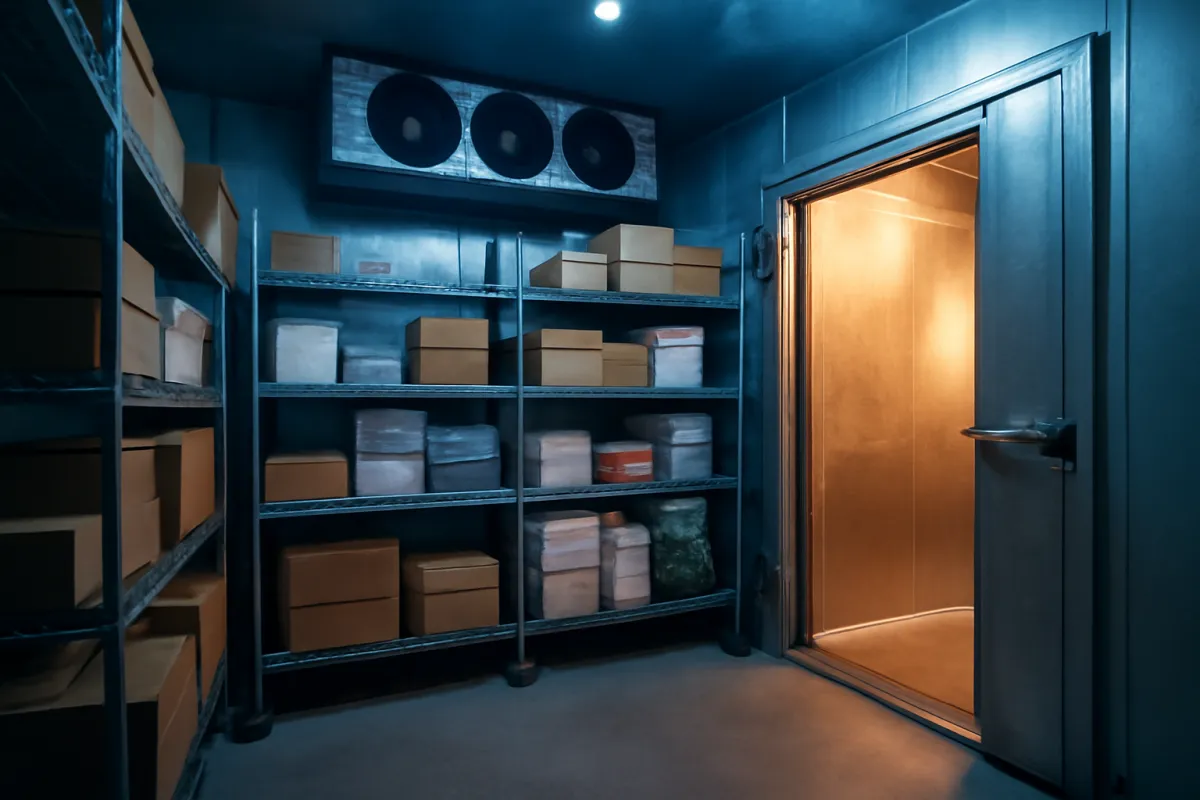
The single most useful thing to understand about a walk-in freezer is that you are not buying an appliance, you are commissioning a small building inside your building. That reframing explains almost every surprise in the quote. The panels are structural insulated sections that bolt together on site. The door is a heavy insulated assembly with a heated frame, a closer, and safety release hardware. The floor is either an insulated panel floor or a floorless design set over a properly insulated and finished slab, and getting that wrong is expensive to fix later.
Then there is the refrigeration system, which is engineered rather than selected off a shelf: an evaporator inside the box, a condensing unit somewhere with access to outside air, refrigerant lines between them, a drain line for defrost water that itself has to be protected from freezing, and controls. Illustratively, a compact walk-in freezer commonly lands near the high four figures for the box and system, with installation adding several thousand more, so a small installed unit often totals somewhere in the high teens of thousands and a larger one runs into the mid five figures.
Because so much of that is site-specific, a walk-in is always quoted against your actual space rather than a catalog. Two identical boxes in two different buildings can differ by a wide margin on line runs alone. A former food space that already has the slab, the drainage, and the electrical capacity in place is a genuine discount, a point our commercial kitchen case study makes about food-facility infrastructure generally.
What goes into a walk-in freezer quote
Ask three suppliers for a walk-in freezer price and you will get three numbers that are not comparing the same thing, so it helps to know the line items. The box itself covers panels, corner and ceiling sections, the door assembly, and interior finishes. The refrigeration package covers the evaporator, the condensing unit, the metering device, and controls. Installation covers assembly, setting and brazing the line set, evacuation and charging, the electrical connections, and the drain. Beyond those sit the items easiest to leave out of a comparison: the floor, shelving, a temperature alarm and monitoring, and any structural or roof work the condensing unit requires.
The variables that move the total most are size in cubic feet, indoor versus outdoor siting, the distance between the box and the condensing unit, and the condition of the space. Length of the refrigerant line run is a genuine cost, not a rounding item, because it is material, labor, and a system design constraint at once. Outdoor and rooftop placements add weatherproofing and access considerations.
When you compare quotes, normalize them to the same scope before you compare prices. The cheapest number on the page is frequently the one that excluded the floor, the shelving, the monitoring, or the electrical work, and those exclusions reappear later at retail. Insist on a line-item scope from every bidder, then compare like with like.
Self-contained versus remote condensing
Every walk-in and many larger cabinets face a choice between a self-contained refrigeration system and a remote condensing unit, and it changes both the cost and the daily experience of the kitchen. A self-contained system puts the whole works in one package, typically mounted through the ceiling or on top of the box. It costs less up front, installs faster because there is no field-brazed line set, and it is the straightforward answer for a small indoor box.
The catch is that a self-contained unit rejects all of its heat into the room it sits in. A freezer works hard, so that is a real and continuous heat load dumped into a kitchen that is already fighting cooking equipment for comfort. That heat then costs money twice: once as a warmer kitchen your air conditioning has to fix, and once as a warmer condenser inlet that makes the freezer itself less efficient. It is also noise, right where people work.
A remote condensing unit moves the noisy, hot half of the system outdoors or onto the roof, leaving only the evaporator inside. It costs more, because the line set, the labor, mounting, and often structural or electrical work all get added, but it takes the heat and most of the sound out of the kitchen and it usually gives the compressor a cooler place to breathe. For a walk-in freezer running around the clock in a hot kitchen, that combination frequently justifies the premium. Weigh the two on installed cost plus a decade of running cost with the equipment ROI calculator, not on the equipment price alone.
Defrost systems and why they matter
Everything a freezer touches carries moisture, and every time a door opens, humid air enters and freezes onto the evaporator coil. Frost on a coil is an insulator, and an insulated coil cannot absorb heat, so a freezer that cannot defrost itself slowly stops working while appearing to run perfectly. Defrost is therefore not an optional feature, it is a required part of how a freezer stays a freezer.
There are a few common approaches, and they trade capital against running cost. Off-cycle or air defrost, where the compressor pauses and the fan melts light frost, works only where the box temperature is high enough, which generally rules it out for a true freezer. Electric defrost uses resistance heaters on the coil and is the common answer for freezers because it is reliable and simple, at the cost of the electricity it consumes and the heat it deliberately adds. Hot gas defrost routes warm refrigerant back through the evaporator, which is more efficient and faster but adds valves and complexity to the system.
The controls matter as much as the method. A defrost cycle that runs on a fixed timer defrosts whether or not there is frost to remove, wasting energy on every unnecessary cycle. Demand-based defrost initiates on actual conditions instead, and on a hard-working freezer that difference compounds over ten years. The drain line also has to be heated or routed so that meltwater leaves rather than refreezing into an ice dam, which is one of the more common and more annoying failures in the category.
Door heaters, gaskets, and cold loss
The door is where a freezer loses most of what it spends money making. Around the perimeter of a freezer door sits a gasket, and around many frames sit low-wattage heaters whose entire job is to keep that gasket from freezing to the frame and to keep condensation off the frame and the glass. Without them, gaskets tear when the door is pulled and frames ice over, so the heaters earn their small continuous draw.
Gaskets are consumables, and treating them as permanent is a common and expensive mistake. A gasket that is cracked, compressed flat, or torn at a corner lets a continuous stream of humid air into the box, which lands as frost on the coil, more defrost cycles, more compressor run time, and a higher bill every single day until someone replaces a part that costs very little. The dollar-bill test is the oldest check in the business: close the door on a slip of paper and see whether it pulls out freely.
Door closers and hinges belong in the same conversation. A closer that no longer pulls the door shut turns every busy service into a partially open freezer, and a hinge that has dropped means the gasket no longer meets the frame evenly along its length. These are inexpensive parts whose failure costs far more than their replacement, which is exactly the profile of maintenance that gets deferred and should not be.
Energy consumption and why door discipline dominates it
A commercial freezer runs every hour of every day for its whole life, so its energy consumption is not a footnote, it is the largest recurring cost in this case study. Illustratively, a chest freezer might cost under two hundred dollars a year to run, an undercounter freezer a few hundred, a single-section reach-in around six hundred, and a walk-in freezer well into four figures. Your own number depends on your electricity rate, the efficiency of the unit, the ambient temperature around it, and how the staff use it.
That last variable is the one operators consistently underrate. Every door opening exchanges cold, dry air for warm, humid air. That warm air has to be cooled again, and its moisture lands on the coil as frost, which triggers more defrost cycles, which the compressor then has to undo. A walk-in freezer door propped open during a delivery for ten minutes is not one event, it is an hour of recovery work afterward. Door discipline is free, it requires no capital, and it is one of the largest levers anyone has on this bill.
The physical setup matters almost as much. A condenser choked with grease and dust cannot reject heat, so the compressor runs longer for the same result. A freezer wedged into a hot corner beside a fryer with no clearance is fighting a warmer inlet all day. Strip curtains on walk-in doors, clean coils, correct clearances, and a habit of closing doors are unglamorous and collectively worth more than most efficiency features you can pay for.
Where the ten-year freezer dollar goes
Take an illustrative single-section reach-in freezer and follow the whole decade rather than the invoice. The unit is around $4,500. Installation is modest, call it $400 for a dedicated circuit and placement. Energy at roughly $630 a year is about $6,300 over ten years. Maintenance, gaskets, coil cleaning, a service call or two, and a fan motor along the way, comes to roughly $225 a year, about $2,250 over the decade. The total lands near $13,400, and the purchase price is barely a third of it.
Where the ten-year cost of a reach-in freezer goes
Illustrative single-section reach-in freezer, purchase through year ten. Shares of about $13,400 total.
Energy is the largest slice, not the sticker. That inversion is the difference between a freezer and most other stainless in the kitchen.
Compare that split to the equivalent picture for a cooler, where the unit itself dominates the first-year cost and the energy share is smaller. The freezer’s harder duty pushes the running cost up until it overtakes the purchase price, and it does so well inside a normal service life. An operator optimizing purely on sticker is optimizing the second-largest slice of the chart.
What drives the cost of a commercial freezer
Once the class is chosen, a short list of variables sets the price inside that class. Capacity comes first, since more cubic feet means more panel, more steel, and more compressor. Section or door count follows, because each door is a hinge, a gasket, a heater, and a hole in the insulation. Compressor sizing and refrigeration design come next, and a low-temperature system is meaningfully more machine than a medium-temperature one. Then build quality: gauge of the stainless, quality of the insulation and how it is foamed, hinge and latch hardware, and whether the interior is finished to be cleaned easily.
Efficiency features are the fourth driver and the one most worth paying for in this category. Better insulation, efficient fan motors, demand-based defrost, controlled anti-condensate heating, and improved door seals all cost more up front and all reduce the largest slice of the ten-year chart above. On a piece of equipment that runs continuously for a decade, that arithmetic tends to favor the better unit more often than it does on equipment that runs a few hours a day.
Controls and monitoring are the fifth. A digital controller with an accurate display, a high-temperature alarm, and remote monitoring costs real money and prevents the failure mode that actually destroys value, which is a freezer failing quietly overnight and a full inventory arriving warm in the morning. For a box holding several thousand dollars of frozen product, alarms are cheap insurance rather than a luxury feature.
Maintenance items that actually fail
Freezers fail in predictable places, and knowing them turns an unpredictable repair budget into a maintenance schedule. Gaskets go first and most often, because they are flexible parts being pulled and slammed dozens of times a day in the cold. Door closers and hinges follow, for the same reason. Evaporator coils ice up when defrost is not working correctly or when a door is not sealing, and a coil in that state chokes airflow until the box will not hold temperature. Condenser coils clog with grease and dust, which is a cleaning task rather than a repair, and skipping it is the fastest way to shorten a compressor’s life.
Fan motors, both evaporator and condenser, are wear items that fail with reasonable warning if anyone is listening. Defrost heaters and defrost termination sensors fail in ways that look like a refrigeration problem but are not, which is why an accurate diagnosis is worth paying a competent technician for. Drain lines block or refreeze. And at the end of the list sits the compressor, which is the expensive failure and the one that most often ends a unit’s economic life.
The maintenance that prevents most of this is unglamorous and cheap: clean the condenser on a schedule, check gaskets monthly, keep clearances clear, watch that the defrost cycle is actually terminating properly, and treat any unexplained frost buildup as a symptom rather than a nuisance. Illustratively, budgeting a few percent of the purchase price per year for maintenance is a more honest plan than budgeting nothing and treating every failure as a surprise.

New versus used commercial freezers
Much of a freezer is durable. The stainless cabinet lasts decades, the shelves and racks are simple, the gaskets are cheap wear parts anyone can replace, and a scratched exterior affects nothing. If that were the whole unit, used would win every time, which is exactly the reasoning that makes used prep tables, shelving, and worktables such an easy call.
The refrigeration system is the problem. A compressor is a wear item with a finite life, a low-temperature compressor works harder than a cooler’s, and the history that determines its remaining life is precisely the thing a used listing does not tell you. Worse, the failure mode is asymmetric: a cooler failing overnight warms product that can sometimes be salvaged, while a freezer failing overnight thaws inventory that generally cannot be refrozen and sold. The equipment risk and the inventory risk arrive together.
That gives a workable rule. Buy the cabinet used when the compressor history is known and recent, or when the unit comes professionally refurbished with a rebuilt or replaced system and a short warranty from a dealer who will stand behind it. Be far more cautious with an old, unbranded, or auction-lot freezer whose service record is unknown, because the discount is real but so is the possibility of buying a compressor replacement at full price six months later. Our used-versus-new equipment case study runs the cost-per-working-year math that settles these calls, and frozen storage is the textbook case where paying for reliability earns its keep.
Installation, clearance, and the electrical supply
The number on the invoice is not the number running in the kitchen. A chest or undercounter freezer is close to plug-and-play, needing a dedicated circuit, a level spot, and the manufacturer’s clearance for airflow. A reach-in needs the same plus enough door swing to load it. A walk-in is a different project entirely: assembly, a line set, evacuation and charging by a licensed technician, a drain, electrical connections, and often work on the roof or an exterior pad for the condensing unit.
Electrical capacity is the constraint that most often surprises a first-time buyer. Commercial freezers commonly want dedicated circuits, and larger units and remote condensing systems may want higher voltage or three-phase service that a small retail space simply does not have. Adding capacity means a panel, a permit, and an electrician, and it can dwarf the cost of the freezer that triggered it. Confirm what the space actually has before ordering anything, not after it arrives on a pallet.
Clearance deserves one more mention because it is free and routinely ignored. A freezer needs room to reject heat, and a unit crammed against a wall or beside a heat source works harder for its whole life. Give every unit the space its manufacturer asks for, keep it away from cooking equipment where the layout allows, and let a former food space with existing infrastructure be the discount it usually is, the same lever our commercial kitchen equipment case study identifies across the whole build.
Permits, health code, and equipment listing
This is the part where honest coverage has to be careful, because requirements are set locally rather than nationally. What is broadly true is that commercial food equipment is commonly expected to be listed to a recognized sanitation standard, with NSF listing the one most often named, and that health authorities generally care about whether equipment can be cleaned, whether it holds safe temperatures, and whether you can demonstrate that it does. Whether a particular listing is mandatory where you operate, and how it is enforced, is a question for your local health department rather than a supplier’s catalog copy.
Permitting follows the same logic with more construction attached. A plug-in freezer usually triggers nothing beyond whatever electrical work it needs. A walk-in is construction, and depending on the jurisdiction it may involve building, electrical, mechanical, or plumbing permits, plus a food-facility plan review by the health authority that looks at the whole layout rather than the box alone. Refrigerant handling is separately regulated in many places and is work for a licensed technician regardless.
The practical posture is to ask early and in writing. Call the local building department and the local health department before the order is placed, describe what you intend to install and where, and get the requirements from the people who will inspect it. Retrofitting a finished walk-in to satisfy an inspector costs multiples of building it correctly the first time, and the timeline damage is often worse than the money. Our commercial kitchen requirements case study covers this posture across a whole food facility.
Sizing a freezer to your menu and delivery schedule
Frozen storage you do not fill costs money to buy, money to install, and money every hour to keep cold, so sizing is a real financial decision rather than a rounding exercise. Start from the menu: which items are held frozen, in what quantity, and how fast do they turn. Add the par levels you keep as a buffer against a missed delivery. Add room for air to circulate, because a freezer packed solid does not move air and does not hold temperature evenly. That total, not the showroom, sets the capacity.
Delivery frequency is the other half of the calculation and it is the one people forget. A kitchen taking frozen deliveries twice a week needs to hold days of product. A kitchen taking one bulk delivery a week or a fortnight needs to hold far more, and that is usually what pushes an operation across the line into needing a walk-in. Changing the delivery schedule is sometimes cheaper than changing the freezer, and it is worth pricing both before committing capital.
Then match the class to the position. Bulk and hold-back stock belongs in the cheapest storage per cubic foot you have, whether that is a chest freezer or a walk-in. Line stock belongs in reach-in or undercounter units at the stations that use it. Customer-facing product belongs in a merchandiser only if it sells. Run your type and size through the companion beside this case study, then check it against the volume it supports with the equipment ROI calculator.
Cost of ownership per cubic foot
The metric that makes this whole category comparable is cost per cubic foot, and it is worth working through because it explains why kitchens graduate to a walk-in. Take an illustrative single-section reach-in freezer holding around 23 cubic feet at $4,500. That is roughly $196 per cubic foot to buy. Carry it out to the ten-year total of about $13,400 and it is roughly $583 per cubic foot to own for a decade.
Now take an illustrative walk-in freezer with an eight-by-eight footprint and an eight-foot ceiling, about 512 cubic feet gross, at $18,000 installed. That is around $35 per cubic foot to buy. Add roughly $2,340 a year in energy and about $650 a year in service and the ten-year total lands near $47,900, or around $94 per cubic foot. On a ten-year basis the walk-in is something like six times cheaper per cubic foot than the reach-in.
Two honest caveats keep that from being a blanket recommendation. Gross volume is not usable volume, since shelving, aisles, and airflow clearance consume a meaningful share of a walk-in, so the real gap is narrower than the raw arithmetic suggests. And a walk-in you only half fill has thrown away most of its advantage, because you pay to cool the whole room regardless. The walk-in wins on cost per cubic foot only once your volume genuinely fills it, and until then the reach-in that costs more per cubic foot is still the cheaper decision.
Warranty, service contracts, and the compressor
Because the compressor is the expensive failure, warranty structure tells you where the manufacturer thinks the risk sits. Commercial refrigeration commonly carries a shorter warranty on the unit overall and a longer one specifically on the compressor, and reading those terms carefully before purchase is worth more than reading the spec sheet. Ask what is covered, for how long, whether labor is included, who performs the work, and how quickly.
Beyond the factory warranty sit extended coverage and service contracts, which convert an unpredictable risk into a predictable annual line. Whether that is a good trade depends entirely on what the unit holds. A chest freezer holding a few hundred dollars of product and cheap to replace is a reasonable candidate for running to failure. A walk-in freezer holding a kitchen’s frozen inventory, whose loss closes the kitchen and writes off the stock, is exactly where a contract with a guaranteed response time earns its cost several times over.
The cheapest insurance of all is monitoring. A temperature alarm that texts someone at two in the morning turns a catastrophic loss into an inconvenient service call, and it costs a small fraction of the inventory it protects. Pair it with the maintenance schedule above, decide coverage unit by unit rather than as a blanket policy, and price financing options for the larger units through our restaurant equipment financing case study and the buy-versus-lease comparison in our lease-versus-buy case study.
A worked example: a small cafe and a full-service kitchen
Put the framework on two illustrative budgets at opposite ends. First a small cafe or bakery. It needs a chest freezer for bulk and hold-back stock at an illustrative $1,300 and an undercounter freezer beneath the service counter at $2,200, so $3,500 of equipment plus roughly $280 of electrical and placement work, about $3,780 up front. Running cost is around $490 a year in electricity and about $175 a year in maintenance, so roughly $6,650 over a decade. The ten-year total lands near $10,430, and the operating half is larger than the capital half. No walk-in, no construction, no permit conversation beyond ordinary electrical work.
Now a full-service kitchen. It needs a walk-in freezer for bulk at an illustrative $18,000 installed, two single-section reach-in freezers on the line at $4,500 each plus installation, about $9,720, and a glass-door merchandiser for frozen desserts at $6,000 plus $480 of setup. That is roughly $34,200 up front. Energy runs about $4,440 a year across the three, and service about $1,400 a year, so around $58,400 over ten years. The ten-year total is near $92,600, and the recurring side has comfortably overtaken the purchase side.
The gap between the two examples is the whole point. Same category, same purpose, roughly nine times the cost, and the difference is volume held and hours run rather than a fancier version of the same box. It is also the clearest illustration of the through-line: in frozen storage, what you pay to buy is a down payment on what you pay to run. Run your own class and size through the companion beside this case study before you commit to either shape.
The bottom line
What does a commercial freezer cost? Whatever the class and capacity your menu actually demands, and those two choices answer most of the question. A chest freezer runs in the low four figures, a single-section reach-in in the mid four figures, a blast chiller into the low five figures, and a walk-in freezer from the high four figures for the box and system into the mid five figures installed, illustratively. The distance between them is volume, insulation, and a refrigeration system sized for a harder duty, not a premium badge.
The second answer is the one that separates freezers from the rest of the stainless in a kitchen. Freezing is harder than refrigerating, so the compressor is bigger, the defrost cycle is real work, the door heaters draw continuously, and over a decade the energy bill commonly exceeds the purchase price. Judge every freezer on cost per cubic foot over its life, not on the sticker, and the ranking of options frequently changes.
Operators who buy frozen storage well do four things. They size to the menu and the delivery schedule rather than to the budget. They treat a walk-in as a construction project with permits, drainage, electrical capacity, and condensing-unit placement to resolve before the order rather than after. They spend on efficiency, controls, and a temperature alarm, because those attack the largest slice of the ten-year cost and the failure that destroys inventory. And they respect that used refrigeration is riskier than used stainless, buying cabinets cheaply but pricing compressors honestly. Place frozen storage inside the whole kitchen with our commercial kitchen equipment case study, compare it against the cooler side in our commercial refrigeration case study, and run your own number through the equipment ROI calculator so the plan arrives before the invoice does.
Written for the operator pricing frozen storage rather than for anyone moving a box off a showroom floor: this case study is educational material, not financial, tax, legal, engineering, or food-safety advice, and it names no brand, dealer, model, installer, or lender. Every purchase band, energy estimate, service figure, and cubic-foot calculation here is an illustrative sketch built to show how the category is priced and operated, and your real number comes from a quote against your actual menu, space, and electricity rate. Sanitation listing expectations, permit requirements, plan review, refrigerant handling rules, and inspection practice are set by your local health department and building authority and change over time, so ask them directly before you order, and put a licensed refrigeration contractor and a qualified professional between you and any purchase, installation, or financing you commit to.
Frequently asked questions
How much does a commercial freezer cost?
Illustratively, a commercial chest freezer commonly runs in the low four figures, an undercounter freezer somewhat above that, a single-section reach-in freezer in the mid four figures, a three-section reach-in toward the high four figures, a blast chiller into the low five figures, and a walk-in freezer from roughly the high four figures for the box and system into the mid five figures once it is built and installed. The spread is wide because the word covers a countertop-height box and a refrigerated room built out of insulated panels. Size, section count, the compressor, and the defrost system move the number far more than the badge on the door. Treat any single figure as a planning shape and get a quote on the exact unit and space you are buying.
How much does a walk-in freezer cost?
Illustratively, a compact walk-in freezer commonly lands near the high four figures for the panels, the door, and the refrigeration system, with installation adding several thousand more, so a small installed box often totals somewhere in the high teens of thousands and a larger one runs into the mid five figures. A walk-in freezer costs meaningfully more than a walk-in cooler of the same footprint because it holds a much lower temperature, needs thicker insulation, needs an insulated floor or a floorless design over an insulated slab, and needs heated door frames to stop the gasket freezing shut. The bigger reason the number moves is that a walk-in is a construction project rather than an appliance purchase, so the site drives the price. Line runs, condensing-unit placement, drainage, and electrical capacity are all quoted against your actual building.
Why does a freezer cost more to run than a refrigerator?
A freezer holds a temperature far below the kitchen around it, and the heat leaking in through the walls, the floor, and every door opening scales with that temperature difference, so the compressor works harder and runs longer for the same cabinet size. On top of that, a freezer has to defrost, and every defrost cycle deliberately warms the evaporator to melt accumulated frost, which the compressor then has to pull back out. Door heaters that keep frames and gaskets from freezing add another small continuous draw. Illustratively, a freezer commonly draws something like half again to double what a cooler of the same size does, which is why the running cost per cubic foot is the number that separates the two categories over a decade.
What does it cost to run a commercial freezer per year?
Illustratively, a chest freezer might cost under two hundred dollars a year in electricity, an undercounter freezer a few hundred, a single-section reach-in freezer around six hundred, and a walk-in freezer well into four figures because it holds a large volume at a low temperature around the clock. The exact figure turns on your local electricity rate, the unit's efficiency, how hot the kitchen around it runs, and how often and how long the doors stand open during service. Over a ten-year life the cumulative energy bill on a freezer commonly exceeds the purchase price, which is the single most important thing to understand about the category. Confirm your own rate on a recent utility bill rather than assuming a national average.
Are used commercial freezers worth buying?
Used refrigeration is riskier than almost any other used equipment category, and a freezer is the riskiest corner of it, because the compressor and the low-temperature refrigeration system are wear items working harder than a cooler's and a failure spoils frozen inventory rather than merely warming it. The stainless cabinet, the shelves, the racks, and the gaskets are durable and cheap to service, so a serviced unit from a reputable dealer with a known compressor history can be a genuine bargain. An old unbranded freezer with no service record is a gamble whose downside is a full inventory loss plus an emergency replacement at retail. Our used-versus-new equipment case study runs the cost-per-working-year math that decides these calls.
What size commercial freezer do I need?
Size the freezer to what your menu actually holds frozen between deliveries, plus the par levels you keep as a buffer, plus room for air to move around the product, rather than to the largest unit the budget allows. Frozen storage you do not fill still costs money to buy, to install, and to keep at temperature every hour of the year. A cafe or bakery may need nothing more than a chest freezer and an undercounter unit, a busy line often needs reach-in freezers at the stations that burn through frozen product, and a high-volume kitchen with weekly bulk deliveries is the case where a walk-in freezer earns its cost per cubic foot. The companion beside this case study turns your type and size into a planning number you can test against your delivery schedule.
Do I need a permit for a walk-in freezer?
Requirements vary by jurisdiction, and a walk-in is far more likely to trigger them than a plug-in appliance because it involves construction, electrical work, refrigerant lines, drainage, and sometimes a rooftop or exterior condensing unit. In many places some combination of building, electrical, mechanical, and plumbing permits applies, and the finished installation may also be reviewed by the health authority as part of a food-facility plan review. Equipment listing to a recognized sanitation standard such as NSF is commonly expected for commercial food equipment, but what is actually required and how it is enforced is set locally. Confirm the specifics with your local building department and your local health department before the box is ordered, because retrofitting to satisfy an inspector is far more expensive than building to their requirements the first time.
Should I buy, lease, or finance a commercial freezer?
For an operator whose cash is the binding constraint, financing or leasing spreads a freezer purchase into monthly payments and preserves the working capital a young kitchen needs to survive its opening months, which is often the deciding factor rather than the headline cost of the equipment. Buying outright is usually cheaper over the life of gear you intend to run for a decade, because you avoid the financing premium and keep the asset, but it drains cash exactly when a new kitchen is most fragile. Because a walk-in freezer is long-lived infrastructure rather than a consumable, it is a natural candidate for spreading over its useful life if the payment fits the cash the kitchen can realistically produce. Our buy-versus-lease and restaurant equipment financing case studies run both sides of that comparison.