
What's on this page
- Before you start
- Step 1: Nail the concept and validate the demand
- Step 2: Write the business plan and budget
- Step 3: Secure the funding
- Step 4: Pick and lease the location
- Step 5: Get the licenses and permits
- Step 6: Design the space and buy or lease the equipment
- Step 7: Hire and train the team
- Step 8: Market and run a soft opening
- Startup cost by restaurant type
- Where restaurant startup money goes
- A worked example: opening a small full-service restaurant
- Common mistakes when opening a restaurant
- Troubleshooting: tight budget, no experience, and permit delays
- Your restaurant opening checklist
- The bottom line
Short answer: Opening a restaurant is an eight-step dependency chain: concept, plan and budget, funding, location and lease, permits, buildout and equipment, team, then marketing and a soft opening. Expect several months to a year or more, and an illustrative cost from the high tens of thousands for a truck to the mid-to-high six figures for a full-service room. Fund several months of working capital on top of the buildout.
Opening a restaurant comes down to eight steps in a rough order: nail a concept people actually want, put it on paper as a plan and a budget, fund it, sign a lease on the right location, clear the licenses and permits, build out the space and equip the kitchen, hire and train a team, then market and soft-open before you throw the doors wide. Follow that chain and you turn a vague ambition into a business with a real chance of surviving its first year.
The reason most restaurant advice feels useless is that it skips the order and the caveats. Anyone can list the steps; the money lives in what goes wrong at each one, from a lease signed before the numbers were checked to a menu built so wide it drowns the kitchen in food cost. This walkthrough treats each step as an action with a matching thing to watch for, works one realistic opening end to end, and points you at the common mistakes that close restaurants before they find their footing. For the full price of each line, our rundown on how much it costs to open a restaurant sits alongside this one, and you can size your own opening budget as you read with the equipment ROI calculator.
Key takeaways
- Opening a restaurant is an eight-step dependency chain: concept, plan and budget, funding, location and lease, permits, buildout and equipment, team, then marketing and a soft opening.
- Expect several months to a year or more, and an illustrative cost from the high tens of thousands for a truck to the mid-to-high six figures for a full-service room. The buildout and runway usually cost more than the equipment.
- The single most fatal mistake is opening undercapitalized. Fund several months of working capital on top of the buildout, because revenue arrives as a trickle that builds.
- The health and building inspections and the liquor license gate your opening date, so start the permit applications early and build slack into the timeline.
- Run a soft opening before you launch. It catches the kitchen, service, and pricing problems while the stakes are low and the reviews are not yet public.
Before you start
Before you spend a dollar, three things need to be roughly in place, because everything downstream leans on them. The first is a concept clear enough to say in a sentence: what you serve, to whom, at what price, and why they will pick you over the place down the street. The second is a budget that is honest about the whole cost, not just the visible kitchen, and the money or the plausible financing to cover it. The third is evidence that real demand exists for this concept in this location, gathered before you commit rather than discovered after.
Here is what you need lined up before step one:
- A concept and a rough menu you can describe in one sentence, with a target customer and price point.
- A realistic budget covering buildout, equipment, licenses, furniture, inventory, and several months of working-capital runway.
- Proof of demand: the neighborhood, the foot traffic, the competition, and who your customer actually is.
- Time and stamina: plan for several months to a year from decision to open, and expect the timeline to slip.
Difficulty is high and the failure rate is real, so treat the preparation as the cheapest insurance you will buy. The steps below assume you are opening a fixed-location restaurant, but the same chain, lightened, applies to a truck or a ghost kitchen. Nothing here is professional advice, and every figure is an illustrative planning shape you should test against your own market.
Step 1: Nail the concept and validate the demand
Start by making the concept specific, then prove someone wants it. A concept is not a cuisine, it is a full answer: what you serve, the service style (full-service, quick-service, counter, or takeout), the price point, the atmosphere, and the customer you are aiming at. Write it as a single sentence you can say out loud, because if you cannot, neither can your customers, your staff, or your lender. A vague “elevated comfort food” becomes “a fast-casual counter serving $14 smash burgers and shakes to lunch office workers and evening families.”
Then validate it before you commit money. Walk the neighborhoods you are considering at the hours you plan to be busy and count the foot traffic yourself. Study the direct competitors: what they charge, how full they are, and the gap your concept fills that theirs does not. Talk to potential customers, run a pop-up or a market stall if you can, and watch whether people actually pay your price rather than merely saying they like the idea. Cheap validation now prevents an expensive lease later.
Watch out for falling in love with the concept instead of the demand. The most common founder trap is building the restaurant you personally want to eat at, in a location you like, at a price that feels right to you, without checking that enough paying customers agree. A concept that thrills you and a market that supports it are two different tests, and only the second one pays the rent. Validate the demand as coldly as you can, because every later step, the budget, the lease, the equipment, is sized to the concept you lock in here, and changing it after the buildout is ruinous.

Step 2: Write the business plan and budget
Turn the validated concept into a written plan and a line-item budget, because this is the document that disciplines your thinking and that every lender and investor will ask to see. The plan does not need to be long, but it needs to be real: the concept and menu, the target market and competition, the location strategy, the management team, a marketing plan, and financial projections that show revenue ramping, costs, and when the restaurant reaches break-even. The projections are where optimism goes to get corrected, so build them from the bottom up: covers per day times average ticket, against food cost, labor, rent, and the rest.
The budget is the part that decides whether you can actually open. Price every line: the lease deposit and first rent, the buildout or renovation, the kitchen equipment, furniture and fixtures, the point-of-sale system, initial inventory, licenses and permits, insurance, signage, pre-opening labor, and, critically, the working-capital runway to carry the restaurant through its slow opening months. Our rundown on how much it costs to open a restaurant breaks each of those lines down by type and size, and you can model your own numbers in the calculator as you build the budget.
Watch out for treating the buildout and equipment as the whole budget. First-timers routinely price the visible restaurant, the ovens and the dining room, then run out of cash three slow months after opening because they never funded the runway. A restaurant opens to a trickle of customers that builds over months, while the rent and payroll come due in full from day one. Budget the working capital as a real line, not a hopeful afterthought, because the plan that carries a funded runway is the plan that survives the gap between opening and getting busy.
Step 3: Secure the funding
With a plan and a budget in hand, line up the money, and expect it to come from several sources rather than one. The common mix is owner savings, a bank or SBA loan, equipment financing for the kitchen, and investment from partners or family, layered to cover the full budget with a margin. Owner equity, your own cash in the deal, is what lenders and investors look for first, because money that comes in behind yours wants to see you exposed to the same risk. As an illustrative shape, funding a large share of the project through a loan while covering a meaningful slice from savings is a common structure, but the right split depends on your access to each source.
Match the funding source to what it funds. An SBA 7(a) loan is flexible and suits a full opening where equipment, buildout, and working capital travel together; equipment financing, secured by the gear itself, is often the easiest single piece to arrange and keeps cash free for the buildout and runway. Our restaurant equipment financing case study works that route end to end, from what you need to qualify through to a complete kitchen deal priced through loan, lease, and cash, so you can see the monthly number before a lender shows it to you. A line of credit covers smaller and unpredictable purchases, and it doubles as a cushion for a slow month.
Watch out for underfunding the runway to make the loan smaller. It is tempting to borrow only enough to build and equip, because a smaller loan feels safer, but a restaurant that opens with no working-capital cushion is the one most likely to close. Borrow, or raise, enough to carry several months of full operating costs past opening, and keep the debt payment small enough that a slow third month does not sink you. Fund the runway before the finishes, and never let the financing structure assume revenue arrives faster than restaurants actually ramp.
Step 4: Pick and lease the location
Choose the location on the numbers and the fit, then negotiate the lease carefully, because this is the most binding and least reversible decision in the whole process. The right space matches your concept’s customer: a lunch counter needs office foot traffic, a destination dinner spot can trade some visibility for lower rent, and a family restaurant needs parking and easy access. Count the foot traffic at your peak hours, check visibility and signage rights, confirm the zoning allows a restaurant with your service style, and study the surrounding businesses that will feed or starve your door. Rent is commonly targeted as a single-digit-to-low-teens percentage of projected sales, so let your revenue projection cap what you can afford rather than falling for a space you cannot fill.
The physical bones matter as much as the location. A former restaurant with a compliant hood, grease trap, and kitchen plumbing can save you a fortune and months of buildout, while a bare shell or a former retail space may need a hood, ventilation, gas, three-phase electrical, and a grease interceptor added from scratch. Have the space inspected for those systems before you sign, because their absence turns a cheap lease into an expensive one. Negotiate the lease terms hard: the length, renewal options, who pays for improvements (a tenant-improvement allowance from the landlord is real money), and a rent-free build-out period so you are not paying full rent while you construct.
Watch out for signing a lease before the funding and the buildout cost are confirmed. A lease is a personal-guarantee-backed, multi-year obligation, and locking it in before you know what the space costs to convert or whether your financing closed is how operators end up paying rent on a restaurant they cannot afford to build. Confirm the venting, zoning, and buildout estimate, and get the financing lined up, before your signature commits you to years of rent.
Step 5: Get the licenses and permits
Start the permits early, because the inspections gate your opening date and several of these take longer than first-timers expect. The common set for a fixed restaurant includes a business license and an employer tax registration, a food service or food establishment permit, a food handler or manager certification for you and your staff, a health department permit tied to a physical inspection, a certificate of occupancy from the building department after construction, and, if you pour alcohol, a liquor license. Signage, outdoor seating, music, and grease disposal frequently carry their own permits on top. The exact list varies by city, county, and state, so confirm your specific requirements with the local authorities rather than trusting any general checklist, including this one.
Sequence them against the buildout, because some permits depend on it. Building and plumbing permits come before and during construction, the health inspection and the certificate of occupancy come near the end when the space is finished, and the liquor license runs on its own, often much slower, track. In many markets the liquor license is the single most expensive and time-consuming piece, sometimes capped in number and bought on a secondary market at a steep price, so if alcohol is central to your concept, start it first and price it honestly.
Watch out for treating permits as paperwork you handle at the end. A failed health inspection, a missing grease interceptor the building department flags, or a liquor license stuck in a queue can push your opening back by weeks or months while the rent keeps running. Because your opening date depends on inspections you do not fully control, apply early, build the space to code the first time, and keep slack in the timeline for a re-inspection. The cost of starting the permits early is a little effort; the cost of starting late is paying rent on a finished restaurant you are not yet allowed to open.
Step 6: Design the space and buy or lease the equipment
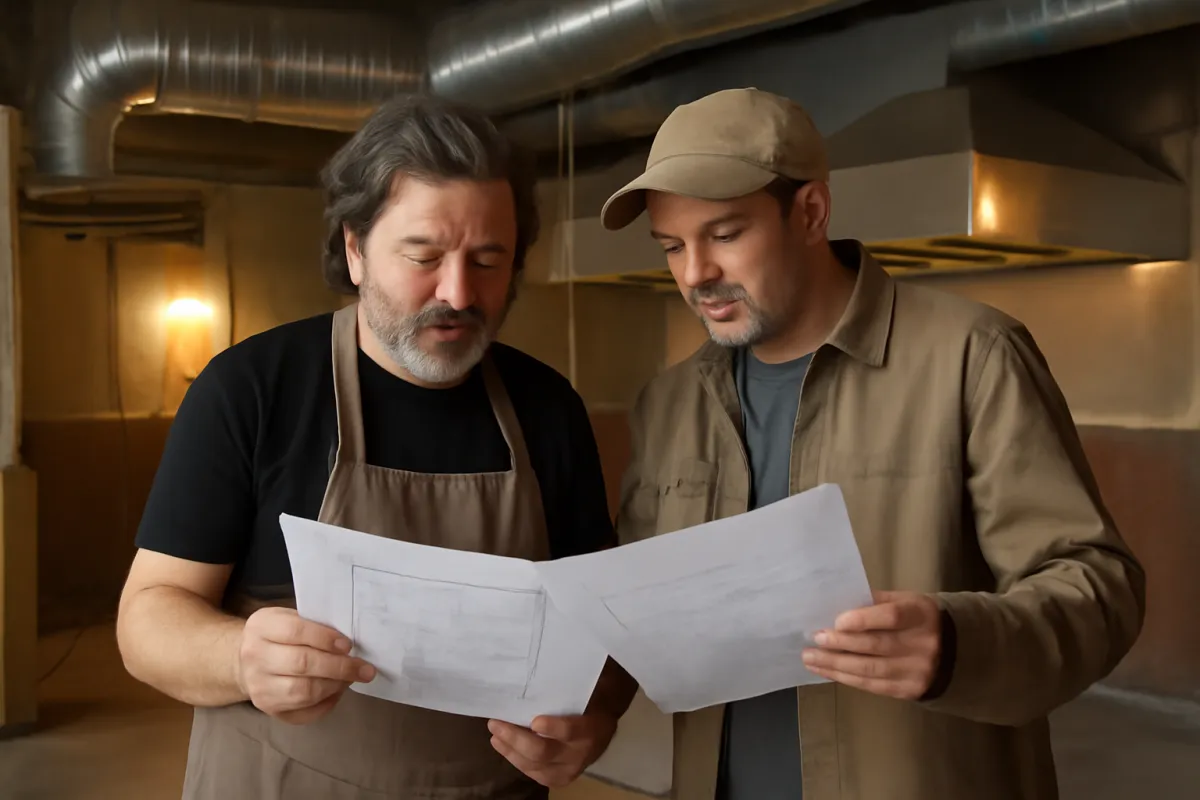
Design the layout around the workflow, then equip the kitchen to the menu, in that order, because the flow decides how many covers you can turn and how hard the labor works. Lay out the front of house for the customer journey and the seat count your rent needs, and lay out the kitchen for a clean line from delivery to storage to prep to cook to pass, so staff are not crossing paths at the peak. Design the space and the menu together: every cooking method your menu adds (fry, grill, saute, bake) lengthens the cooking line and enlarges the hood above it, which is why a tight menu is the strongest lever you have on the equipment budget.
Then buy or lease the equipment deliberately. Own the durable, long-life core that you will run hard for years, ranges, ovens, hoods, walk-ins, and reach-ins, and consider leasing or financing the pieces that date quickly or that you are unsure about, to preserve cash for the runway. Our rundown on commercial kitchen equipment cost breaks the package down by concept, and our buy-versus-lease analysis runs the own-or-lease comparison on any single machine. Financing the equipment keeps cash in the business, which is often the whole reason to finance rather than buy outright; our restaurant equipment financing case study covers the routes and their illustrative costs.
Watch out for over-building the kitchen and the menu at once. A vast menu demands a vast kitchen, which inflates the equipment bill, the ventilation, the labor, and the food waste all together, and it is the classic way a first restaurant spends its runway on gear it barely uses. Buy the equipment your validated menu actually needs, keep the equipment line in proportion to the buildout and the runway, and resist the trap of specifying a professional kitchen big enough for a menu twice the size of the one you will really sell. Run the equipment line against your budget in the calculator before you place the order.
Step 7: Hire and train the team
Hire the leadership first, then the line, and train everyone before you serve a paying customer, because service quality is made or lost here. The key early hire is usually a head chef or kitchen manager and, if you are not running the floor yourself, a general manager, because these are the people whose experience covers the gaps in yours. From there, staff the kitchen (line cooks, prep, dish) and the front of house (servers, bartenders, host) to the covers you expect, and remember that a new restaurant is often overstaffed relative to its slow opening weeks, which is a cost your runway has to carry. Write clear roles and pay rates into the budget, because labor is one of the three costs, with food and rent, that decide whether a thin margin survives.
Training is the step that separates a smooth opening from a chaotic one. Run the kitchen through the full menu until the food is consistent and the timing holds under pressure, train the front of house on the menu, the point-of-sale system, and the service standards, and rehearse the handoffs between kitchen and floor. This is what a soft opening (step eight) exists to stress-test, but the training has to come first so the soft opening reveals fixable gaps rather than raw chaos.
Watch out for hiring for opening week instead of the slow months after it. It is easy to staff up for the excitement of launch and then find the payroll unaffordable once the opening rush fades to a normal Tuesday, so scale the team to sustainable volume with a plan to add as sales grow. Watch out, too, for skimping on training to open faster, because a restaurant that opens before its team is ready spends its first, most visible weeks making the mistakes customers remember and review. Experienced hires and real training cost money up front and save far more in avoided turnover, waste, and lost regulars.
Step 8: Market and run a soft opening
Build local awareness before you open, then run a soft opening to shake the system out before the real launch. Marketing for a restaurant is mostly local and mostly earned: a Google Business Profile and accurate listings so people can find you, an Instagram or local social presence showing the food, outreach to nearby offices or neighbors, and a simple opening offer to pull the first customers through the door. Start this a few weeks before opening so there is an audience waiting, not on opening day to an empty room. The goal of pre-opening marketing is a soft base of curious locals, because word of mouth from those first visits does more than any ad.
Then run a soft opening: open quietly to a limited crowd, friends, family, neighbors, or a reservation-only preview, at reduced capacity or a limited menu, before the public launch. A soft opening is a live rehearsal that surfaces the real problems, a dish that takes too long, a station that jams at the pass, a point-of-sale flow that confuses servers, a price that feels wrong, while the stakes are low and the reviews are not yet public. Fix what it reveals, then do a proper grand opening once the kitchen and service hold up under a full room.
Watch out for skipping the soft opening to save time, and for launching loud before the operation can handle it. A packed grand opening with an untested kitchen produces slow tickets, wrong orders, and the exact bad first impressions that public reviews lock in permanently. The soft opening is cheap insurance against an expensive first impression, so protect it even when the schedule is tight. Marketing brings people in; a soft opening makes sure that when they arrive, the restaurant is ready to keep them.
Startup cost by restaurant type
Before the worked example, it helps to see how far the total moves with the format, because the type you chose in step one sets the scale of every later step. The chart below sketches an illustrative all-in cost to open, working capital included, across four common formats. These are planning shapes, not quotes, and your own number depends on the square footage, the local rent, and how much the space needs building out.
Illustrative all-in cost to open, by restaurant type
Format sets the scale before any line is priced. Illustrative planning figures including working capital, not quotes.
Each bar is drawn from its illustrative figure as a share of the highest, about $700k. The food truck opens for roughly a tenth of the fine-dining room, mostly because it carries no dining-room buildout and little rent. Size, rent, and buildout move each of these far more than the kitchen equipment does.
The spread is the point: the same word, restaurant, covers a $75,000 truck and a $700,000 dining room, and the format you validated in step one is the single biggest driver of the whole budget. It also explains why the troubleshooting advice below, start with a truck or a ghost kitchen, is not a consolation prize but a genuine strategy for entering the business at a tenth of the cost and growing into the larger room later.
Where restaurant startup money goes
It also helps to see how a single opening budget divides, because the split is not where most first-timers expect. The stacked bar below shows an illustrative breakdown of a full-service opening, and the surprise is usually how much sits outside the visible kitchen: the buildout that converts the space and the working-capital runway that carries the restaurant to break-even together dwarf the equipment.
Where a full-service restaurant's startup budget goes
Illustrative split of a full-service opening. Shares sum to 100.
On this illustrative split, the buildout and the working-capital runway together are 60 cents of every dollar, while the kitchen equipment everyone pictures is one line in five. A former restaurant with a compliant kitchen shrinks the buildout slice and shifts the balance toward the runway.
That split reframes where your attention belongs. The equipment is the part buyers obsess over, but the buildout and the runway are where the budget is won or lost, which is why steps two and three spend so long on the plan, the funding, and the working capital. Trim the buildout by choosing a former food space, keep the equipment in proportion, and protect the runway as the line that keeps the doors open until revenue arrives.
A worked example: opening a small full-service restaurant
Run one realistic opening through all eight steps so the pieces connect. Imagine a first-time operator opening a small full-service neighborhood restaurant, about 2,000 square feet, seating roughly 50, serving a focused seasonal menu at a mid price point. Step one: the concept is “an approachable 30-seat-plus neighborhood bistro serving a short seasonal menu to local diners,” validated by counting evening foot traffic on the target street and running two pop-up dinners that sold out at the planned prices. Step two: the business plan projects covers building over six months to break-even, and the budget lands in the mid six figures all in, with the buildout as the largest line and a funded working-capital runway of several months.
Step three: funding comes from owner savings covering a meaningful slice, an SBA-backed loan for the bulk, and equipment financing for the kitchen so cash stays free for the runway. Step four: the operator leases a former cafe with existing plumbing and a serviceable hood, which trims the buildout sharply and shortens the timeline, at a rent the sales projection can carry. Step five: business, food service, and health permits go in early, the certificate of occupancy follows the buildout, and because the concept includes wine, the liquor license is started first as the long pole.
Step six: the space is laid out for a clean kitchen line and a 50-seat room, and the equipment is sized to the short menu, with the durable core owned and financed and a couple of pieces leased. Step seven: an experienced chef and a small trained front-of-house team come on a few weeks before opening. Step eight: local social posts and a neighborhood preview build a base, a friends-and-family soft opening catches a slow dessert station and a mispriced entree, both fixed before the grand opening. The restaurant opens on budget, with runway in the bank, into a base of locals who already knew it was coming. Run your own version of these numbers in the calculator, and remember every figure here is illustrative.
Common mistakes when opening a restaurant
The failures cluster into a short list of avoidable errors, and knowing them in advance is half the defense:
- Underestimating working capital. The single most fatal mistake: spending the whole budget on the buildout and equipment and opening with no cash cushion to survive the slow first months. Fund several months of full operating costs as a real line.
- A weak location. Choosing a cheap or convenient space that lacks the foot traffic, visibility, or customer fit the concept needs. Rent you can afford in a spot you cannot fill is still a bad deal.
- Opening undercapitalized. Borrowing only enough to build, or raising too little, so a normal slow patch or a small overrun tips the restaurant into a cash crisis before it finds its footing.
- Skipping the business plan. Opening on enthusiasm without projections that force an honest look at covers, food cost, labor, rent, and the break-even timeline. The plan is where optimism gets corrected on paper instead of in the bank account.
- Over-building the menu. A sprawling menu inflates the equipment, the ventilation, the labor, the inventory, and the food waste all at once. A tight menu is cheaper to build, faster to run, and easier to execute well.
- No soft opening. Launching loud with an untested kitchen and team, so the most visible first weeks produce the slow, wrong, and disappointing service that public reviews lock in permanently.
The through-line across all six is optimism about how fast and how smoothly revenue will arrive. A realistic budget, a funded runway, a tight menu, and a soft opening are all defenses against the same assumption, that a new restaurant gets busy and profitable faster than restaurants actually do.
Troubleshooting: tight budget, no experience, and permit delays
What if the budget is too tight for a full restaurant? Start smaller and climb. A food truck, a ghost kitchen renting existing commercial kitchen space, a pop-up inside another venue, or a takeout-only concept cut the buildout and rent that make a fixed restaurant expensive, and they let you build a following and a track record that make later financing possible. Our rundown on the cost to start a food truck prices that lower rung. The lean format is not a failure, it is the realistic on-ramp to the larger room.
What if you have no restaurant experience? Buy it or borrow it. Hire an experienced head chef and general manager, work a season inside a similar restaurant before you open, or bring on a partner who has run a kitchen, and budget a larger cushion because the learning curve costs money while you climb it. The parts that punish inexperience most, labor scheduling, food-cost control, and cash flow, are the least visible from the dining-room side, so put experienced people on exactly those.
What if the permits are delayed? Assume they will be and build slack in. Apply early, build to code the first time to avoid re-inspections, and start the liquor license before anything else because it is usually the slowest. If a permit stalls after the buildout is done, you are paying rent on a finished restaurant you cannot open, so a negotiated rent-free build-out period and a timeline with margin are the defenses.
What if the rent is high? Let the sales projection cap it, not the other way around. Rent much above a single-digit-to-low-teens share of projected sales strains a thin margin permanently, so either negotiate a tenant-improvement allowance and a lower rate, find a former food space that cuts the buildout, or walk. A great location you cannot afford to fill is worse than a good one you can.
Your restaurant opening checklist
Save this compact list and work it in order:
- Concept written in one sentence, with target customer and price point.
- Demand validated: foot-traffic counts, competitor study, a pop-up or test.
- Business plan and full line-item budget, working-capital runway included.
- Funding secured across savings, loan or SBA, equipment financing, and partners.
- Location chosen on the numbers; lease negotiated with improvements and a build-out period.
- Space inspected for hood, venting, gas, electrical, grease trap, and zoning before signing.
- Permits started early: business, food service, health, occupancy, and liquor first.
- Layout designed around workflow; equipment sized to the menu, core owned, rest financed or leased.
- Leadership hired first, team hired and fully trained before serving anyone.
- Local marketing live a few weeks out; soft opening run and its problems fixed before launch.
The bottom line
Opening a restaurant is not mysterious once you see it as an ordered chain rather than a leap. Validate a specific concept, put it on paper as a plan and a real budget, fund it with a genuine runway, sign a location the numbers support, clear the permits early, build and equip to a tight menu, hire and train before you serve, and soft-open before you launch. Each step has one thing that quietly sinks operators who skip it, and the biggest of them, an underfunded runway, hides at the very start in a budget that priced the kitchen and forgot the slow months.
The operators who open well treat the money and the caveats as seriously as the food. They fund the working capital before the finishes, keep the equipment in proportion to the buildout and the runway, choose the location on foot traffic rather than affection, start the permits before the schedule forces them to, and rehearse the whole operation in a soft opening while the stakes are low. Do that, and opening day becomes what it should be: the moment a validated, funded, well-drilled business opens its doors to customers who were already waiting, rather than a gamble on optimism. Price your own version as you go in the calculator, and treat every figure here as an illustrative starting point, not a promise.
This walkthrough is educational material for prospective restaurant owners, not financial, legal, tax, or business advice, and it endorses no lender, franchise, or supplier. Every cost, share, timeline, and range here is an illustrative planning shape meant to show how the steps and the money fit together, and your real numbers will be set by your concept, your market, your local rents, and the specific space you build in. Licensing, permitting, health, zoning, and liquor rules in particular vary widely by city, county, and state and change over time, so confirm the requirements that apply to you with the relevant local authorities. Build a real budget on the space in front of you, fund a genuine runway, and put an accountant, an attorney, and experienced operators between you and any signature.
Frequently asked questions
What are the steps to open a restaurant?
Opening a restaurant follows a fairly consistent order: nail the concept and confirm there is demand for it, write a business plan and a real budget, secure the funding, find and lease a location, get the licenses and permits, design the space and buy or lease the equipment, hire and train the team, then market and run a soft opening before you launch. The exact sequence flexes because some steps overlap, and a lease often cannot close until funding is lined up. Treat the eight steps as a dependency chain rather than a strict calendar, because a permit delay or a financing hiccup can reshuffle the timeline. Each step in this walkthrough carries its own caveat, because the order that works on paper meets a messier reality in practice.
How much does it cost to open a restaurant?
Illustratively, a food truck can open in the high tens of thousands, a small quick-service spot commonly lands in the low-to-mid six figures, a full-service restaurant often runs the mid-to-high six figures, and fine dining can reach seven figures. The format, the square footage, and how much construction the space needs decide almost everything, which is why the range is so wide. The buildout and the working-capital runway usually cost more than the visible kitchen equipment. Our companion rundown on the cost to open a restaurant prices each line by type and size, and the figures here are illustrative planning shapes rather than quotes.
Do you need experience to open a restaurant?
You do not strictly need restaurant experience to open one, but opening without it raises the risk sharply, so most first-timers offset the gap deliberately. Hiring an experienced general manager or head chef, working a season inside a similar restaurant before you open, or bringing on a partner who has run a kitchen all substitute borrowed experience for your own. The parts that punish inexperience most are labor scheduling, food-cost control, and cash-flow management, none of which are obvious from the dining-room side of the business. If you are opening cold, budget a larger working-capital cushion and lean harder on experienced hires, because the learning curve costs money while you climb it.
How long does it take to open a restaurant?
From signed concept to open doors, a fixed-location restaurant commonly takes several months to a year or more, and the buildout plus the permitting are usually what set the pace. A light conversion of a former restaurant with a compliant kitchen can move fast, while a bare shell that needs a new hood, grease trap, electrical, and plumbing can add many months and a health-department and building-inspection queue on top. Financing timelines, lease negotiations, and equipment lead times all stack into the schedule. Build slack into the plan, because a restaurant that has to pay rent for extra pre-opening months while it waits on a permit burns cash it planned to open with.
What licenses and permits do you need to open a restaurant?
The common set includes a business license, an employer tax registration, a food service or food establishment permit, a food handler or manager certification, a health department permit with an inspection, a certificate of occupancy from the building department, and, if you serve alcohol, a liquor license. Signage, music, outdoor seating, and grease disposal often carry their own permits, and the exact list varies by city, county, and state. The liquor license is frequently the slowest and most expensive, and in some markets it is capped or bought on a secondary market. Start the permit applications early, because the health and building inspections gate your opening date, and confirm the specific requirements with your local authorities rather than a general list.
How do you get funding to open a restaurant?
Restaurants are commonly funded with a mix of owner savings, a bank or SBA loan, equipment financing for the kitchen, and money from partners or investors, rather than a single source. Lenders want to see a solid business plan, some of your own cash in the deal, and often collateral or a personal guarantee, and a first-time operator usually faces tighter terms than an established one. Equipment financing is often the easiest piece to arrange because the gear itself secures the loan. Our walkthrough on how to finance restaurant equipment covers that route in detail, and every figure here is illustrative because your actual terms depend on your credit, the concept, and the market.
Can you open a restaurant with no money?
Opening a full restaurant with no money is not realistic, but you can start much smaller and climb toward one, which is how many operators reduce the entry cost. A food truck, a ghost kitchen renting an existing commercial space, a pop-up inside another venue, or a takeout-only concept all cut the buildout and rent that make a fixed restaurant expensive. These formats let you build a following, prove the concept, and accumulate the capital and track record that make later financing possible. The honest version of opening with little money is starting with a lean format and growing into the restaurant, not conjuring a full dining room from nothing.
What is the biggest mistake people make when opening a restaurant?
The most common fatal mistake is underestimating the working capital needed to survive the first slow months, so the restaurant opens undercapitalized and runs out of cash before it finds its footing. A new restaurant opens to a trickle that builds over months, while the rent, payroll, and food orders come due immediately, and many owners spend their whole budget on the buildout and equipment with nothing left for the runway. Close behind are a weak location, an over-built menu that inflates food cost and labor, and skipping a proper business plan. The through-line is optimism about how fast revenue will arrive, which is exactly the assumption a realistic budget and a funded runway are meant to protect against.